
Ringkasan Eksekutif
Panduan pembeli lengkap untuk konfigurasi pendant medis: tipe lengan, standar outlet gas (DIN/BS/AFNOR), antarmuka listrik, zonasi basah/kering, aksesori, dan perencanaan pemasangan untuk OK dan ICU.
Masuki ruang operasi atau unit perawatan intensif mana pun yang dipasang sebelum sistem suplai gantung di langit-langit menjadi standar, dan Anda akan melihat masalah yang sama: kekusutan selang gas, kabel listrik, dan kabel jaringan yang meliuk di lantai dari stopkontak dinding ke sisi tempat tidur pasien. Tenaga klinis tersandung olehnya. Petugas kebersihan tidak dapat menjangkau bagian bawahnya. Dan setiap kali ahli anestesi memindahkan monitor, seseorang harus merangkak di bawah meja untuk mengarahkan ulang kabel. Di pabrik kami, kami mendengar cerita ini dari insinyur rumah sakit di hampir setiap panggilan proyek.
Pendant medis mengatasi masalah ini dengan membawa semua utilitas — oksigen, udara medis, vakum, listrik, data — turun dari langit-langit melalui lengan artikulasi, menempatkan koneksi tepat di tempat yang dibutuhkan tim klinis. Tetapi inilah kendala yang mengejutkan sebagian besar pembeli pertama kali: konfigurasi pendant medis bukanlah keputusan yang berlaku untuk semua ukuran. Panjang lengan, rentang rotasi, jumlah outlet gas, standar terminal, kapasitas listrik, dan tata letak aksesori semuanya berbeda antara ruang operasi dan ruang ICU. Jika salah satu parameter salah, Anda menghadapi pekerjaan retrofit yang mahal setelah pemasangan — atau lebih buruk, pendant yang tidak dapat membawa peralatan yang sebenarnya digunakan oleh departemen Anda.
For the configuration decisions that shape a retrofit scope, see our medical pendant retrofit guide.
Panduan ini membahas setiap titik keputusan konfigurasi, dari geometri lengan hingga standar terminal gas hingga pemilihan aksesori, sehingga tim pengadaan dan insinyur rumah sakit dapat menentukan sistem yang tepat sejak awal. Kami mengacu pada pola yang kami lihat dari ratusan proyek yang dikirim ke rumah sakit di lebih dari 60 negara.
Tipe Pendant Medis: Menyesuaikan Sistem dengan Departemen
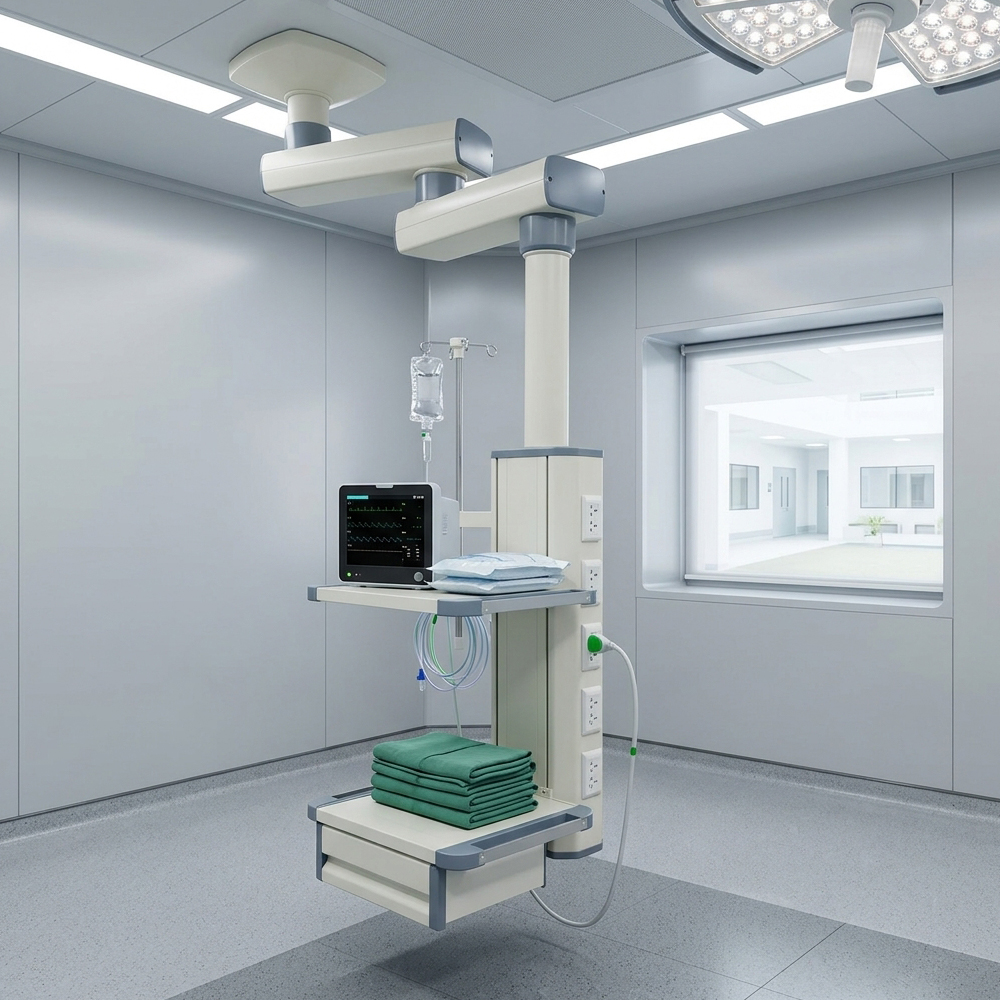
Keputusan konfigurasi pertama bukan tentang lengan atau stopkontak — tetapi tentang kategori pendant mana yang sesuai dengan alur kerja klinis. Dalam praktiknya, rumah sakit menentukan tiga tipe utama, dan mencampuradukannya menyebabkan pengeluaran berlebihan atau kelengkapan ruangan yang kurang.
Pendant bedah (OK) melayani ruang operasi. Mereka membawa mesin anestesi, monitor bedah, unit elektrokauter, dan menara endoskopi. Karena tim bedah bekerja dalam busur yang ketat di sekitar meja, pendant OK memprioritaskan posisi yang presisi dan kapasitas muatan yang tinggi. Pendant bedah lengan ganda bermotor secara rutin mendukung 150 kg atau lebih peralatan di rak dan konsolnya.
Gantungan jembatan ICU membentang di atas tempat tidur dari satu kolom langit-langit ke kolom lainnya, menciptakan balok horizontal dengan sisi basah (pompa infus, syringe driver, tiang infus) dan sisi kering (ventilator, monitor). Format jembatan memberi staf perawat akses dari kedua sisi tempat tidur tanpa lengan yang mengayun ke ruang kerja klinis. Jembatan ICU yang khas menyediakan 16 soket listrik, 16 titik pembumian ekipotensial, 3 outlet oksigen, 3 outlet vakum, dan 3 outlet udara terkompresi per posisi pasien.
Pendant anestesi adalah subtipe OK khusus yang dirancang untuk menggantungkan mesin anestesi itu sendiri. Mereka mengintegrasikan pasokan gas (O2, udara, vakum, N2O, AGSS), listrik, dan data dalam kepala layanan yang ringkas, menjaga stasiun kerja anestesi tidak menyentuh lantai dan dalam jangkauan lengan ahli anestesi.
Menurut pengalaman kami, kesalahan spesifikasi yang paling umum adalah memesan pendant lengan tunggal gaya OK untuk ruang ICU. Lengan tersebut menghalangi akses perawat dari satu sisi tempat tidur, dan jumlah rak terlalu sedikit untuk pompa infus dan monitor yang dibutuhkan ICU modern. Selalu mulai dari alur kerja departemen, bukan dari katalog produk.
Konfigurasi Lengan: Tunggal vs. Ganda, Panjang, dan Rotasi
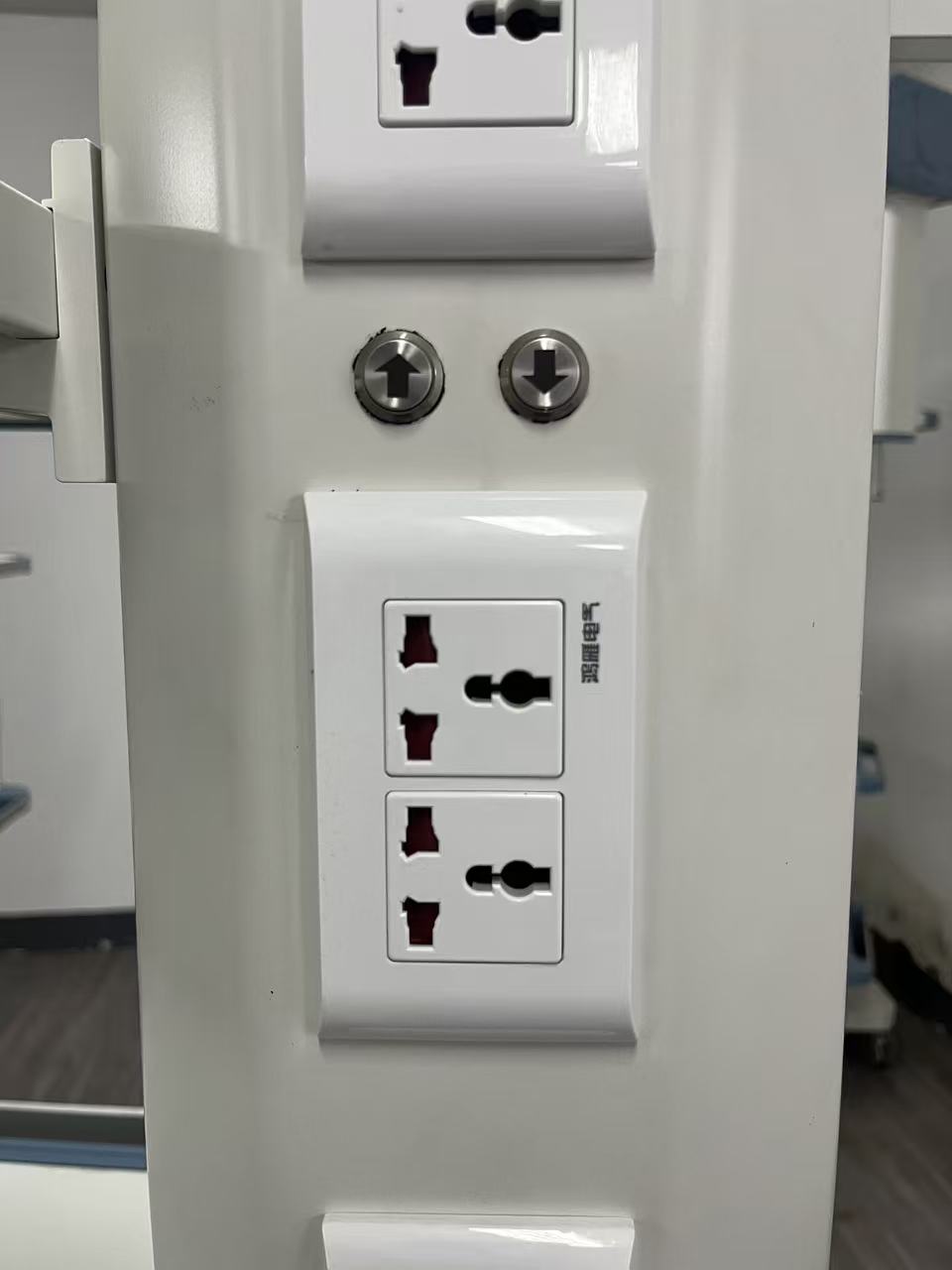
Rakitan lengan menentukan seberapa jauh jangkauan pendant, berapa banyak beban yang dapat ditopang, dan seberapa leluasa klinisi dapat memposisikannya kembali. Tiga parameter yang penting: jumlah lengan, panjang lengan, dan sudut rotasi.
Pendant lengan tunggal berputar di sekitar satu poros langit-langit. Cocok untuk ruangan yang lebih kecil atau ruang pasien tunggal di mana kelompok peralatan berada dalam busur yang dapat diprediksi. Lengan tunggal menjaga biaya dan beban langit-langit tetap lebih rendah — beban bersih tipikal untuk struktur lengan itu sendiri tetap di bawah 60 kg.
Pendant lengan ganda menambahkan titik artikulasi kedua, memperluas radius kerja dan memungkinkan kepala layanan menjangkau lebih jauh melintasi meja atau tempat tidur. Di kamar operasi standar, jangkauan lengan gabungan mencapai 700 mm hingga 1100 mm per segmen lengan, memberikan total area kerja yang mencakup seluruh area operasi. Lengan ganda sangat penting ketika pendant harus melayani posisi anestesi dan meja instrumen bedah.
Rotasi pada sebagian besar pendant modern mencapai 340 derajat secara horizontal. Lengan dan kotak terminal dapat berputar secara independen atau bersamaan, memberikan kontrol posisi yang presisi bagi klinisi. Gerakan vertikal — kemampuan untuk menaikkan atau menurunkan konsol — berkisar antara 500 mm hingga 650 mm pada lengan bermotor, memungkinkan penyesuaian ketinggian dari sekitar 600 mm hingga 1200 mm di atas lantai.
Pengereman adalah detail yang sering diabaikan pembeli sampai pendant bergeser di tengah prosedur. Ada tiga jenis rem: rem gesekan mekanis (sederhana, murah, memerlukan penyetelan berkala), rem pneumatik (menggunakan udara bertekanan dari suplai pendant itu sendiri, gaya penahan yang konsisten), dan rem listrik (hampir bebas aus, dikendalikan dari panel sakelar pendant). Untuk kamar operasi dengan penggunaan tinggi, kami merekomendasikan rem pneumatik atau listrik karena rem gesekan kehilangan gaya penahan setelah ribuan siklus reposisi.
Stopkontak Gas Medis: Jenis, Jumlah, dan Standar Terminal
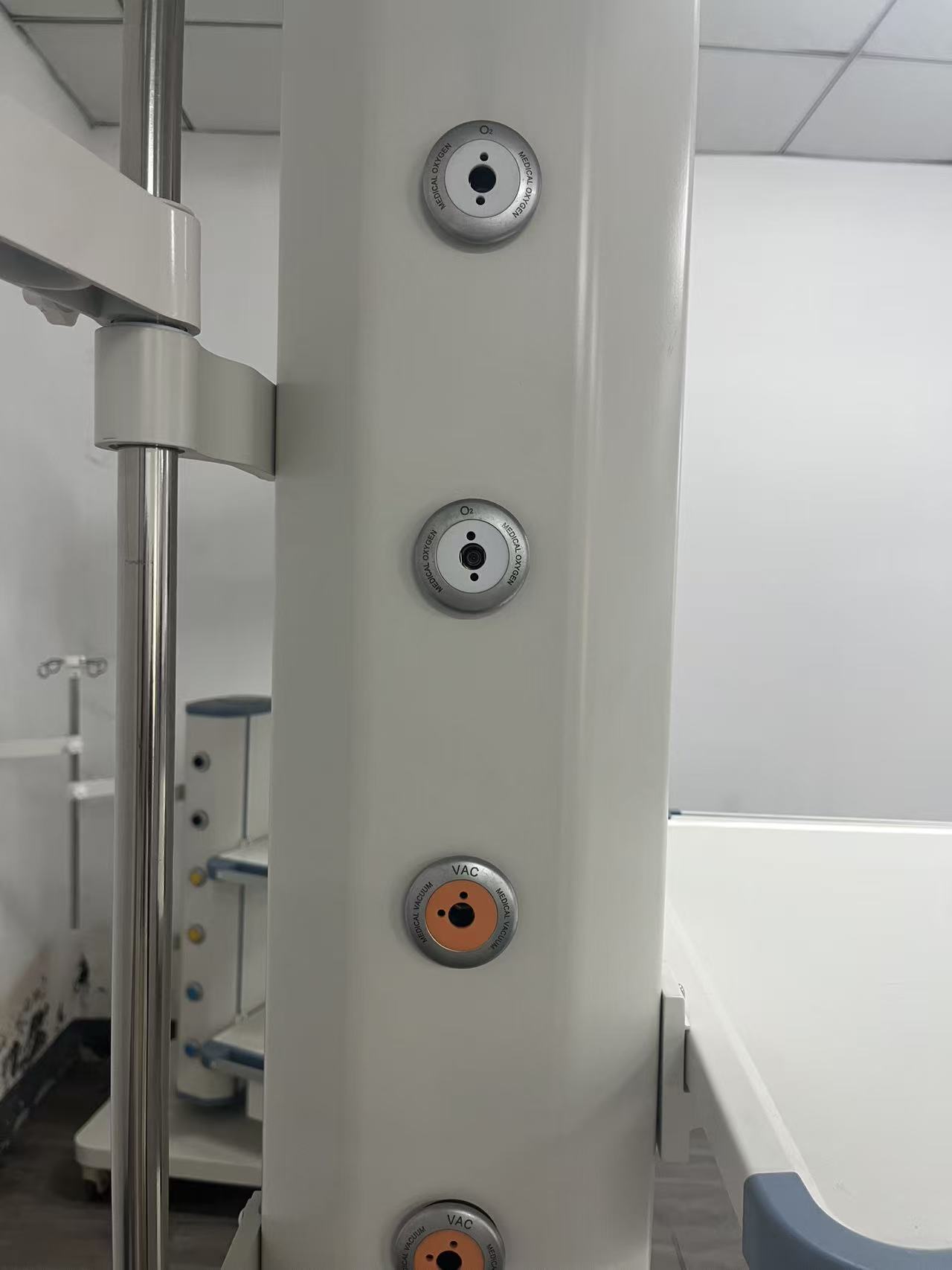
Stopkontak gas adalah fungsi inti dari setiap pendant. Pertanyaan konfigurasi memiliki dua lapisan: gas apa dan berapa banyak masing-masing, serta standar terminal nasional apa yang harus dipatuhi oleh stopkontak.
Gas medis umum yang disalurkan melalui terminal pendant adalah oksigen (O2), udara medis bertekanan (4 bar), vakum (suction), nitrogen oksida (N2O), karbon dioksida (CO2), nitrogen (N2), dan pembuangan gas anestesi (AGSS). Tidak semua departemen membutuhkan semuanya. Pendant anestesi kamar operasi biasanya menentukan 2 stopkontak oksigen, 2 stopkontak udara, 2 stopkontak vakum, 1 stopkontak N2O, dan 1 stopkontak AGSS. Pendant ICU dapat menggandakan jumlah oksigen dan vakum karena ventilator dan perangkat suction berjalan bersamaan untuk banyak pasien.
Standar terminal menentukan bentuk fisik, pengkodean, dan ketidakmampuan pertukaran setiap stopkontak. Ini adalah masalah regulasi dan keselamatan — probe yang tidak cocok dapat mengirimkan gas yang salah kepada pasien. Standar internasional yang mengatur adalah ISO 9170-1 (Unit terminal untuk sistem pipa gas medis), yang mendefinisikan persyaratan kinerja dan keselamatan. Profil nasional kemudian menentukan faktor bentuk fisik:
| Standar | Wilayah | Pengidentifikasi Utama | Pengkodean Gas Umum |
|---|---|---|---|
| DIN 13260 | Jerman, Eropa Tengah, Timur Tengah | Probe berulir dengan diameter spesifik gas | O2 putih, Udara hitam, Vakum biru |
| BS 5682 | Britania Raya, Irlandia, Persemakmuran | Probe dorong dengan kerah berindeks | O2 putih, Udara hitam/kuning, Vakum kuning |
| AFNOR NF S90-116 | Prancis, Afrika Frankofon | Model bayonet dengan takik khusus gas | O2 putih, Udara putih/hitam, Vakum hijau |
| JIS / DISS / Ohmeda / Chemetron | Jepang / AS (berbagai produsen) | Fitting DISS berulir atau fitting khusus merek | Warna + jarak ulir per gas |
Saat menentukan pendant untuk proyek ekspor, kami selalu mengonfirmasi standar pipa rumah sakit yang ada sebelum produksi. Mencampur outlet DIN pada pipa BS — atau sebaliknya — memerlukan rakitan adaptor yang menambah titik kegagalan. Produsen pendant harus menyediakan outlet dengan standar yang sama persis dengan yang digunakan instalasi gas sentral (CGU) rumah sakit, diverifikasi terhadap laporan uji kesesuaian ISO 9170-1.
Satu pelajaran berharga: selalu minta sertifikat uji terminal gas sebelum pemasangan. Kami pernah melihat proyek tertunda tiga bulan karena outlet pendant berformat DIN tetapi outlet dinding rumah sakit berstandar BS, dan otoritas setempat menolak komisioning sampai setiap terminal diganti. Konfirmasikan standar secara tertulis pada tahap pesanan pembelian.
Antarmuka Listrik, Data, dan Pembumian
Pendant modern membawa jauh lebih banyak daripada gas. Konfigurasi listrik dan data sering kali menentukan apakah pendant dapat mendukung beban peralatan aktual departemen tanpa menyambung kabel ekstensi secara daisy-chain — praktik yang melanggar batas arus bocor IEC 60601-1 dan menciptakan risiko kebakaran.
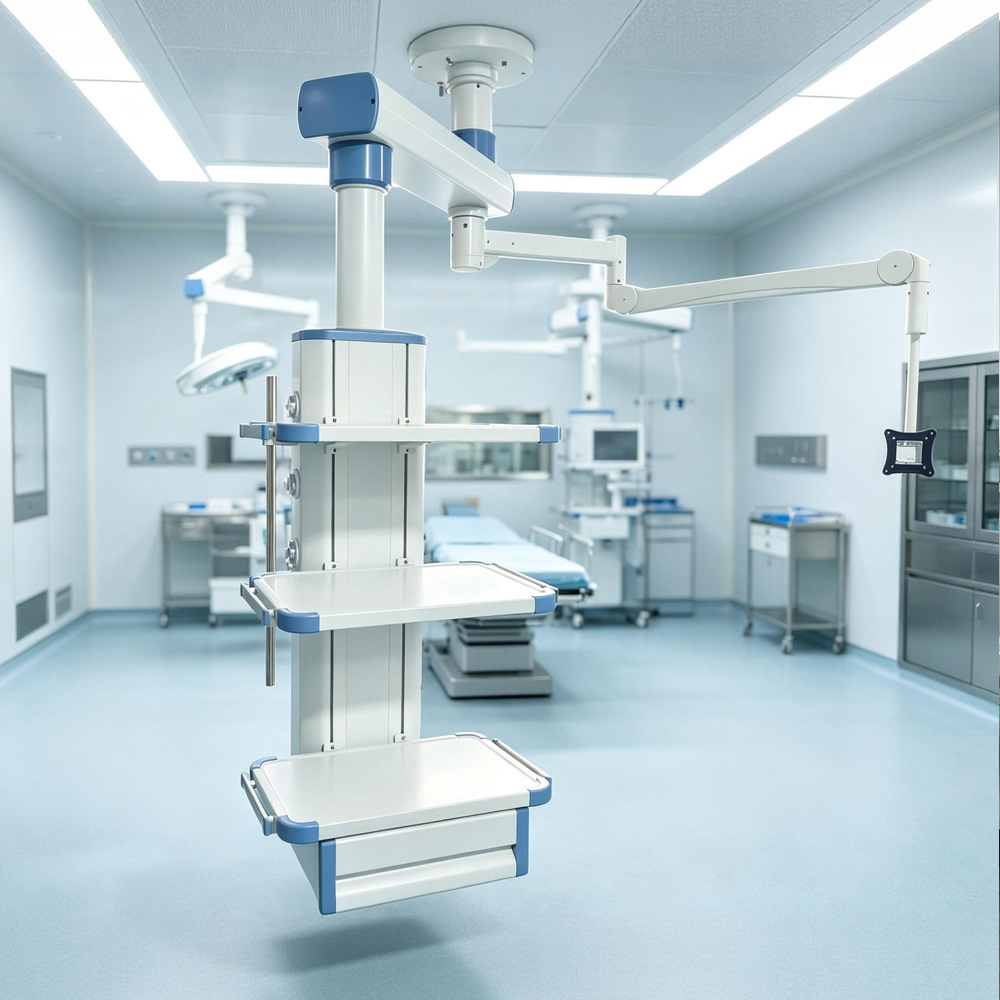
Pendant anestesi kamar operasi standar menyediakan 8 soket 230 V satu fase (Schuko, BS 1363, atau NEMA 5-15 tergantung wilayah), 8 pin ikatan ekipotensial, dan 4 port data RJ45 (Cat 6). Pendant jembatan ICU dapat ditingkatkan hingga 16 soket dan 16 titik pembumian per posisi pasien karena setiap sisi tempat tidur menjalankan ventilator, dua atau tiga pompa infus, monitor pasien, dan kadang-kadang perangkat penghangat secara bersamaan.
Dua detail spesifikasi penting di sini. Pertama, soket harus berada pada sistem daya terisolasi (IPS) atau sirkuit transformator kelas medis, bukan sirkuit bangunan umum. IEC 60601-1 mensyaratkan bahwa pasokan listrik area pasien membatasi arus bocor ke tanah hingga 0,5 mA dalam kondisi normal. Kedua, pin ikatan ekipotensial harus terhubung ke busbar pembumian ekipotensial ruangan; tanpa ini, menyentuh dua perangkat secara bersamaan dapat menciptakan jalur mikro-kejut melalui pasien.
Port data (RJ45 Cat 6) memberi makan sistem informasi rumah sakit, integrasi panggilan perawat, dan semakin banyak, pemantauan IoT. Tentukan setidaknya 2 port RJ45 ganda per pendant untuk memungkinkan ekspansi di masa depan. Beberapa rumah sakit juga meminta port video (HD-SDI atau HDMI over IP) untuk pendant endoskopi yang memberi makan layar bedah.
Pemisahan Zona Basah dan Zona Kering pada Pendant ICU
Pendant jembatan ICU terbagi menjadi dua zona fungsional, dan memahami pembagian ini sangat penting untuk konfigurasi yang benar. Zona kering membawa peralatan elektronik — ventilator, monitor pasien, defibrillator — yang harus dijauhkan dari cipratan cairan. Zona basah membawa pompa infus, pompa jarum suntik, tiang infus, dan tabung hisap yang kontak dengan cairan merupakan hal rutin.
Pada pendant jembatan yang dirancang dengan baik, rak sisi kering berukuran sekitar 430 mm kali 480 mm dengan kapasitas beban minimum 40 kg per rak, dan pembawa berputar 180 derajat pada sumbu vertikalnya sehingga perawat dapat mengayunkan monitor ke arah tempat tidur atau menjauh darinya. Sisi basah mengintegrasikan rel pompa infus, tiang IV rangkap empat, dan kait drainase, dengan kapasitas angkut total minimal 110 kg untuk menangani enam pompa atau lebih ditambah kantong cairan.
Pemisahan ini bukan sekadar kenyamanan — ini adalah persyaratan keselamatan. Cairan IV yang tumpah mencapai catu daya ventilator menciptakan bahaya kelistrikan. Saat meninjau Perencanaan pendant ICU versus OK (kamar operasi), pembagian basah/kering adalah perbedaan tata letak terbesar antara kedua lingkungan tersebut. Pendant OK tidak memerlukannya karena paparan cairan dikelola secara berbeda di area bedah.
Untuk rumah sakit yang merencanakan ICU baru, kami merekomendasikan untuk menentukan sisi basah dengan permukaan tahan bahan kimia (ABS kelas medis atau baja tahan karat dengan sambungan tersegel) karena disinfektan berbasis klorin merusak baja berlapis bubuk dalam beberapa tahun setelah pembersihan harian.
Aksesori dan Perencanaan Beban
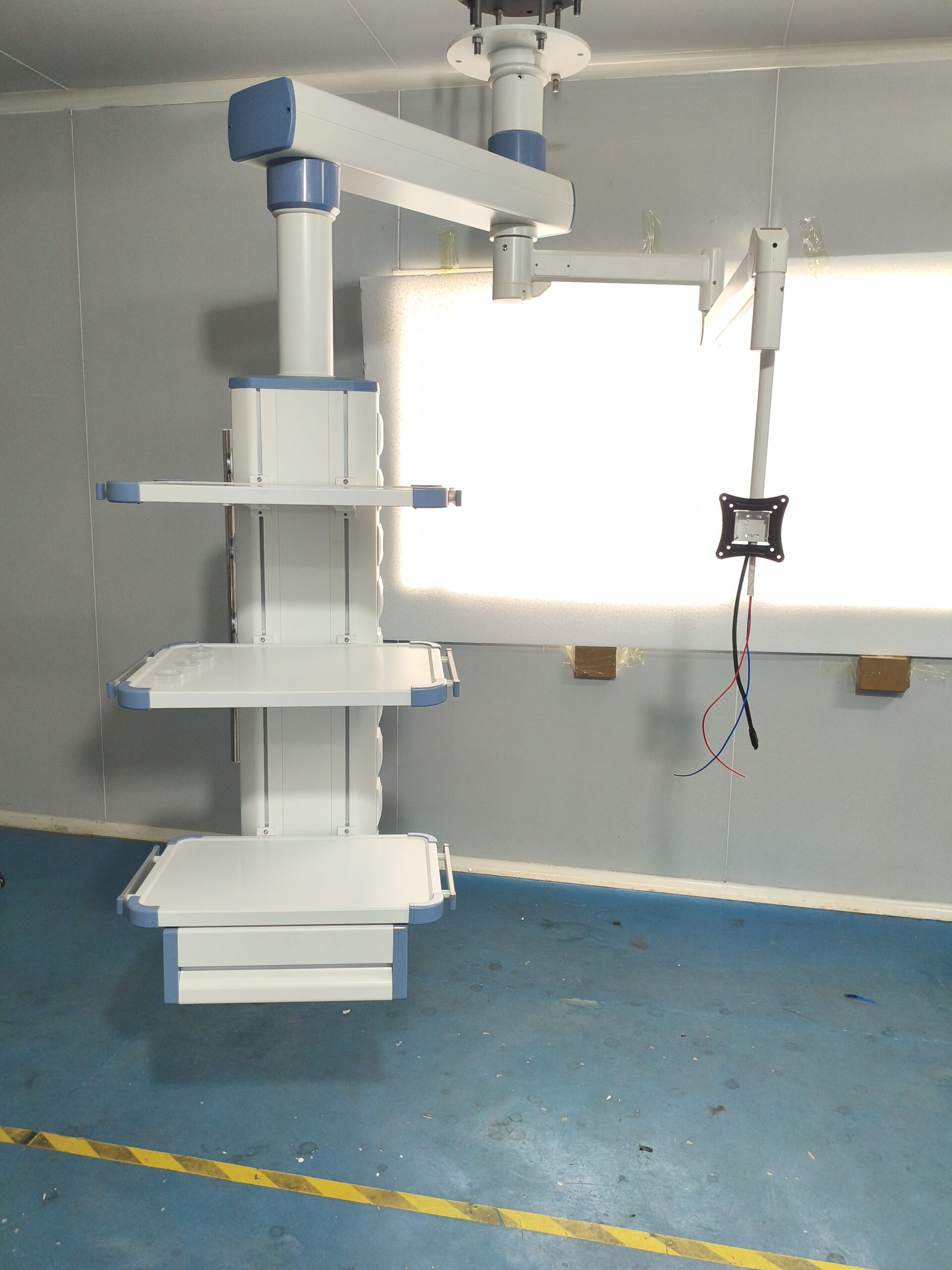
Aksesori mengubah lengan pendant kosong menjadi workstation fungsional. Opsi yang tersedia meliputi rak peralatan (satu, dua, atau tiga tingkat), laci untuk bahan habis pakai, braket pompa infus, lengan monitor, baki keyboard/penulisan, keranjang kateter, regulator hisap, flowmeter, dan tiang IV. Setiap aksesori menambah berat, dan totalnya harus tetap berada dalam kapasitas muat terukur lengan tersebut.
Di sinilah pembeli mendapat masalah. Lengan pendant bermotor yang diberi peringkat 115 kg terdengar murah hati sampai Anda menjumlahkan ventilator (18 kg), dua monitor di lengan (12 kg), tiga pompa infus (9 kg), tabung hisap (4 kg), unit laci (8 kg), dan perangkat rak itu sendiri (15 kg). Itu sudah 66 kg sebelum ada yang menempatkan instrumen bedah, kantong cairan, atau defibrillator di rak. Di pabrik kami, kami menghitung beban aksesori penuh pada tahap penawaran dan memberi tanda ketika daftar keinginan pelanggan mendekati 80 persen dari kapasitas terukur — ambang batas itu tidak menyisakan margin untuk peningkatan peralatan di masa depan.
Untuk pendant OK yang membawa mesin anestesi, mesin itu sendiri dapat berbobot 80-120 kg. Dalam kasus tersebut, pendant harus diberi peringkat minimal 150 kg beban bersih, dan struktur langit-langit harus menahan beban statis dan dinamis gabungan — yang dapat melebihi 300 kg ketika lengan sepenuhnya diperpanjang dan mesin sedang bergerak. Persetujuan teknik struktural pada jangkar langit-langit bersifat non-negosiasi.
Persyaratan Pemasangan dan Koordinasi Langit-Langit
Pendant hanya seaman langit-langit tempat ia digantung. Perencanaan pemasangan harus memperhatikan tinggi langit-langit, beban struktural, dan koordinasi spasial dengan peralatan lain yang dipasang di langit-langit.
Pemasangan pendant standar mengasumsikan tinggi langit-langit beton mentah hingga 4000 mm dengan plafon gantung (palsu) sekitar 3000 mm. Kolom langit-langit pendant melewati plafon palsu dan berjangkar ke pelat struktural di atasnya menggunakan jangkar kimia tugas berat atau baut tembus. Pelat antarmuka di titik pemasangan membawa semua jalur suplai — pipa gas, kabel listrik, saluran data — dan memungkinkan pemutusan cepat untuk servis.
Koordinasi langit-langit adalah langkah yang paling sering menyebabkan konflik di lokasi. Di OK modern, langit-langit menampung lampu bedah, C-arm pencitraan, kanopi aliran udara laminar, dan kadang-kadang pendant kedua. Busur rotasi 340 derajat pendant tidak boleh bertabrakan dengan jalur pergerakan lampu bedah atau sapuan C-arm. Kami menyediakan gambar CAD berukuran yang menunjukkan amplop penuh gerakan pendant, dan kami meminta setiap pelanggan untuk menindihkannya pada tata letak langit-langit mereka sebelum mengonfirmasi pesanan. Untuk panduan terperinci tentang jalur kabel dan selang di dalam kolom pendant, lihat artikel kami tentang manajemen kabel pendant medis.
Keandalan jangka panjang juga bergantung pada perencanaan akses pemeliharaan. Pelat antarmuka harus dapat dijangkau dari atas plafon palsu tanpa membongkar lengan pendant. Tentukan pendant dengan kartrid terminal gas yang dapat diservis dan konektor listrik plug-in sehingga satu teknisi dapat mengganti stopkontak yang aus dalam waktu kurang dari 30 menit. Panduan kami tentang perawatan dan suku cadang pendant medis mencakup interval servis yang direkomendasikan dan perlengkapan suku cadang yang harus disediakan setiap rumah sakit.
Konfigurasi Pendant OR vs. ICU: Perbandingan Berdampingan
Tabel di bawah ini merangkum perbedaan konfigurasi utama antara pendant ruang operasi pada umumnya dan pendant jembatan ICU. Gunakan sebagai daftar periksa awal saat menyusun spesifikasi Anda.
| Parameter | Pendant OR (Bedah/Anestesi) | Pendant Jembatan ICU |
|---|---|---|
| Jenis lengan | Lengan bermotor tunggal atau ganda | Balok jembatan horizontal dengan pembawa ganda |
| Rotasi | 340 derajat (lengan + konsol independen) | 180 derajat per pembawa (sisi kering/basah) |
| Perjalanan vertikal | 500-650 mm bermotor | Tinggi balok tetap; pembawa meluncur secara horizontal |
| Beban muat tipikal | 150-250 kg (mesin anestesi + monitor) | 110 kg sisi basah + 40 kg per rak kering |
| Stopkontak gas (per unit) | O2 x2, Udara x2, Vakum x2, N2O x1, AGSS x1 | O2 x3, Vakum x3, Udara x3 (per pasien) |
| Stopkontak listrik | 8 x 230 V | 16 x 230 V (per pasien) |
| Port data | 4 x RJ45 Cat 6 | 2 x RJ45 Cat 6 ganda |
| Aksesori kunci | Lengan monitor, rak instrumen, laci | Rel pompa infus, tiang infus, rak monitor |
| Pemisahan basah/kering | Tidak diperlukan | Penting (keselamatan cairan vs. elektronik) |
| Titik beban langit-langit | Jangkar tunggal (terpusat) | Dua kolom (terdistribusi) |
Kesimpulan
Mengonfigurasi pendant medis adalah latihan rekayasa sistem, bukan sekadar belanja dari katalog. Geometri lengan harus sesuai dengan alur kerja klinis ruangan. Outlet gas harus mengikuti standar pipa rumah sakit yang ada secara ketat. Kapasitas listrik harus mengakomodasi setiap perangkat yang dijalankan departemen saat ini — ditambah yang akan datang tahun depan. Dan struktur plafon harus menahan beban dinamis penuh tanpa melendut.
Key Takeaways:
- Mulailah dari alur kerja departemen (OK vs. ICU vs. endoskopi) sebelum memilih jenis lengan, jumlah gas, atau aksesori. Kasus penggunaan klinis menentukan setiap keputusan selanjutnya.
- Konfirmasikan standar terminal gas (DIN, BS, AFNOR, atau lainnya) dengan instalasi gas pusat rumah sakit pada tahap pesanan pembelian. Memasang ulang outlet dengan standar yang salah memakan waktu berbulan-bulan.
- Hitung total beban aksesori pada saat penawaran harga dan jaga di bawah 80 persen dari kapasitas muat lengan untuk mempertahankan margin bagi peralatan masa depan.
- Koordinasikan area rotasi pendant dengan lampu bedah, C-arm, dan unit aliran udara laminar menggunakan overlay CAD yang berdimensi sebelum mengonfirmasi pemasangan.
Jika Anda merencanakan departemen baru atau meningkatkan pendant yang sudah ada, tim teknik kami dapat meninjau gambar plafon dan daftar peralatan Anda untuk menghasilkan proposal konfigurasi dengan perhitungan beban dan verifikasi terminal gas. Jelajahi rentang pendant medis kami atau ajukan permintaan penawaran khusus proyek — kami merespons dalam satu hari kerja.
Pertanyaan yang Sering Diajukan
Bisakah saya mencampur standar outlet gas pada satu pendant?
Secara teknis ya, tetapi kami sangat menyarankan untuk tidak melakukannya. Standar campuran menciptakan sambungan adaptor yang menambah jalur kebocoran dan mempersulit perawatan. Tentukan satu standar yang sesuai dengan pipa rumah sakit Anda secara menyeluruh.
Berapa tinggi langit-langit yang dibutuhkan untuk lampu gantung bermotor?
Instalasi standar mengasumsikan plafon struktural hingga 4000 mm dengan plafon gantung sekitar 3000 mm. Plafon yang lebih rendah memerlukan kolom yang dipendekkan; konfirmasikan jarak bebas minimum dengan pabrikan.
Seberapa sering rem gantung harus diservis?
Rem gesekan mekanis perlu pemeriksaan setiap 6 bulan di kamar operasi dengan penggunaan tinggi. Rem pneumatik dan elektrik sebagian besar bebas aus tetapi harus diuji setiap tahun selama pemeliharaan preventif.
Apa perbedaan antara lengan pegas dan lengan motor?
Lengan pegas menggunakan pegas mekanis untuk penyesuaian ketinggian dan memerlukan kalibrasi ulang teknisi ketika beban berubah. Lengan motor menggunakan motor listrik untuk penentuan posisi yang presisi dengan tombol, tanpa bergantung pada beban.
Apakah lampu gantung memerlukan sertifikasi kelistrikan terpisah?
Ya. Sistem kelistrikan pendant harus mematuhi IEC 60601-1 untuk peralatan listrik medis. Minta laporan uji tipe dari produsen dan pastikan soket berada pada sistem daya terisolasi.
Anda Mungkin Juga Menyukai...

Gas Outlet Colour Coding and Pin Index: What Medical Equipment Importers Must Check
Medical gas systems are built on a simple principle: it must be impossible to connect...

Blood Donation Chairs: Specifying Seating for Donor Safety and Compliance
Blood establishments face a seating problem that ordinary furniture cannot solve: donors sit for 15...

Veterinary Grooming Tables: What Pet-Care Chains Should Spec
Pet grooming chains are scaling faster than their equipment sourcing, and the grooming table at...