

Executive Summary
A practical service planning guide to medical pendant maintenance and spare parts: risk-based PM schedules, failure-prone components, inventory tiering, and manufacturer service commitments for OR and ICU ceiling pendants.
A medical pendant rarely fails all at once. It degrades quietly — a brake that needs two hands instead of one, a gas outlet that hisses only when the column is rotated to a certain angle, a shelf that drifts a few millimeters overnight. By the time the ICU head nurse files a work order, the problem has usually been building for months, and the repair is now urgent, expensive, and hard to schedule around a full ward. In our work supporting hospitals and distributors across 15 countries, the difference between a pendant that runs 15 years and one that becomes a liability in 6 is almost never the hardware. It is the maintenance and spare parts plan behind it.
This guide is written for biomedical engineers, facilities managers, and distributors who maintain ceiling-mounted medical pendants in ORs, ICUs, and emergency departments. It lays out how to structure a preventive maintenance program, which wear parts actually fail in the field, how to size a spare parts inventory without freezing capital, and what to demand from your manufacturer’s spare parts service before you sign the purchase contract. The framework applies whether you run two pendants in a district hospital or forty across a regional health network.
One note on scope: we manufacture pendants, so we see both sides — the engineering tolerances inside the arm and the procurement spreadsheets outside it. Wherever possible I reference published standards (ISO 11197, IEC 60601-1, ISO 7396-1, HTM 02-01) rather than our own marketing numbers. Where no published data exists, I say so and give field experience instead.
Step 1: Build the Asset Register Before Anything Else
Every maintenance program that fails, fails at the register. If you cannot answer “how many pendants do we have, of which model, installed when, with which gas and electrical configuration” in under five minutes, you do not have a maintenance program — you have a repair habit. The asset register is the foundation for PM scheduling, spare parts forecasting, warranty claims, and end-of-life planning.
For each pendant, record at minimum:
- Identification: serial number, model, manufacturer, installation date, warranty end date.
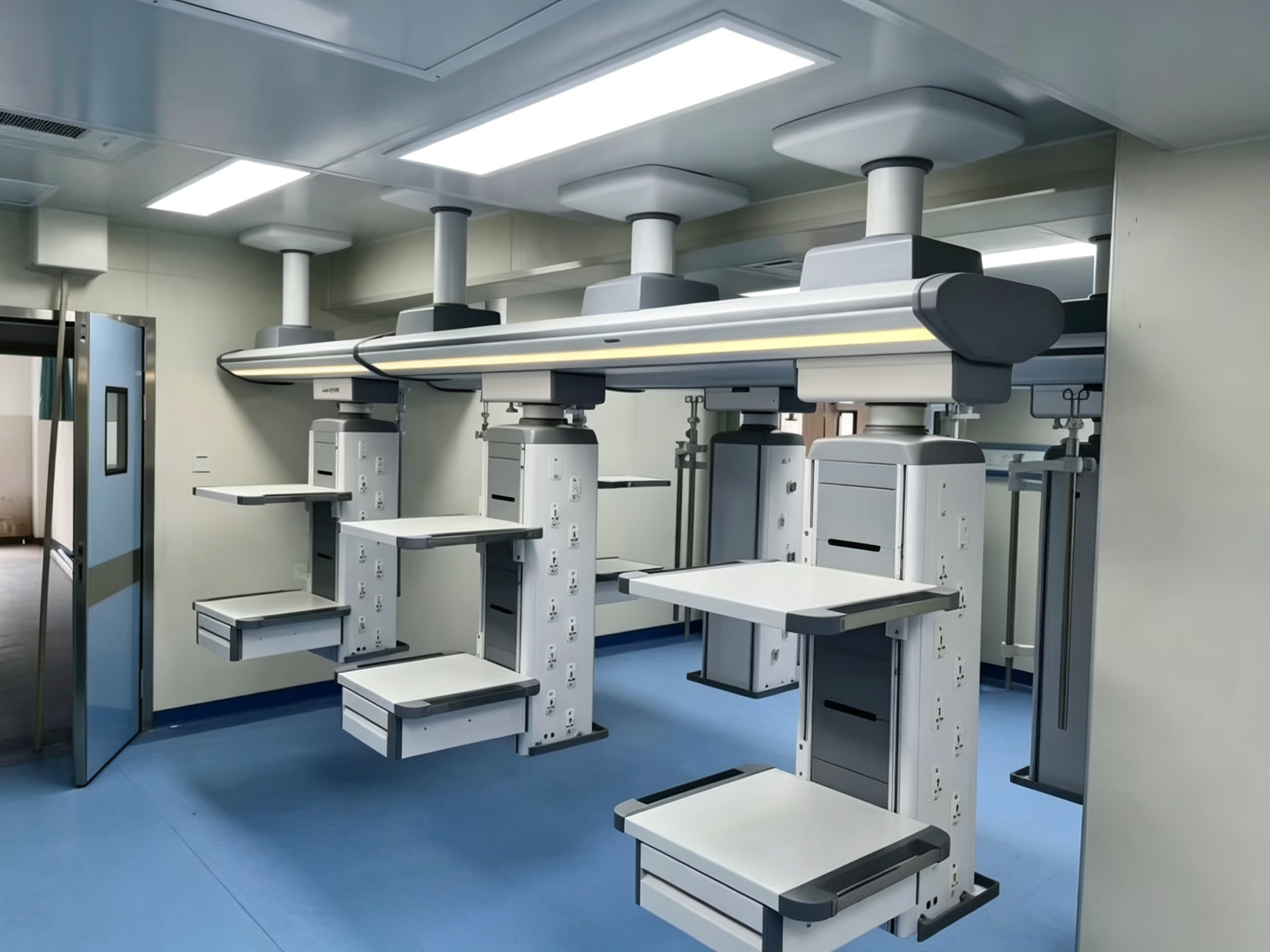
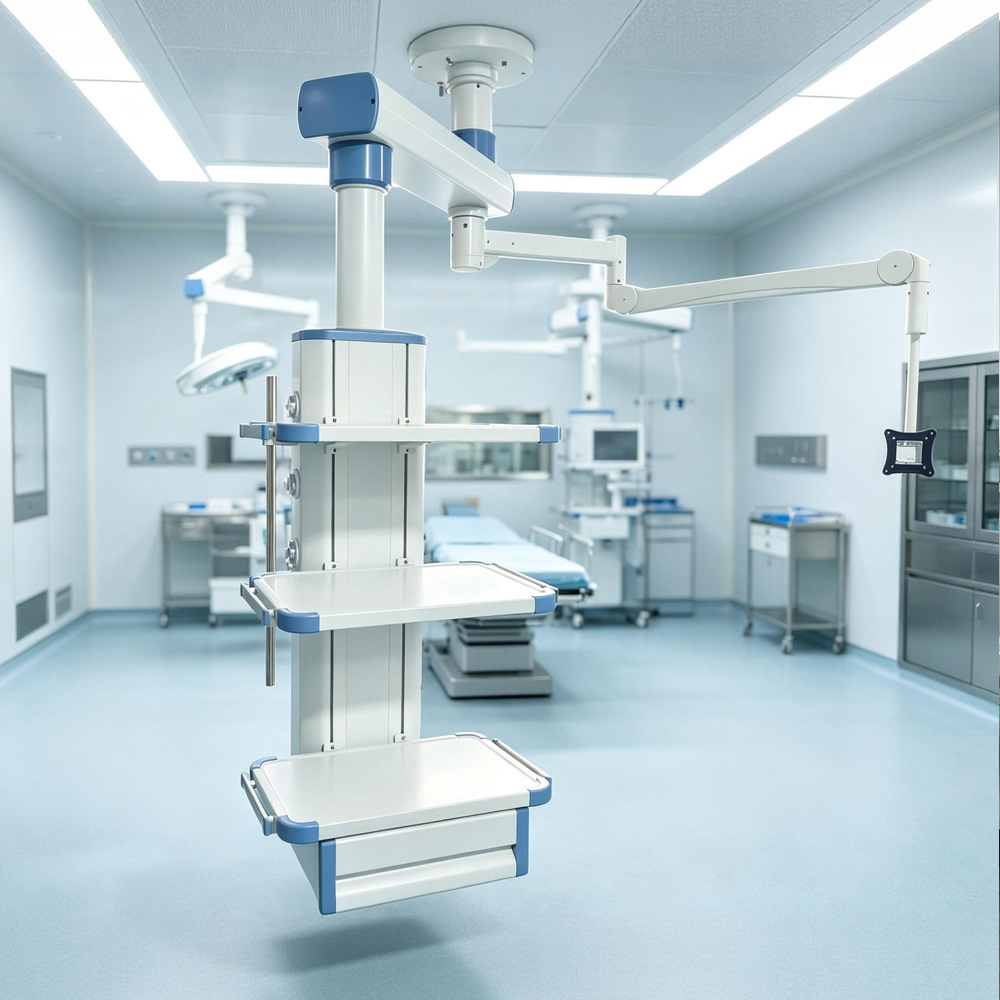
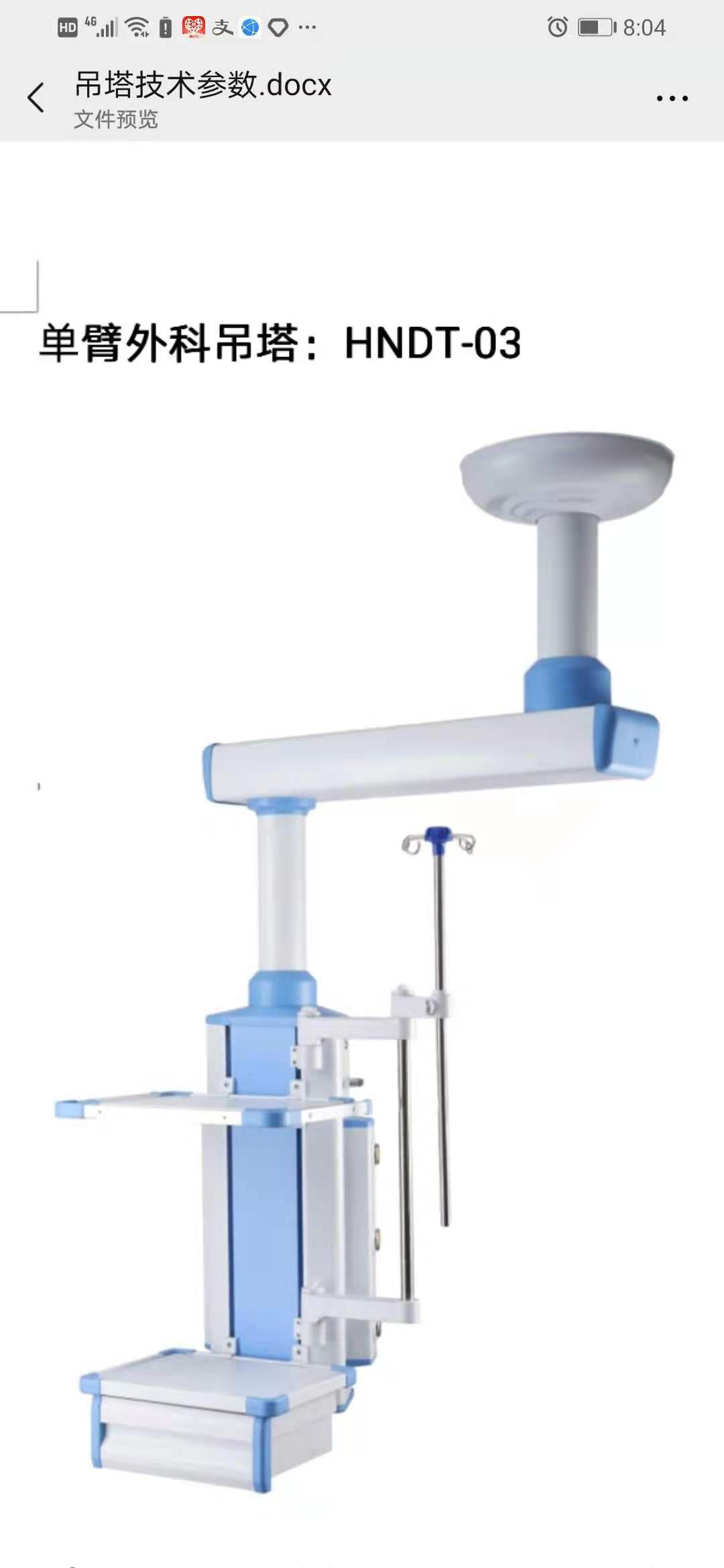
- Configuration: single or double arm, arm reach, column type (fixed, height-adjustable, motorized), number and standard of gas outlets (O₂, N₂O, medical air, vacuum, AGSS), electrical socket count and standard, data/communication ports, accessories (shelves, drawers, infusion poles, monitor arms, equipment rails).
- Load profile: rated working load per arm and per shelf, and the actual equipment mounted (ventilator, monitors, syringe pumps). Overloading is the single fastest way to destroy bearings and brakes.
- Service history: every inspection, repair, and part replaced, with date, technician, and part number.
This register feeds directly into your CMMS or even a disciplined spreadsheet. Evidence-based equipment management research published in Medical & Biological Engineering & Computing has shown that structuring maintenance decisions around documented device history and risk — rather than fixed calendar intervals alone — improves availability while cutting unnecessary interventions. The register is what makes that possible.
Step 2: Set a Risk-Based Preventive Maintenance Schedule
Medical supply units — the standards family that covers ceiling pendants — are governed internationally by ISO 11197 (the 2019 edition is current; a fifth edition reached Final Draft International Standard stage at ISO in 2026). For the electrical safety aspects, IEC 60601-1 applies, and the medical gas side connects to ISO 7396-1 pipeline systems and terminal units. In the UK, HTM 02-01 guidance has long set the expectation that medical gas terminal units on pendants are inspected and maintained on a planned schedule. None of these documents hand you a ready-made PM calendar — they define performance and safety requirements, and it is your program’s job to verify them periodically.
A practical three-tier PM structure
- Weekly (clinical staff, 5 minutes): visual check of brakes and drift, gas outlet levers, shelf and rail fixings, cable condition, unusual noise during rotation. Log anomalies immediately.
- Quarterly or semi-annual (biomedical engineering): brake holding torque check, bearing play inspection, gas outlet leak test at each terminal unit, electrical socket retention and earth continuity test, height-adjustment mechanism function, fastener torque audit on shelves and accessories.
- Annual (full service): complete mechanical inspection of arm joints and bearings, internal cable and hose condition inside the arm, gas hose integrity and outlet re-certification, insulation resistance and protective earth testing to IEC 60601-1 principles, load test at rated capacity, and replacement of scheduled wear parts regardless of apparent condition.
Experience note: the pendants that generate emergency calls are almost never the ones on a PM schedule. In our after-sales data, the majority of urgent brake and bearing failures arrive from sites with no documented annual service. Planned maintenance is not a cost center — it is the difference between a 40-minute scheduled part swap and a closed ICU bed.
Adjust interval by risk and usage, not just calendar. A pendant in a 24/7 ICU carrying a ventilator accumulates rotation cycles and load hours far faster than one in a step-down ward. If your register tracks usage intensity, you can move high-duty units to semi-annual full service and keep low-duty units on annual cycles without compromising safety.
Step 3: Know the Parts That Actually Fail
Spare parts planning starts with an honest failure map. After years of field returns and service reports, the failure distribution for articulated ceiling pendants is remarkably consistent. The structural column and arm extrusions essentially never fail. What fails are the moving, sealing, and user-contact components:
| Component | Typical Failure Mode | Early Warning Sign | Typical Service Interval* | Stock Priority |
|---|---|---|---|---|
| Friction brake pads / brake assemblies | Wear, contamination with aerosol disinfectants | Arm drifts after positioning; needs two hands to hold | 2–4 years (high-use ICU) | High — stock on site |
| Arm bearing sets | Fatigue, play from overload or side loading | Grinding noise, visible wobble at full extension | 4–7 years | High — at least one set per fleet |
| Gas outlet seals and valve cores | O-ring aging, probe wear, particle contamination | Audible hiss, slow leak test decay | Seal kits 2–3 years; full outlet 5–8 years | High — seal kits on site |
| Internal gas hoses | Flex fatigue at bend points inside rotating joints | Leak only at certain rotation angles | 5–8 years | Medium — stock for fleets of 10+ |
| Electrical sockets and switches | Contact wear, cracked housings from impact | Loose plugs, intermittent power | 3–6 years | Medium |
| Shelf / rail / drawer hardware | Fastener loosening, slide wear | Shelf tilt, drawer resistance | Inspect quarterly; replace on condition | Low-medium |
| Motorized height-adjustment actuators | Motor wear, limit switch failure, control board faults | Slow travel, stops mid-stroke | 5–10 years | Medium — one actuator per fleet |
*Intervals are field-observed ranges for quality pendants under normal hospital use, not manufacturer guarantees. Cleaning chemistry matters: aggressive quaternary ammonium or chlorine-based disinfectants accelerate seal aging and brake pad contamination, which is why the cleaning protocol your infection control team approves belongs in the maintenance plan too.
Two failure patterns deserve special attention because we see them repeatedly misdiagnosed. First, a pendant arm that has lost its smooth, balanced movement is usually a bearing wear problem, not a “tighten everything” problem — continuing to use it accelerates damage to the joint housing. Second, a gas outlet that leaks only at certain arm positions is almost always an internal hose fatigue issue, not a terminal unit issue, and replacing the outlet alone will not fix it.

Step 4: Size the Spare Parts Inventory Rationally
The two classic mistakes are holding zero stock (“we’ll order when it breaks”) and holding a full duplicate of everything (“just in case”). The first converts every failure into multi-week downtime when the part ships internationally; the second freezes capital in parts that age on the shelf — rubber seals and gas hoses have finite shelf life whether installed or not. The rational middle ground is a criticality-tiered inventory.
Tier A — stock on site, always
- Gas outlet seal kits and valve cores for every gas type installed (per-outlet cost is trivial; a leaking O₂ terminal unit is not).
- Brake pads or brake service kits for each arm model in the fleet.
- Electrical sockets and fuses matching your installed standard.
- Fastener and cover kit (the small parts that vanish during any repair).
Tier B — one unit per fleet or per site group
- Complete arm bearing set for each arm generation you operate.
- One full gas outlet assembly per gas standard, for swap-and-repair turnaround.
- One height-adjustment actuator and control board if you run motorized columns.
Tier C — order on demand, with a guaranteed lead time
- Internal hose sets, structural covers, complete columns, and cosmetic panels — low failure rate, high unit cost, long shelf life not guaranteed for elastomers.
Rule of thumb from the field: the cost of a sensible Tier A + Tier B kit for a ten-pendant ICU is typically a low single-digit percentage of the original equipment value — while a single week of one blocked ICU bed costs the hospital more than the entire kit. Inventory is cheap insurance when it is the right inventory.
Research on hospital equipment economics supports this direction. A cost-minimization analysis published in BMC Health Services Research comparing maintenance versus replacement strategies in district hospitals found that systematic maintenance investment consistently outperformed reactive replacement for major equipment. And the PartsSource State of Healthcare Technology Management reports have repeatedly highlighted parts availability and supply chain lead time as top operational risks for HTM teams — a risk that grew, not shrank, after the supply disruptions of recent years. Your inventory plan is your hedge against that volatility.
Step 5: Lock the Manufacturer’s Side Before You Buy
Maintenance planning starts at procurement, not at the first breakdown. When evaluating a pendant supplier, the after-sales terms matter as much as the arm reach. A manufacturer operating an ISO 13485 quality management system is required to maintain traceable production and component records — ask for the spare parts commitment in writing, as part of the tender or purchase agreement:
- Parts availability period: a committed number of years after model discontinuation (10 years is a reasonable benchmark for capital equipment under EU MDR-era expectations).
- Guaranteed dispatch lead time for Tier A/B parts, with a named logistics channel for your region.
- Documentation package: exploded diagrams, part numbers, service manuals, and torque specifications — without these, your own technicians cannot do first-line work.
- Training: factory or remote training for your biomedical team on brake adjustment, seal replacement, and gas leak testing.
- Backward compatibility policy: whether new outlet or brake revisions remain compatible with your installed generation.
For distributors, this doubles in importance: your reputation with the hospital is only as good as your parts pipeline. We advise distributors to negotiate a standing consignment kit of Tier A parts with the first container order, and to review consumption annually against the hospital fleet’s service records. If you are planning a full turnkey operating room project, fold the spare parts kit and the first two annual services into the project budget from day one — it is far easier to fund there than as a later emergency purchase.

Step 6: Common Mistakes That Shorten Pendant Life
Most of these come from service reports we have read hundreds of times:
- Overloading shelves and rails. Every monitor, pump, and accessory adds up. Exceeding rated load does not break the arm today; it halves the bearing life and voids the warranty argument tomorrow.
- Using the arm as a pull handle. Staff repositioning the column by dragging it sideways from a shelf edge applies lateral force the bearings were never designed for. Train staff to move pendants by the designated handles.
- Uncontrolled cleaning chemicals. Spraying disinfectant directly onto gas outlets and brake housings drives fluid into seals and friction surfaces. Damp-cloth application only, with the chemistry your manufacturer approves.
- Mixing non-OEM gas probes and outlet parts. Terminal units are standardized by gas type and national standard, but tolerances differ between manufacturers. A “close enough” seal kit is how slow leaks start.
- Skipping the rotation-angle leak test. Testing outlets only in the neutral position misses flex-fatigued internal hoses. Always test through the full range of arm movement.
Step 7: Decide When to Repair, Refurbish, or Replace
A well-maintained pendant should deliver 12–15 years of service, and the structure often remains sound well beyond that. The replacement decision should be driven by three questions, in order:
- Safety and compliance: can the unit still pass its gas, electrical, and load tests to current requirements? If parts are discontinued and workarounds involve non-OEM gas components, the answer is effectively no.
- Clinical fit: ICU and OR practice changes — more devices per bed, heavier monitors, AGSS requirements. A pendant that cannot carry today’s equipment set is functionally obsolete even if mechanically perfect.
- Economics: when annual repair spend on a unit approaches a meaningful fraction of replacement cost — a common working threshold in HTM practice is around 50% — replacement wins. Mid-life refurbishment (new bearings, brakes, hoses, outlets, and sockets on the existing structure) is often the best-value third option for fleets aged 7–10 years.
Conclusion
Medical pendant maintenance is not complicated, but it is unforgiving of neglect. The program that works is the one built on five pillars: a complete asset register, a risk-based PM schedule anchored to ISO 11197 and IEC 60601-1 performance requirements, a spare parts inventory tiered by criticality, contractual parts commitments secured at procurement, and disciplined habits around loading, handling, and cleaning. Get those right and a pendant becomes one of the most reliable assets in the hospital — invisible in the best possible way. If you are auditing an existing fleet or specifying a new one, our team can share the maintenance checklist and parts kit configuration we recommend for your pendant models; reach us through the contact page.
Frequently Asked Questions
How often should a medical pendant be serviced?
A practical baseline is weekly visual checks by clinical staff, quarterly or semi-annual functional inspections by biomedical engineering, and one full annual service covering mechanical, gas, and electrical systems. High-duty ICU pendants benefit from moving the full service to every six months.
Which spare parts should a hospital always keep in stock?
At minimum: gas outlet seal kits and valve cores for every gas type installed, brake service kits for each arm model, matching electrical sockets, and a fastener kit. Fleets of ten or more pendants should also hold at least one complete bearing set and one full outlet assembly per gas standard.
What standards govern medical pendant maintenance?
The core references are ISO 11197 (medical supply units — the 2019 edition, with a fifth edition in final draft at ISO), IEC 60601-1 for electrical safety, and ISO 7396-1 for the medical gas pipeline side. National guidance such as UK HTM 02-01 adds planned-maintenance expectations for terminal units. Manufacturers operating under ISO 13485 must also maintain traceable production and service documentation.
Why does my pendant arm drift after positioning?
Drift almost always indicates worn or contaminated friction brake pads, or developing bearing play — often accelerated by overloading or disinfectant ingress. It will not resolve by tightening external fasteners, and continued use accelerates joint damage. Schedule a brake and bearing inspection promptly.
Is it safe to use third-party spare parts on a medical pendant?
For cosmetic panels, possibly. For gas-carrying, load-bearing, braking, or electrical components — no. Tolerances and materials in OEM parts are validated as a system under the device’s regulatory file; unvalidated substitutions create leak, load, and liability risks, and typically void both warranty and compliance standing.
You May Also Like...

Medical Pendant Installation: 5 Mistakes That Cause Early Failure
medical pendant installation mistakes is the first checkpoint buyers should lock before they approve a...

Medical Pendant vs Tower Boom: How to Choose the Right Ceiling Supply Unit
Medical pendant vs tower boom explained: structural differences, coverage radius, load capacity, installation conditions, and...

Medical Pendant for an Endoscopy Suite: Configuration Guide vs. the OR
How to configure a medical pendant for an endoscopy suite: endoscopy vs anesthesia towers, monitor...