
الملخص التنفيذي
A complete buyer's guide to medical pendant configuration: arm types, gas outlet standards (DIN/BS/AFNOR), electrical interfaces, wet/dry zoning, accessories, and installation planning for OR and ICU.
Walk into any operating room or intensive care unit that was fitted before ceiling-mounted supply systems became standard, and you will see the same problem: a tangle of gas hoses, power cables, and network wires snaking across the floor from wall outlets to the patient bedside. Clinicians trip over them. Cleaning crews cannot reach underneath. And every time the anaesthetist repositions a monitor, someone has to crawl under the table to reroute a cable. In our factory, we hear this story from hospital engineers on nearly every project call.
A medical pendant solves this by bringing every utility — oxygen, medical air, vacuum, electricity, data — down from the ceiling on an articulated arm, placing connections exactly where the clinical team needs them. But here is the catch that catches most first-time buyers off guard: medical pendant configuration is not a one-size-fits-all decision. The arm length, rotation range, gas outlet count, terminal standard, electrical capacity, and accessory layout all differ between an operating theatre and an ICU bay. Get one parameter wrong and you face costly retrofit work after installation — or worse, a pendant that cannot carry the equipment your department actually uses.
بالنسبة لقرارات التكوين التي تُشكّل نطاق التعديل التحديثي، راجع medical pendant retrofit guide.
This guide walks through every configuration decision point, from arm geometry to gas terminal standards to accessory selection, so that procurement teams and hospital engineers can specify the right system the first time. We draw on patterns we see across hundreds of projects shipped to hospitals in more than 60 countries.
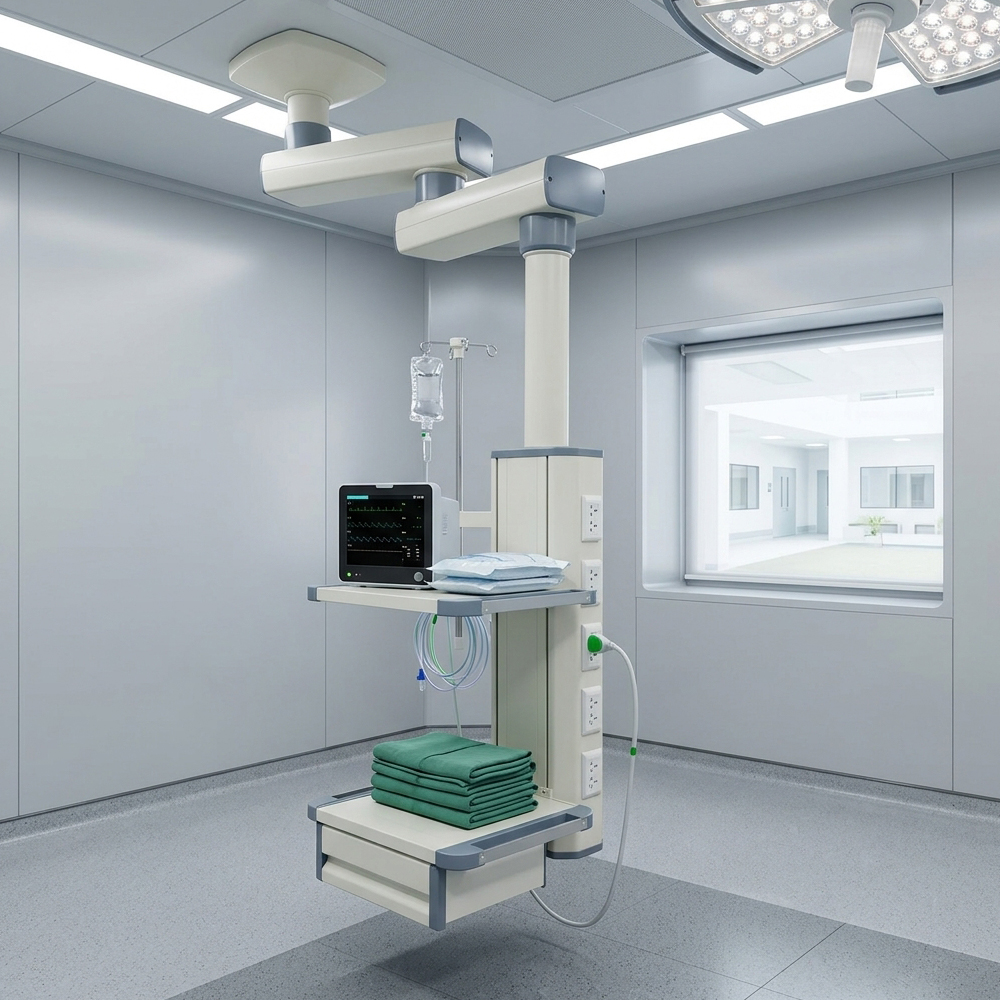
Medical Pendant Types: Matching the System to the Department
The first configuration decision is not about arms or outlets — it is about which pendant category fits the clinical workflow. In practice, hospitals specify three main types, and confusing them leads to overspending or under-equipping a room.
Surgical (OR) pendants serve the operating theatre. They carry anaesthesia machines, surgical monitors, electrocautery units, and endoscope towers. Because the surgical team works in a tight arc around the table, OR pendants prioritise precise positioning and high payload capacity. A motorized double-arm surgical pendant routinely supports 150 kg or more of equipment on its shelves and console.
معلقات جسرية لوحدة العناية المركزة span the bed from one ceiling column to another, creating a horizontal beam with a wet side (infusion pumps, syringe drivers, IV poles) and a dry side (ventilators, monitors). The bridge format gives nursing staff access from both sides of the bed without arms swinging into the clinical workspace. A typical ICU bridge provides 16 electrical sockets, 16 equipotential grounding nodes, 3 oxygen outlets, 3 vacuum outlets, and 3 compressed air outlets per patient position.
Anaesthesia pendants are a specialised OR subtype designed to suspend the anaesthesia machine itself. They integrate gas supply (O2, air, vacuum, N2O, AGSS), power, and data in a compact service head, keeping the anaesthesia workstation off the floor and within the anaesthetist’s arm’s reach.
In our experience, the single most common specification error is ordering an OR-style single-arm pendant for an ICU bay. The arm blocks nursing access from one side of the bed, and the shelf count is too low for the infusion pumps and monitors a modern ICU requires. Always start from the department workflow, not the product catalogue.
Arm Configuration: Single vs. Double, Length, and Rotation
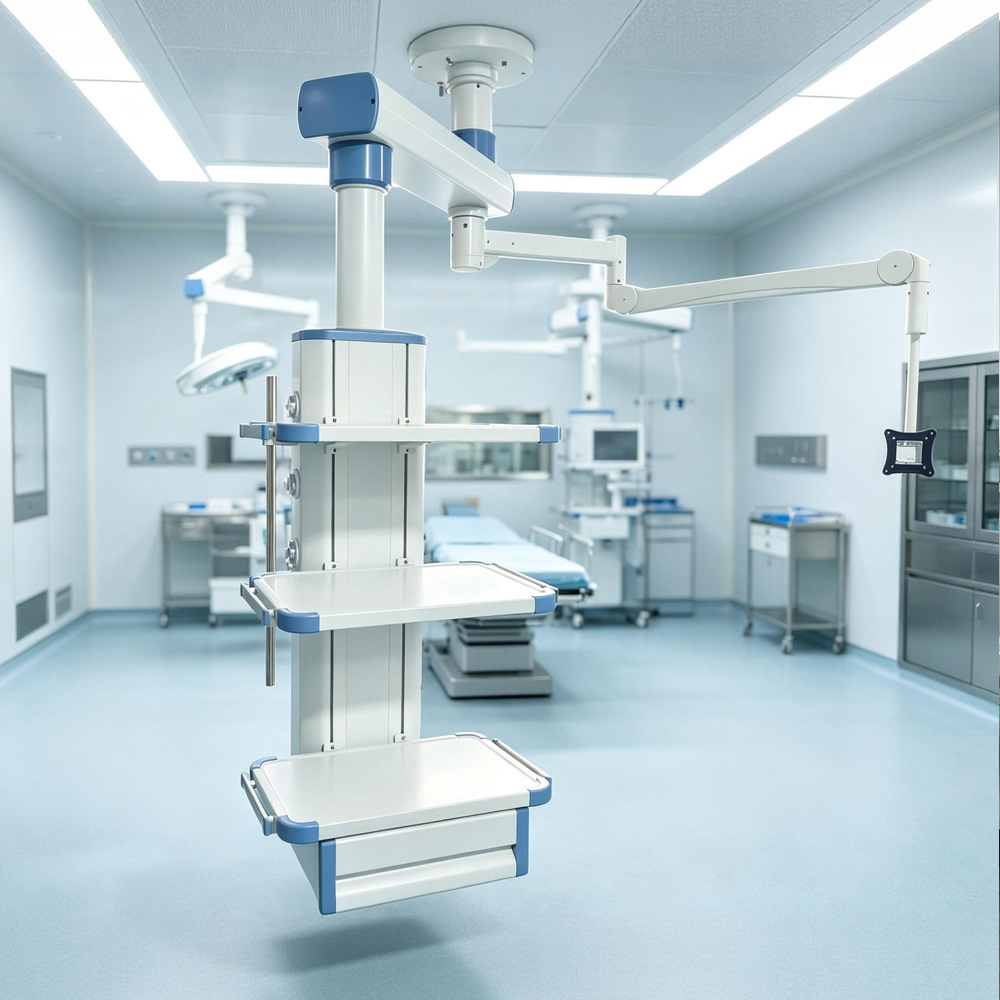
The arm assembly determines how far the pendant reaches, how much it can carry, and how freely clinicians can reposition it. Three parameters matter: arm count, arm length, and rotation angle.
Single-arm pendants rotate around one ceiling pivot. They suit smaller rooms or single-patient bays where the equipment cluster stays within a predictable arc. A single arm keeps cost and ceiling loading lower — typical net load stays under 60 kg for the arm structure itself.
Double-arm pendants add a second articulation point, extending the working radius and allowing the service head to reach further across the table or bed. In a standard OR, the combined arm reach spans 700 mm to 1100 mm per arm segment, giving a total working envelope that covers the full surgical field. Double arms are essential when the pendant must serve both the anaesthesia position and the surgical instrument table.
Rotation on most modern pendants reaches 340 degrees horizontally. The arm and the terminal box can rotate independently or simultaneously, giving clinicians fine control over positioning. Vertical travel — the ability to raise or lower the console — ranges from 500 mm to 650 mm on motorized arms, allowing height adjustment from roughly 600 mm to 1200 mm above the floor.
Braking is the detail buyers overlook until the pendant drifts mid-procedure. Three brake types exist: mechanical friction brakes (simple, low-cost, require periodic adjustment), pneumatic brakes (use compressed air from the pendant’s own supply, consistent holding force), and electric brakes (near wear-free, controlled from the pendant’s switch panel). For high-use ORs, we recommend pneumatic or electric brakes because friction brakes lose holding force after thousands of repositioning cycles.
Medical Gas Outlets: Types, Quantities, and Terminal Standards
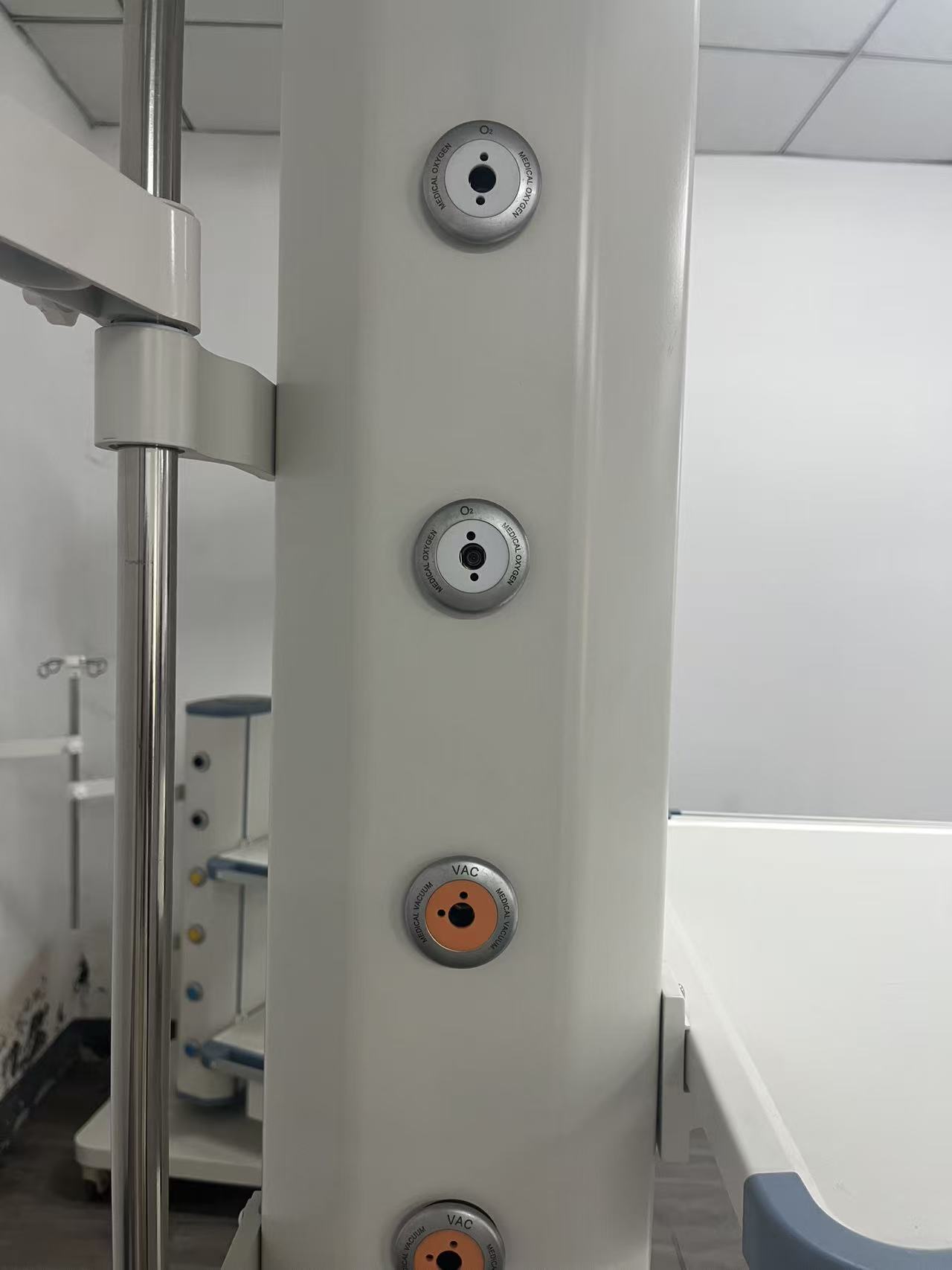
Gas outlets are the core function of any pendant. The configuration question has two layers: which gases and how many of each, and which national terminal standard the outlets must follow.
The common medical gases delivered through pendant terminals are oxygen (O2), medical compressed air (4 bar), vacuum (suction), nitrous oxide (N2O), carbon dioxide (CO2), nitrogen (N2), and anaesthetic gas scavenging (AGSS). Not every department needs all of them. An OR anaesthesia pendant typically specifies 2 oxygen outlets, 2 air outlets, 2 vacuum outlets, 1 N2O outlet, and 1 AGSS outlet. An ICU pendant may double the oxygen and vacuum count because ventilators and suction devices run simultaneously on multiple patients.
The terminal standard determines the physical shape, coding, and non-interchangeability of each outlet. This is a regulatory and safety issue — mismatched probes can deliver the wrong gas to a patient. The governing international standard is ISO 9170-1 (Terminal units for medical gas pipeline systems), which defines performance and safety requirements. National profiles then specify the physical form factor:
| قياسي | المنطقة | Key Identifier | Common Gas Coding |
|---|---|---|---|
| DIN 13260 | Germany, Central Europe, Middle East | Threaded probe with gas-specific diameter | O2 white, Air black, Vacuum blue |
| BS 5682 | United Kingdom, Ireland, Commonwealth | Push-in probe with indexed collar | O2 white, Air black/yellow, Vacuum yellow |
| AFNOR NF S90-116 | France, Francophone Africa | Bayonet-style with gas-specific notches | O2 white, Air white/black, Vacuum green |
| JIS / DISS / Ohmeda / Chemetron | Japan / USA (various manufacturers) | Threaded DISS or brand-specific fittings | Colour + thread pitch per gas |
When specifying pendants for export projects, we always confirm the hospital’s existing pipeline standard before production. Mixing DIN outlets on a BS pipeline — or the reverse — requires adapter assemblies that add failure points. The pendant manufacturer should provide outlets in the exact standard the hospital’s central gas plant (CGU) uses, verified against ISO 9170-1 conformance test reports.
One hard-won lesson: always request the gas terminal test certificates before installation. We have seen projects delayed three months because the pendant outlets were DIN-formatted but the hospital’s wall outlets were BS, and the local authority refused commissioning until every terminal was replaced. Confirm the standard in writing at the purchase-order stage.
Electrical, Data, and Grounding Interfaces
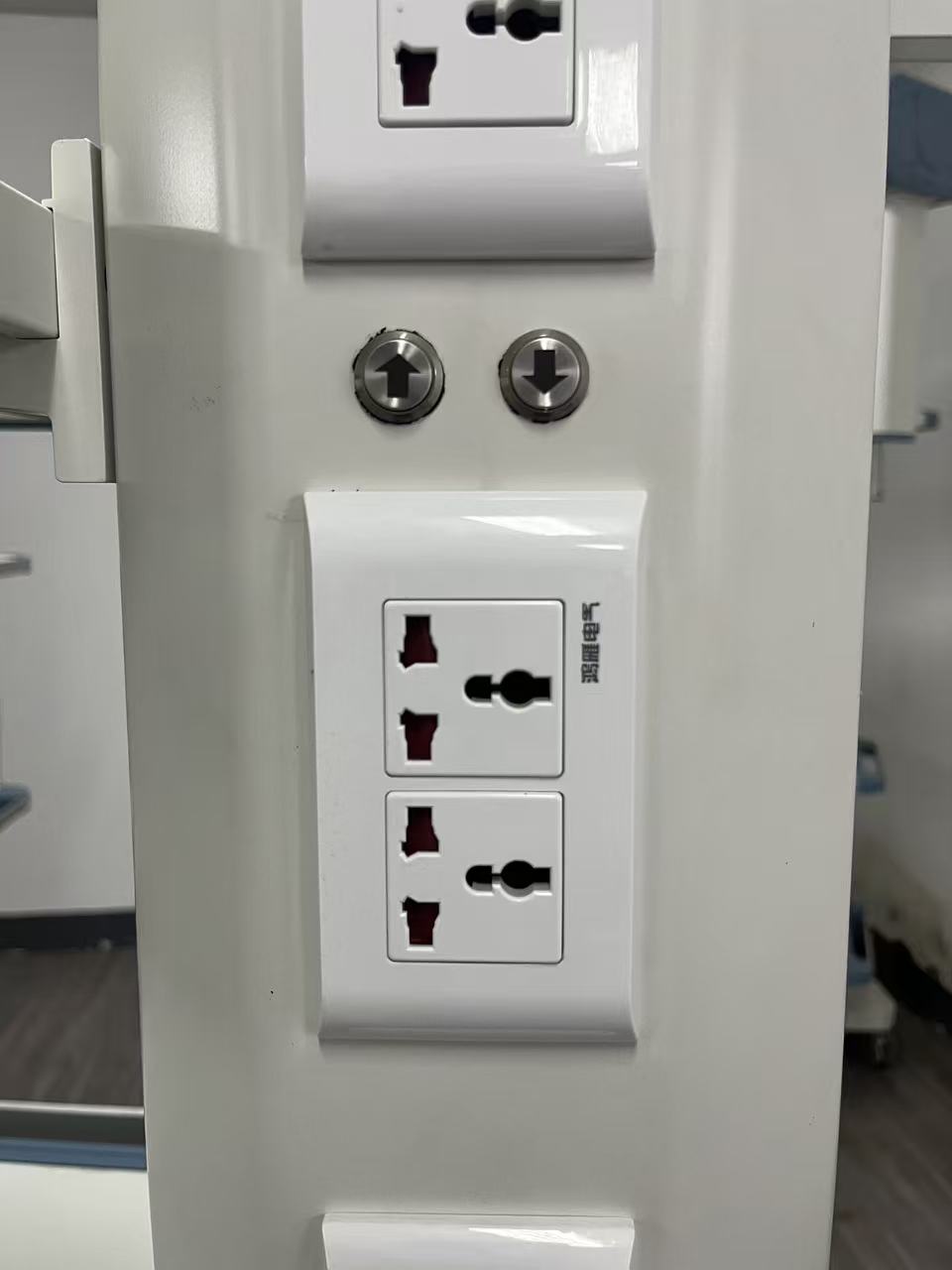
Modern pendants carry far more than gas. The electrical and data configuration often determines whether the pendant can support the department’s actual equipment load without daisy-chaining extension leads — a practice that violates IEC 60601-1 leakage-current limits and creates a fire risk.
A standard OR anaesthesia pendant provides 8 single-phase 230 V sockets (Schuko, BS 1363, or NEMA 5-15 depending on region), 8 equipotential bonding pins, and 4 RJ45 data ports (Cat 6). ICU bridge pendants scale up to 16 sockets and 16 grounding nodes per patient position because each bedside runs a ventilator, two or three infusion pumps, a patient monitor, and sometimes a warming device simultaneously.
Two specification details matter here. First, the sockets should be on an isolated power system (IPS) or medical-grade transformer circuit, not a general building circuit. IEC 60601-1 requires that patient-area electrical supplies limit earth leakage current to 0.5 mA under normal conditions. Second, equipotential bonding pins must connect to the room’s equipotential grounding busbar; without this, touching two devices simultaneously can create a micro-shock path through the patient.
Data ports (RJ45 Cat 6) feed the hospital information system, nurse-call integration, and increasingly, IoT monitoring. Specify at least 2 double RJ45 ports per pendant to allow for future expansion. Some hospitals also request video ports (HD-SDI or HDMI over IP) for endoscopy pendants that feed surgical displays.
Wet-Zone and Dry-Zone Separation in ICU Pendants
ICU bridge pendants divide into two functional zones, and understanding this split is critical for correct configuration. The dry zone carries electronic equipment — ventilators, patient monitors, defibrillators — that must stay away from fluid spills. The wet zone carries infusion pumps, syringe drivers, IV poles, and suction canisters where fluid contact is routine.
In a well-designed bridge pendant, the dry-side shelves measure approximately 430 mm by 480 mm with a minimum load capacity of 40 kg per shelf, and the carrier rotates 180 degrees around its vertical axis so nurses can swing the monitor toward or away from the bed. The wet side integrates infusion pump rails, a quadruple IV pole, and drainage hooks, with a total carrying capacity of at least 110 kg to handle six or more pumps plus fluid bags.
The separation is not merely convenient — it is a safety requirement. Spilled IV fluid reaching a ventilator’s power supply creates an electrical hazard. When reviewing ICU versus OR pendant planning, the wet/dry split is the single biggest layout difference between the two environments. OR pendants do not need it because fluid exposure is managed differently in the surgical field.
For hospitals planning a new ICU, we recommend specifying the wet side with chemical-resistant surfaces (medical-grade ABS or stainless steel with sealed seams) because chlorine-based disinfectants degrade powder-coated steel within a few years of daily wiping.
Accessories and Load Planning
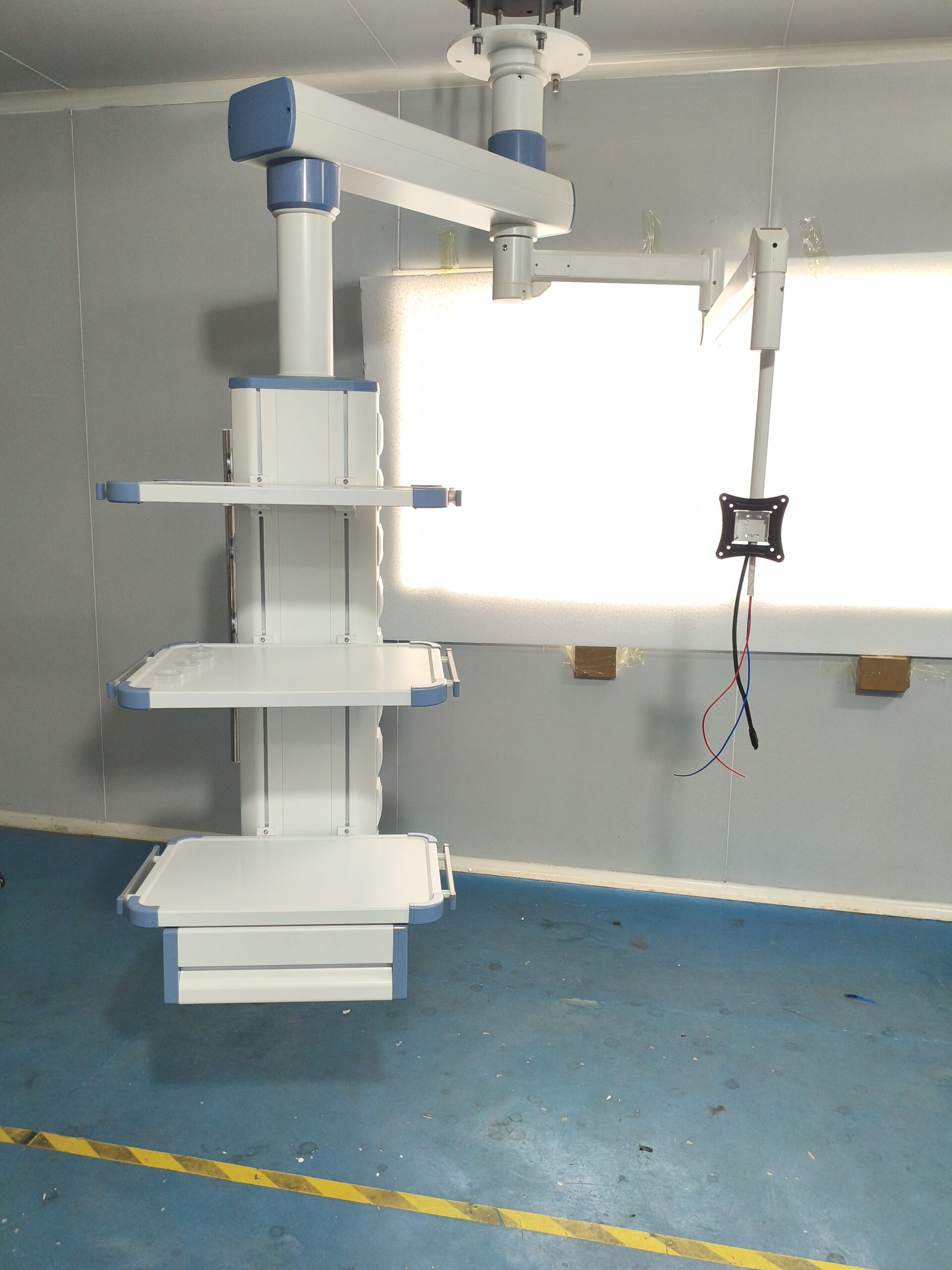
Accessories turn a bare pendant arm into a functional workstation. The available options include equipment shelves (single, double, or triple tier), drawers for consumables, infusion pump brackets, monitor arms, keyboard/writing trays, catheter baskets, suction regulators, flowmeters, and IV poles. Each accessory adds weight, and the total must stay within the arm’s rated payload.
Here is where buyers get into trouble. A motorized pendant arm rated for 115 kg sounds generous until you add up a ventilator (18 kg), two monitors on arms (12 kg), three infusion pumps (9 kg), a suction canister (4 kg), a drawer unit (8 kg), and the shelf hardware itself (15 kg). That is already 66 kg before anyone places surgical instruments, fluid bags, or a defibrillator on the shelf. In our factory, we calculate the full accessory load at the quotation stage and flag when a customer’s wishlist approaches 80 percent of rated capacity — that threshold leaves no margin for future equipment upgrades.
For OR pendants carrying an anaesthesia machine, the machine itself can weigh 80-120 kg. In that case, the pendant must be rated for at least 150 kg net payload, and the ceiling structure must handle the combined static and dynamic load — which can exceed 300 kg when the arm is fully extended and the machine is in motion. Structural engineering sign-off on the ceiling anchor is non-negotiable.
Installation Requirements and Ceiling Coordination
A pendant is only as safe as the ceiling it hangs from. Installation planning must address ceiling height, structural loading, and spatial coordination with other ceiling-mounted equipment.
Standard pendant installations assume a raw concrete ceiling height of up to 4000 mm with a suspended (false) ceiling at approximately 3000 mm. The pendant’s ceiling column passes through the false ceiling and anchors to the structural slab above using heavy-duty chemical anchors or through-bolts. The interface plate at the mounting point carries all supply lines — gas pipes, electrical cables, data conduits — and allows fast disconnection for service.
Ceiling coordination is the step that causes the most on-site conflicts. In a modern OR, the ceiling hosts surgical lights, imaging C-arms, laminar airflow canopies, and sometimes a second pendant. The pendant’s 340-degree rotation arc must not collide with the surgical light’s travel path or the C-arm’s sweep. We provide dimensioned CAD drawings showing the pendant’s full envelope of motion, and we ask every customer to overlay these on their ceiling layout before confirming the order. For detailed guidance on routing cables and hoses within the pendant column, see our article on إدارة كابلات التعليق الطبي.
Long-term reliability also depends on planning for maintenance access. The interface plate should be reachable from above the false ceiling without dismantling the pendant arm. Specify pendants with serviceable gas terminal cartridges and plug-in electrical connectors so that a single technician can replace a worn outlet in under 30 minutes. Our guide on صيانة الملحقات الطبية المعلقة وقطع الغيار covers the recommended service intervals and the spares kit every hospital should stock.
OR vs. ICU Pendant Configuration: Side-by-Side Comparison
The table below summarises the key configuration differences between a typical operating room pendant and an ICU bridge pendant. Use it as a starting checklist when building your specification.
| المعلمة | OR Pendant (Surgical/Anaesthesia) | ICU Bridge Pendant |
|---|---|---|
| Arm type | Single or double motorized arm | Horizontal bridge beam with dual carriers |
| Rotation | 340 degrees (arm + console independent) | 180 degrees per carrier (dry/wet side) |
| Vertical travel | 500-650 mm motorized | Fixed beam height; carriers slide horizontally |
| Typical payload | 150-250 kg (anaesthesia machine + monitors) | 110 kg wet side + 40 kg per dry shelf |
| Gas outlets (per unit) | O2 x2, Air x2, Vac x2, N2O x1, AGSS x1 | O2 x3, Vac x3, Air x3 (per patient) |
| Electrical sockets | 8 x 230 V | 16 x 230 V (per patient) |
| Data ports | 4 x RJ45 Cat 6 | 2 x double RJ45 Cat 6 |
| Key accessories | Monitor arm, instrument shelf, drawer | Infusion pump rails, IV pole, monitor shelf |
| Wet/dry separation | Not required | Essential (fluid vs. electronics safety) |
| Ceiling load point | Single anchor (concentrated) | Two columns (distributed) |
الخاتمة
Configuring a medical pendant is a systems-engineering exercise, not a catalogue shopping trip. The arm geometry must match the room’s clinical workflow. The gas outlets must follow the hospital’s existing pipeline standard to the letter. The electrical capacity must accommodate every device the department runs today — plus the ones arriving next year. And the ceiling structure must bear the full dynamic load without deflection.
النقاط الرئيسية:
- Start from the department workflow (OR vs. ICU vs. endoscopy) before selecting arm type, gas count, or accessories. The clinical use case drives every downstream decision.
- Confirm the gas terminal standard (DIN, BS, AFNOR, or other) against the hospital’s central gas plant at the purchase-order stage. Retrofitting wrong-standard outlets costs months of delay.
- Calculate total accessory load at quotation time and keep it under 80 percent of the arm’s rated payload to preserve margin for future equipment.
- Coordinate the pendant’s rotation envelope with surgical lights, C-arms, and laminar airflow units using dimensioned CAD overlays before confirming installation.
If you are planning a new department or upgrading existing pendants, our engineering team can review your ceiling drawings and equipment list to produce a configuration proposal with load calculations and gas-terminal verification. Explore our medical pendant range or request a project-specific quotation — we respond within one business day.
الأسئلة المتكررة
هل يمكنني خلط معايير مخارج الغاز في وحدة معلّقة واحدة؟
Technically yes, but we strongly advise against it. Mixed standards create adapter joints that add leak paths and complicate maintenance. Specify one standard matching your hospital’s pipeline throughout.
ما هو ارتفاع السقف المطلوب للمصباح المعلق المزود بمحرك؟
تفترض التركيبات القياسية سقفًا إنشائيًا يصل إلى 4000 مم مع سقف مستعار حوالي 3000 مم. تتطلب الأسقف المنخفضة عمودًا مختصرًا؛ تأكد من الخلوص الأدنى مع الشركة المصنعة.
كم مرة يجب صيانة المكابح المعلقة؟
تحتاج المكابح الاحتكاكية الميكانيكية إلى فحص كل 6 أشهر في غرف العمليات عالية الاستخدام. أما المكابح الهوائية والكهربائية فهي في الغالب خالية من التآكل، ولكن ينبغي اختبارها سنويًا أثناء الصيانة الوقائية.
ما الفرق بين الذراع الزنبركية والذراع الحركية؟
يستخدم الذراع الزنبركي نوابض ميكانيكية لضبط الارتفاع ويتطلب إعادة معايرة من الفني عند تغير الحمل. يستخدم الذراع الكهربائي محركًا كهربائيًا لتحديد الموضع بدقة بضغطة زر بغض النظر عن الحمل.
Do pendants require separate electrical certification?
Yes. The pendant’s electrical system must comply with IEC 60601-1 for medical electrical equipment. Request the manufacturer’s type-test report and confirm the sockets are on an isolated power system.
قد يعجبك أيضًا...

Gas Outlet Colour Coding and Pin Index: What Medical Equipment Importers Must Check
Medical gas systems are built on a simple principle: it must be impossible to connect...

Blood Donation Chairs: Specifying Seating for Donor Safety and Compliance
Blood establishments face a seating problem that ordinary furniture cannot solve: donors sit for 15...

Veterinary Grooming Tables: What Pet-Care Chains Should Spec
Pet grooming chains are scaling faster than their equipment sourcing, and the grooming table at...