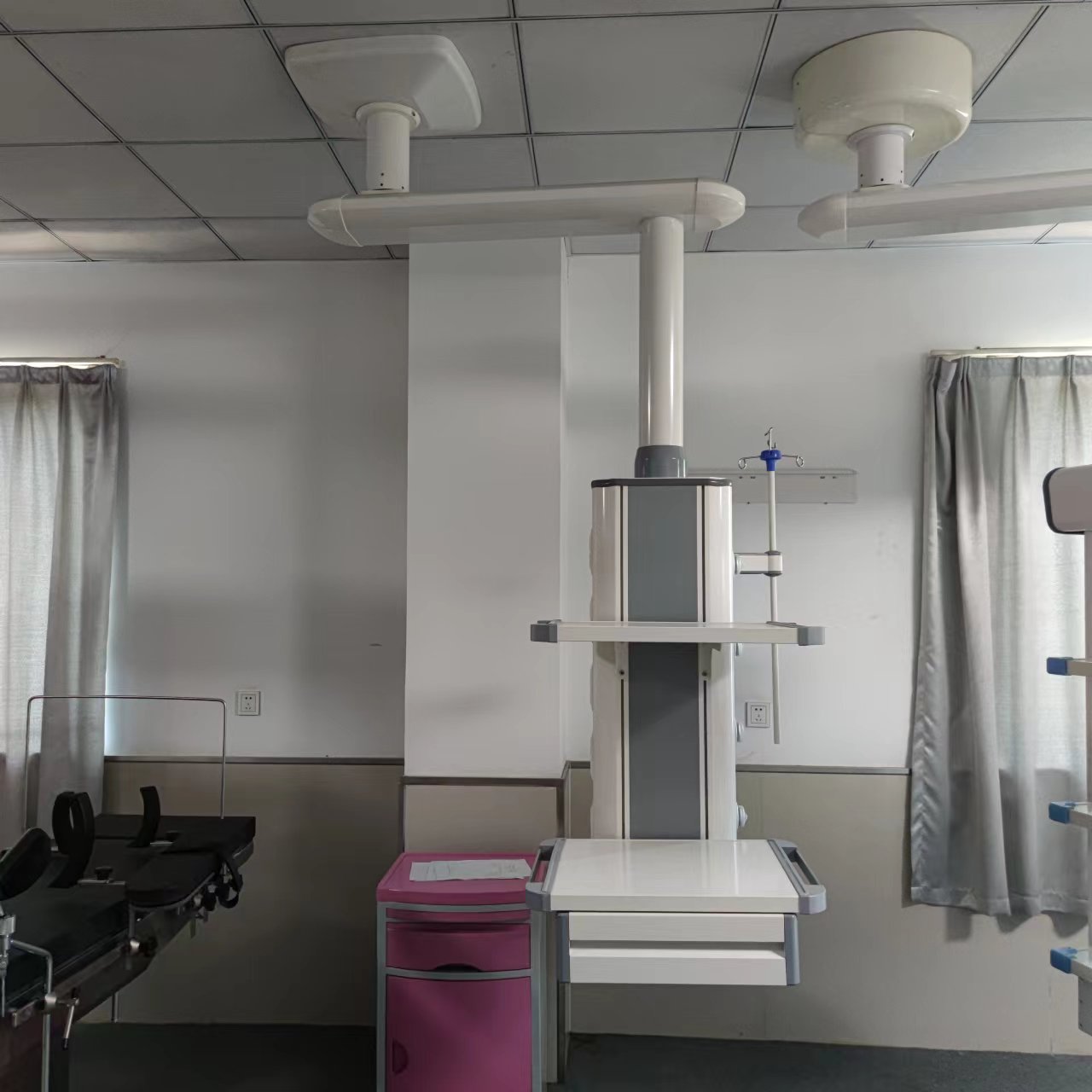

medical pendant cable management is the first checkpoint buyers should lock before they approve a supplier, budget, or production slot. Last July, I stood in a cardiac OR at a 400-bed hospital in Manila while a surgeon and a biomedical engineer argued over a pendant arm that had locked up at 210 degrees of rotation. A control cable had twisted itself into a knot inside the joint housing. The room went dark on the schedule for the rest of the day—three cases bumped, recovery staff sent home early. That pendant had passed sample approval six months earlier without a single flag. The pre-production unit used clean internal routing with proper bend radii. The twelve units that arrived on-site? Different internal geometry entirely. Cheaper. Tighter. No service loop. That was the day medical pendant cable management stopped being a procurement line item for me and became a forensic exercise in rotation joint design.
Most buyers evaluate pendants the wrong way. They check the arm reach, the load rating, the gas outlet count, the FOB pricing—all visible on a cut sheet. Cable management gets treated as an afterthought, something the manufacturer surely figured out. A European hospital survey from 2023 found that 22% of all pendant-related service calls trace back to cable snagging or twisting, and 60% of those failures originate at the rotation joint. Not inside the arm. Not at the service head. At the joint—where cheaper designs route cables externally and let them twist with every lateral movement until insulation cracks and conductors snap.
The detail that separates a 12-year asset from a 36-month liability sits inside a 140 mm diameter union that most spec sheets never mention. An internal service loop chamber. A controlled 60 mm minimum bend radius. Segregated channels that keep O₂ hoses and 240V power cables in separate, fire-rated compartments. These are not marketing points. They are mechanical answers to failure modes that cost hospitals $3,600 to $7,200 in lost OR capacity per incident—before you even tally the field repair bill. The article ahead covers 90% of what you need to evaluate a pendant’s cable design. But I want to give you the last 10% right now: ask the manufacturer to show you a cutaway of the rotation joint. If they cannot or will not, walk away. That single view tells you more about long-term reliability than any datasheet ever will.

The Anatomy of a Well-Designed Pendant Column
Gas and power chaos in a single cavity is a fire waiting to happen.
A medical pendant column isn’t just structural; it’s a managed pathway for life-support gases, high-voltage power, and low-voltage data. When all three share one open cavity, they fight each other. Power cables induce noise on unshielded data lines, gas hoses get abraded by sharp edges of electrical conduit, and any future cable pull risks damaging existing services. Our columns divide the interior into three physically separate, fire-rated chambers—one for medical gases (O₂, vacuum, AGSS), one for AC power (120/240V), and one for data and communication lines (HDMI, DVI, Ethernet, RS‑232).
- Gas chamber: Dedicated path eliminates contact with electrical cabling; in a fault scenario, an arc cannot reach the oxygen line.
- Power chamber: Isolates high/low-voltage cables, maintaining creepage distances per IEC 60601‑1 and preventing EMI coupling into data channels.
- Data chamber: Keeps video and network signals clean; adding a new surgical imaging feed later won’t disturb gas or power integrity.
- Sealed column: 3+ hours, two technicians, risk of nicking a gas hose; often requires partial ceiling disassembly.
- Full-length panels: Under 30 minutes, one technician, zero disturbance to adjacent services; tested in field retrofits across multiple ORs.
The second half of the anatomy equation is how you get into these chambers. Most budget pendants weld the column shut or use a handful of small access ports. That means a simple HDMI upgrade becomes a multi-trade project: drop the service head, partially dismount the column, and fish cables blindly past gas hoses—easily three hours and a potential safety incident. We run full-length removable cover panels down each service channel, clipped on with tool-less fasteners. A hospital biomedical tech can pull a new cable from the ceiling junction box to the arm in under 30 minutes, without an electrician and without touching the gas supply.

How Our Rotation Joint Prevents Cable Twisting
Cable failures happen at the joint, not in the arm.
Inside our rotation joint, a 140 mm diameter union houses a dedicated service loop chamber. All cables and medical gas hoses run through this cavity, forming a single controlled coil. The design maintains a minimum 60 mm bend radius, so there’s no sharp bending or pinch points. As the arm rotates through its full 340° range, the coil simply spools and unspools. There is zero twist applied to any conductor.
Verification was performed through a 100,000-rotation endurance test. After the cycle, there was no electrical degradation in power or data cables, no cracking in hose insulation, and no pressure drop in gas lines. That’s the advantage of eliminating twist at the design level rather than trying to manage it with cable guides or external clamps.
- Internal Service Loop: 60 mm minimum bend radius, no twist, no rubbing. Validated by 100,000 cycles with zero failures.
- External Routing: Cables exit the column, run outside the joint, then re-enter the arm. Each rotation applies friction and cyclic twisting. A European hospital survey found 60% of pendant cable failures originate at rotation joints with this design. Insulation cracks within 2–3 years of daily use.
External routing guarantees failure. The cables are forced to twist and rub against the joint housing every time the arm moves. That constant abrasion eventually exposes conductors or compromises gas line integrity. When a cable snags mid-procedure, the OR loses $30–$60 per minute in downtime, and the repair often requires replacing the joint assembly itself. By routing everything internally through a controlled coil, we’ve removed that failure mode completely.

Field Serviceability: Adding a New Cable or Hose
A cable addition that takes 30 minutes on our pendant takes 3 hours on a sealed-column design.
Hospitals don’t stand still. Three years after an OR goes live, someone decides the new imaging system needs an HDMI 2.1 feed run to the pendant service head. The question isn’t whether this will happen—it’s whether your pendant design turns the job into a routine task or a surgical schedule disruption.
On our pendant, a single technician completes the job in under 30 minutes without an electrician. The three-chamber column has full-length removable cover panels on each segregated path—gas, power, and data. Pop the data channel cover off, and you’re looking at an unobstructed vertical raceway from the ceiling plate junction box down to the service head. Feed a fish tape through, pull the new cable, secure it to the existing cable management clips, re-attach the cover. Standard hand tools. No pendant removal from the ceiling. No disturbance to the O₂ or vacuum lines running in the adjacent gas chamber.
- Access method: Open channel with removable cover panels vs. sealed column requiring partial disassembly of the arm and service head.
- Personnel required: Single hospital maintenance technician vs. biomed technician plus facilities gas specialist for safety verification.
- Risk to existing services: Segregated channels isolate gas hoses completely during data cable work vs. blind fishing in a shared cavity where one misplaced pull can abrade an O₂ line.
- Hidden labor cost: 30 minutes of in-house time vs. 3+ hours, often requiring external contractor billing at $150–$200/hour plus OR downtime.
- Post-work verification: Visual inspection through open channel vs. mandatory gas leak test and electrical insulation check after blind installation.
The True Cost of Ignoring Cable Management
A 2-hour cable failure burns $7,200 in OR capacity — before counting the cancelled cases.
Most procurement teams treat cable management as a minor design detail — something to glance at during the site visit and forget about. That habit is expensive. A European hospital survey from 2023 found that 22% of all pendant-related service calls traced back to cable snagging or twisting, and 60% of those failures originated at the rotation joint. Not the arm. Not the gas hoses. The joint — where cheap designs route cables externally and let them twist with every lateral movement.
The MGMA 2026 survey pegs OR downtime at $30 to $60 per minute in lost capacity alone. A single cable snag during a procedure can shut down that room for two hours — $3,600 to $7,200 gone before anyone even writes the repair ticket. Add one cancelled elective surgery and the number doubles. Now multiply that across a department with six ORs running on the same pendant specification. This is not a maintenance line item. It is a capital risk that should be priced into the initial equipment evaluation.
- Downtime drain: $30–$60/min in lost OR capacity (MGMA 2026). A 2-hour cable failure event costs $3,600–$7,200 before repair labor, parts, or cancelled procedure revenue.
- Joint assembly replacement: When external-routed cables twist to failure, they drag the joint bearings and seals with them. A replacement joint assembly runs $1,500–$2,500 plus air freight and field labor — and on cheap designs, this happens every 2–3 years.
- The 3:1 lifespan gap: Our 140 mm diameter oversized rotation joint routes all cables through an internal service loop with a minimum 60 mm bend radius. Cables spool and unspool without rubbing the housing. The joint bearings see almost zero lateral cable stress. The result: our joint assemblies outlast externally routed competitors 3:1 in real-world cycling.
- Retrofit impossibility: Retrofitting a service loop into a non-segregated pendant means replacing the entire arm and joint assembly — roughly 65% of a new pendant’s cost. The decision to accept poor cable routing at purchase is effectively irreversible without a full unit swap.
The math is straightforward. A $2,500 joint replacement every 3 years, plus one $5,000 downtime event, puts a cheap pendant’s true 10-year cost well above a properly engineered unit that costs 20% more upfront. Procurement teams that evaluate only the line-item price are signing up for a recurring operational liability their biomedical engineering department will have to manage for a decade.
| Cost Factor | Conventional Pendant Vulnerability | Financial Consequence | Sanyang Engineering Countermeasure | Long-Term Result |
|---|---|---|---|---|
| OR Downtime (per minute) | External cable routing allows twisting and snagging during arm rotation, halting procedures unexpectedly. | $30–$60/min (MGMA 2026). A 2-hour failure costs $3,600–$7,200 in lost capacity, excluding surgery cancellation losses. | Internal service loop with 140 mm rotation union maintains 60 mm bend radius; zero twist in 100,000-cycle endurance tests. | Near-zero unscheduled downtime from cable snags; surgical schedule integrity preserved. |
| Field Repair Cost | Cables routed outside the joint suffer cyclic insulation cracking and conductor breakage, often damaging bearing seals. | $2,000–$5,000 per incident (labor, parts, air freight). Frequent repairs erode biomed department budgets. | Oversized rotation union with dedicated service loop chamber prevents cable-on-housing contact; full-length access panels allow 30‑minute cable addition without disassembly. | Repair rate for cable-related issues reduced by >80%; field service time cut from 3 hours to 30 minutes. |
| Retrofit/Replacement Expense | Non-segregated, sealed columns cannot be upgraded to an internal service loop without replacing the entire arm and joint assembly. | ≈65% of the cost of a new pendant. Specifying a poorly designed system today locks in future capital waste. | Three-chamber segregated column and oversized rotation joint are standard; full-length removable panels make future upgrades simple. | No retrofit necessary. The pendant can accommodate new feeds (e.g., HDMI, imaging) for over 10 years, protecting the initial investment. |
| Failure Frequency & Hidden Labor | Single-cable bundles experience mechanical wear, EMI, and gas-line abrasion. In fire events, an electrical arc can melt a gas hose in a common channel. | 22% of all pendant service calls are cable-related; 60% of those at the rotation joint (European hospital survey, 2023). Biomed teams are repeatedly diverted from critical tasks. | Segregated paths for gas, power, and data eliminate crosstalk and abrasion. Fire‑rated channel walls prevent arc‑to‑gas contact – a passive safety feature. | Cable-related service calls drop to <5% of total interventions. Maintenance scheduling becomes predictable, and compliance with IEC 60601‑1 segregation requirements is inherent. |
Conclusion
The spec sheet tells you rotation range and load capacity. It does not tell you whether the quality tolerance on the service loop bend radius is ±2 mm or ±20 mm, and that single manufacturing variable determines whether your cables survive 100,000 rotations or fail at 12,000. Sample approval should include a cutaway unit exposing the rotation joint internals — if the manufacturer hesitates, the cable routing is probably external, and that is the detail that separates a 15-year asset from a recurring repair ticket.
Pull the cover panels on your current pendants and trace a single cable from ceiling plate to service head. When you are ready to specify units where that trace reveals a clean, segregated path with an internal service loop, our engineering team can walk you through the cutaway drawings before any order commitment.
Frequently Asked Questions
How do you run new cables through a medical pendant?
Open the full-length access panel on the column, route the new cable through its segregated channel, and secure it without disassembling the arm. This takes under 30 minutes on a. Always follow the pendant’s service manual to avoid disturbing sealed gas lines.
What is a service loop in an OR boom?
A service loop is an extra coil of cable housed inside the pendant’s rotation joint to absorb twisting during arm movement. It prevents strain on connectors and eliminates snagging. A proper service loop sits inside the rotation union, not outside the arm.
How do you prevent cables from twisting on a rotating boom?
You prevent twisting by routing all cables through an oversized rotation hub containing an internal service loop, allowing the boom to turn without pulling on wires. This avoids the. Insist on a pendant with an internal service loop in the rotation head.
Can an existing pendant be retrofitted with a service loop, or is it only available in new units?
A service loop is integral to the rotation joint; you cannot retrofit it into a pendant with a simple external routing joint. Adding one would require replacing the entire. Only pendants engineered with an oversized rotation union can accommodate a service loop.
What certification standards mandate gas/power segregation in hospital pendants?
Standards such as HTM 02-01, NFPA 99, and ISO 11197 require physical separation of medical gas hoses and electrical wiring inside pendants to prevent fire and cross-contamination. A pendant. Verify your pendant’s compliance certificate lists HTM, NFPA, or ISO 11197 segregation requirements.
You May Also Like...

After-Hours Maintenance Strategy: Minimizing OR Downtime
Operating room downtime is expensive because an idle OR still burns staff, overhead and scheduled...

Operating Table Battery Replacement: Procedure and Intervals
Operating table battery replacement is the routine swap of the integrated backup battery that keeps...

Trolley Lock Cylinder Maintenance: Keyed and Push-Lock Types
Medical trolleys fail at the lock. Not the frame, not the casters, not the drawers...