


Executive Summary
Medical pendant vs tower boom explained: structural differences, coverage radius, load capacity, installation conditions, and a department-by-department procurement framework for OR and ICU.
Walk into any modern operating room or intensive care unit and look up. Chances are the most important utilities—medical gases, electricity, data, and equipment support—arrive at the bedside from the ceiling rather than the floor. The trouble is that buyers, project engineers, and even some distributors use the words “pendant,” “tower,” and “boom” interchangeably, then specify the wrong system for the room. I have sat through procurement meetings where a hospital asked for a “tower boom” and three vendors quoted three completely different structures. The result was a six-week delay while everyone re-aligned on what the room actually needed. If you are searching for a clear answer to medical pendant vs tower boom, you are not alone—and the wrong choice here is expensive to reverse once the ceiling is poured.
The honest truth is that pendant, tower, and boom are not three unrelated products. They are three structural expressions of the same idea: bringing utilities to the point of care from overhead, keeping the floor clear for staff, trolleys, and cleaning. The differences are real, though, and they matter for coverage radius, load capacity, ceiling load-bearing, and which department the unit serves. In our work supplying medical pendant systems for operating rooms and ICUs across more than 15 countries, the most common specification mistake is matching the structure to a catalogue name rather than to the room’s clinical workflow. This guide breaks down the structural differences, the coverage and load trade-offs, the installation realities, and a department-by-department decision framework so you can specify with confidence.
One note on terminology before we go further. In everyday hospital language, “medical pendant” and “ceiling supply unit” are often synonyms, while “tower” usually means a rigid vertical column and “boom” a long horizontal articulated arm. Manufacturers do not always draw these lines the same way, which is exactly why a written functional specification beats a product label every time.
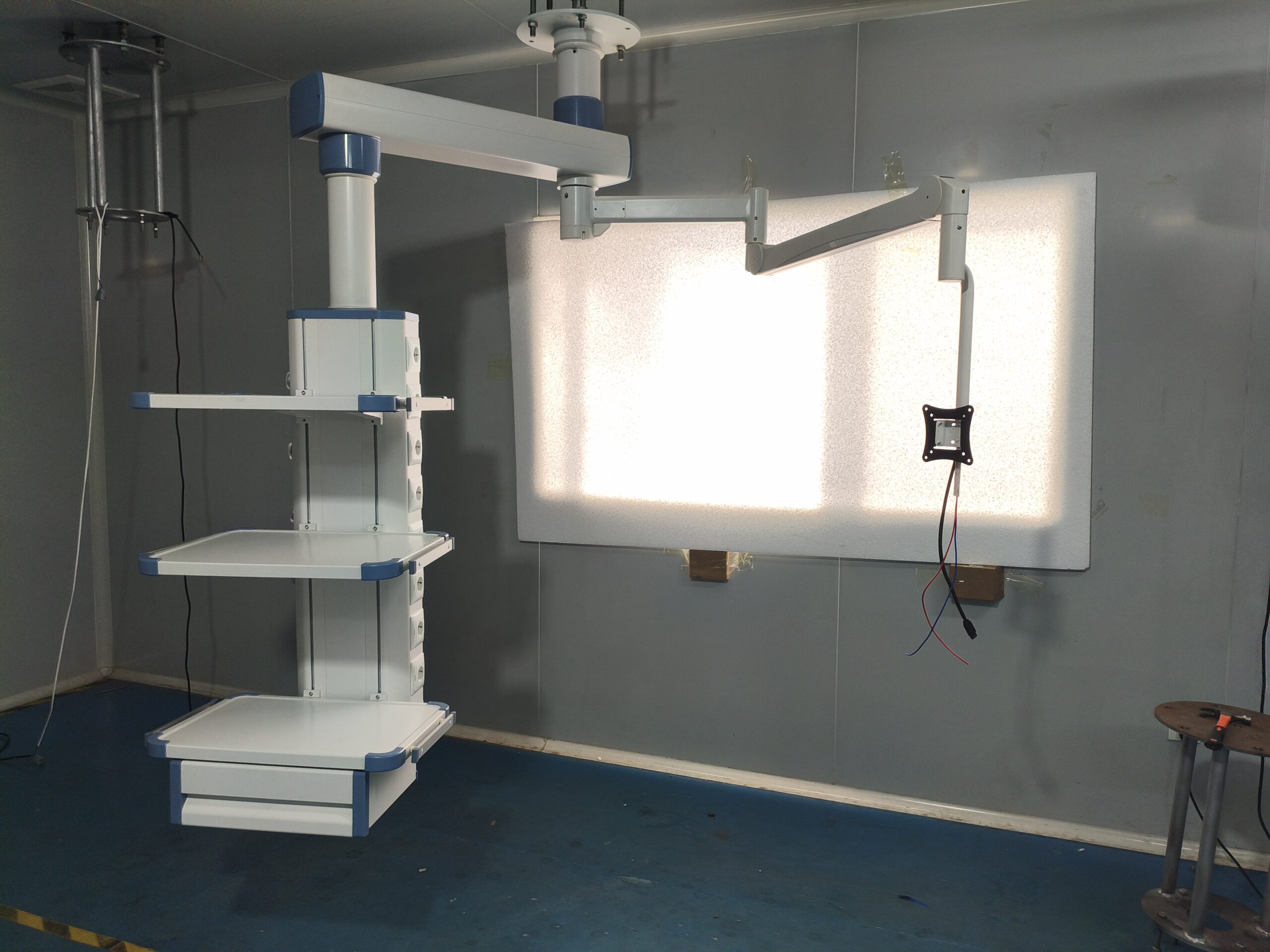
What Are Pendants, Towers, and Booms, Really?
All three systems solve the same core problem: deliver medical gases (oxygen, medical air, vacuum, nitrous oxide, and sometimes CO2 or nitrogen), electrical power, network data, and equipment mounting to a defined zone around a bed or table—without cables and hoses trailing across the floor. Floor clutter is not just untidy; it is a trip hazard, an infection-control headache, and a barrier to rapid repositioning in an emergency. Moving those services overhead addresses all three at once, which is why ceiling supply units have become standard in new-build theatres and critical care areas.
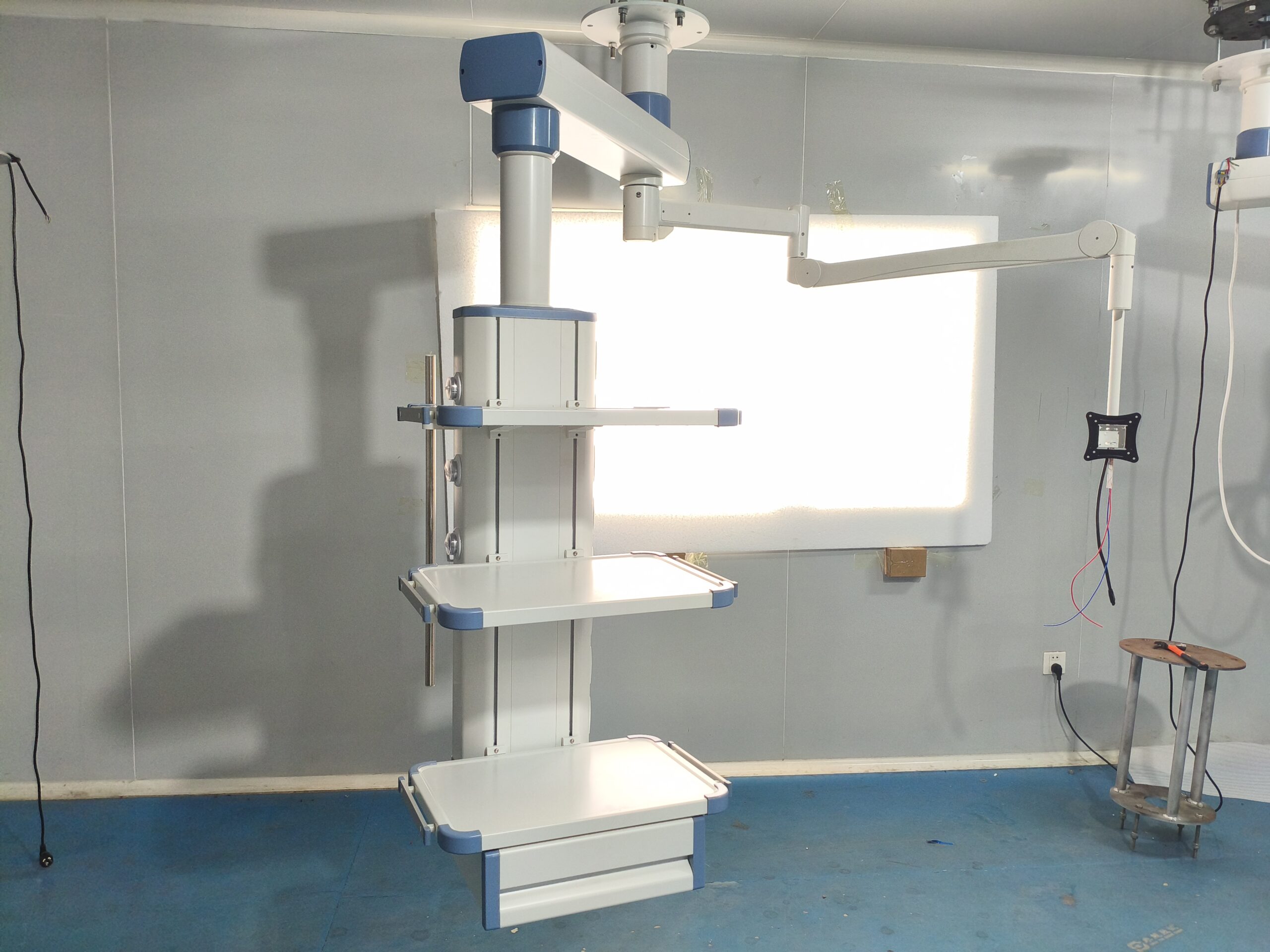
- Medical pendant (ceiling supply unit): The umbrella term. A pendant is any ceiling-suspended carrier of utilities and equipment. It can be rigid (fixed), single-articulated (one rotating arm), or double-articulated (two arms for extended reach). In an OR you will typically see a surgical pendant positioned over the anaesthetic work area and another over the surgical field.
- Tower (rigid column): A fixed vertical structure that drops utilities straight down from the ceiling to a defined point. It does not swing. Towers are common where the equipment position never changes—above a fixed imaging system, a steriliser, or a wall-mounted workstation. The advantage is rigidity and zero drift; the limitation is zero reach.
- Boom (articulated arm): A long horizontal arm, often double-articulated, that swings equipment across a wide arc. Booms dominate the operating room because the anaesthetist and the surgical team need to reposition monitors, infusion pumps, and gas outlets around the table as the procedure changes. A boom is, in effect, a pendant with an emphasis on reach and movement.
So when a buyer asks “medical pendant vs tower boom,” the practical question is usually: do I need a fixed drop (tower), a moderate articulated reach (single-arm pendant), or a long sweeping reach (double-arm boom)? Answering that means looking at four engineering variables: structure, coverage, load, and installation. We will take each in turn.
Names vary by manufacturer; physics does not. Always specify the coverage radius, the working load, and the number of articulation points in writing—then let the vendor propose the structure that meets those numbers.
Structural Differences: How the Three Systems Are Built
The structural design dictates everything downstream—how far the unit reaches, how much it can carry, how it behaves under load, and what the ceiling has to support. Understanding the build of each system is the fastest way to avoid over- or under-specifying.
A rigid tower is essentially a fixed column suspended from a ceiling mounting plate. It has no rotating joints, which means no friction brakes to maintain and no risk of positional drift over time. Because the load path runs straight down through the column into the ceiling anchor, towers handle vertical loads very efficiently. The trade-off is that the service point sits exactly where the column ends; if the bed moves even 30 centimetres, the gas outlets and power sockets no longer align. Towers suit static equipment positions, not dynamic clinical zones.
A single-arm pendant adds one rotating joint—usually a vertical rotation at the ceiling mount plus a horizontal pivot at the arm. This gives a defined coverage radius, typically enough to swing a monitor or a small equipment tray across one bed position. Single-arm units are the workhorse of general wards, recovery areas, and smaller procedure rooms where equipment does not need to travel far.
A double-arm boom adds a second articulation point, effectively creating an elbow. This roughly doubles the usable reach and lets the user pull equipment in close, push it away, and swing it laterally around the table. In a busy operating theatre, that freedom is essential: the anaesthetic pendant must clear the C-arm, the surgical team, and the instrument trolley while still keeping gas outlets and screens within arm’s reach. The cost of that freedom is mechanical complexity—more joints, more friction brakes, and a larger ceiling footprint to absorb the off-axis loads.

One structural detail buyers routinely overlook is the brake and locking system. Every articulated joint needs a reliable brake to hold position once the user lets go. Cheap friction brakes creep under sustained load—a monitor arm that slowly sags over a shift signals underspecified brakes. Higher-end systems use mechanical or gas-spring locking with defined holding torque. When you compare quotes, ask specifically about the brake type on each joint and its rated holding torque, not just the headline load capacity.
Coverage Range and Positioning Flexibility
Coverage is the most visible difference between the three systems, and it is the one clinicians feel immediately. Coverage is best described as a working radius—the horizontal distance the service point can travel from the ceiling anchor—combined with the vertical adjustment range and the rotation angle.
A rigid tower has effectively zero horizontal coverage: the service point is fixed. A single-arm pendant typically covers a radius in the range of one arm’s length, enough to serve one bed or one side of a table. A double-arm boom extends that reach substantially and, crucially, lets the user position equipment on either side of the patient and then retract it completely out of the way. That retract-and-reposition behaviour is what makes booms indispensable in theatres, where the room has to be reconfigured between a laparoscopic case, an open procedure, and an imaging run within minutes.
- Fixed tower: Best when the equipment position is permanent. Zero repositioning, maximum rigidity, minimum maintenance.
- Single-arm pendant: Best for one-bed zones where equipment moves occasionally—recovery bays, general wards, dialysis, and minor procedure rooms.
- Double-arm boom: Best for high-acuity, multi-team zones where equipment must sweep around the patient—operating theatres, ICU bays, and hybrid rooms.
Do not confuse maximum reach with useful reach. A long boom that can technically extend two metres is only as good as its ability to hold a loaded monitor steady at full extension. The further the load sits from the ceiling anchor, the greater the overturning moment and the more the arm deflects. This is why coverage and load capacity must be evaluated together—a point we return to next. For a deeper look at positioning zones around the bed, our guide on ICU versus OR medical pendant planning walks through the layout logic room by room.
Specify the coverage you actually use, not the maximum the catalogue boasts. A boom sized for a 1.8-metre working radius that is only ever used at 0.8 metres is over-engineered, over-priced, and puts needless stress on the ceiling anchor.
Load Capacity: What Each System Can Really Carry
Load capacity is where specification errors become safety issues. Every pendant, tower, and boom has a rated working load—the maximum weight of equipment (monitors, infusion pumps, ventilators, gas outlets, cable management, and trays) it can safely support, usually stated for both the static case and the fully extended case. These two numbers can differ significantly, because extending a load away from the column multiplies the bending moment at every joint and at the ceiling fixing.
| System Type | Typical Coverage Radius | Typical Working Load | Articulation | Best-Fit Environment |
|---|---|---|---|---|
| Rigid tower / fixed column | Fixed point (no horizontal travel) | High; load path is vertical | None | Static equipment, imaging, fixed workstations |
| Single-arm pendant | Moderate (one arm length) | Medium; derates slightly at extension | One rotating joint | Wards, recovery, dialysis, minor procedures |
| Double-arm boom (surgical / ICU) | Large (sweeps around the patient) | Medium; derates significantly at full reach | Two articulation points | Operating theatres, ICU, NICU, hybrid rooms |
Two practical load considerations come up on almost every project. First, account for the full equipment package, not just the monitor: a modern ICU pendant might carry two monitors, a ventilator, multiple pumps, a defibrillator tray, gas outlets, and a nurse-call interface, reaching its design load faster than buyers expect. Second, plan for growth—hospitals rarely remove equipment from a pendant, they add to it—so specifying headroom above today’s load avoids a costly structural retrofit later.
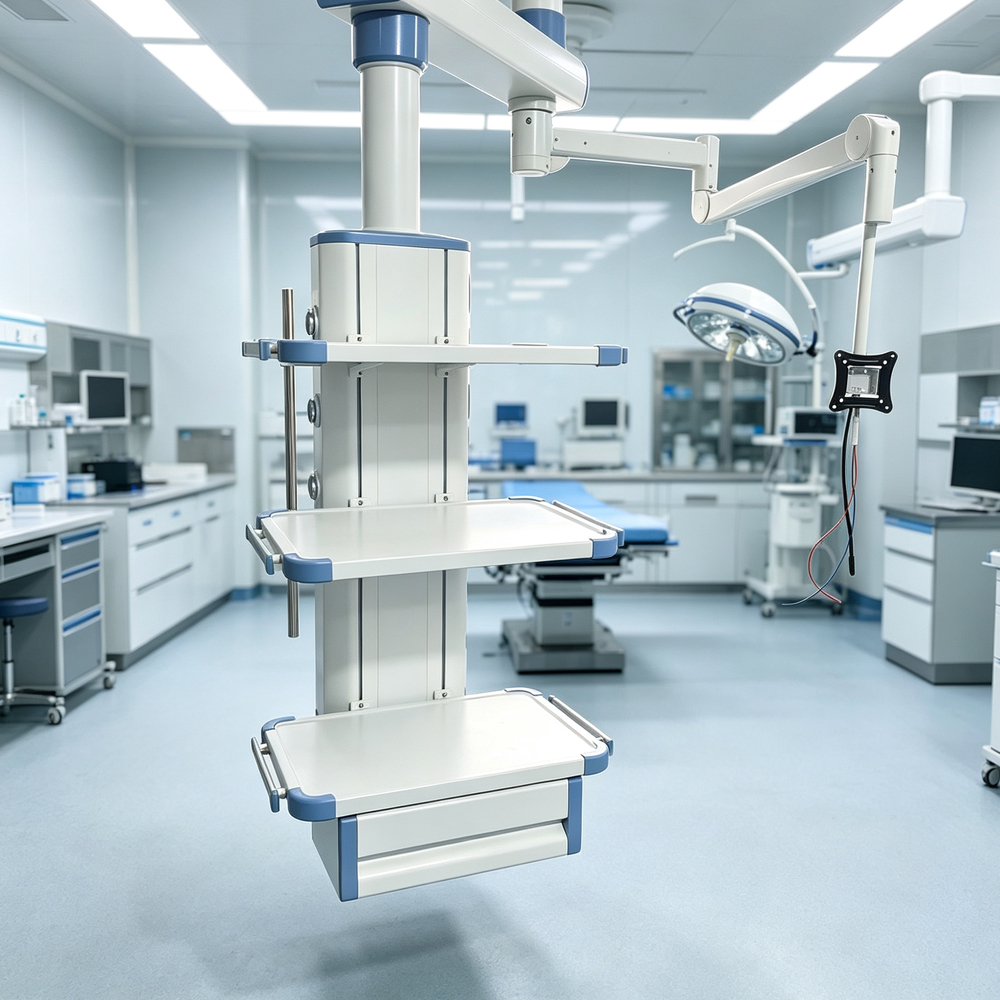
From a compliance standpoint, ceiling supply units that carry electrical medical equipment fall under the IEC 60601 family of safety standards, and the manufacturer’s quality system should be certified to ISO 13485. Medical gas delivery is governed separately—many projects reference HTM 02-01 (the UK Health Technical Memorandum on medical gas pipeline systems) or the equivalent national standard. Ask any prospective supplier for test evidence against these frameworks rather than accepting a self-declared datasheet. A reputable factory will provide it without hesitation.
Installation Conditions and Ceiling Requirements
Here is the part of the decision that surprises buyers most often: the ceiling, not the pendant, is frequently the limiting factor. A ceiling supply unit transfers its own weight plus the full equipment load—plus dynamic forces from being swung around—into the building structure. The ceiling must be designed to take that load, and the fixing method depends entirely on what is above the ceiling tile.
There are three common mounting scenarios. The first is a direct fix to a concrete slab, which is the strongest and simplest case: anchor bolts go straight into the structural deck. The second is a steel support frame or spreader beam built into the ceiling void, used when the slab is too thin, post-tensioned, or otherwise unsuitable for direct anchoring. The third—and the one that causes the most retrofit headaches—is a lightweight suspended ceiling with no structural support above it. In that case, an independent support structure has to be introduced, which adds cost and coordination with the building contractor.
- Confirm the slab type early: Concrete thickness, grade, and whether it is post-tensioned all determine the anchor specification. Post-tensioned slabs cannot be drilled freely—hitting a tendon is a serious structural risk.
- Coordinate the gas and electrical risers: The pendant is only as useful as the services feeding it. The medical gas pipeline outlets and the electrical/data drops have to be routed to the ceiling anchor point during construction, not after.
- Allow for dynamic load: An articulated boom in motion imposes higher peak forces than a static load. The fixing design should account for movement, not just weight.
- Plan the ceiling void depth: Double-arm booms and their mounting hardware need more vertical space than a slim rigid tower. Verify the void depth before ordering.
This is also where new-build and retrofit projects diverge sharply. In a new-build operating suite, the structural engineer can cast in the support points and route the services exactly where the pendants hang—clean, strong, and cost-effective. In a retrofit, you are constrained by the existing structure, and the pendant choice may be dictated by what the ceiling can take rather than what clinicians ideally want. We always recommend a structural survey before finalising the specification on a retrofit; it is far cheaper than discovering a load limitation after the units are fabricated. If you are fitting out a whole department, a turnkey operating room solution bundles the pendants, lights, tables, and services coordination into one engineered scope, removing much of the interface risk between trades.
Department Fit: Matching the System to the Room
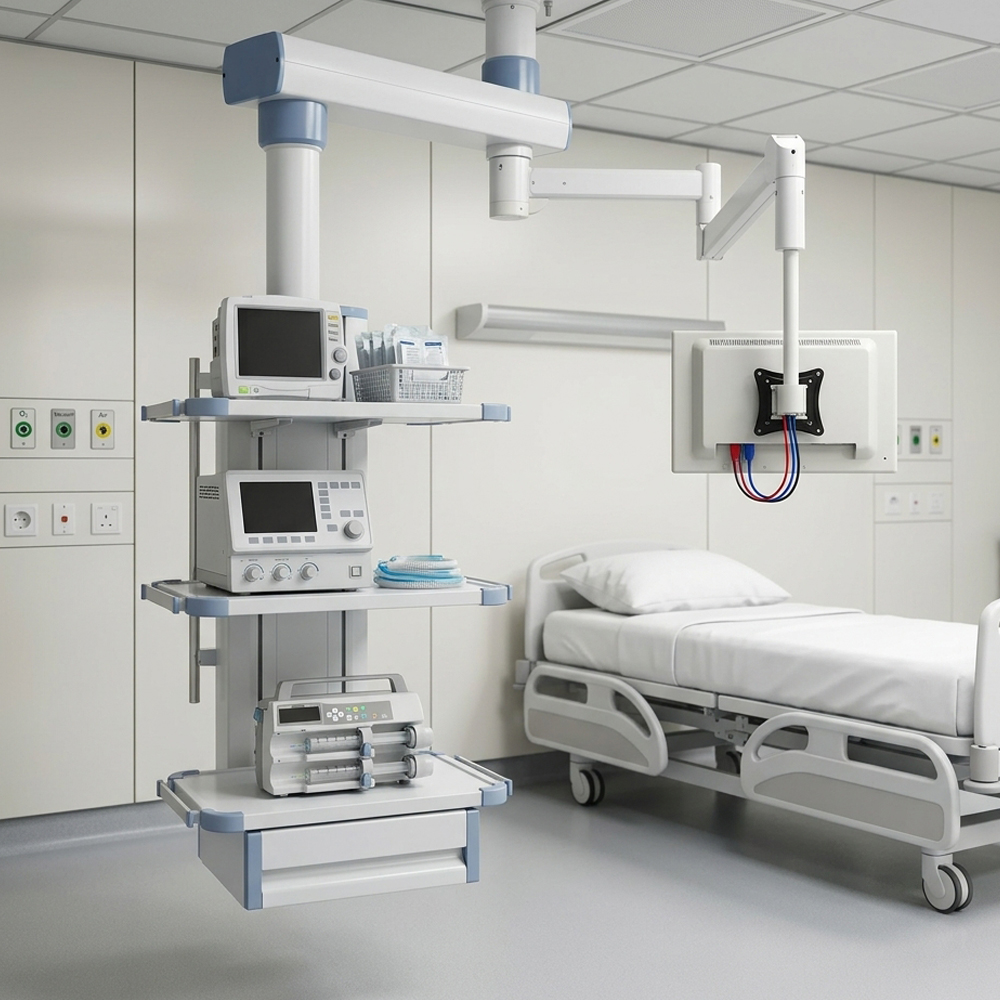
The right answer to medical pendant vs tower boom depends less on the product label and more on the clinical workflow of the specific department. The same hospital will typically use all three structures in different rooms. Here is how the decision tends to fall in practice.
Operating theatres favour double-arm booms. The anaesthetic pendant needs to position gas outlets, a ventilator, monitors, and infusion pumps around the head of the table and then retract for imaging. A second surgical pendant often carries the electrosurgical unit, suction, and a screen over the field. The constant repositioning makes the long reach and multi-joint movement of a boom essential. Pairing the pendant with the right operating table and surgical lights is part of the same layout exercise, because all three compete for ceiling space above the patient.
Adult ICUs also lean toward articulated pendants or booms, but the priority shifts from sweeping reach to dense equipment support at the bedside. An ICU pendant typically carries more pumps and monitors than an OR pendant, so load capacity and the number of gas outlets and power sockets matter more than maximum reach. A single- or double-arm unit sized for the equipment package is the norm.
NICU and paediatric areas need careful load planning around incubators and phototherapy units, with shorter reach but high flexibility for rapid access to the infant. Endoscopy and minor procedure rooms often do well with single-arm pendants—enough reach to bring a monitor and suction to the patient, then clear the space. Recovery bays, general wards, and dialysis are classic single-arm pendant territory, while fixed imaging suites and sterilisation areas are where rigid towers earn their place because the equipment never moves.
Do not let one department’s preference drive the whole hospital’s specification. A theatre boom is overkill at a dialysis chair, and a rigid tower is useless over an operating table. Specify room by room, then consolidate vendors where it makes commercial sense.
A Procurement Decision Framework
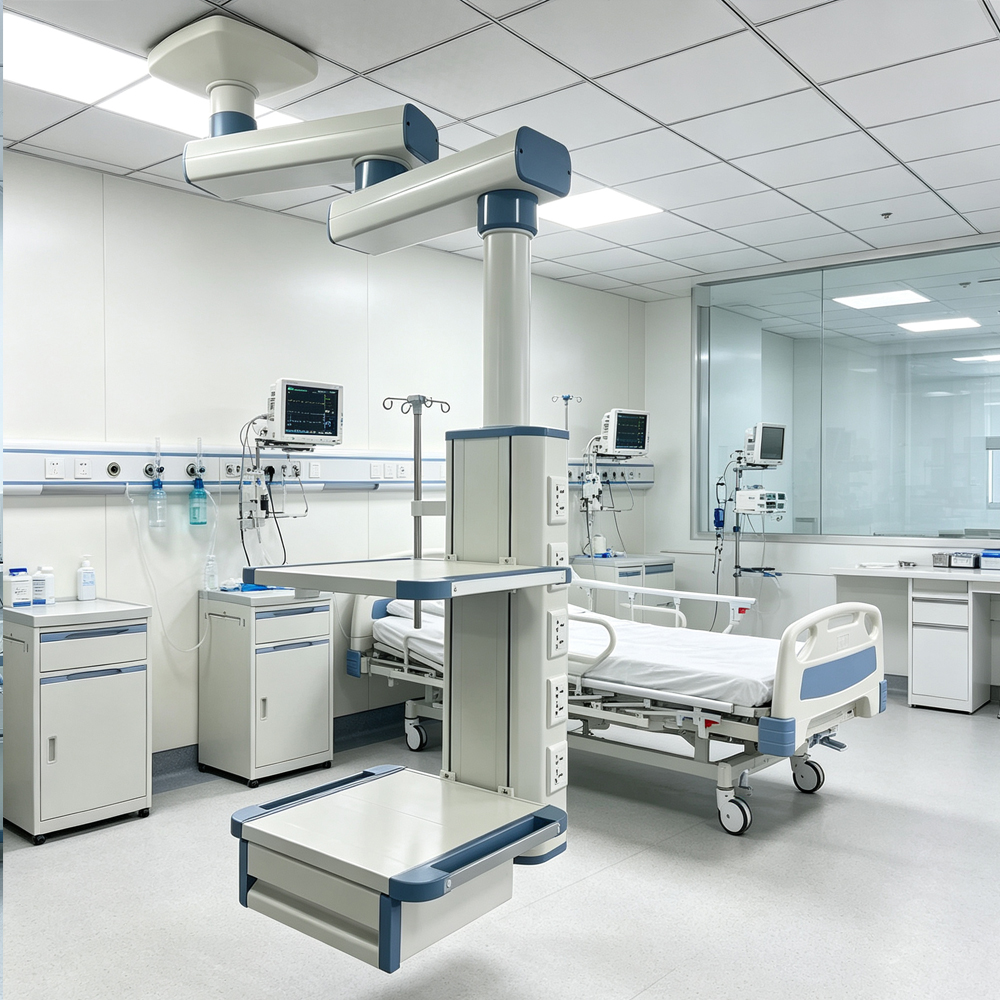
Pull the four variables together and the procurement decision becomes a structured conversation rather than a guessing game. We recommend working through the same five questions on every room, in the same order, so the specification is defensible to clinicians, the structural engineer, and finance alike.
- Step 1 — Map the clinical workflow. What equipment must reach the patient, how often does it move, and how far does it travel? This determines whether you need a fixed drop, a single arm, or a double arm.
- Step 2 — Calculate the real load. Total the equipment weight today, add a margin for future additions, and ask for the rating at the extension you will actually use—not just the retracted figure.
- Step 3 — Survey the ceiling. Confirm slab type, void depth, and the route for gas and electrical risers. On retrofits, do this before you finalise the unit.
- Step 4 — Verify compliance. Require IEC 60601 evidence for the electrical side, ISO 13485 for the quality system, and the applicable medical gas standard (such as HTM 02-01) for the pipeline connection.
- Step 5 — Plan for service life. Ask about brake maintenance, spare-part availability, and the warranty on rotating joints. A pendant is a 10-to-15-year asset; the cost of ownership matters as much as the purchase price.
Running every room through that sequence produces a specification that names the structure, the coverage radius, the working load at extension, the mounting method, and the compliance evidence—five concrete items a vendor can quote against and an engineer can sign off. It also exposes the rooms where a cheaper structure would do the job just as well, which is where the real savings are. For projects spanning multiple rooms and trades, coordinating pendants within a broader fit-out through an experienced medical equipment manufacturer reduces the interface risk that causes most delays. When you are ready to validate a layout or request a quotation, a direct conversation through our contact page is the fastest way to turn a specification into a priced proposal.
Conclusion
The medical pendant vs tower boom question resolves into four engineering variables: structure, coverage, load, and installation. A rigid tower is the right answer when equipment never moves and the load is heavy and vertical. A single-arm pendant suits one-bed zones that need occasional repositioning. A double-arm boom is built for high-acuity, multi-team rooms where equipment must sweep around the patient and then clear the field. The labels matter less than the numbers—coverage radius, working load at extension, mounting method, and compliance evidence.
Specify room by room, not hospital by hospital. Map the workflow, calculate the real load with a margin for growth, survey the ceiling before you commit on a retrofit, and demand IEC 60601, ISO 13485, and the applicable medical gas standard from any supplier. Do that and the structure choice becomes obvious—and reversible only on paper, never in poured concrete. If you would like a second opinion on a layout or a room-by-room quotation, Sanyang Medical’s engineering team is glad to review your specification and propose the right configuration for each room.
Frequently Asked Questions
What is the main difference between a medical pendant and a tower boom?
A medical pendant is the general term for any ceiling-suspended unit that carries gases, power, data, and equipment to the point of care. A tower is a rigid, fixed column with no movement, while a boom is a long articulated arm that swings equipment across a wide radius. In practice, a boom is a type of pendant designed for maximum reach and repositioning, whereas a tower is a fixed drop for static equipment.
Which system is best for an operating room versus an ICU?
Operating theatres typically use double-arm booms because the anaesthetic and surgical teams must constantly reposition monitors, pumps, and gas outlets around the table and then retract them for imaging. ICUs more often use single- or double-arm pendants sized for a dense equipment package, where load capacity and the number of outlets matter more than maximum reach. The right choice always follows the room’s clinical workflow.
How much weight can a ceiling pendant or boom safely hold?
It depends on the unit and, critically, on the extension. A boom may be rated for a high load when retracted but significantly less at full reach, because extending the load multiplies the bending moment at each joint and the ceiling fixing. Always ask for the working load rating at the specific extension you intend to use, and leave headroom for equipment you may add later.
What ceiling conditions are needed to install a medical pendant?
The ceiling must transfer the unit’s weight plus the equipment load—and the dynamic forces from movement—into the building structure. The best case is a direct anchor into a concrete slab; otherwise a steel support frame is used. Lightweight suspended ceilings need an independent support structure. Always confirm slab type, void depth, and the routing of gas and electrical risers before finalising the specification, especially on retrofit projects.
Which standards should a medical pendant comply with?
Look for compliance with the IEC 60601 family for electrical safety of medical equipment, ISO 13485 for the manufacturer’s quality management system, and the applicable medical gas pipeline standard such as HTM 02-01 or your national equivalent. Reputable manufacturers provide test evidence and certificates on request rather than relying on self-declared datasheets.
You May Also Like...

Medical Pendant Installation: 5 Mistakes That Cause Early Failure
medical pendant installation mistakes is the first checkpoint buyers should lock before they approve a...

Medical Pendant for an Endoscopy Suite: Configuration Guide vs. the OR
How to configure a medical pendant for an endoscopy suite: endoscopy vs anesthesia towers, monitor...

Medical Pendant Electrical Integration: Power, Data & Grounding Guide
A practical engineering guide to medical pendant electrical integration: strong/weak current separation, socket count and...