
Executive Summary
Surgical light color temperature between 3500K and 5000K balances tissue color discrimination against surgeon visual fatigue. Here is the specialty-by-specialty selection framework we use on real OR projects.
Every operating room equipment buyer knows to check the lux rating on a surgical light datasheet. Far fewer can tell you what color temperature that same light produces — and even fewer understand why that single number quietly determines whether your surgeons finish a six-hour case with clear tissue discrimination or a tension headache behind the eyes. I have watched hospitals spend premium budgets on 160,000-lux light heads, then field complaints within a month that the light “looks too blue,” “washes out the bowel,” or “makes everything glare by hour four.” The illuminance was fine. The surgical light color temperature was the problem.
The uncomfortable truth is that there is no universal “best” Kelvin setting. A cardiac surgeon dissecting coronary vessels wants a different spectral character than an orthopedic surgeon contouring a plate on a femur. The 3500K to 5000K range that modern LED light heads offer is the working window where tissue color fidelity and surgeon visual comfort negotiate against each other. Get the balance wrong and you either dull the reds that signal bleeding or burn out the team’s eyes with blue-rich glare. This guide walks through the physics, the clinical trade-offs, and the verification steps we use on real LED surgical light projects.

What Surgical Light Color Temperature Actually Measures
Color temperature, formally called correlated color temperature (CCT), describes the hue of a light source by comparing it to an ideal black-body radiator, expressed in Kelvin. Lower values look warm and yellowish; higher values look cool and bluish. Natural daylight sits around 5,800K, which is why light in the 4,300K to 5,000K band reads as “daylight-like” to the human eye. In an operating room, CCT determines the overall cast laid over the surgical field — whether tissue appears under a slightly golden noon-afternoon tone or a crisp, blue-white morning-sky tone.
The international standard governing this parameter is IEC 60601-2-41, with the current third edition (IEC 60601-2-41:2021) published in September 2021. The standard requires surgical luminaires to produce a color temperature between 3,000K and 6,700K — a deliberately wide envelope that keeps illumination color-neutral enough for visual diagnosis while permitting both warm and cool designs. Notably, the third edition replaced the older acceptable chromaticity region defined in (x,y) color space with a requirement on Duv, the metric that quantifies how far a light source sits from the ideal black-body locus. In plain terms: it is no longer enough to hit a target Kelvin number. The light must also avoid the green or magenta tint that cheap LED phosphor blends can introduce, because that tint distorts tissue color even when the CCT reads correctly on a meter.
CCT is a one-number summary of an entire spectrum. Two light heads can both report 4,500K while rendering a liver in visibly different hues — the difference hides in Duv and in the red end of the spectrum, which is exactly where surgical decisions happen.
Within the standard’s envelope, manufacturers typically ship LED surgical lights in one of three bands. Warm heads cluster around 3,500K to 4,000K, neutral heads around 4,000K to 4,500K, and cool heads around 4,500K to 5,000K. Values above 5,000K are classified as cold colors with a bluish tint, while the 3,000K to 4,000K band is considered warm and yellowish. Most adjustable-color LED platforms on the market — including the Sanyang Medical 700/500 color series — offer continuous tuning across roughly 3,500K to 5,000K, which covers the practical needs of virtually every open surgical specialty without ever leaving the compliant zone.
One specification interaction deserves attention here: CCT and central illuminance are not independent in how they feel. The same 120,000 lux at 5,000K will subjectively appear harsher and more glaring than at 4,000K, because short-wavelength blue light scatters more readily inside the eye and off moist tissue surfaces. That is why the Kelvin selection conversation must always happen together with the brightness conversation — never in isolation.
Tissue Color Discrimination: Where Warm and Cool Light Diverge
The clinical argument for color temperature starts with hemoglobin. Oxygenated and deoxygenated blood absorb light most strongly around the 542 nm and 577 nm bands — the green-yellow part of the spectrum — and reflect the reds that let a surgeon distinguish a well-perfused bowel segment from an ischemic one, or a tumor margin from healthy parenchyma. A light source that is weak in the red portion of its spectrum flattens exactly these distinctions, no matter how high its lux rating climbs.
This is where the color rendering index enters. IEC 60601-2-41 requires a general color rendering index (Ra) between 85 and 100 for surgical luminaires, and the industry places special emphasis on R9 — the special index for saturated red. R9 measures how faithfully a light renders deep reds, and it correlates directly with hemoglobin chroma rendition. A head with Ra 95 but R9 of 60 will make a surgical field look acceptably white on camera yet clinically dull in person: bleeding points lose their urgency, and subtle perfusion differences blur together. When evaluating any light head, insist on the full R1 through R15 matrix rather than the single Ra average.
So where does CCT land in this picture? Warm light in the 3,500K to 4,000K band carries proportionally more long-wavelength energy, which tends to render reds, oranges, and yellows with richer saturation. Vascular structures, liver, bowel, and muscle all gain visible depth. The trade-off is reduced perceived contrast between pale tissue types — fat, fascia, and nerve sheaths can look more similar under warm light, and the overall field reads slightly “softer.”
Cool light at 4,500K to 5,000K flips the balance. The blue-rich spectrum sharpens edge contrast and makes whites appear cleaner, which helps when distinguishing fibrous planes, bone, and calcified structures. The cost is a relative desaturation of reds: under a strongly cool head at high illuminance, fresh bleeding can appear darker and less vivid, and some surgeons report that inflamed tissue loses its characteristic flush. Neither band is wrong — they simply optimize different visual tasks, which is precisely why specialty matters more than fashion in this decision.
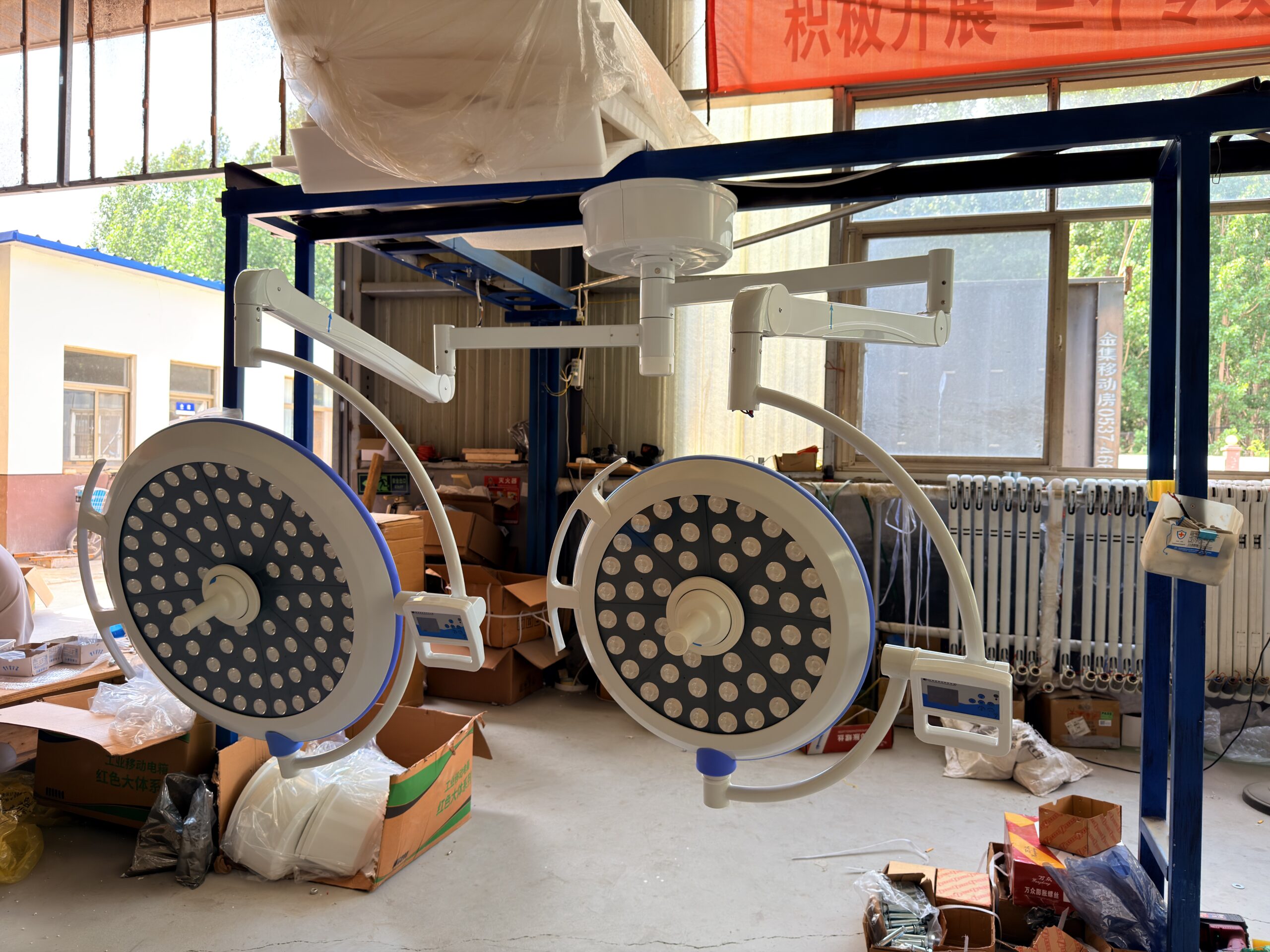
There is also a time dimension that buyers routinely overlook: color rendering degrades as LED phosphors age, and the degradation is not always even across the spectrum. A head that ships at R9 of 90 can drift materially lower after tens of thousands of hours, shifting both CCT and red fidelity at the same time. We covered the failure patterns and the 400-hour repair-cost trap in our guide on surgical light color rendering degradation — the short version is that specifying initial values without specifying maintenance values leaves your tissue discrimination quality to chance.
The Surgeon’s Eye: Visual Fatigue Is a Lighting Specification, Not a Mood
The second half of the balance is the surgical team’s visual system, and the research is more nuanced than most brochures admit. A study from Lund and Aarhus Universities (Hemphälä et al., Lighting Research & Technology) tested surgical staff under multiple lighting scenarios and reached a subtle conclusion: raising ambient illuminance and moving to a higher correlated color temperature did not, by itself, improve measured visual ability — but staff rated the improved lighting as better and reported lower tiredness. Color temperature works on comfort and perceived workload more than on raw acuity, and comfort over a six-hour case is what prevents errors in hour five.
The operating room is hostile to the eye independent of any light head. A review on ergo-ophthalmological risk in the OR (Journal of Perioperative Nursing, 2021) documents the strain cocktail: conditioned low-humidity air, intense lighting, surgical smoke, and involuntary blink suppression during concentrated work. Add a blue-rich 5,000K beam at maximum illuminance and you amplify two problems at once — increased intraocular light scatter and greater subjective glare off the moist surgical field. Surgeons describing “harsh” light are usually reporting this combination, not a measurable defect.
Visual fatigue compounds like interest. A 4% contrast penalty at hour one is invisible; the same penalty at hour five of a Whipple procedure is a surgeon leaning in, repositioning the light, and losing flow. Specify color temperature for the worst hour of the longest case, not for the first ten minutes of an elective knee.
More recent work quantifies the cognitive side of lighting ergonomics. A 2025 study in Frontiers in Medical Technology on a smart surgical lighting system used NASA-TLX workload scoring with EEG measurements and found significantly lower mental demand, effort, and frustration — plus higher P300 amplitude at electrode Fz, indicating reduced cognitive load — when the light eliminated constant manual readjustment. The lesson for color temperature is indirect but real: every parameter that forces the surgeon to consciously compensate draws on the same finite cognitive budget the operation requires.
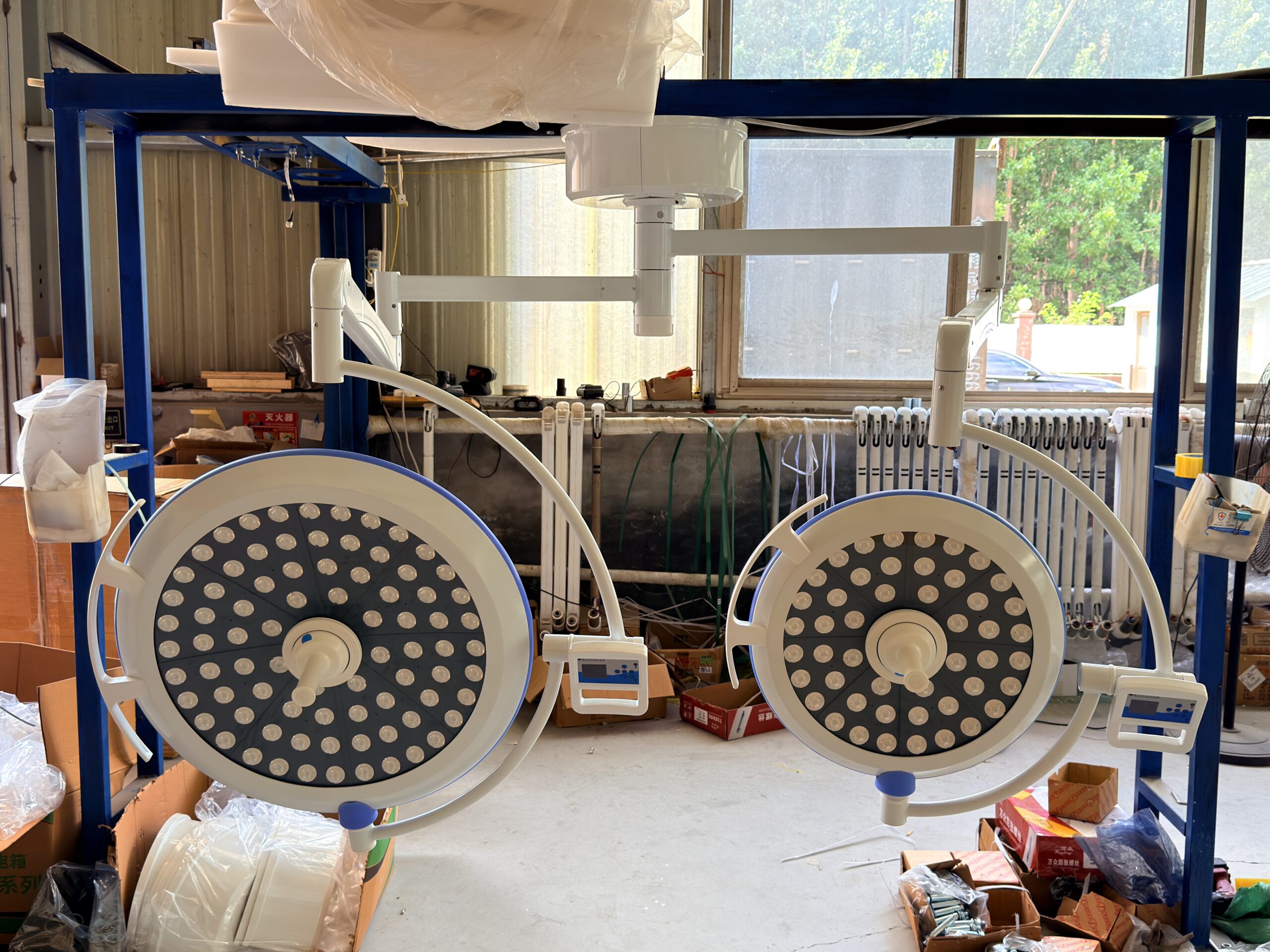
Age matters too, and it rarely enters the procurement conversation. The crystalline lens yellows with age, filtering short-wavelength light — a 58-year-old chief surgeon perceives a 5,000K field as noticeably warmer and dimmer than a 32-year-old resident perceives the same field. In departments with senior-heavy rosters, a neutral 4,300K to 4,500K default with per-case adjustability satisfies the full age spread better than a fixed cool setting.
The 3500K–5000K Decision Framework by Surgical Specialty
With the physics and physiology on the table, the question becomes practical: what should your rooms actually run? Our framework starts from the dominant visual task of each specialty, then checks it against the team’s stated preference during a live demonstration — never from a catalog alone. Treat the working ranges below as starting points for your demo sessions, not codified requirements; IEC 60601-2-41 sets the legal envelope (3,000K to 6,700K) but deliberately leaves the clinical optimum to the user.
| Surgical Setting | Practical CCT Range | Dominant Visual Task | Why This Band Works |
|---|---|---|---|
| General / abdominal surgery | 4,000K – 4,500K | Perfusion assessment, plane dissection | Neutral band balances red saturation with plane contrast; safest default for mixed lists |
| Cardiac and vascular surgery | 3,800K – 4,300K | Vessel and bleeding-point discrimination | Warmer cast deepens red rendering where hemoglobin contrast is the primary cue |
| Orthopedics and trauma | 4,300K – 5,000K | Bone, implant, and hardware contrast | Cooler light sharpens pale-structure edges; red desaturation is an acceptable trade |
| OB/GYN | 4,000K – 4,500K | Tissue tone and bleeding assessment | Neutral rendering supports both vascular and membranous tissue evaluation |
| ENT and microsurgery | 4,300K – 5,000K | Fine-structure detail under magnification | Cooler band maximizes micro-contrast; often paired with microscope lighting |
| Ophthalmology | 4,000K – 4,500K | Delicate intraocular visualization | Neutral band limits blue-light exposure to sensitive ocular tissue |
| Laparoscopy / endoscopy (room light) | 4,000K – 4,500K | Monitor-dominant; room light for setup | Neutral ambient light avoids color-adaptation conflict between field and screens |
Two cross-cutting rules refine the table. First, match the light to the room’s longest and most demanding case, not its average case — a general room that runs a Whipple once a week should be tuned for the Whipple. Second, coordinate the surgical light with the room’s ambient lighting. The same Lund-based research group recommended general lighting levels of roughly 2,000 lux in the room periphery, 4,000 lux surrounding the table, and 5,500 lux on the table itself, with the surgical luminaire’s central beam between 50,000 and 100,000 lux based on surgeon-selected cavity illuminance. A huge CCT mismatch between a 5,000K surgical head and a 3,000K ambient ceiling forces the surgeon’s visual system to re-adapt every time they look up from the field — a small but real fatigue source that a coordinated specification eliminates for free.
Fixed vs. Adjustable Color Temperature: When Variability Pays Off
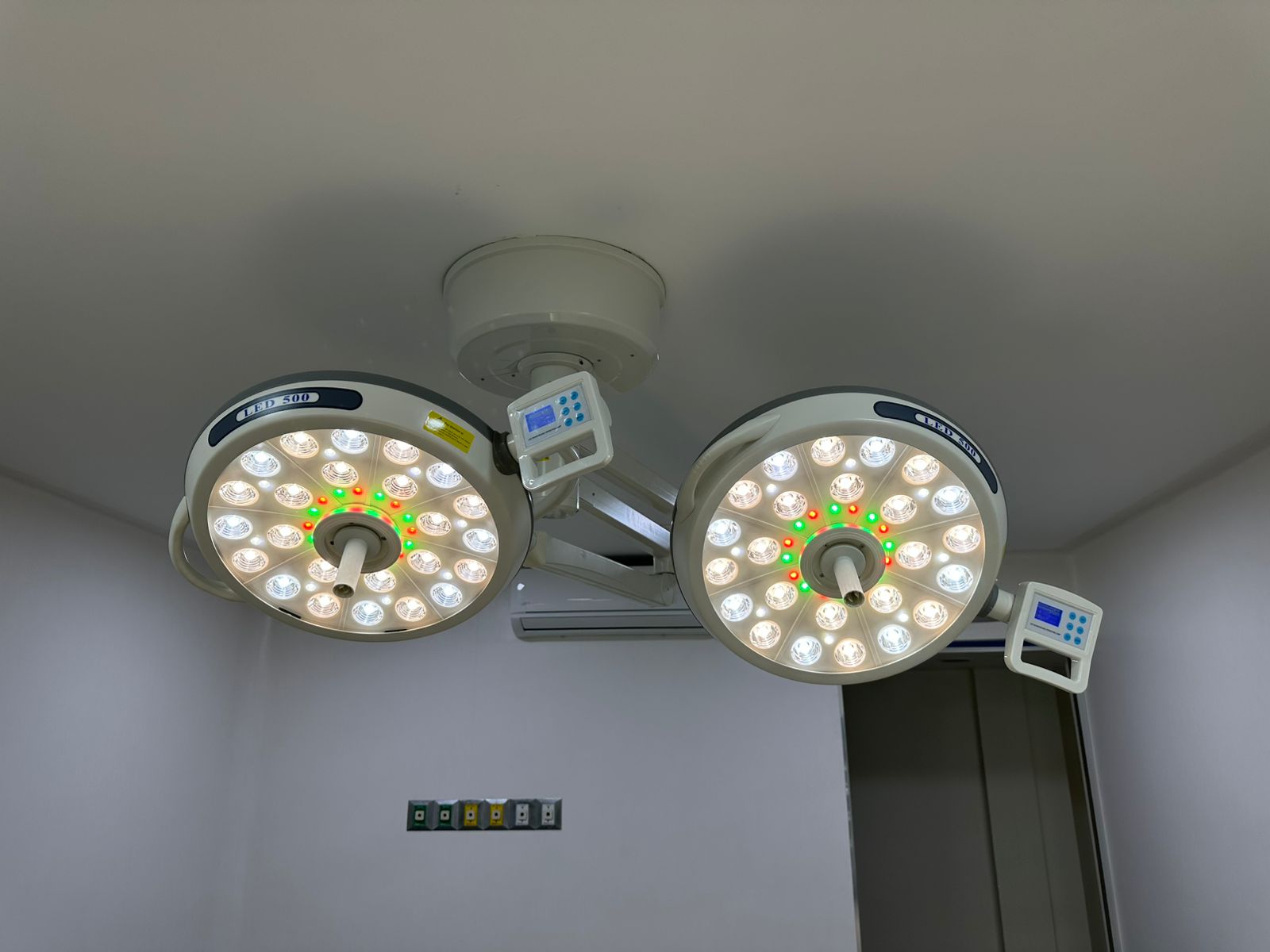
Once you know the target band, the next specification fork is fixed versus adjustable CCT. A single-specialty center — a high-volume orthopedic clinic, for example — can lock in a fixed 4,500K to 5,000K head and enjoy simpler calibration, tighter binning, and usually a better price. The optical design of a fixed-CCT head can be optimized around one phosphor blend, which typically yields better Duv control and more consistent R9 across the production batch.
Adjustable-color heads, tunable across roughly 3,500K to 5,000K in fine steps, are the right answer wherever the surgical mix varies: multi-specialty hospitals, teaching centers where residents rotate through services, and any facility running both vascular and orthopedic lists in the same room. The engineering question to press on any supplier is not whether the head can change Kelvin — almost all color-series heads can — but what happens to the rest of the specification while it does. Three checks separate serious platforms from gimmicks:
- CRI stability across the range: Ask for Ra and R9 measured at the low, middle, and high ends of the tuning range. A credible platform holds Ra above 90 and R9 above 85 at every setting; a weak one lets R9 collapse at the warm or cool extremes.
- Duv discipline: Confirm the chromaticity stays within the IEC 60601-2-41:2021 Duv requirement at all settings, not just the factory default. Green-shift at mid-range is the classic signature of poorly blended phosphor bins.
- Illuminance behavior: On some designs, changing color temperature also changes delivered lux at the same dimmer setting. Surgeons will notice within one case. The control system should compensate so that a Kelvin change never forces a brightness readjustment mid-procedure.
For distributors and OEM partners building a private-label line, this is also where localization decisions get made: different markets genuinely prefer different defaults, with many Middle Eastern and Southeast Asian hospitals favoring cooler settings and European buyers trending neutral. Our OEM/ODM localization service configures default CCT presets, control labeling, and documentation per target market before the first container ships. And if you are weighing how the light integrates with ceiling architecture — boom mounting, ceiling height, dual-head geometry — our comparison of ceiling-mounted versus wall-mounted surgical lights maps those mechanical choices against the same clinical requirements.
Never buy “adjustable color temperature” as a checkbox. Buy the measured Ra, R9, and Duv values at every point of the adjustment range — because that is what your surgeons will actually operate under on the day they dial away from the factory default.
How to Verify Color Temperature Claims Before You Sign the PO
Datasheets are promises, not measurements. Color quality degrades silently — no alarm sounds when R9 drops ten points — so verification belongs in your acceptance protocol, not your assumptions. A spectroradiometer calibrated to the CIE 13.3 framework measures the full spectral power distribution, from which CCT, Duv, Ra, and the special indices R9 through R15 are derived. The third edition of IEC 60601-2-41 also added exposure limits and test conditions for photobiological hazards, reflecting the higher luminance densities of modern LED arrays — another reason to request the ed. 3 test report rather than an older ed. 2 certificate.
The acceptance checklist below is the one we run at commissioning. It takes under an hour per light head with the right meter, and it catches the three failure modes that datasheet review misses: chromaticity drift off the black-body locus, red-rendering weakness behind a respectable Ra average, and Kelvin shift when the dimmer moves.
| Check | Method | Passing Criterion |
|---|---|---|
| CCT at default setting | Spectroradiometer at 1,000 mm (or manufacturer’s reference distance) | Within 3,000K – 6,700K per IEC 60601-2-41 and within ±10% of the ordered value |
| Chromaticity deviation | Duv calculated from measured spectrum | Meets the ed. 3 Duv requirement; no visible green or magenta cast on a white reference card |
| Color rendering | Full CRI matrix (R1 – R15) per CIE 13.3 | Ra 85 – 100 per standard; recommend Ra ≥ 90 and R9 ≥ 85 for major OR use |
| CCT stability across dimming | Measure CCT at 100%, 50%, and minimum dimmer settings | Shift no greater than ±150K across the dimming range |
| Adjustable heads: range verification | Measure CCT, Ra, and R9 at low, mid, and high color settings | All values remain within specified bands at every setting |
| Photobiological safety | Ed. 3 test report review | Exposure limits documented per IEC 60601-2-41:2021 |
Build one more clause into the purchase: scheduled re-verification. LED phosphor aging shifts CCT and erodes R9 gradually, slowly enough that a team adapts without noticing — until a new surgeon asks why the light looks tired. A twelve-month spectroradiometer check turns color quality from a commissioning event into a managed asset. If you are assembling the full procurement picture — illuminance, shadow dilution, depth of illumination, and service economics — our LED surgical light buying guide walks through the complete specification sheet line by line.
Conclusion
Selecting surgical light color temperature is not a search for a magic number — it is a controlled trade-off between two legitimate clinical goods. Warm settings in the 3,500K to 4,000K band deepen the red rendering that vascular and abdominal work depends on; cool settings up to 5,000K sharpen the contrast that orthopedic and microsurgical teams prefer; and the neutral 4,000K to 4,500K corridor remains the safest default for mixed rooms. The IEC 60601-2-41:2021 envelope of 3,000K to 6,700K keeps all of these options compliant, provided Duv discipline and R9 performance hold up under measurement — which is exactly what your acceptance protocol should prove before the light ever reaches a patient.
Specify by specialty, verify with a spectroradiometer, and re-verify on a schedule. If you are planning a multi-room build and want color temperature coordinated with ambient lighting, booms, and the rest of the room ecosystem, our turnkey operating room solutions team handles the full integration — and you can contact our engineers directly to run a live color-temperature demo against your own case mix before you commit.
Frequently Asked Questions
What color temperature is best for a surgical light?
There is no single best value — the optimum depends on the specialty. Cardiac and vascular teams generally prefer 3,800K to 4,300K for richer red rendering, orthopedic and ENT surgeons tend toward 4,300K to 5,000K for sharper contrast on pale structures, and mixed general-surgery rooms are safest in the neutral 4,000K to 4,500K band. All sit inside the 3,000K to 6,700K range IEC 60601-2-41 permits. The deciding step is a live demonstration with your own surgeons, not a catalog specification.
Is 5,000K too blue for long operations?
At high illuminance, 5,000K can increase subjective glare and intraocular light scatter, which some surgeons experience as eye strain during cases lasting several hours — particularly in dry, low-humidity OR environments where blink rate is already suppressed. If your teams run long lists, a neutral 4,300K to 4,500K setting or an adjustable head that can be warmed during marathon cases is usually the more comfortable choice. Reserve fixed 5,000K heads for rooms where bone and hardware contrast dominate, such as orthopedics and trauma.
Does color temperature affect the camera feed in a hybrid or digital OR?
Yes, indirectly. Endoscope and camera systems carry their own white balance, but the room’s surgical light still affects everything the camera does not cover — open conversion phases, instrument tables, and any overhead recording of the field. Large CCT mismatches between the surgical head and ambient lighting also force the surgical team’s eyes to re-adapt every time they look away from a monitor. For hybrid rooms, we recommend aligning the surgical light’s color temperature within a few hundred Kelvin of the room’s ambient and display lighting.
Can you change the color temperature of an existing LED surgical light?
Only if the light head was built with mixed phosphor LED bins and a tuning control — the so-called color or CCT-adjustable series. Fixed-color heads cannot be retuned; their spectrum is set by the phosphor blend chosen at manufacture. If your existing heads are fixed and your surgical mix has changed, the realistic options are retrofitting color-series heads where the platform supports it, or replacing the light head while retaining the suspension arm. Ask your supplier for the measured Ra and R9 at every point of the tuning range before buying an adjustable model.
What does IEC 60601-2-41 actually require for color temperature?
The current third edition (IEC 60601-2-41:2021) requires surgical luminaires to operate between 3,000K and 6,700K and replaces the old (x,y) chromaticity region with a Duv requirement, so the light must also stay close to the ideal black-body locus without green or magenta drift. The standard additionally sets color rendering (Ra 85 – 100), central illuminance between 40,000 and 160,000 lux, and — new in the third edition — photobiological hazard exposure limits for modern high-luminance LED sources. Always request an ed. 3 test report when procuring.
For ophthalmic procedures requiring lower color temperatures, the ophthalmic and ENT surgical light guide explains dimming requirements.
You May Also Like...

Bariatric OR Package: Table, Bed and Trolley Coordination
A bariatric OR package coordinates the operating table, the patient bed and the trolley for...

Lumen vs Lux: What These Surgical Light Units Mean
Lumen and lux are not the same thing. Lumen measures the total light a fixture...

Emergency Department Equipment for Trauma, Resuscitation and Triage
An emergency department is built around speed, and its equipment has to be ready the...