
Executive Summary
Ceiling-mounted or wall-mounted surgical light? Compare installation height, laminar airflow, space, and total installed cost to choose the right mounting for your operating room.
Every operating room equipment plan eventually reaches the same deceptively simple line item: will it be a ceiling mounted surgical light, a wall-mounted unit, or a mobile stand? Teams spend weeks debating lux levels, then treat the mounting configuration as an afterthought decided in a ten-minute call. That sequence is backwards. The photometric head can be swapped in a future upgrade; the ceiling anchor, the wall bracket, and the structural steel behind them are fifteen-year decisions. I have seen ceiling-mounted systems specified into rooms whose slab height left the head swinging a hand-width above the laminar diffuser, and wall-mounted units sold into a cardiac program where the light could reach only one quadrant of the table. Both were expensive mistakes, made at the drawing stage, when they were still free to fix.
Once the choice is made, the structure, power and positioning sequence for wall units is covered in our wall mounted surgical light installation guide.
As a manufacturer that ships both configurations — plus mobile stands — to hospitals and distributors in more than 30 countries, we are pulled into this decision weekly. The market context matters: the global surgical lights market was valued at roughly USD 3.29 billion in 2025 and is projected to reach about USD 3.46 billion in 2026 at a 5.3% CAGR per Research and Markets, with ceiling-mounted systems the largest segment at around 42.5% share in 2026 according to Coherent Market Insights. That dominance reflects the geometry of modern operating rooms, where the light must share ceiling space with laminar diffusers, pendants, and imaging booms while delivering a shadow-free field. If you are comparing LED surgical lights for a new build or renovation, the mounting choice deserves the same engineering attention as the photometry.
This guide walks through the four factors that actually decide the question — installation height and ceiling clearance, laminar airflow compatibility, usable space and range of motion, and total installed cost — and ends with a decision framework for your next design meeting. It complements our LED surgical light buying guide, which covers photometric specifications in depth; here the focus is strictly on where the light lives in the room.
A ceiling mounted surgical light hangs from a suspension system anchored to the room’s structural ceiling or to a dedicated superstructure above the accessible grid. A vertical tube drops through the ceiling, typically 0.6 to 1.2 meters, terminating in one or two horizontal carrier arms, each carrying a light head. The dual-head configuration on two independent arms is the workhorse of general surgery: a primary field light plus a positionable second source for retractors. The assembly rotates around the vertical suspension axis, letting the heads sweep the full footprint of the table.
A wall-mounted surgical light fixes its carrier arm directly to a load-bearing wall, usually through a steel backing plate embedded during construction or retrofit. The arm geometry is similar, but the pivot sits on the room’s perimeter instead of above the table. Most wall-mounted installations carry a single head, and the usable envelope is an arc extending roughly one arm-length into the room. Purchasing guides, including Avante Health Solutions’ surgical lighting buying guide, describe the three mainstream configurations as ceiling mount, wall mount, and portable floor stand, with wall mounting positioned as the space-saving option where ceiling support is limited.
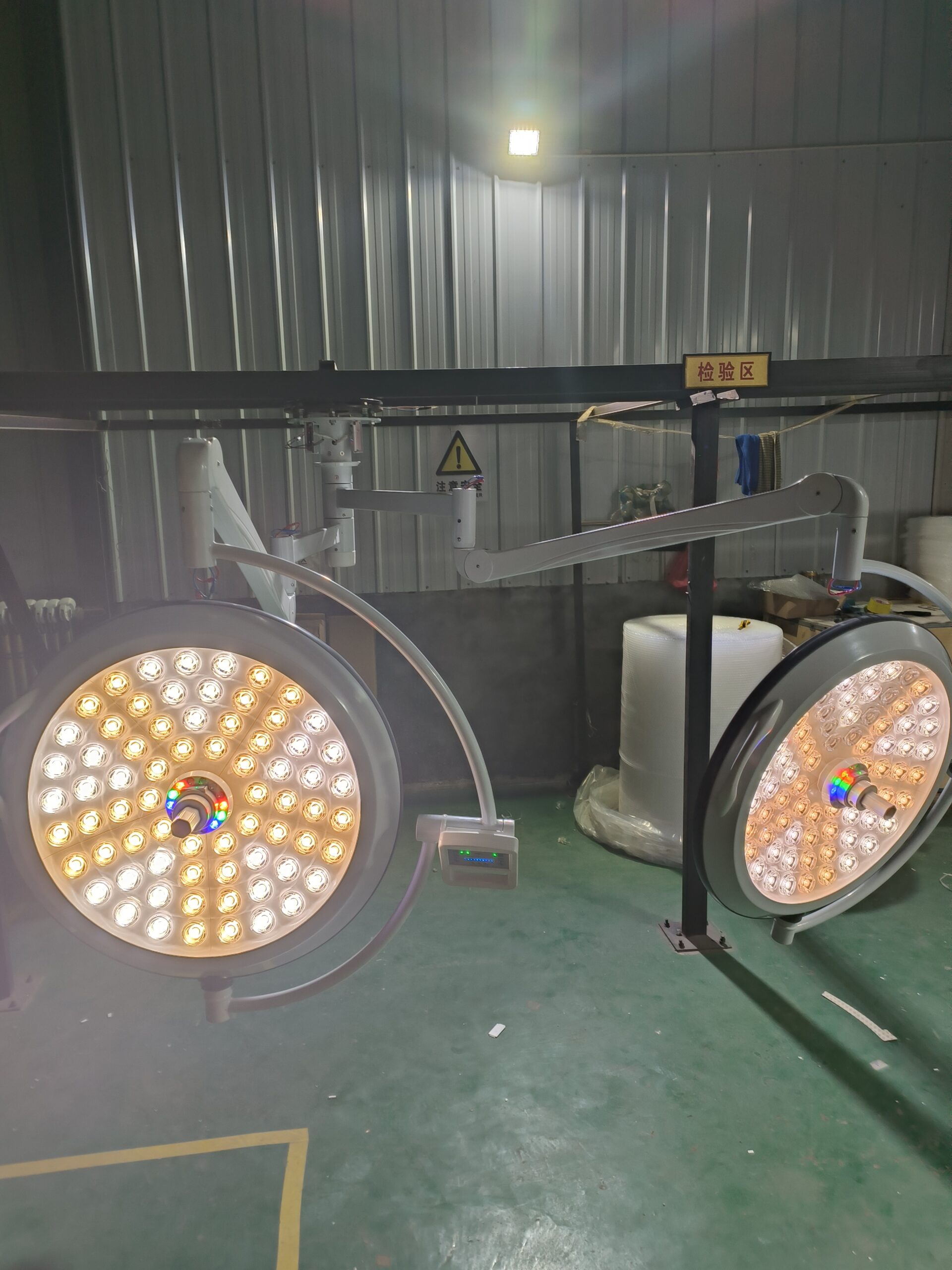
Neither configuration is a portable unit. Mobile floor stands solve a different problem — flexibility — and we return to them below. The ceiling-versus-wall decision is fundamentally a building-interface decision, not a lighting decision: the same LED head behaves completely differently depending on which structure carries it.
Choose the mounting before you choose the light head. The mounting is a construction decision with a fifteen-year horizon; the head is an equipment decision with a five-to-seven-year upgrade cycle. Getting the order wrong is how hospitals end up paying for structural rework that was never budgeted.
Installation Height and Ceiling Clearance: The Numbers That Govern the Choice
Surgical lighting geometry is governed by IEC 60601-2-41, whose current third edition (2021) defines central illuminance at a manufacturer-declared reference distance (DRef) — typically one meter — along with the light field diameters d10 and d50, the depth of illumination L1 plus L2 (where illuminance falls to 60% of central), and shadow dilution tested with a 210 mm mask simulating a surgeon’s head. Rated central illuminance reaches up to 160,000 lux, and color temperature must fall between 3,000 K and 6,700 K. None of those numbers mean anything in your room unless the head can physically sit at its reference distance above the field — which is where mounting height becomes the constraint.
Work through the arithmetic. The surgical field typically sits 0.8 to 1.1 meters above the finished floor, and a light head with a one-meter reference distance wants to hover roughly one meter above it — underside around 1.8 to 2.1 meters above the floor. But the head also has to park, swung aside and raised, when the C-arm comes in and between cases. A ceiling-mounted system on a standard suspension gives the head travel across most of the drop-tube length, so it can park near the ceiling and descend to working height. In rooms with finished heights of 3.0 meters or more this works cleanly. Below about 2.8 meters, the parking position starts to collide with the laminar diffuser array, pendant monitors, and door frames, and the vertical travel that makes ceiling mounting comfortable disappears.
Wall mounting inverts the constraint. The carrier arm attaches at a fixed elevation — the vertical column typically spans roughly 1.8 to 2.4 meters up the wall — and the head can rarely be raised much above its mount. That is an advantage in genuinely low rooms with no ceiling space to give, but the parked head sits at staff height on the room perimeter rather than overhead: exactly what you want in a cramped procedure room, and a collision hazard in a full operating room.
- Measure the structural slab, not the accessible ceiling. The suspension anchors to structure; a 3.3-meter slab with a 0.5-meter plenum gives you 2.8 meters of finished height, and that is the number that matters.
- Map everything else in the ceiling first. Laminar diffusers, medical pendants, surgical displays, sprinklers, and the C-arm’s travel path all claim the zone above the table before the light does.
- Verify vertical travel, not just parked height. Ask each manufacturer for the head’s full travel range at your suspension length and confirm that working and parked positions both clear obstructions.
- Check the drift requirement. IEC 60601-2-41 edition 3 added a requirement for acceptable drift of the light head on its suspension system — improper installation is one of the most common causes of drifting heads.
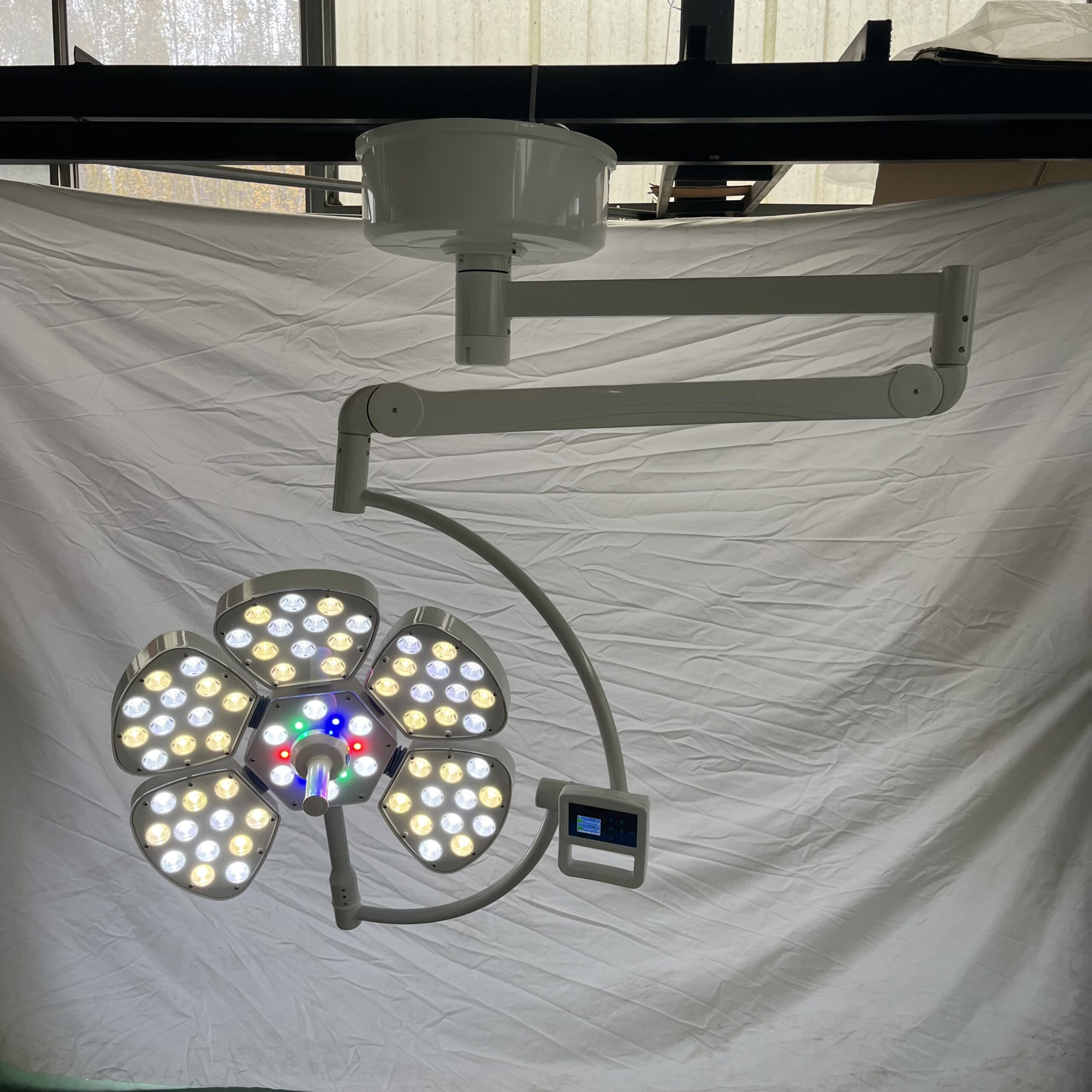
One note from our installation files: when a room’s finished height lands in the awkward 2.8-to-3.0-meter band, a low-profile suspension with a short drop tube and slim heads can still deliver a workable ceiling-mounted installation — but only if the ceiling zone was coordinated early. If the diffuser array and pendants were laid out without reserving the light’s footprint, the room becomes a wall-mount candidate by default.
Laminar Airflow Compatibility: Where the Mounting Decision Meets Infection Control
If your operating room runs a vertical laminar airflow system — HEPA-filtered air supplied downward through a diffuser array above the table — the surgical light is not just a lighting device. It is an obstruction in the cleanest air stream in the hospital, and its position changes how particles move. This is the most under-discussed factor in the ceiling-versus-wall decision.
A 2019 study in the Journal of Healthcare Engineering by Kai and colleagues measured airflow and cleanliness in two equivalent operating rooms with vertical laminar systems — one with a single-axis light in the center of the ceiling, one with lights on two axes flanking the table. The single-axis room showed an oblique, fluctuating current flowing toward the center, because the light blocked the central diffuser position, with persistent air stagnation below it. The two-axis room produced uniform downward laminar flow, and dust at the field center cleared significantly faster. The message for specifiers: a light on the ceiling centerline forces the diffuser array to work around it.
Wind-tunnel and CFD work by Zoon and colleagues at Eindhoven University of Technology quantified the obstruction effect from another angle: infection risk from airborne deposition was proportional to the lamp’s projected surface area, and lamps below 0.1 square meters of projected area did not measurably disturb the downward flow. A 2025 computational fluid dynamics analysis in the journal Fluids confirmed that laminar performance remains sensitive to lighting configuration. Our laminar airflow operating room design guide covers the diffuser layout side of this equation.
In a laminar room, the ceiling is HVAC equipment first and mounting structure second. Every square meter of luminaire you hang through the diffuser plane is a square meter of clean air that has to detour — and detoured air deposits particles.
How do the configurations compare? A wall-mounted light keeps the ceiling entirely clear, which sounds ideal — and in rooms with small diffuser arrays it genuinely is. But the light then reaches the field from the side at a low angle, casting longer shadows from hands and instruments and throwing light across the sterile drape line. Ceiling-mounted systems on two axes flanking the table preserve both downward lighting geometry and a coherent diffuser layout.
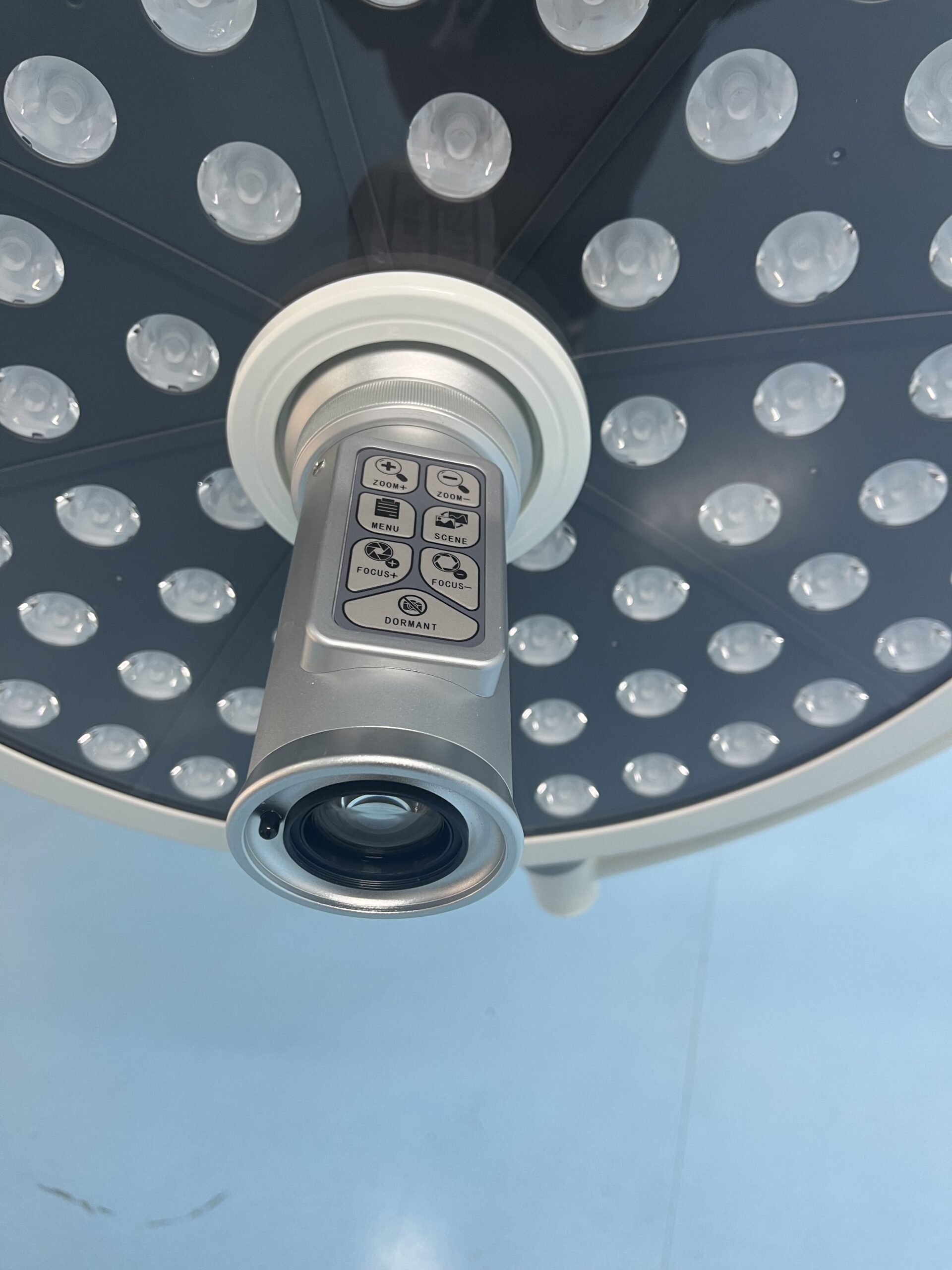
The rule we apply in our own turnkey projects: if the room has a laminar system, plan the ceiling as one coordinated layout — diffusers, lights, pendants, displays — and prefer dual-axis ceiling mounting with slim heads. If the room uses conventional mixing ventilation, which describes most procedure rooms and clinics, airflow obstruction is a minor factor and the decision reverts to height and cost.
Space, Layout, and Range of Motion in the Operating Room
The ceiling-mounted system’s defining advantage is its working envelope. Because the suspension axis sits above the table, the arms rotate through a full circle and the heads can be placed over any point of the patient — or over two fields simultaneously in a dual-head setup — without anyone touching a stand. The floor stays completely clear, which matters more than it sounds: a typical major OR runs with the anesthesia machine, instrument tables, a C-arm, suction, and five to eight people in roughly 35 to 42 square meters. This is also why ceiling mounting dominates hybrid rooms, where fixed imaging equipment claims ceiling space and the light must dodge a rotating C-arm gantry. Our operating room layout and dimensions guide covers the clearance zones involved.
The wall-mounted system’s envelope is an arc. The head can reach the table zone nearest its wall and perhaps the middle of the table — but the far side is physically out of range. For a single-position procedure — an endoscopy suite, a dental or ophthalmic room, a minor surgery unit where patient position never changes — that limitation is irrelevant, and the wall mount delivers exactly the targeted illumination that guides describe as its strength. MeCanMed’s surgical lamp buyer’s guide positions wall mounting for space-constrained rooms, minor surgery, and settings where ceiling load-bearing capacity or height is insufficient; Inspital observed in a 2026 analysis that wall mounting is a practical, economical solution in specific situations while ceiling-mounted systems remain the modern OR standard.
- Rooms where wall mounting works well: endoscopy suites, minor procedure rooms, emergency department bays, dental and ophthalmic suites, examination rooms, and retrofits with low ceilings or non-structural slabs.
- Rooms where ceiling mounting is the default: major operating rooms, cardiac and orthopedic suites, hybrid ORs, obstetric theaters, and any room where the surgical site moves along the table or two operators need independent fields.
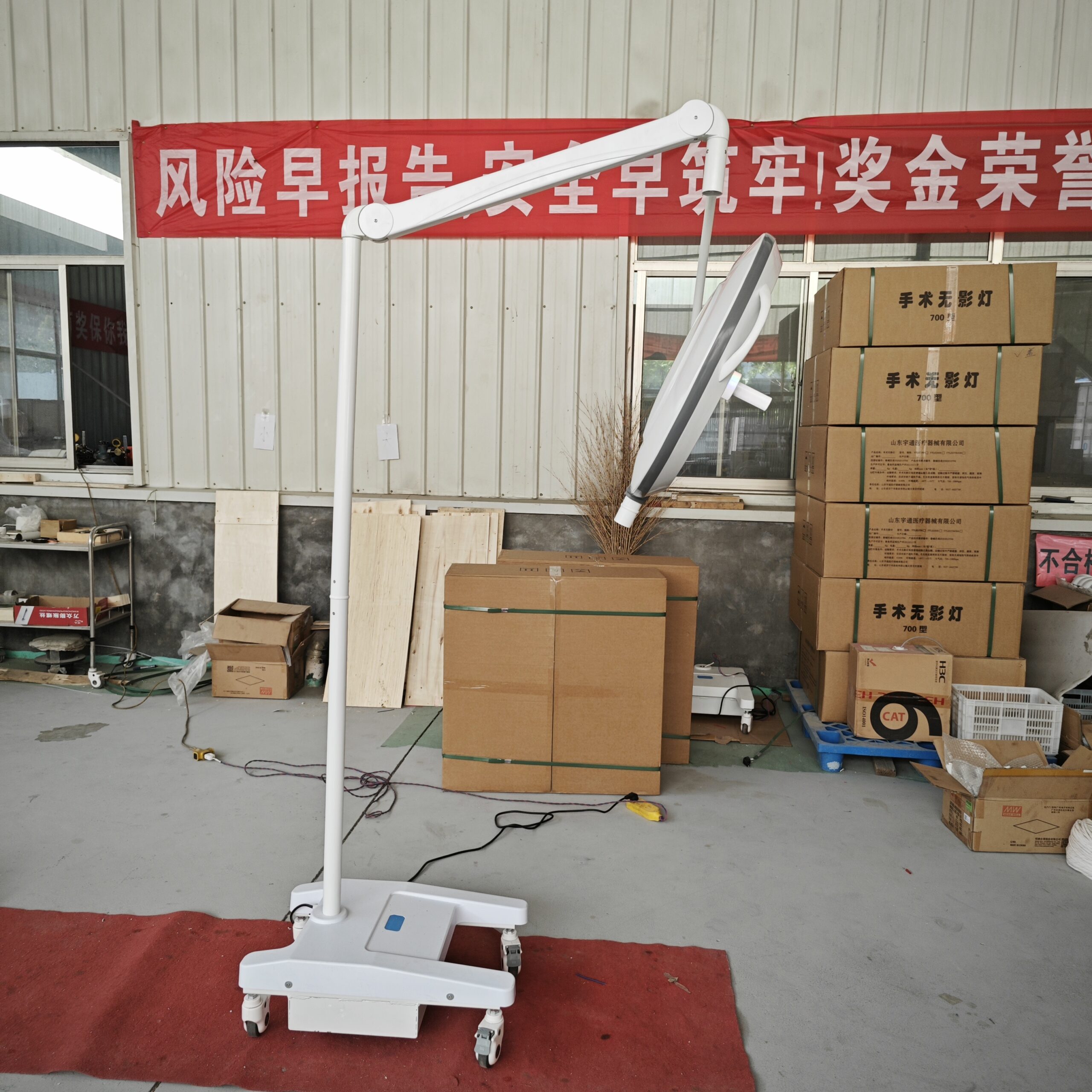
- The supplement, not the substitute: a mobile floor stand adds a third, repositionable source for retractors and secondary fields in either room type.
One spatial factor rarely makes the spreadsheet: cleaning. A ceiling-mounted head with sealed housings wipes down in place and interferes with nothing during terminal cleaning. A wall-mounted head parked at staff height sits where people and trolleys move, and over years that shows up as bumped housings.
Cost Comparison: Purchase, Installation, and Lifetime Ownership
The honest comparison is installed-system-versus-installed-system plus ten years of ownership, not equipment-versus-equipment. The equipment gap is real but modest: a dual-head ceiling mounted surgical light costs more than a wall-mounted single-head unit because you are buying two arms, a suspension column, and a second head. The installation gap is where projects get surprised. A ceiling mount must anchor to structure, which in a renovation means opening the ceiling, verifying or reinforcing the superstructure, and routing power through the plenum — work ranging from minor updates to a complete retrofit. A wall mount needs a verified load-bearing wall, a backing plate, and a shorter electrical run.
| Cost Factor | Ceiling-Mounted System | Wall-Mounted System |
|---|---|---|
| Equipment (typical LED) | Higher — dual heads, two carrier arms, suspension column, control electronics | Lower — single head, one arm, wall bracket assembly |
| Structural work | Ceiling opening, superstructure verification or reinforcement, plenum routing | Backing plate into load-bearing wall; minimal if the wall is suitable |
| Installation complexity | Higher — balancing two arms, drift adjustment, coordination with HVAC and pendants | Lower — single pivot, short run, small crew |
| Renovation disruption | Ceiling demolition and reinstatement; ICRA and interim life-safety measures in occupied facilities | Localized wall work; room back in service faster |
| Running cost (LED) | Comparable per head — 40,000–60,000 hour LED service life, 55–65% energy saving versus halogen | Comparable per head; fewer heads means lower absolute consumption |
| Upgrade path | Heads and arms upgrade on the existing suspension; the anchor is a long-lived asset | Whole-arm replacement typical; wall plate may carry over |
Two cost dynamics deserve emphasis. First, LED technology has compressed the operating-cost difference: modern heads run 40,000 to 60,000 hours before output decays to the 70% threshold that lifespan ratings actually describe, and hospitals replacing halogen report energy savings in the 55–65% range per luminaire. The mounting choice no longer changes the utility bill much; it changes the construction budget. Second, the ceiling suspension is a long-lived asset — the anchor and tube routinely outlast two generations of light heads — so the higher day-one cost amortizes across multiple upgrades, while a wall-mounted installation is replaced as a unit. Our surgical light maintenance and TCO guide covers the ten-year ownership side.
Budget the ceiling mount as construction plus equipment, and the wall mount as equipment plus a wall survey. The hospitals that get surprised are the ones that priced both as if they were the same kind of purchase.
Decision Framework: Matching the Configuration to the Room
Strip the decision to its four variables — ceiling height and clearance, airflow, range of motion, and installed budget — and most rooms resolve themselves. The matrix below is the one we use internally when a distributor or hospital sends us a floor plan.
| Room Type | Recommended Configuration | Why |
|---|---|---|
| Major OR (general, cardiac, orthopedic) | Ceiling-mounted, dual-head, two-axis | Full-table coverage, two independent fields, laminar-compatible airflow, clear floor |
| Hybrid OR with fixed imaging | Ceiling-mounted, coordinated with booms and diffusers | Light must dodge C-arm travel; only overhead mounting gives the needed envelope |
| Minor procedure room / clinic | Wall-mounted single head | Fixed patient position, targeted illumination, lower installed cost, no ceiling work |
| Endoscopy / dental / ophthalmic suite | Wall-mounted | Single-position procedures; arc reach covers the field; compact footprint |
| Emergency / trauma bay | Wall-mounted or mobile stand | Speed and simplicity; multiple bays served without per-bay ceiling work |
| Low-ceiling renovation (under ~2.8 m finished) | Wall-mounted, or low-profile ceiling mount after a clearance study | Insufficient vertical travel for a standard suspension; wall mount sidesteps the ceiling |
Run the decision in this order, because each step can end the conversation:
- Step 1 — Clearance check. Confirm finished ceiling height and map the ceiling zone. If there is not enough vertical travel for a ceiling-mounted head to work and park, the decision is made.
- Step 2 — Airflow check. If the room runs vertical laminar flow, design the ceiling as one system and default to dual-axis ceiling mounting.
- Step 3 — Motion check. If the surgical site moves along the table or two operators need independent fields, ceiling mounting is the only configuration that delivers. If the site is fixed, cost decides.
- Step 4 — Budget check. Price both options as installed systems, including structural work and reinstatement, and compare on ten-year ownership.
For multi-room projects, the configuration decision belongs in the master plan, not room by room — a coordinated ceiling strategy across an OR block buys better pricing and standardizes spare parts and training. That is the kind of coordination a turnkey operating room package is built to deliver.
Conclusion
The ceiling mounted surgical light is the standard configuration for major operating rooms for engineering reasons, not tradition: full-table range of motion, dual independent fields, a clear floor, and — arranged on two axes — a laminar airflow pattern that clears particles from the field faster than a center-blocked single axis. Wall-mounted lighting is the right answer where its constraints stop mattering: fixed-position procedures, space-constrained and low-ceiling rooms, clinics, endoscopy, and emergency bays, at a lower installed cost. The mistakes happen when the choice is made on equipment price alone, without the clearance measurement, the airflow review, and the installed-cost comparison this article walks through.
If you are planning an OR block and want a second opinion on the mounting layout, send us the floor plan, the finished ceiling heights, and the ventilation concept, and our engineering team will return a configuration recommendation with the suspension and structural requirements spelled out. Contact us with your drawings and we will take it from there.
Frequently Asked Questions
Can a ceiling-mounted surgical light be installed in a room with a low ceiling?
Sometimes. What matters is the vertical travel between the parked and working positions, not the ceiling height by itself. Rooms with roughly 3.0 meters or more of finished height usually accommodate a standard suspension. In the 2.8-to-3.0-meter band, a short drop tube and slim heads can still work if the ceiling zone is coordinated early. Below that, a wall-mounted unit or mobile stand is usually the realistic choice, because a head that cannot park clear of obstructions becomes a daily collision problem.
Are wall-mounted surgical lights suitable for major surgery?
Generally no, and the limitation is geometric rather than photometric. A wall-mounted head delivers the same lux and color rendering as a ceiling-mounted one, but its working envelope is an arc extending from the wall — it cannot translate over the full length of the table, cannot serve a second surgical field, and reaches the site from a side angle that lengthens shadows. Where the site moves or two operators need independent light, ceiling mounting is what the room needs.
Does the mounting type affect IEC 60601-2-41 compliance?
The photometric and electrical requirements — central illuminance up to 160,000 lux, color temperature between 3,000 and 6,700 K, shadow dilution, photobiological safety — apply regardless of mounting. But the third edition (2021) added a requirement for acceptable drift of the light head on its suspension system, making the mechanical installation part of the compliance conversation. A head that creeps out of position fails in practice what the type test passed.
How much more does a ceiling-mounted installation cost than a wall-mounted one?
The equipment difference — dual heads, two arms, and a suspension column versus a single head and wall bracket — is usually smaller than the installation difference. Ceiling mounting adds structural verification or reinforcement, ceiling opening and reinstatement, and in occupied facilities infection-control risk assessment. Wall mounting needs a load-bearing wall survey and an embedded backing plate. Compare on ten-year ownership, since the ceiling suspension typically outlasts two generations of light heads.
Can we convert a wall-mounted light to ceiling-mounted later?
Physically yes, but treat it as a construction project rather than an equipment swap. The conversion requires opening the ceiling, installing a structural anchor, routing a new electrical feed through the plenum, and reinstating the ceiling — and the head itself may not accept a suspension arm, since wall-arm and ceiling-arm yokes and balancing springs can differ. If there is a realistic chance of upgrading within five years, installing the anchor and conduit during the original renovation is cheaper than mobilizing the trades twice.
You May Also Like...

Bariatric OR Package: Table, Bed and Trolley Coordination
A bariatric OR package coordinates the operating table, the patient bed and the trolley for...

Lumen vs Lux: What These Surgical Light Units Mean
Lumen and lux are not the same thing. Lumen measures the total light a fixture...

Emergency Department Equipment for Trauma, Resuscitation and Triage
An emergency department is built around speed, and its equipment has to be ready the...