
Why Ophthalmic and ENT Surgery Need Different Light Intensities
General surgical lights are engineered to deliver 40,000 to 160,000 lux at the operative field. That brightness works for abdominal, orthopedic, and cardiovascular procedures where the surgical site is relatively large and deep. Ophthalmic microsurgery and ENT endoscopic surgery operate under completely different constraints. The target tissue in ophthalmic procedures can be less than 2 mm in diameter, viewed through an operating microscope that already magnifies illumination. Flood that field with 100,000 lux and the retina faces phototoxic stress. ENT surgeons working through narrow canals need focused, adjustable light that does not wash out endoscopic monitor images.
The international standard governing surgical luminaires, IEC 60601-2-41, defines illuminance categories and requires that manufacturers declare the intended use environment for each model. For distributors and hospital procurement teams specifying lights for ophthalmology and ENT suites, understanding where general-purpose surgical lights end and specialty lighting requirements begin is the difference between a functional operating room and one that forces surgeons to dim, block, or supplement inadequate lighting.
IEC 60601-2-41 Illuminance Bands for Specialty Surgery
The IEC 60601-2-41 standard classifies surgical luminaires by their maximum illuminance output and their ability to maintain uniformity across the defined light field. While the standard does not prescribe specific lux values per surgical specialty, clinical practice and institutional guidelines have established working ranges that procurement specifications should reference.
| Specialty | Typical Lux Range at Surgical Field | Key Lighting Requirement |
|---|---|---|
| Ophthalmic microsurgery | 8,000 to 20,000 lux | Dimmable to 5,000 lux or below to reduce retinal phototoxicity during prolonged procedures |
| ENT (sinus, laryngeal) | 15,000 to 25,000 lux | Narrow spot focus with minimal scatter to avoid endoscopic monitor glare |
| General surgery | 40,000 to 100,000 lux | Deep cavity illumination with high shadow dilution |
| Examination and minor procedures | 5,000 to 15,000 lux | Adjustable intensity with wide flood pattern |
These ranges come from clinical lighting practice documented in surgical lighting research and institutional procurement guidelines. A light that cannot dim below 20,000 lux is not suitable for ophthalmic microsurgery, regardless of how bright its maximum output is. The dimming floor matters more than the ceiling.
Ophthalmic Surgery: Protecting the Retina From Phototoxicity
Retinal phototoxicity is a well-documented risk in ophthalmic surgery. The retina, particularly the macula, is sensitive to prolonged exposure to high-intensity light in the 400 to 500 nm wavelength range (blue light). An operating microscope delivering 50,000 lux or more directly to the retina during a 60-minute vitrectomy can cause photochemical damage. This is why ophthalmic operating microscopes have built-in filters and why the overhead surgical light in an ophthalmic OR must be dimmable to levels far below general surgery requirements.
For procurement teams specifying lighting for an ophthalmic suite, the critical specification is not maximum illuminance but the dimming range. The light must reach a floor of approximately 5,000 lux or lower without flicker, color shift, or loss of CRI. Color temperature should stay within 3,500K to 4,000K to minimize blue-spectrum output. A surgical light that dims by reducing LED count rather than reducing current per LED creates an uneven field and should be rejected for ophthalmic use.

ENT Surgery: Focused Illumination Without Monitor Interference
ENT procedures present a different challenge. The surgeon works in a narrow canal or cavity, often while simultaneously viewing an endoscopic monitor. A bright overhead light that floods the field causes two problems: it creates glare on the monitor screen and it washes out the subtle tissue contrast that endoscopic cameras are tuned to capture. ENT surgeons need overhead light that is focused, adjustable in spot diameter, and dimmable enough to serve as ambient fill light rather than primary illumination.
The spot diameter control matters here. A surgical light with a spot diameter adjustable from 15 cm to 30 cm lets the surgeon narrow the beam to the surgical canal without illuminating the surrounding face and monitor. Lights with only a fixed flood pattern force the ENT team to position drapes or tilt the light head away from the monitor, which reduces effective illumination at the surgical site.
Color Temperature and CRI Requirements for Microsurgery
Color rendering index (CRI) of Ra greater than 95 is standard for surgical lighting, and this requirement becomes more critical in ophthalmic and ENT microsurgery where tissue differentiation depends on subtle color variations. A CRI of 95 means the light renders 95 percent of the visible color spectrum compared to a reference source. Below 90, vascular structures in ophthalmic and ENT tissue can appear uniformly pink, making it harder to distinguish arteries from veins.
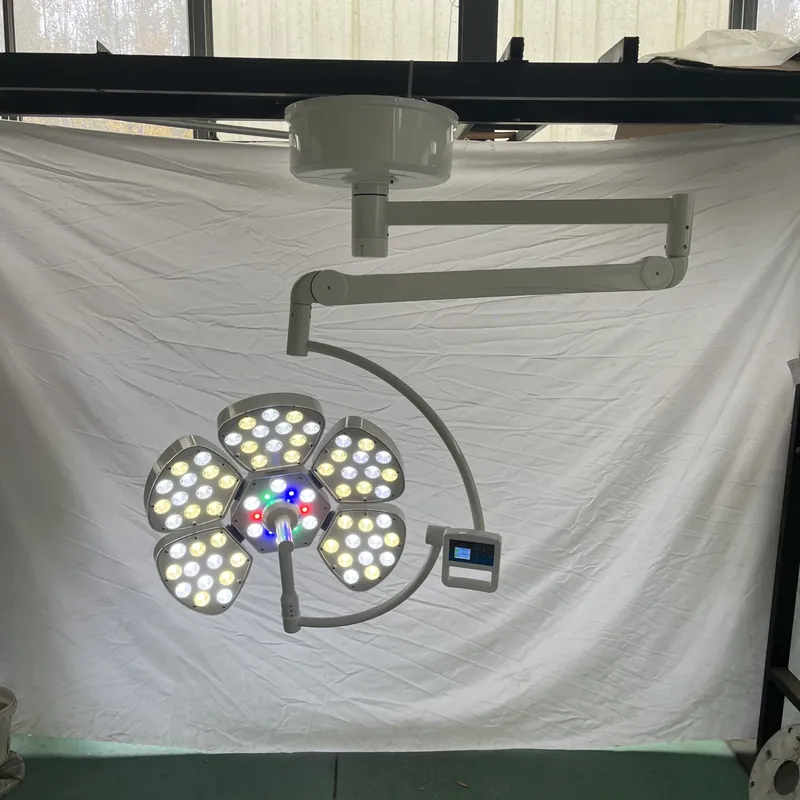
Color temperature selection differs by specialty. General surgery typically uses 4,000K to 5,000K for maximum contrast. Ophthalmic suites benefit from 3,500K to 4,000K to reduce blue-spectrum exposure. ENT procedures can use the standard 4,000K to 5,000K range since there is no retinal exposure concern. Sanyang Medical’s 700-500 Color LED series allows adjustable color temperature between 3,500K and 5,000K, which lets a single fixture serve both general and specialty surgery when the OR schedule includes mixed case loads.

Procurement Specifications: What to Put in the Tender
When writing technical specifications for an ophthalmic or ENT surgical light, distributors and hospital procurement teams should include the following parameters beyond the standard electrical safety and mechanical requirements. These specifications ensure that suppliers cannot substitute a general-purpose light for a specialty model.
- Dimming range: Must dim to 5,000 lux or below at the surgical field without color shift or flicker. Continuous dimming, not stepped.
- Spot diameter control: Adjustable from 15 cm to 30 cm minimum, with sharp edge falloff to prevent ambient scatter.
- Color temperature: Adjustable between 3,500K and 5,000K, with the lower range available for ophthalmic procedures.
- CRI: Ra greater than 95, with R9 (red rendering) greater than 90 for vascular tissue differentiation.
- Backup power: Battery capable of maintaining reduced illuminance for at least 2 hours during power interruption.
- Camera integration: Optional camera mount for teaching and documentation in ENT procedures.
For reference on how these specifications compare to general surgical light requirements, the illuminance requirements by surgery type guide covers the full range of surgical specialties. The color temperature selection guide explains the clinical reasoning behind 3,500K versus 5,000K choices in detail.
Mobile Versus Ceiling-Mounted Lights for Specialty Surgery
Not every ophthalmic or ENT procedure happens in a dedicated operating room. Outpatient ophthalmic clinics and ENT examination rooms often use mobile surgical lights that can be repositioned between chairs and procedure tables. Mobile lights for ophthalmic use must meet the same dimming and color temperature requirements as ceiling-mounted units, but with lower maximum illuminance (typically 20,000 to 40,000 lux) since the working distance is shorter and the procedures are less invasive.
For ENT examination rooms, a mobile light with a spot diameter of 10 to 20 cm and dimmable output is sufficient. The advantage of mobile units is flexibility: a single light can serve an ENT examination chair in the morning and be wheeled to a minor procedure room in the afternoon. Sanyang Medical’s LED 500 Mobile series is designed for exactly this mixed-use scenario, with a maximum output of 50,000 lux that can be dimmed to 8,000 lux for ophthalmic examination.
Facilities planning a dedicated ophthalmic OR should still specify ceiling-mounted dual-head lights for maximum stability and aseptic control. The LED versus halogen comparison explains why LED technology is the only viable choice for ophthalmic and ENT lighting, as halogen lights cannot achieve the low dimming floors required for retinal safety.
Common Procurement Mistakes in Specialty Surgical Lighting
Three mistakes recur in tenders for ophthalmic and ENT surgical lights. First, specifying only maximum illuminance without requiring a dimming floor. A light rated at 120,000 lux sounds impressive, but if it cannot dim below 25,000 lux, it is dangerous in an ophthalmic OR. Second, omitting spot diameter control from the specification, which allows suppliers to submit fixed-flood lights that are unsuitable for ENT work. Third, accepting a single color temperature setting when mixed caseloads require adjustable output between 3,500K and 5,000K.
For a broader guide to specifying surgical lights across all surgical specialties, the LED surgical light buying guide covers lux, CRI, and shadow dilution specifications that matter for every procurement decision. For facilities ready to specify equipment for a new ophthalmic or ENT suite, Sanyang Medical’s surgical light product line includes adjustable color temperature models and mobile units designed for specialty applications.
Frequently Asked Questions
What lux level is safe for ophthalmic surgery?
Ophthalmic microsurgery typically uses 8,000 to 20,000 lux at the surgical field, with the ability to dim to 5,000 lux or below during prolonged retinal procedures to prevent phototoxicity. The overhead surgical light should work in conjunction with the operating microscope, not compete with it.
Can one surgical light serve both general and ophthalmic surgery?
Yes, if the light has a dimming range from 5,000 to 100,000 lux with continuous control, adjustable color temperature between 3,500K and 5,000K, and spot diameter control. Lights with fixed output or stepped dimming are not suitable for mixed caseloads.
What color temperature is best for ENT surgery?
ENT surgery can use 4,000K to 5,000K since there is no retinal exposure concern. The priority is spot focus control to prevent monitor glare. If the same room is used for ophthalmic procedures, an adjustable color temperature light set to 3,500K to 4,000K is preferable.
Why is CRI 95 important for ophthalmic and ENT surgery?
CRI greater than 95 ensures accurate rendering of vascular tissue colors. In ophthalmic and ENT microsurgery, distinguishing between arteries, veins, and surrounding tissue depends on subtle color differences that lower CRI lights render uniformly, increasing the risk of misidentification.
You May Also Like...

Bariatric OR Package: Table, Bed and Trolley Coordination
A bariatric OR package coordinates the operating table, the patient bed and the trolley for...

Lumen vs Lux: What These Surgical Light Units Mean
Lumen and lux are not the same thing. Lumen measures the total light a fixture...

Emergency Department Equipment for Trauma, Resuscitation and Triage
An emergency department is built around speed, and its equipment has to be ready the...