
Executive Summary
Stainless steel or ABS polymer? Compare corrosion, weight, cost, and disinfectant compatibility, then pick the right medical trolley material for each hospital department.
Walk into any hospital procurement meeting and you will hear the same debate recycled every budget cycle: should the next fleet of ward carts be stainless steel or engineering polymer? The facilities manager wants the perceived hygiene of steel. The finance director wants the lower invoice price of plastic. The infection control nurse wants whichever one survives the disinfectant rotation without streaking, pitting, or cracking. All three are right, and all three are arguing past each other, because the stainless vs polymer medical trolley question is not one question. It is four — corrosion behaviour, weight and ergonomics, total cost of ownership, and disinfectant compatibility — bundled into one purchase-order line item.
I have spent years specifying hospital furniture for operating theatres, wards, and CSSD units, and the pattern of failure is almost always the same. A buyer selects a material on a single attribute — usually the sticker price or a gut feeling about “medical grade” — and discovers eighteen months later that the crash cart is tea-stained around the welds, or that the polymer dressing trolley has gone brittle under a quaternary ammonium rotation it was never rated for. The material was never the problem; the mismatch between the material and the medical trolley application was.
This guide is the comparison I wish every buyer had before signing a purchase order. It separates the two material families properly, walks through the four decision criteria that actually matter in a working hospital, and finishes with a department-by-department framework you can take straight into your next tender. If you are also finalising the running gear of your carts, read our companion piece on medical trolley caster selection — the best body material in the world still fails on the wrong wheels.
Stainless vs Polymer Medical Trolley: The Two Material Families Defined
“Medical grade” is a marketing phrase, not a material specification. Always ask for the alloy grade or the polymer resin family before you compare prices.
When a supplier says “stainless steel,” they almost always mean one of two austenitic grades: AISI 304 or AISI 316 (often sold as 316L, the low-carbon variant). Grade 304 — V2A in European notation — is the workhorse of hospital furniture: excellent general corrosion resistance, good formability, and an accepted price point. Grade 316 (V4A) adds roughly two to three percent molybdenum, which dramatically improves resistance to chlorides and pitting. That single alloying addition is the difference between a cart that survives a coastal hospital’s saline-laden air and one that develops rust freckles within a year.
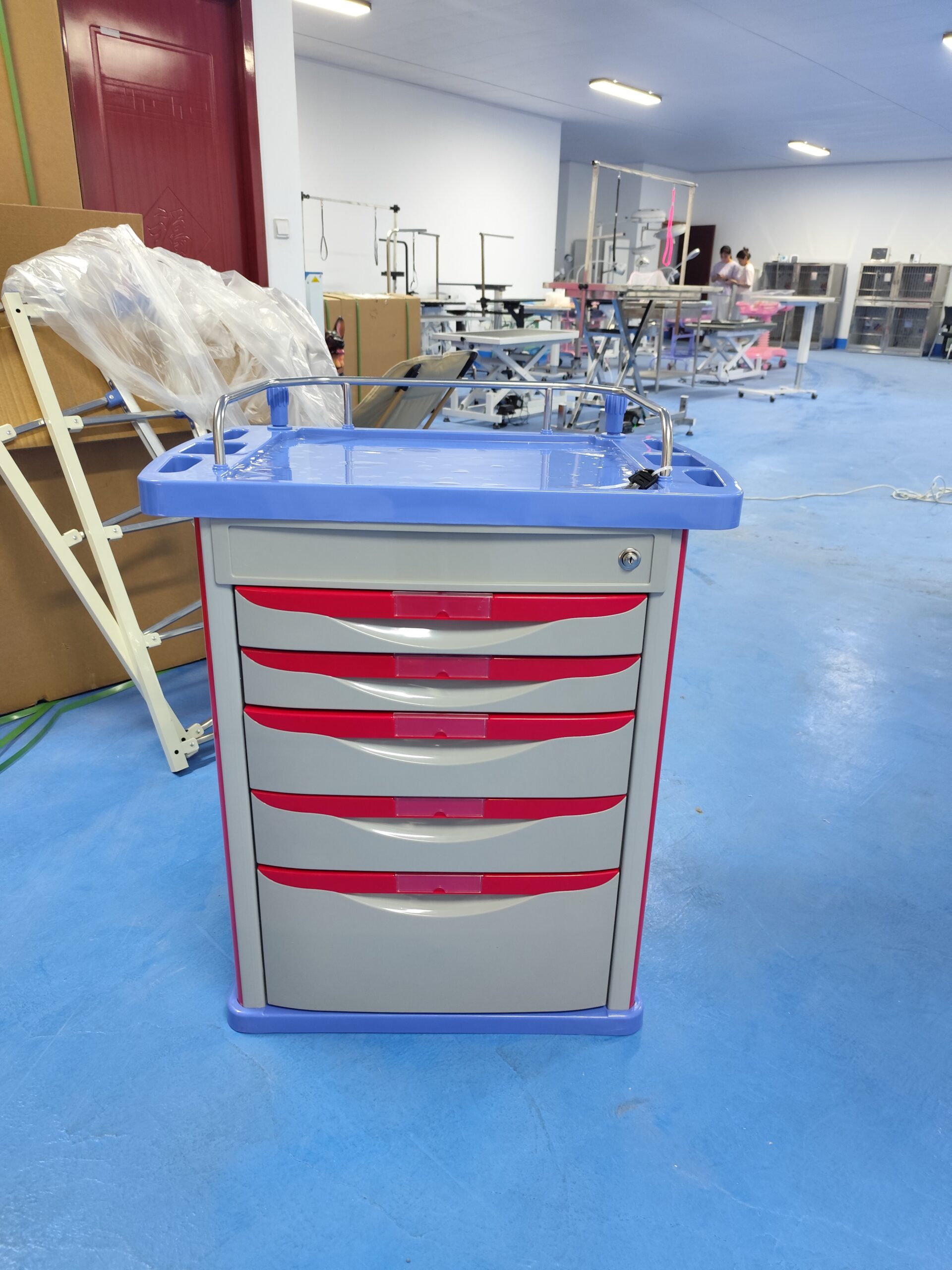
When a supplier says “polymer” or “ABS,” they usually mean a trolley whose body, drawers, and work surface are moulded from acrylonitrile butadiene styrene — a tough, rigid engineering thermoplastic — often over an internal aluminium or steel frame carrying the structural load. ABS is the dominant resin because it balances impact strength, chemical resistance, and mouldability at a competitive cost. Higher-end polymer carts may use polycarbonate blends or antimicrobial-filled resins, but ABS is the baseline in nine out of ten quotations.
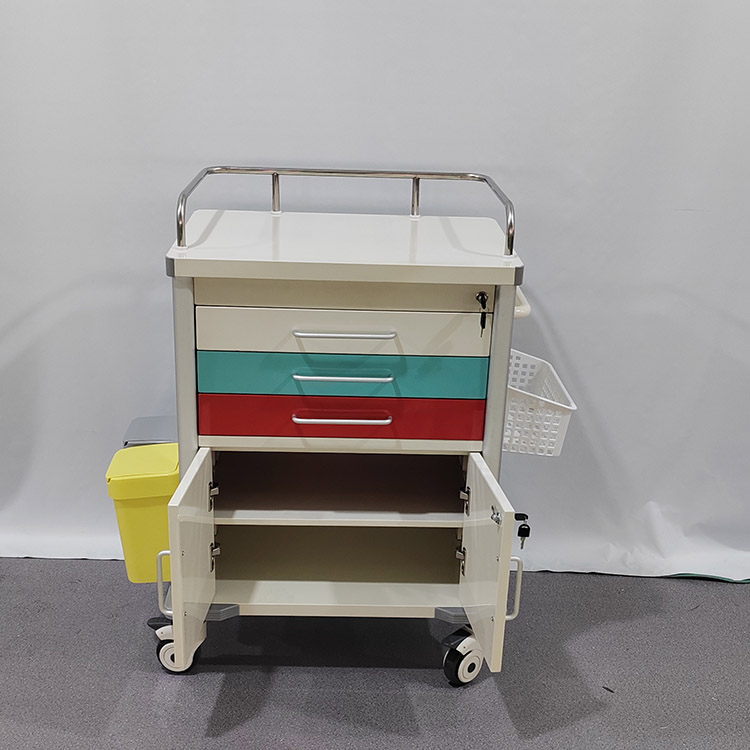
There is also a third, often-overlooked family: powder-coated mild steel. It sits between the two in price and performance, and it matters because many “budget stainless” tenders are actually coated steel in disguise. The coating is only as good as its adhesion, and once it chips — which it will, at the caster brackets and bumper rails — the underlying carbon steel corrodes quickly. Knowing which of the three families you are actually being quoted is the first act of due diligence.
The table below summarises the headline differences before we unpack each criterion. Treat it as a map, not a verdict — every row has exceptions driven by grade, resin formulation, and build quality.
| Criterion | Stainless Steel (304 / 316) | Engineering Polymer (ABS) |
|---|---|---|
| Typical body weight | Heavier; a loaded steel cart demands more push force | Roughly 30–40% lighter than an equivalent metal cart |
| Corrosion mechanism | Passive film; vulnerable to chloride pitting and crevice attack | Does not rust; vulnerable to chemical stress cracking and UV embrittlement |
| Chlorine / bleach tolerance | 304 marginal; 316 better but still requires rinse-off | Generally good at wipe-down concentrations |
| Impact behaviour | Dents but retains structure; dents trap soil | Absorbs and rebounds; can crack at low temperature |
| Surface hygiene | Non-porous when polished; welds and scratches create niches | Seamless moulded surface; colour-through finish hides scratches |
| Upfront cost | Higher; driven by alloy price and fabrication labour | Lower; moulded parts amortise tooling at volume |
| Repairability | Welds and panels can be reworked on site | Cracked mouldings usually replaced, not repaired |
| Noise | Rattles and rings on impact | Damped, quiet operation |
Corrosion and Disinfectant Compatibility: Where the Decision Is Really Made
A trolley does not fail because of the ward it works on. It fails because of what the cleaning crew sprays on it twice a day, every day, for a decade.
Corrosion is the most misunderstood failure mode in hospital furniture, because stainless steel is widely assumed to be immune. It is not. Stainless resists corrosion only because of an ultra-thin chromium oxide passive film, and that film can be locally destroyed by halide ions. The British Stainless Steel Association’s guidance on sodium hypochlorite is blunt: the hypochlorite ion is aggressive to stainless steels, acting like wet chlorine gas, and pitting or crevice corrosion can occur on most grades in a five percent solution at ambient temperature, with an added risk of stress corrosion cracking at elevated temperature. That is not an edge case — sodium hypochlorite is the backbone of hospital disinfection worldwide.
So the “stainless is always more hygienic” argument collapses unless you match grade to cleaning chemistry. A 304 cart wiped with a chlorine disinfectant and left to air-dry will tea-stain and eventually pit, especially at weld seams; 316 tolerates the same regime far better but still benefits from a fresh-water rinse. Industry bodies such as Team Stainless have commissioned research — including work by Manchester Metropolitan University and AgroParisTech — on how disinfection performs on aged as well as new stainless surfaces, a recognition that the hygiene case depends on maintenance, not just composition.

Polymer carts approach the same problem from the opposite direction. ABS does not corrode electrochemically — there is no passive film to break down, so chlorine, quaternary ammonium compounds, and alcohol wipes do not cause rust, and manufacturers of medical-grade ABS carts routinely cite resistance to prolonged disinfectant exposure as a core selling point. But polymers have their own degradation pathway: chemical stress cracking. Aggressive agents — strong solvents, some phenolic formulations, high-concentration peroxide blends — can migrate into the resin and initiate fine cracks under residual moulding stress. The cart does not rust; it crazes. And a crazed surface is a hygiene liability, because those micro-cracks are impossible to disinfect.
The honest engineering answer is that both families are compatible with the disinfectants hospitals actually use, provided two conditions are met. First, match the material to the chemistry: if your protocol is built on hypochlorite, lean toward 316 stainless or a chlorine-rated polymer, and insist on a rinse step either way; if it is built on quats and alcohol, both perform well. Second, keep the surface intact — a polished, passivated stainless finish or a colour-through polymer finish, with no chips, cracks, or exposed substrate. Compatibility charts such as the Cole-Parmer database, which rates 304 and 316 against common disinfectants, are a useful reference, but they test flat coupons, not welded carts. Our detailed breakdown of cleaning agents and contact times is in the companion guide on medical trolley disinfection protocols.
Weight, Push Force, and the Ergonomics Nobody Budgets For
The second criterion is the one your nursing staff will notice on day one, even if it never appears in the tender documents: how hard the cart is to move. A polymer-bodied cart is substantially lighter than its steel equivalent — manufacturers of ABS hospital carts commonly quote figures around forty percent lighter than a comparable metal cart — and that delta compounds across a shift. A medication round touching sixty patients means sixty starts, stops, and course corrections, and every kilogram of dead weight multiplies the force through a nurse’s shoulders and lower back.
This is not a comfort issue; it is a workforce issue. Musculoskeletal disorders are among the leading causes of lost working days in nursing, and manual handling of loaded carts is a documented contributor. A lighter cart reduces the breakaway force needed to start it rolling and the force needed to hold it on a ramp or in a lift. It also changes collision dynamics: a polymer cart bumping a doorframe at walking pace transfers less energy than a steel one, which is why lightweight fleets see fewer chipped walls — and fewer dented cart corners.
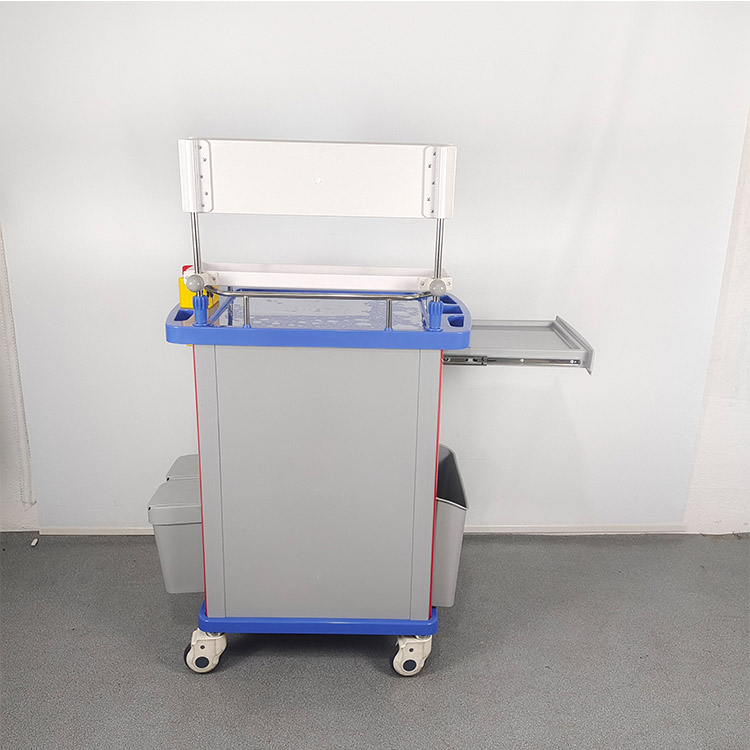
Steel advocates correctly point out that total weight is dominated by the payload, not the body. A fully loaded crash cart approaches the same mass regardless of material, because the drugs, defibrillator, and suction unit outweigh the frame. True — but the body is the only part of the total mass you can engineer down without compromising the payload. And the acoustic difference is real: polymer carts run noticeably quieter, with no metallic rattle over expansion joints, which matters on night shifts and paediatric wards.
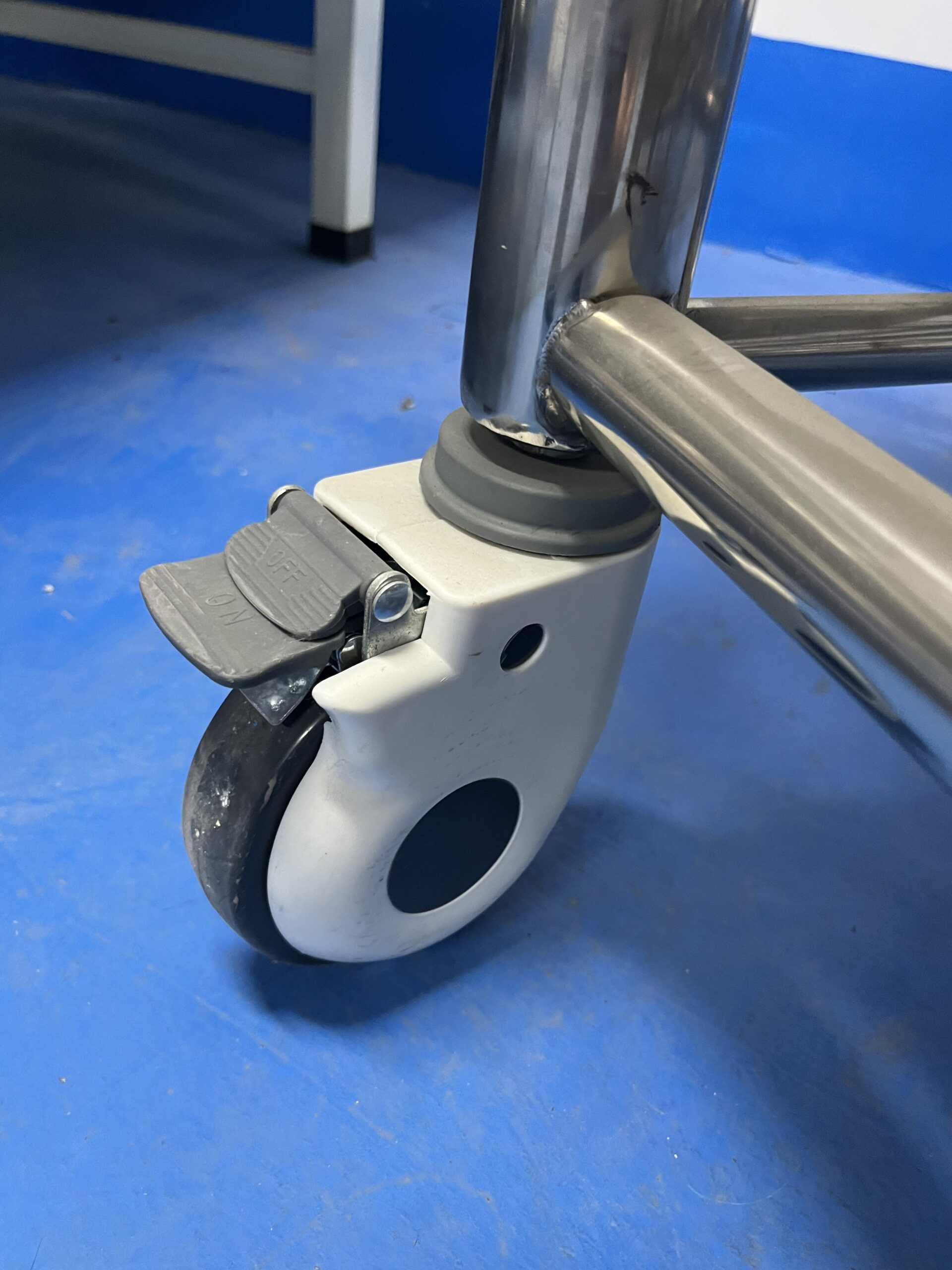
One ergonomic caveat favours steel. Being stiffer, a well-designed steel cart carries a heavy, concentrated load on a single shelf without the deflection sometimes seen in polymer shelving. If your use case is dense instrument trays or fluid cases, verify the per-shelf load rating rather than the headline cart capacity. The interplay between body stiffness, caster choice, and load distribution is covered in our guide on medical trolley stability.
Total Cost of Ownership: Look Past the Invoice Price
The purchase price is the down payment. The cleaning labour, the repairs, the replacement cycle, and the downtime — that is the rest of the loan.
On a pure invoice comparison, polymer carts usually win. An entry-level ABS emergency or crash cart is typically priced in the low hundreds of dollars per unit, while an equivalently configured stainless steel cart commands a meaningful premium driven by raw alloy cost, welding labour, and finishing. For a hospital furnishing fifty ward stations on a tight capital budget, that gap is real and legitimate. But the sticker price is perhaps a third of the story over a ten-year service life, and buyers who optimise on it alone routinely end up paying more.
The first hidden cost is service life in a given environment. In a dry, low-chemical-load setting — a records office, a clean supply store — a coated or 304 steel cart and an ABS cart both last a decade or more, and the polymer’s lower price is a genuine saving. In a harsh setting — a coastal hospital, a dialysis unit, a CSSD with constant chlorine and peroxide — a marginal steel cart can be unserviceable in three to five years while a correctly specified polymer or 316 cart is still working, and replacing a cart twice erases the initial saving plus the soft costs of disposal and re-tendering.
The second hidden cost is cleaning labour, where polymer often has a structural advantage: a seamless moulded body with integrated spill guards wipes down faster than a steel cart whose rail joints, bumper brackets, and spot-welded shelves each need attention. Multiply ninety seconds of extra cleaning per cart per day across a fifty-cart fleet and you recover a substantial fraction of a full-time employee’s week. The third is repairability, where steel swings back: a dented panel can be reworked and a failed weld re-welded by a competent workshop, whereas a cracked polymer moulding is usually a replacement part and a lead time.
The disciplined way to compare is a simple ten-year model per candidate cart: purchase price, plus the cleaning-labour delta, plus expected replacement count in your environment, plus material-specific accessories. You need the right order of magnitude, not spreadsheet precision. Ask suppliers for the expected service life in your specific disinfectant regime, not a generic warranty period — a supplier who commits to a service-life estimate in writing stands behind the material choice. This is also where fleet standardisation pays off: mixing three material families means three cleaning protocols, three spare-part streams, and three replacement schedules. Our guide on medical trolley fleet standardization shows how to collapse that complexity.
Impact Resistance, Load Capacity, and Day-to-Day Durability
Hospitals are hard on furniture, and the failure modes differ by material in ways that matter for safety, not just appearance. Stainless steel yields rather than fractures: a hard knock against a bed rail dents it, and a dent is a cosmetic problem until it becomes a hygiene one, because a deformed surface is harder to clean and a deep dent can crack the passive film and seed corrosion. The structure, however, keeps carrying the load. That ductility is why steel remains the default for the heaviest duties — stretcher trolleys, instrument-laden CSSD carts, and anything carrying concentrated loads near its rated capacity.
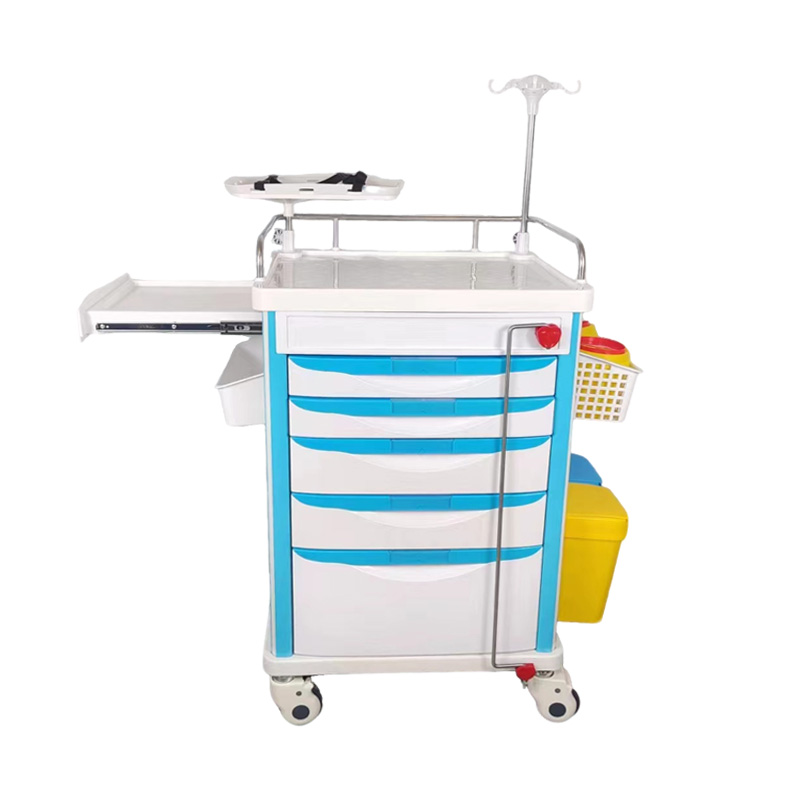
ABS behaves differently: it is tough rather than ductile. At room temperature it absorbs impact energy and rebounds, which is why polymer crash carts come out of a resuscitation event — shoved, bumped, and slammed repeatedly — largely unscathed. But toughness is temperature-dependent: in a cold corridor, ABS moves toward its brittle transition, and a sharp point-impact that would dent steel can crack a polymer corner. The rule is that polymer excels at the distributed, repeated, low-energy impacts of daily ward life, while steel is safer where a single high-energy impact or a very heavy concentrated load is the design case.
Load capacity deserves a specific warning, because it is where specifications are most often misread. A cart’s rated capacity is a whole-system number — body, shelves, casters, and joints — and it is not evenly distributed. A polymer cart rated for a respectable total load may still have drawers or shelves with much lower individual limits, and overloading a single drawer is the most common way to crack a moulded runner. Steel carts are more forgiving of uneven loading but transmit overload directly to the casters, so the running gear must be rated to match. Whichever material you choose, ask for per-shelf and per-drawer ratings in writing and check them against your heaviest actual configuration, not your average one. For carts certified under a quality system such as ISO 13485, these load figures should be documented and traceable — a reasonable request in any hospital tender.
How to Choose: A Department-by-Department Decision Framework
Having separated the four criteria, selection becomes a matter of weighting them per department rather than declaring a universal winner. The framework below is the one I use when advising hospitals on a mixed fleet, and it resolves most stainless vs polymer medical trolley decisions in under an hour. Start with the dominant stressor in each area — chemical, mechanical, ergonomic, or budgetary — let that drive the material, then use the secondary criteria to pick the grade or resin.
- Operating theatres and CSSD: Lean stainless (304 for general, 316 where chlorine or saline exposure is heavy). The loads are high, the equipment is dense, and the carts must tolerate heat and aggressive terminal cleaning. Polymer has a role for lightweight anaesthesia and suture carts that are moved constantly, but the heavy instrument traffic belongs on steel.
- Wards and medication rounds: Lean polymer. The dominant costs here are ergonomic and acoustic — nurses push these carts kilometres every shift — and the chemical load is moderate. A colour-coded ABS fleet also supports medication-safety workflows in a way bare steel cannot.
- Emergency and crash carts: Either can work, but polymer currently dominates because it combines impact tolerance, light weight for rapid redeployment, and seamless surfaces for fast decontamination between events. Specify a chlorine-compatible resin if your post-event protocol uses hypochlorite.
- Dialysis, coastal, and high-chloride settings: If you choose steel it must be 316 with a documented passivation finish and a rinse step; otherwise a chlorine-rated polymer is the lower-risk default. This is the environment where a cheap 304 cart fails fastest and most visibly.
- Budget-constrained, low-stress settings: Coated steel or entry-level polymer are both defensible; decide on which failure you can tolerate — coating chips and rust (steel) or long-term embrittlement (polymer) — and buy accordingly.
Whatever you decide, encode it in the tender so it cannot be value-engineered away after award. Specify the exact alloy grade or resin family, the required surface finish, the per-shelf and per-drawer load ratings, the disinfectant regime the cart must withstand, and the expected service life. Vague language like “medical grade stainless” or “high-quality ABS” invites substitution. If you are sourcing from an OEM/ODM manufacturer, this is also the moment to align on localisation — regional disinfectant chemistries and climates differ, and a cart specified for a Scandinavian hospital is not the same cart as one for a tropical coastal facility. Our OEM/ODM localisation team works through exactly these material-and-environment trade-offs with distributors.
Conclusion
The stainless vs polymer medical trolley question has no single answer, and any supplier who tells you otherwise is selling inventory, not a solution. Stainless steel — correctly graded, finished, and maintained — remains the right call for heavy, hot, high-chloride duties. Engineering polymer — correctly formulated and matched to your disinfectant chemistry — is the right call for high-mileage, ergonomic, impact-heavy ward work, and usually wins on total cost of ownership there. Failures happen when a material is chosen on price or habit and then asked to do a job it was never specified for.
Run the four-part analysis — corrosion and disinfectant compatibility, weight and ergonomics, total cost of ownership, and impact/load durability — weight it per department, and write the result into your tender as enforceable specifications. For a material recommendation against your actual disinfectant protocol and environment, contact our engineering team with your department list and cleaning chemistry, and we will map the right family and grade to each cart in your fleet.
Frequently Asked Questions
Is stainless steel always more hygienic than a polymer medical trolley?
No. Hygiene is a property of surface condition, not material family. A polished, intact stainless surface and a seamless, colour-through polymer surface are both non-porous and easy to disinfect. The risk appears when the surface degrades: stainless develops pits and weld discoloration that harbour soil, while polymer develops stress cracks that do the same. The more hygienic cart is whichever one stays intact under your specific cleaning regime.
Will bleach-based disinfectants damage a stainless steel trolley?
They can. Sodium hypochlorite is among the most aggressive common disinfectants toward stainless steel; British Stainless Steel Association guidance notes that hypochlorite can cause pitting and crevice corrosion on most grades, with a risk of stress corrosion cracking at higher temperature. If your protocol relies on hypochlorite, specify grade 316 rather than 304, use the recommended dilution, and follow with a fresh-water rinse — or choose a chlorine-rated polymer cart.
How much lighter is an ABS trolley than a stainless steel one?
For the body and shelving, manufacturers of medical ABS carts commonly quote figures around thirty to forty percent lighter than an equivalent metal cart, depending on design and on how much of the structure is polymer versus an internal metal frame. A loaded cart’s total weight is dominated by its payload, so the ergonomic benefit shows up most on high-frequency, long-distance rounds where staff push the empty or lightly-loaded cart.
Can a cracked ABS trolley body be repaired, or must it be replaced?
Usually replaced. Plastic welding or adhesive repair can restore appearance temporarily, but rarely returns the original structural and hygiene properties, and the repair line becomes a new crevice that is hard to disinfect. Steel, by contrast, can generally be reworked — dents pulled, panels replaced, welds re-done — by a competent workshop. Factor this into total cost of ownership: polymer’s lower purchase price versus steel’s easier repairability.
What should I specify in a tender to prevent material substitution?
Name the exact material — for example “AISI 316 stainless steel, 2B finish, passivated” or “medical-grade ABS, colour-through, chlorine-compatible” — rather than generic phrases like “medical grade.” Also require per-shelf and per-drawer load ratings, the disinfectant regime the cart must withstand, the expected service life, and traceability to a quality system such as ISO 13485. Requiring the supplier to confirm the material grade on the delivery note gives you a checkpoint at goods receipt.
After selecting materials, follow the medical trolley assembly guide for caster and drawer installation.
You May Also Like...

Bariatric OR Package: Table, Bed and Trolley Coordination
A bariatric OR package coordinates the operating table, the patient bed and the trolley for...

Lumen vs Lux: What These Surgical Light Units Mean
Lumen and lux are not the same thing. Lumen measures the total light a fixture...

Emergency Department Equipment for Trauma, Resuscitation and Triage
An emergency department is built around speed, and its equipment has to be ready the...