


Executive Summary
A hospital-wide procurement framework for medical trolley fleet standardization — fleet audit, configuration lock, IEC 60601-1 and ISO 13485 specification, 10-year spare parts contracts, and phased rollout.
Walk into the equipment store of a mid-size hospital that has grown department by department for fifteen years, and you will find a museum of medical trolleys: six brands of anesthesia carts, four generations of emergency trolleys, dressing trolleys with three different drawer depths, and at least one model whose manufacturer no longer exists. Every one of them needs different casters, different drawer dividers, different locks, and different spare keys. Biomedical engineering keeps a spreadsheet just to remember which caster fits which cart. This is what happens when medical trolley procurement is treated as a series of one-off purchases instead of a fleet decision.
I have sat on both sides of this table — helping hospitals rationalize chaotic fleets and helping procurement teams write the specification that prevents the chaos from coming back. The pattern is always the same: the hospital that standardizes its trolley fleet spends less per year on spare parts, trains nurses faster when they rotate between wards, passes infection-control audits with fewer findings, and negotiates better pricing because it buys volume on a small number of frames instead of small quantities of everything.
This guide lays out a hospital-wide procurement framework for hospital trolley standardization — from fleet audit to specification lock to phased rollout — based on how we structure fleet programs for hospital groups and turnkey projects. It is written for procurement directors, biomedical engineering leads, and hospital administrators who are tired of paying the hidden tax of a mixed fleet.
Why Mixed Fleets Cost More Than You Think
The purchase price of a trolley is the smallest part of what it costs you. Over a 10-year service life, the real expense is distributed across maintenance labor, spare parts inventory, training, downtime, and replacement casters and drawer slides. When every ward runs a different model, each of those cost lines multiplies.
- Spare parts inventory. A mixed fleet of 12 trolley models can require 30+ distinct spare SKUs — casters, drawer runners, brake pedals, lock cylinders, worktop inserts. Most hospitals respond by either overstocking (dead capital on shelves) or understocking (trolleys parked in corridors waiting for parts).
- Maintenance labor. A technician who knows one platform can service it in 15 minutes. The same technician facing an unfamiliar model needs the manual, the right tools, and often a second visit. Multiply that across hundreds of preventive-maintenance rounds per year.
- Training and clinical risk. When a nurse floats from medical ward to ICU, the crash cart should look and behave exactly the same. Different drawer layouts in an emergency cost seconds; inconsistent brake pedals cause roll-away incidents. A widely cited U.S. hospital system case study on cart fleet caster standardization reported that unifying casters across the fleet cut maintenance complexity and eliminated a whole category of floor-damage and noise complaints.
- Procurement leverage. Ten units of five models is a retail transaction. Fifty units of one or two platforms is a contract — with pricing, warranty, and service terms to match.
Market analysts tracking the medical carts segment — Grand View Research, Mordor Intelligence and others — consistently describe a market growing in the mid-single digits annually, driven by hospital expansion and replacement demand. For a buyer, a growing market means suppliers are competing for fleet-level accounts. That leverage only materializes if you consolidate your demand instead of fragmenting it.
Field note: The most expensive trolley in your hospital is not the premium anesthesia cart — it is the orphan model that only biomedical engineering remembers how to fix. Standardization programs almost always pay for themselves in parts consolidation and labor hours within two to three budget cycles.
Step 1: Audit the Existing Fleet Before You Write Any Specification
Every successful hospital trolley standardization project starts with a physical audit, not a catalog. Send someone — ideally biomedical engineering with a ward nurse — through every department with a simple form. You are building the baseline that the whole framework rests on.
For each trolley, record:
- Location, department, and actual daily function (not the function it was bought for)
- Brand, model, year of purchase, and supplier
- Structural condition: frame welds, worktop surface, drawer alignment, caster wear, brake function
- Configuration actually in use: number of drawers, accessories mounted, lock type
- Failure history from the CMMS or maintenance log: what broke, how often, and how long the unit was out of service
Two things usually emerge from this audit. First, 20–30% of the fleet is functionally redundant — trolleys doing a job that a smaller or simpler unit could do, or sitting idle because a department over-ordered. Second, the failure data clusters: casters, drawer slides, and brakes account for the overwhelming majority of work orders. Those three components should therefore carry the most weight in your new specification, because they drive your lifetime cost.
Group the audited fleet into functional classes. Most hospitals converge on five or six: emergency/crash carts, anesthesia trolleys, treatment and dressing trolleys, infusion/IV trolleys, medication trolleys, and patient-transfer stretchers. Each class becomes a line item in your standardization plan with its own approved configuration.
Step 2: Define Functional Classes and Lock the Configurations
The mistake most committees make at this stage is trying to design one universal trolley. There is no such thing. An anesthesia trolley needs a tilting top bin layout, a dedicated suction and monitor shelf position, and drawer depths matched to airway kits. An emergency trolley needs a breakaway lock seal system, a defibrillator tray, a cardiac board, and IV pole mounts. Standardization does not mean one cart — it means one approved configuration per function, held constant for a decade.
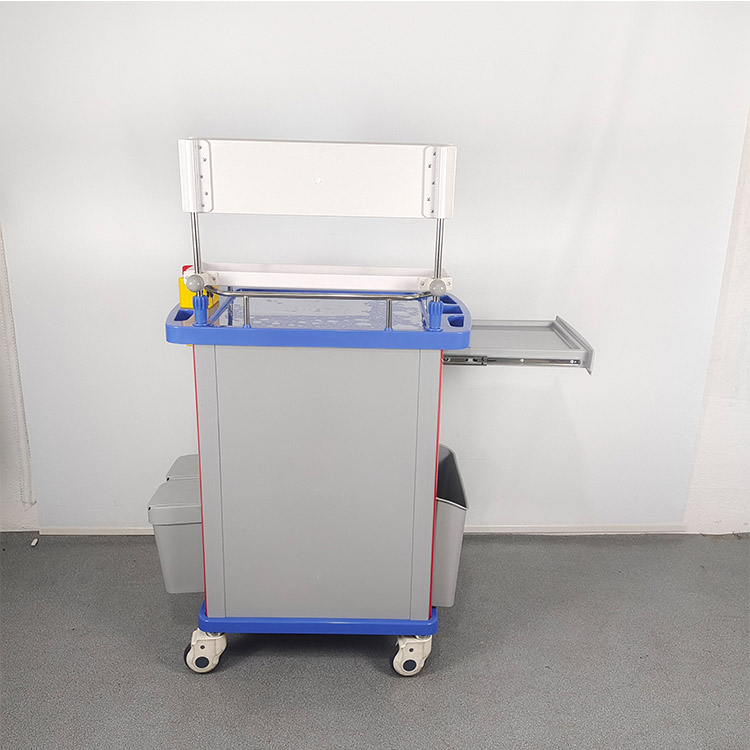
For each functional class, freeze a written configuration sheet covering:
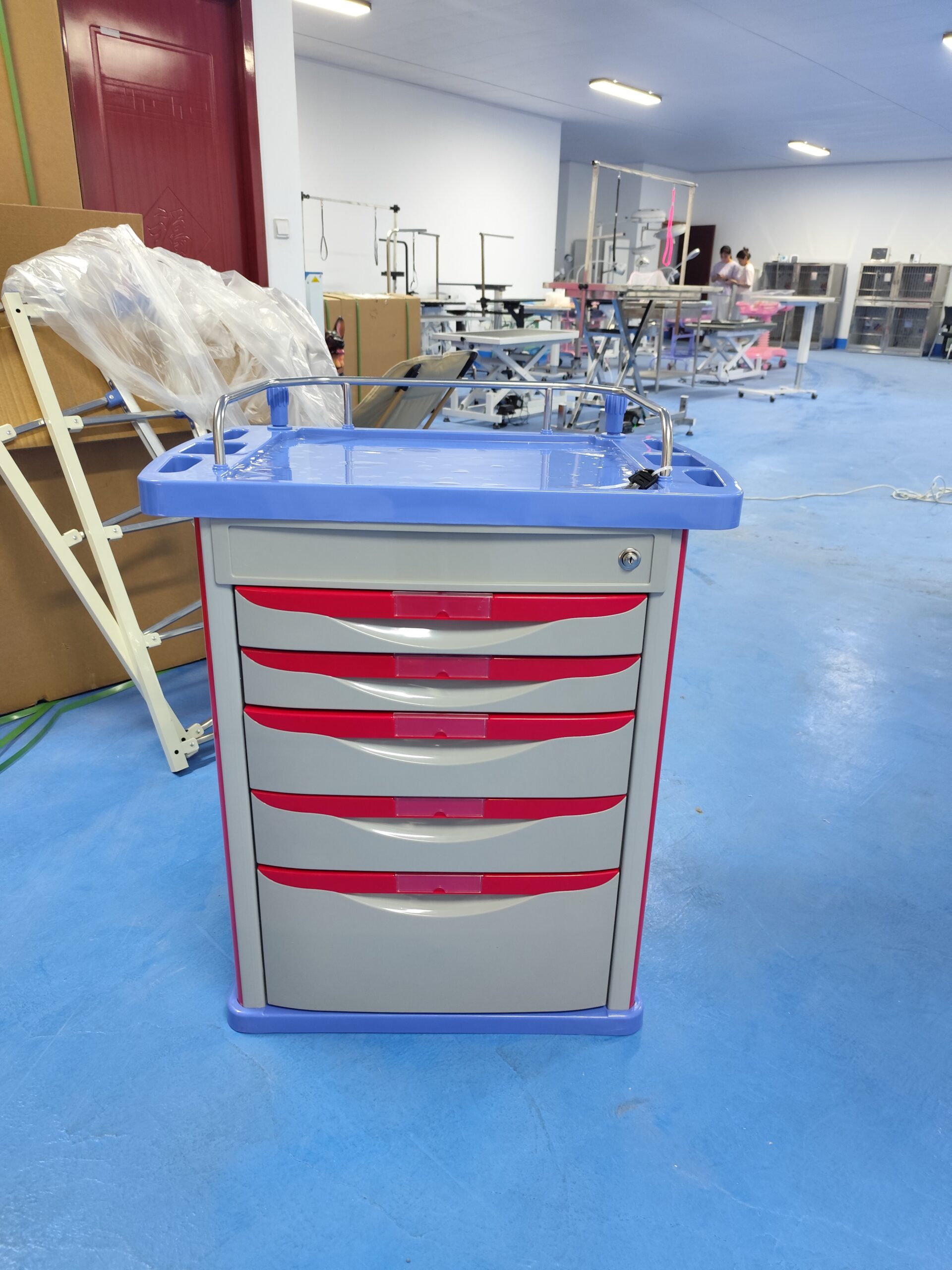
- Frame and worktop: material (powder-coated steel, stainless, or ABS), overall dimensions that fit your door widths and elevator cabs, and worktop load rating
- Drawer system: count, internal heights, divider system, soft-close runners, and a single keying/locking policy across the hospital
- Mobility: one caster specification hospital-wide — diameter, tread material, bearing type, and two-brake/two-swivel layout — so every caster in the building is interchangeable
- Accessories: an approved accessory list (IV poles, defibrillator trays, waste bins, glove box holders, sharps containers) with standard mounting points, so any accessory fits any trolley of that class
- Infection control: smooth, chemical-resistant surfaces; no exposed screw heads or seams that trap soil; documented compatibility with your hospital’s disinfectant agents
Warning: Never let individual departments customize drawer counts or add bolt-on accessories outside the approved list. One “small change” per ward is exactly how a standardized fleet quietly becomes a mixed fleet again within three years.
Step 3: Write the Technical Specification Around Standards, Not Brands
A procurement framework survives staff turnover only if the specification references objective standards and testable requirements rather than brand names. Three anchors belong in every trolley specification we write:
- IEC 60601-1 (3rd edition). When a trolley carries or powers medical electrical equipment — monitors, infusion pumps, defibrillators — the combination falls under medical electrical equipment safety requirements, including mechanical stability, tipping resistance, and enclosure integrity. Requiring the supplier to state compliance of powered configurations against IEC 60601-1 and relevant particular standards filters out hobby-grade products immediately.
- ISO 13485:2016. The manufacturer’s quality management system certificate is your assurance that the tenth production batch matches the first. Ask for the certificate, check its scope covers the product family, and verify it against the notified body’s register.
- EU MDR 2017/745 / local market registration. Depending on your market, trolleys with a medical purpose may carry CE marking under MDR or require local registration. Specify the target market explicitly and require the Declaration of Conformity in the tender package — the same discipline we recommend when hospitals verify supplier ISO and CE certifications for any device class.
Beyond certifications, convert your audit findings into measurable requirements. Casters are the classic example: instead of “high-quality casters,” write “125 mm swivel casters, TPR tread, precision ball bearing, individual brake on at least two casters, tested to 10,000-cycle durability” and ask for the test report. Stability is another: require a tip-resistance test with drawers fully extended at rated load — an unstable trolley with an open drawer is a documented injury mechanism.
| Fleet Class | Core Configuration to Standardize | Key Compliance / Test Point | Typical Replacement Cycle |
|---|---|---|---|
| Emergency (crash) trolley | 5–6 drawers, breakaway seal lock, defibrillator tray, cardiac board, IV pole | Drawer-rated load test; brake holding force; stability with top drawer open | 8–10 years |
| Anesthesia trolley | Tilting bin top, monitor shelf, deep lower drawers, key lock | IEC 60601-1 when powering equipment; worktop load ≥ 40 kg | 8–10 years |
| Treatment / dressing trolley | 2–3 drawers or tiered shelves, guard rails, waste bin mount | Chemical resistance of worktop to hospital disinfectants | 10+ years |
| Infusion / IV trolley | Height-adjustable IV poles, pump mounting rails, compact base | Stability at maximum pole extension; anti-static casters for ICU use | 8–10 years |
| Patient transfer stretcher | Adjustable backrest, side rails, central brake/steer system | Safe working load marking; rail latch strength test | 7–10 years |

Step 4: Choose the Supplier Model — and Lock in Spare Parts for a Decade
With configuration sheets and a standards-based specification in hand, the supplier conversation changes completely. You are no longer comparing brochures; you are comparing lifecycle offers. Structure the tender so that bidders must respond to the same five questions:
- Unit pricing at fleet volumes (e.g., 25 / 50 / 100 units per class)
- Guaranteed spare parts availability period — we advise writing 10 years minimum into the contract
- Spare parts pricing schedule attached to the bid, not negotiated later
- Warranty terms on frame, drawer runners, and casters stated separately (frame warranties of 5+ years are achievable at fleet volumes)
- Lead time and batch-consistency commitments, backed by the factory’s ISO 13485 production controls
This is where a manufacturer-direct relationship pays for itself. A distributor can sell you ten trolleys; only a factory can commit that the drawer runner you need in 2034 is still on the shelf. Our own spare parts service program was built around exactly this problem — fleet customers receive a reserved parts allocation and a fixed spare parts price list at the time of the original purchase, which removes the single biggest source of trolley downtime we see in the field.

Evaluate bidders on total cost of ownership, not ex-works price. A simple 10-year TCO model — purchase price plus parts, plus an estimated maintenance-hours line from your audit data — routinely reverses the ranking that a price-only comparison produces. The cheapest trolley on day one is very often the most expensive trolley by year five.
Field note: Ask every bidder one killer question: “Send me the part number and current price for a replacement drawer runner for the model you sold five years ago.” Factories with real lifecycle discipline answer in a day. Assemblers go quiet.
Step 5: Roll Out in Phases and Govern the Standard
Replacing an entire fleet in one purchase order is rarely necessary or wise. A phased rollout aligned with natural replacement cycles is cheaper and far less disruptive:
- Phase 1 — highest risk first. Emergency and anesthesia trolleys, where configuration consistency has direct clinical-safety implications, plus any units flagged as structurally unsafe in the audit.
- Phase 2 — highest failure cost. Classes generating the most maintenance work orders — typically ward treatment trolleys with worn casters and drawer slides.
- Phase 3 — natural attrition. Remaining classes replaced as units reach end of life, with a hard rule: no non-standard model may be purchased from this point forward, for any department, at any price.
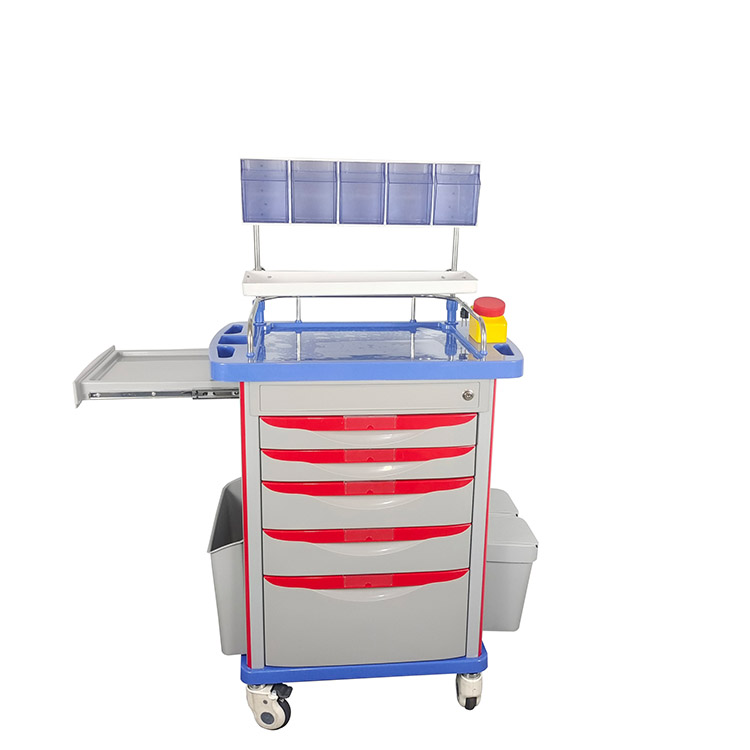
Governance is the part most frameworks skip, and it is why most standardization programs decay. Assign one owner — usually biomedical engineering or the central procurement office — to hold the configuration sheets, approve every trolley purchase order against them, and review the standard annually. New accessory requests go through that owner, get tested, and either join the approved list for the whole hospital or get rejected for everyone. That single gatekeeper mechanism is the difference between a standard and a suggestion.
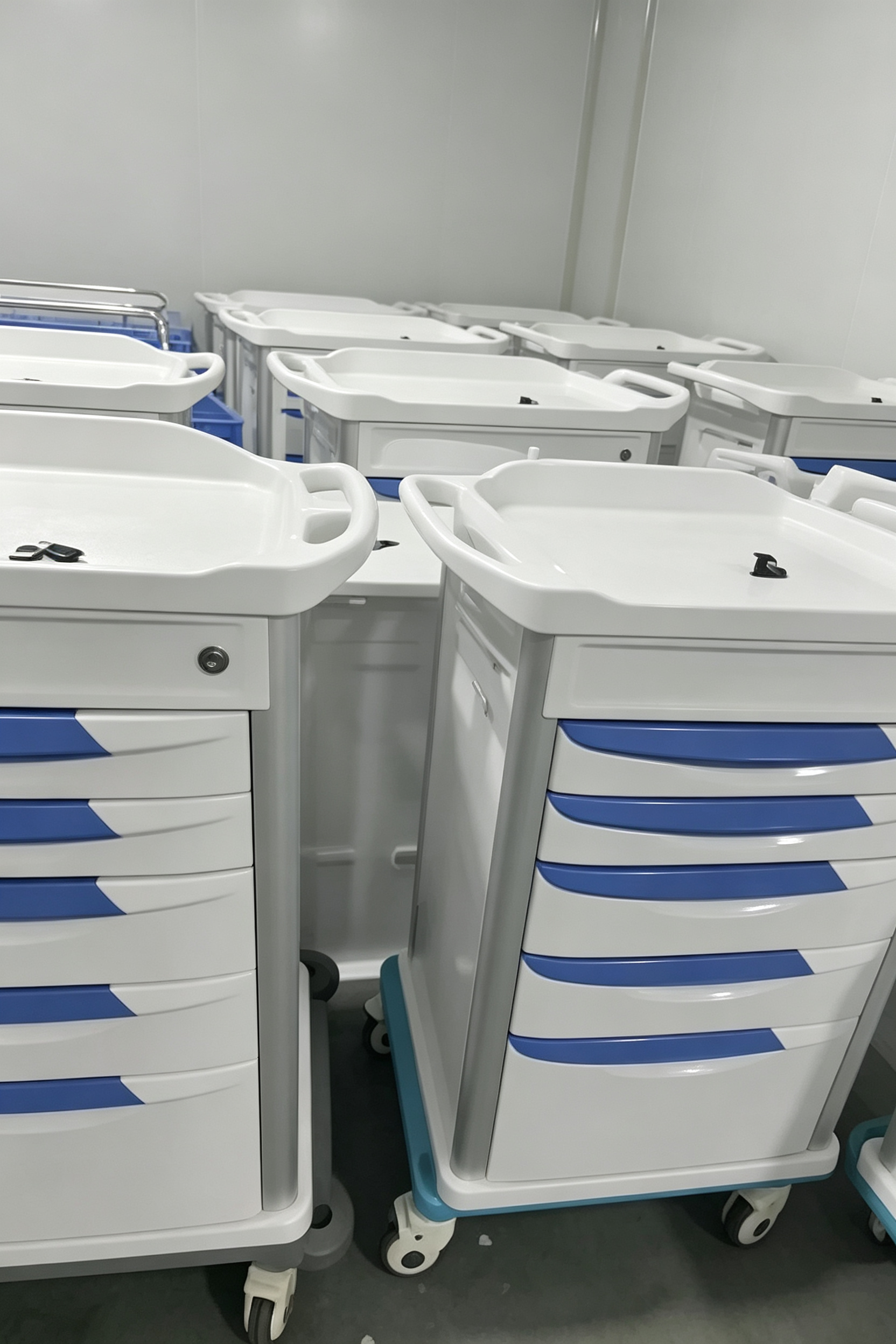
For hospital groups building new facilities, the cleanest path is to bake the trolley standard into the project specification from day one. When we equip facilities under our turnkey operating room and whole-department programs, trolleys are specified alongside the larger equipment — one platform decision, one parts pipeline, one training package for the entire new building.
Conclusion
Hospital trolley standardization is not a purchasing preference; it is an operating strategy. Audit what you actually own, consolidate the fleet into a small number of functional classes, write specifications anchored to IEC 60601-1, ISO 13485:2016 and applicable MDR requirements, contract spare parts availability for a decade, and govern the standard through a single accountable owner. Do those five things and the hidden taxes of a mixed fleet — parts chaos, training overhead, downtime, and weak negotiating positions — simply disappear from the budget.
If you are planning a fleet rationalization or a new facility fit-out, our engineering team can help you build the configuration sheets and run the TCO comparison against real factory data. Contact us with your fleet audit summary, and we will come back with a concrete standardization proposal.
Frequently Asked Questions
How many trolley models should a hospital standardize on?
Most general hospitals converge on five or six functional classes — emergency, anesthesia, treatment, infusion, medication, and patient transfer — with exactly one approved configuration per class. Large multi-site groups may add one or two specialty classes (isolation, endoscopy), but the principle holds: if two models do the same job, one of them is a cost leak.
Does standardization mean every ward gets identical trolleys?
No. Standardization operates at the class level: every emergency trolley in the hospital is identical, but the emergency trolley is deliberately different from the infusion trolley. Within a class, accessories come from one approved list with standard mounting points, so a ward can adapt the trolley to its workflow without breaking parts interchangeability or training consistency.
Which standards matter most when procuring medical trolleys?
Three anchors: IEC 60601-1 (3rd edition) for trolleys that carry or power medical electrical equipment, ISO 13485:2016 as evidence of the manufacturer’s quality management system, and the applicable market regulation — EU MDR 2017/745 for Europe or local registration elsewhere. Convert those into testable requirements (stability tests, caster cycle tests, chemical resistance) rather than accepting certificates at face value.
How long should a supplier guarantee spare parts availability?
Write 10 years minimum into the contract, with a spare parts price schedule attached to the original bid. Casters, drawer runners, brake pedals, and lock cylinders are wear items you will definitely replace. A supplier unwilling to commit parts pricing for a decade is telling you something important about their product’s lifecycle discipline.
What is the realistic payback period for a standardization program?
Hospitals typically recover the transition cost within two to three budget cycles through consolidated parts inventory (often cut by half or more), reduced maintenance labor per unit, lower training overhead, and volume pricing on the standardized platforms. The audit phase usually also surfaces 20–30% redundant units that can be redeployed instead of replaced, which improves the math further.
You May Also Like...

Medical Trolley Corrosion Resistance Guide: Salt Spray Testing for Humid Wards
A practical buyer's guide to medical trolley corrosion resistance: 304 vs 316 stainless steel, powder...

Hospital Utility Trolley Types: A Complete Guide to Selection, Zoning, and Procurement
Discover the six main hospital utility trolley types, their structural differences, infection control zoning rules,...

Medical Trolley Ergonomics: Push Force & Handle Height Guide
How initial and sustained push force, caster selection, and handle height drive musculoskeletal injury risk...