


Operating room ceiling pendants carry the two utilities surgery cannot pause: medical gas and electrical power, delivered exactly where the surgical team works instead of across floor cables that staff trip over. Specifying them well is less about the pendant itself and more about the zones around it: where the bridge rotates, how far the beams reach, and which gas outlets belong at the head of the table versus the anesthesia side. Buyers who understand those zones order pendants that install cleanly and serve for fifteen years; buyers who order on arm length alone create rooms that fight their own equipment.
Our medical pendant line covers single-arm, dual-arm and bridge configurations for OR and ICU projects, and the zone logic below is the same framework our free 3D OR layout service applies. Gas system requirements in health care facilities follow codes such as NFPA 99, which governs how medical gas and electrical systems are designed and verified in patient care areas.
Two pendants, two jobs: surgical and anesthesia
pendant gas, power and position zones
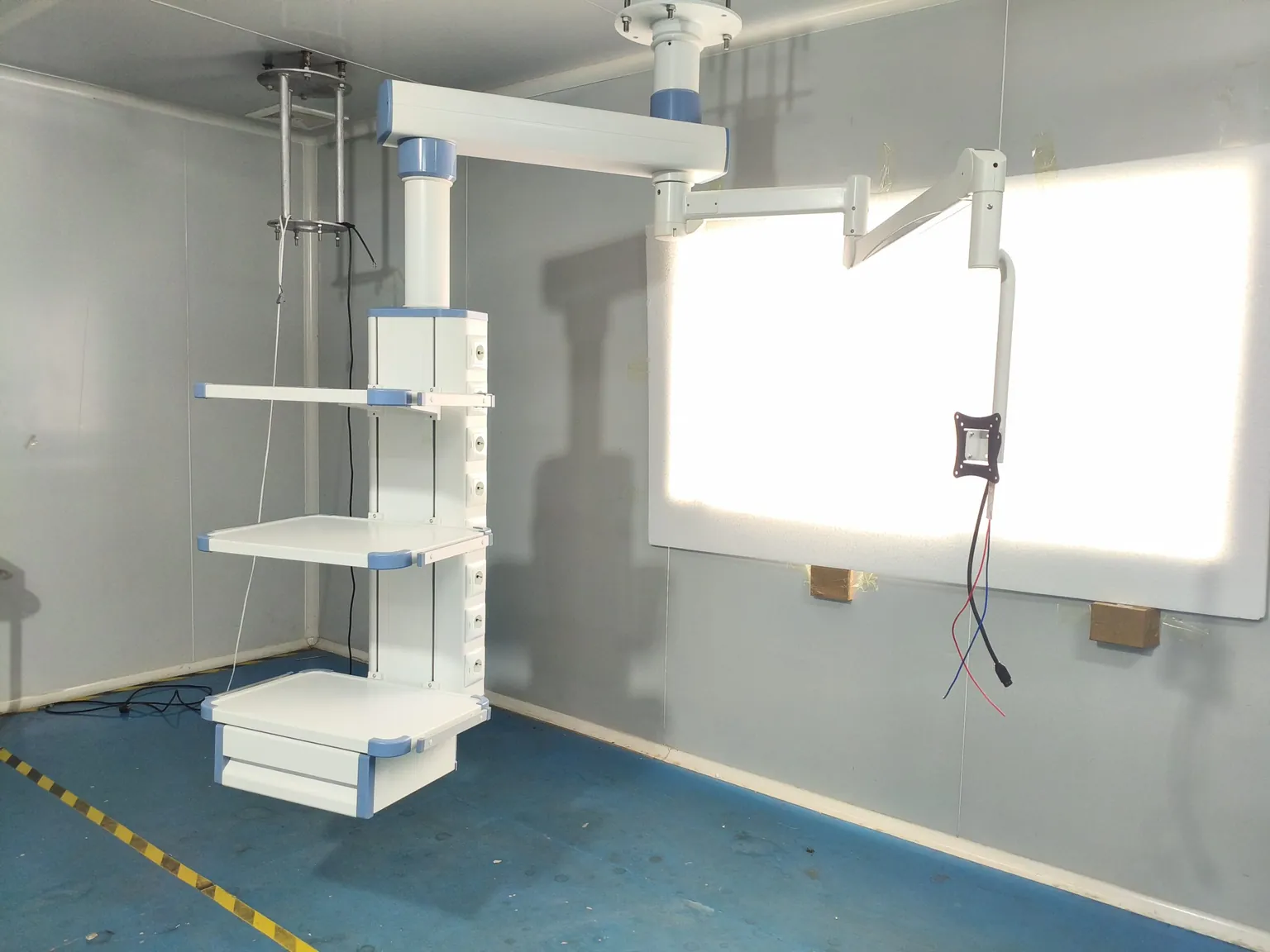
Most operating rooms serve two pendants with distinct duties. The surgical pendant hangs over the table’s operative field and carries the electrosurgical unit, monitor arms and sometimes a camera platform, positioned so cables drop from above without crossing the sterile field. The anesthesia pendant sits at the head of the table and carries the gas delivery side: oxygen, nitrous oxide, medical air, vacuum and the outlets the anesthesia machine depends on. Confusing the two zones is the classic first-time-buyer error, because outlet counts look similar while the working heights and rotation envelopes differ completely. The head pendant needs reach toward the airway with outlets angled for the anesthesia team; the surgical pendant needs clearance over the sterile field with minimal protrusion, and the same zone thinking extends into specialty rooms as our GI endoscopy room guide shows for procedure spaces.
| Zone | Typical services | Positioning priority |
|---|---|---|
| Surgical pendant | Power, ESU, monitors, data | Clearance over sterile field |
| Anesthesia pendant | O2, N2O, air, vacuum outlets | Reach to airway at head |
| ICU bridge | Gas, power, nurse station rail | One bridge per two beds |

Rotation, reach and the ceiling grid reality
Pendant performance lives in three numbers on the datasheet: rotation arc, arm reach and load capacity, and each interacts with the ceiling above. A 340-degree rotation is common on quality pendants, but the useful arc is whatever the ceiling grid and ceiling-mounted lights permit without collision, which is why the layout should be drawn before the pendant is ordered, not after. Arm reach of 800 to 1,000 millimeters per section covers most room geometries at standard OR sizes of roughly 36 to 42 square meters. Load capacity matters most on the surgical side: monitor arms, ESUs and camera platforms stack quickly, and a pendant rated below the real loaded weight sags into the sterile field. Our installation checklist in the ceiling mount guide applies to pendant anchors too, because both hang from structural points the building team must confirm.
Gas outlet planning that passes inspection
Gas outlets on pendants follow national outlet standards, German, British, French or the US Chemetron-style, and mixing standards on one pendant is an error discovered at commissioning. The outlet count should match the room’s procedure mix: a general surgery OR runs a different gas profile than a cardiac room with bypass support. Each outlet should be labeled, and the pendant’s internal gas pathways are pressure-tested before handover, a commissioning step the installing contractor documents per the applicable sections of NFPA 99 or the local equivalent. Electrical side planning parallels the gas work: medical-grade power outlets, isolated power where the room design requires it, and sufficient circuit count that the anesthesia machine and ESU never share a circuit.
We supply pendants as part of turnkey OR packages with free 3D layout design delivered in three working days, so rotation, reach and gas zones are settled on a drawing before manufacturing. Founded in 2015, our 15,000 square meter plant exports to five regions with CE and ISO 13485 certification; inquiries reach the team with layouts and quotations in days.
Video: pendants in a project OR
The clip shows equipment positioned in a clinical-style room. The zones described above are what make pendants disappear into good workflow rather than dominate the room.
Frequently asked questions
What is the difference between a surgical and an anesthesia pendant?
The surgical pendant serves the operative field with power, monitors and ESU connections; the anesthesia pendant serves the airway with gas outlets positioned at the head of the table. Their reach, heights and rotation envelopes differ by design.
How is pendant load capacity calculated?
Sum the mounted equipment weight, monitors and platforms, then add margin for future additions. A pendant rated under the real loaded weight sags into the sterile field over time.
Which gas outlet standard should we order?
The national standard your gas system uses: German, British, French or US Chemetron-style. Mixing standards on one pendant causes commissioning failures and should be specified consistently across the room.
Can pendants be added to an existing OR?
Yes, where the ceiling provides structural anchors and the room height accommodates the arm stack. A site survey confirms anchors, ceiling void depth and the rotation envelope before ordering.
Related reading: OR Traffic Flow Design: From Sterile Core to Recovery Without Crossed Paths
Related reading: Gas Outlet Colour Coding and Pin Index
You May Also Like...

Air Change Rates and Recovery Times in the OR: What Equipment Specs Should Assume
An operating room’s ventilation is invisible until something goes wrong. The air change rate decides...

Pendant Arm Length and Coverage: Matching Reach to Room Layout
A surgical pendant with the wrong arm configuration turns an otherwise correct operating room into...

Surgical Smoke Evacuation: Systems, Filters and Room Planning for OR Teams
Every electrosurgical and laser procedure produces smoke, and the smell in the room after a...

1 thought on “Operating Room Ceiling Pendants: Gas, Power and Positioning Zones”