
Executive Summary
Operating table battery backup is a patient-safety system, not a convenience feature. Learn real-world runtime, UPS pairing, intraoperative power-failure response, and battery maintenance and replacement cycles.
The lights flicker, the anesthesia monitor goes dark for a heartbeat, and the circulating nurse calls out that the building just lost utility power. In that two-second window, the surgeon’s hands are still inside the patient, and the only thing standing between a controlled pause and a genuine emergency is whether the operating table battery backup kicks in cleanly. If the tabletop locks in place, the Trendelenburg tilt freezes, or the column refuses to lower, the team suddenly has a manual-rescue problem on top of a power problem. I have watched this play out in a district hospital where the backup battery had quietly sulfated over eighteen months of neglect: the table would not move electrically, the staff fumbled for a manual release lever nobody had touched since installation, and a routine procedure turned into a twenty-minute scramble.
When the backup battery is depleted, the manual crank is the fallback: see our operating table manual override guide.
Here is the uncomfortable truth that most spec sheets gloss over: an operating table battery backup is not a “nice to have” convenience feature. It is a patient-safety system with a finite, degrading service life. The internal pack is sized to get you through a transfer or a controlled finish of a critical step, not to run a full elective list. And it only works if someone has actually tested it.
This guide is for the people who carry the risk: biomedical engineers, operating room managers, procurement officers, and the distributors who specify tables for tenders. We will walk through how the internal backup system works, what runtime you can realistically expect under surgical load, how the table battery fits with the facility UPS and generator, what to do the moment power drops mid-procedure, and how to maintain and replace the pack so it works the one time it matters, closing with a procurement and acceptance checklist you can drop straight into a tender document. If you are also weighing drive types, our breakdown of electric versus hydraulic operating tables covers how power architecture differs between the two.

Why Operating Table Battery Backup Is a Patient-Safety Issue, Not a Convenience Feature
It is tempting to treat the backup battery as a checkbox line item, the way you might treat a spare power cord. That framing is dangerous because of where the table sits in the chain of clinical consequences. During a procedure, the tabletop position is part of the therapy: reverse Trendelenburg keeps a laparoscopic field clear, a lateral tilt may be controlling bleeding, a lowered column may be the difference between a stable patient and a rushed transfer. When utility power and the facility’s emergency power supply system (EPSS) are both unavailable, the internal battery is the only thing preserving those positions and the ability to change them.
Regulators treat it that way. Operating tables fall under IEC 60601-2-46, the particular standard for the basic safety and essential performance of operating tables, layered on the general IEC 60601-1 standard. The key phrase is “essential performance”: functions whose loss would create an unacceptable risk must remain available or fail safe. A table that silently loses the ability to reposition a patient during a power interruption is failing essential performance. On the facility side, hospitals are governed by emergency power rules such as NFPA 110 and the stored-energy standard NFPA 111. The table battery is the device-level complement to those building-level systems.
A backup battery that has never been tested is not a backup. It is an assumption. And assumptions fail at the worst possible moment, usually in month fourteen, when the pack is already past the point where a voltage check would have caught it.
How the Internal Battery System Works (and What It Can Actually Run)
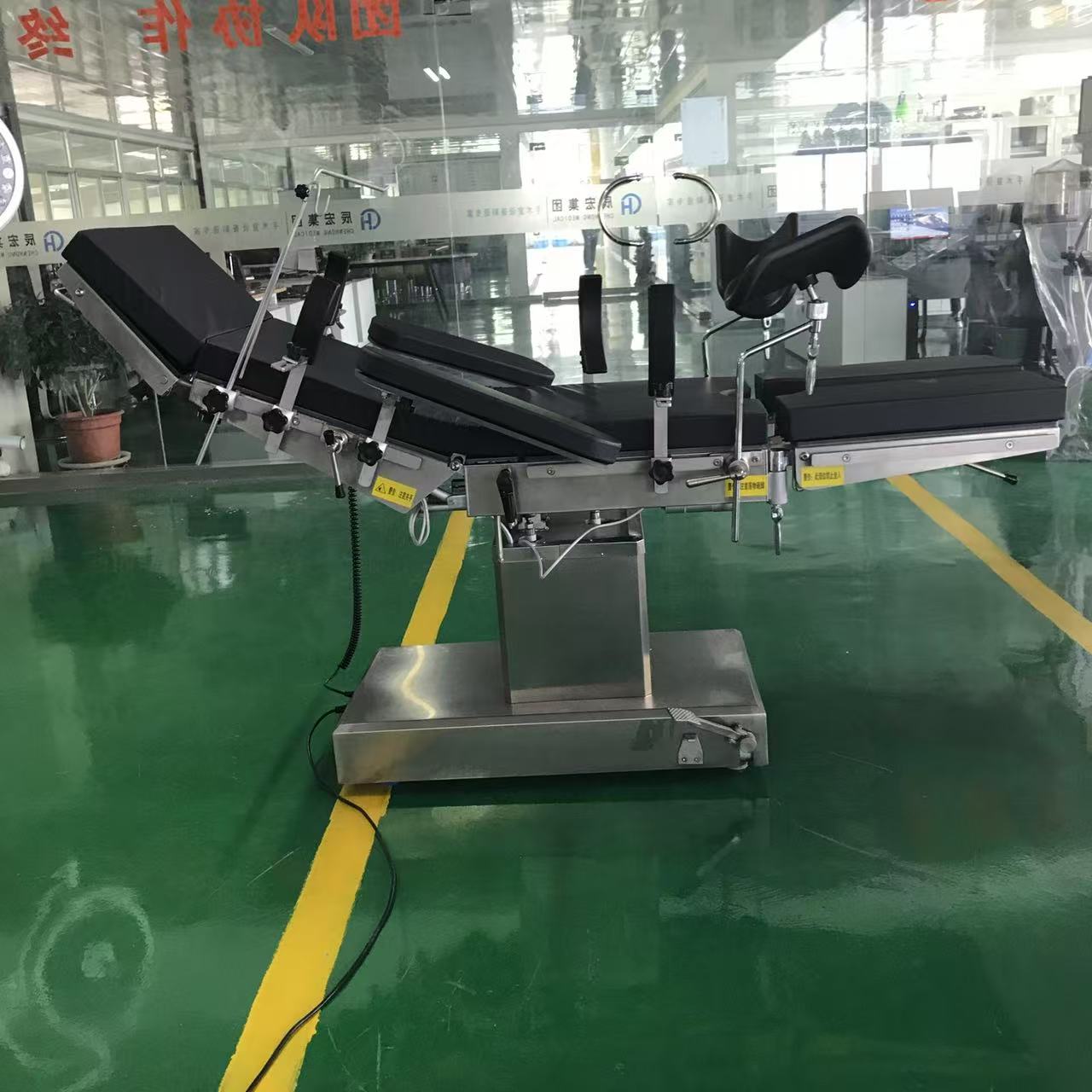
Most modern electric operating tables use a sealed lead-acid (SLA) or lithium-ion pack housed in the base column, paired with a charging board that keeps it topped up whenever the table is on mains power. When utility power is present, the table runs from the mains while the charger holds the pack at float voltage. When power drops, a relay or solid-state switch transfers the drive electronics to the battery, ideally with no interruption the team can perceive. On a poorly designed table, a half-second dropout resets the hand control or drops a memory position.
The critical detail buyers miss is what the battery is actually wired to power. There are generally three tiers, and they have very different implications for your emergency planning:
- Full articulation on battery: The pack drives every electric function, height, tilt, Trendelenburg, backrest, and translation, at full rated load. This is the gold standard and what you should specify for any table used in high-acuity surgery.
- Limited articulation on battery: The pack moves the table but with reduced speed, fewer cycles, or only a subset of axes. Some designs prioritize getting the table flat for transfer over preserving full motion.
- Control and lock only: The battery keeps the control electronics alive and the electromagnetic brakes released or engaged, but cannot drive the motors for long. Here the manual mechanical release becomes the primary rescue path.
You need to know which tier you are buying, stated in writing. A table that only powers the control board is not the same product as one that can run a full repositioning sequence under a 250 kg load, even if both brochures say “battery backup included.” Every electric table should also have a clearly marked, tool-free manual override that lets staff move the tabletop without any electrical power at all. The battery gives powered control; the manual release gives a guaranteed fallback if the battery itself has failed. We cover the electrical safety side of this architecture in our guide to operating table grounding fault troubleshooting, since a degraded ground path and a degraded battery often show up together on aging units.

Battery Runtime: What to Expect Under Real Surgical Load
Runtime is the number everyone asks for first, and the number most often misunderstood. A manufacturer’s stated runtime is usually measured under a gentle test profile, a fixed number of articulation cycles or a fixed current draw at moderate load and controlled temperature. Your operating room will rarely match that profile. A bariatric case at maximum table height with repeated Trendelenburg adjustments draws far more current than a light patient lying flat, and cold rooms reduce available capacity, especially for lead-acid chemistry.
Rather than chase a single runtime figure, specify and verify against a duty profile that reflects your surgical mix. A practical way to frame it is “full repositioning cycles at maximum rated load.” Ask the supplier how many times the battery can move the table from flat to full Trendelenburg and back, at the maximum patient weight rating, before the pack is exhausted. That number is far more meaningful for emergency planning than an abstract “minutes of standby,” because it tells you how many corrective moves your team has if power fails at the worst moment. Treat any specific figure as a starting point for verification, not a guaranteed field result.
| Factor | Effect on Real-World Runtime | What to Specify / Verify |
|---|---|---|
| Patient and accessory load | Higher load raises motor current and shortens available cycles | Cycles measured at maximum rated load, not no-load |
| Battery chemistry | Lithium holds capacity better over life and temperature; SLA is cheaper but degrades faster | Chemistry, rated Ah, and expected cycle/calendar life |
| Ambient temperature | Cold ORs reduce available capacity, especially lead-acid | Runtime characterized across the stated operating range |
| Pack age and cycle history | Capacity fades with calendar age even when rarely used | Manufacture date on pack; replacement interval in PM plan |
| Functions powered on battery | Full articulation drains faster than control-only standby | Written statement of which axes run on battery |
| Charger and float behavior | Over- or under-charging accelerates degradation | Charge status indicator and float voltage documentation |
Voltage is not capacity. A battery can read a perfectly normal resting voltage and still collapse the moment a motor demands real current. The only test that matters is a loaded test, the same lesson facility teams learn the hard way with generator starting batteries under NFPA 110.
Pairing the Table Battery with a Facility UPS and Generator
The operating table does not exist in isolation. It plugs into an operating room that should already be protected by the building’s essential electrical system. In a properly designed facility the chain of defense looks like this: utility power feeds the room through a dedicated branch; a UPS bridges the seconds between a utility loss and generator start; the generator picks up the essential loads within the window required by the applicable code; and the device-level battery, the table’s internal pack, covers any gap or any load not on the emergency branch. Where the table sits in that chain tells you how much you can lean on its internal battery and where you need facility-level protection instead.
A common and costly mistake is assuming the table battery substitutes for a room-level UPS. It does not. The table battery protects the table; it does nothing for the anesthesia machine, surgical lights, monitors, or electrosurgical unit. If those devices lose power, the table staying alive does not save the case. The robust design layers both: facility UPS and generator for the room, and a healthy, tested internal pack for the table as the last line of defense.
- Confirm the receptacle branch. Know whether each table outlet is on normal power, the equipment branch of the essential system, or the life-safety branch. Tables used during critical procedures should be on a protected branch, not a generic convenience circuit.
- Size the room UPS for the bridge. The UPS only needs to carry loads for the seconds it takes the generator to start and stabilize. It is a bridge, not a marathon runner.
- Test the generator transfer under load. A generator that starts but fails to transfer, or transfers with a voltage dip that resets equipment, defeats the whole design. Periodic load-bank testing catches this before a real outage does.
- Keep the table battery as the device-level fallback. Even with a perfect facility system, the internal pack protects against a disconnected table, a tripped local breaker, or a fault downstream of the UPS.

Intraoperative Power Loss: A Practical Emergency Response Flow
Technology only matters if the team knows what to do when it is tested. The moment power fails mid-procedure, the priority order is fixed: protect the patient’s physiology first, preserve the surgical field second, troubleshoot the equipment third. Anesthesia continues manual ventilation; the surgeon stabilizes the operative site; only then does anyone reach for the table controls. A written, drilled protocol beats improvisation every time, and it should be posted where the team can see it, not buried in a binder. A practical step-by-step flow for the table looks like this:
- Step 1, Pause and stabilize. The surgeon halts non-essential movement; anesthesia confirms ventilation and oxygenation are intact on backup power. Nobody touches the table position until the patient is physiologically stable.
- Step 2, Confirm the table is on battery. Check the charge or power-status indicator, then make one deliberate, confirmed move to verify the response before relying on it.
- Step 3, Reposition only as needed. Use the minimum movement required to keep the patient safe and the field workable. Every articulation cycle spends battery capacity you may need again.
- Step 4, Locate the manual release before you need it. If the battery does not respond, go straight to the manual mechanical override. Know its location and operation in advance.
- Step 5, Decide to continue, pause, or transfer. Based on the procedure stage, estimated remaining battery capacity, and facility backup status, the team lead decides whether to finish the critical step, hold, or transfer.
- Step 6, Document and report. Record the event, the table’s behavior, and the battery indicator state. This triggers the post-event battery inspection described in the next section.
The single most important habit is knowing the manual release cold. Run it during onboarding and routine drills. A team that has physically practiced the manual override will execute it in seconds; a team that has only read about it will waste precious minutes locating the lever and figuring out which way it moves. Pair the drill with a clear escalation path so someone checks the UPS and generator status in parallel while the clinical team stays on the patient.

Battery Maintenance, Testing, and Replacement Cycle
This is where the patient-safety framing pays off. A backup battery is a consumable with a predictable degradation curve, and managing it is a scheduled preventive-maintenance task, not a fix-it-when-it-fails task. The failure mode is insidious: a degrading pack looks fine on a resting voltage check right up until the day a motor demands current and the voltage collapses. The only reliable defense is periodic loaded testing combined with a hard calendar replacement interval. Build the battery into your preventive-maintenance (PM) plan with three layers: a frequent visual and indicator check folded into a monthly or quarterly room check; an annual loaded functional test, disconnecting from mains and running a defined articulation sequence at a representative load to confirm the table completes it without voltage sagging below cutoff; and a hard replacement interval driven by chemistry and age.
- Sealed lead-acid (SLA) packs: Plan on a shorter service life and tighter replacement interval. Calendar aging and sulfation from sitting at partial charge are the dominant failure modes. Replace on schedule even if the pack passes a voltage check.
- Lithium-ion packs: Longer calendar and cycle life, better temperature tolerance, and usually an onboard management circuit. Still replace on a defined interval; lithium degrades too, just more slowly.
- Record the manufacture date. Tag every pack with its install and manufacture date at acceptance. Age-based replacement only works if you know the clock’s start point.
- Use only the specified replacement. A pack with the wrong voltage, capacity, or charge profile can damage the charger board. Source replacements through the manufacturer or an authorized spare parts channel.
- Test after every real discharge event. Any time the battery carries a load during an outage, inspect and load-test it afterward. Deep discharge accelerates aging, especially for lead-acid.
The replacement interval itself should come from the manufacturer’s documentation, confirmed against your local conditions: OR temperature, how often the table is unplugged, how frequently the pack is exercised. Where a manufacturer gives a recommended interval, treat it as a maximum and shorten it for harsh environments. Where none is stated, push the supplier to provide one in writing before you accept the table; its absence is itself a procurement red flag. This is also a strong argument for buying from a manufacturer that backs the table with a long-term parts and service commitment, the kind of relationship we describe on our company background page.

Procurement and Acceptance Checklist for Buyers
Everything above collapses into a single question at the tender stage: how do you write a specification and an acceptance test that forces suppliers to deliver a working, maintainable backup system rather than a marketing bullet? Make the battery a tested, documented deliverable with explicit acceptance criteria. Below is a checklist you can adapt directly into a tender’s technical schedule and your goods-inward inspection.
- Stated functions on battery. The bid must list, in writing, every table axis that operates on battery and whether full articulation is available at maximum rated load.
- Runtime expressed as loaded cycles. Require a repositioning-cycle figure at maximum rated load, not just standby minutes, plus the test conditions behind it.
- Battery chemistry and rated capacity. Specify SLA or lithium, the rated Ah, and the expected cycle and calendar life.
- Charge status indication. A clear, visible indicator of charge state and charging status so staff can confirm readiness at a glance.
- Manual override. A tool-free, clearly marked manual release, demonstrated at acceptance and documented in the user manual.
- Documented replacement interval. A manufacturer-stated replacement interval and a confirmed long-term spare-parts commitment.
- Compliance documentation. Evidence of conformity to IEC 60601-2-46 and IEC 60601-1, plus ISO 13485 and, for the EU market, MDR 2017/745.
- Acceptance load test. At goods-inward, disconnect from mains and run a defined articulation sequence under representative load; record pass/fail before signing acceptance.
Two commercial points protect you after signing. First, require the battery pack to be date-marked, with the manufacture date in the acceptance record, so the replacement clock is unambiguous. Second, negotiate spares availability and a battery replacement lead time into the contract; a backup system with a twelve-week parts lead time is not much of a backup. A supplier confident in their product will state a replacement interval, guarantee parts availability for a defined number of years, and support an acceptance load test without hesitation.
The cheapest battery backup is the one you never test and never replace, right up until the day it costs you a patient outcome. Specify it as a maintained safety system, accept it under load, and replace it on a calendar, and the cost per year is trivial against the risk it covers.
Conclusion
An operating table battery backup is best understood as the device-level last line of defense in a layered power-protection strategy. It follows the same essential-performance logic that runs through IEC 60601-2-46, and it complements rather than replaces the facility UPS and generator that protect the rest of the operating room. Its real-world runtime is a function of load, chemistry, temperature, and above all age and maintenance history.
The practical program is straightforward: know exactly which functions your table runs on battery; pair it with a properly tested room-level UPS and generator; drill the intraoperative power-loss flow until the manual override is muscle memory; and manage the pack as a scheduled consumable with documented testing and a hard replacement interval. Carry that discipline into procurement, specifying loaded-cycle performance, charge indication, a documented replacement interval, and an acceptance load test. Do those things and the battery stops being an assumption and becomes what it should be: a tested, dependable safety system ready for the one moment it matters. To explore platforms engineered with this failure case in mind, browse the operating table range or talk to our engineering team.
Frequently Asked Questions
How long does an operating table battery backup actually last during a power failure?
There is no single number, because runtime depends on patient load, battery chemistry, ambient temperature, and pack age. A healthy pack on a well-designed table should support multiple full repositioning cycles at maximum rated load plus a meaningful period of standby control power. Specify a loaded-cycle figure and verify it with a functional test rather than trusting a standby-minutes figure measured under gentle lab conditions.
Do I still need a facility UPS if the table has its own battery?
Yes. The table battery protects only the table; it does nothing for the anesthesia machine, surgical lights, monitors, or electrosurgical unit. A room-level UPS bridges the seconds between utility loss and generator start for the whole ecosystem, while the table’s internal pack remains the device-level fallback for a disconnected table or a fault downstream of the UPS. The two are complementary layers, not substitutes.
How often should the operating table backup battery be replaced?
Follow the manufacturer’s documented replacement interval and treat it as a maximum, shortening it for cold rooms or frequent deep discharges. Sealed lead-acid packs generally need replacing sooner than lithium-ion packs because of sulfation and calendar aging. Replace on a calendar schedule rather than waiting for failure, and always load-test the pack after any real discharge event.
What is the first thing staff should do if power fails mid-surgery?
Protect the patient’s physiology first. Anesthesia confirms ventilation and oxygenation on backup power while the surgeon stabilizes the operative site. Only then should anyone check the table’s battery indicator and make a single deliberate move to confirm powered articulation still works. If the battery does not respond, go straight to the manual mechanical override, which every team should have practiced in advance.
What should I write into a tender to guarantee a usable battery backup?
Require a written statement of which table axes run on battery at maximum rated load, a repositioning-cycle figure measured under load, the battery chemistry and rated capacity, a visible charge-status indicator, a tool-free manual override, a documented replacement interval with guaranteed spare-parts availability, and evidence of conformity to IEC 60601-2-46 and IEC 60601-1. Then make an acceptance load test a condition of sign-off.
You May Also Like...

After-Hours Maintenance Strategy: Minimizing OR Downtime
Operating room downtime is expensive because an idle OR still burns staff, overhead and scheduled...

Operating Table Battery Replacement: Procedure and Intervals
Operating table battery replacement is the routine swap of the integrated backup battery that keeps...

Trolley Lock Cylinder Maintenance: Keyed and Push-Lock Types
Medical trolleys fail at the lock. Not the frame, not the casters, not the drawers...