
Executive Summary
Electric, hydraulic, or manual? Compare operating table drive systems on precision, load capacity, TCO, IEC 60601-2-46 compliance, and maintenance to pick the right table for your OR.
Ask ten hospital procurement officers what matters most in an operating table and you will get ten different answers — until the power cuts mid-procedure, or a hydraulic pump starts weeping oil onto a freshly mopped OR floor. Then the answer becomes very clear: the drive system. Whether a table moves by electric actuators, hydraulic pressure, or manual cranks determines not just the purchase price, but positioning precision, maintenance burden, infection-control workload, and how gracefully the table fails when something goes wrong. When buyers browse our operating table product range, the first question I ask back is never “what is your budget” — it is “what does your surgical day actually look like?”
For the emergency controls on each drive type, including manual cranks and release valves, see our operating table manual override guide.
I have spent years helping hospitals, distributors, and OEM partners match drive systems to real operating rooms, from high-throughput orthopedic centers in Southeast Asia to district hospitals in West Africa running on unstable grids. The electric vs hydraulic operating table debate is not about which technology is “better” in the abstract. It is about which failure modes, cost curves, and maintenance skill sets your facility can actually live with for the next ten to fifteen years. A manual table in a modern laminar-flow theater is a bottleneck; a fully electric table in a clinic with daily brownouts and no local service engineer is a liability.
This guide walks through how each drive system works, a head-to-head comparison of the specifications that matter, and a four-step selection framework we use with our own OEM and project customers. By the end you should be able to defend your choice to a surgical committee, a biomedical engineering team, and a finance director — three audiences who care about very different things.
How the Three Drive Systems Actually Work
Before comparing, it helps to be precise about what each system is, because marketing brochures blur the lines badly. “Electro-hydraulic” in particular gets sold as electric when the underlying motion is still oil-driven.
Electric (Electro-Mechanical) Operating Tables
A true electric operating table uses DC or AC linear actuators — motor-driven screw mechanisms — for every motion: height, Trendelenburg, lateral tilt, back section, and often leg sections and longitudinal slide. The surgeon or circulating nurse controls positioning from a corded hand pendant, an infrared remote, or a foot pedal, and most modern units add a backup battery so the table keeps full function during a mains failure. Positioning is repeatable to the millimeter, speed is consistent regardless of load, and advanced models offer memory presets — press one button and the table drives itself to your standard beach-chair or lithotomy configuration.
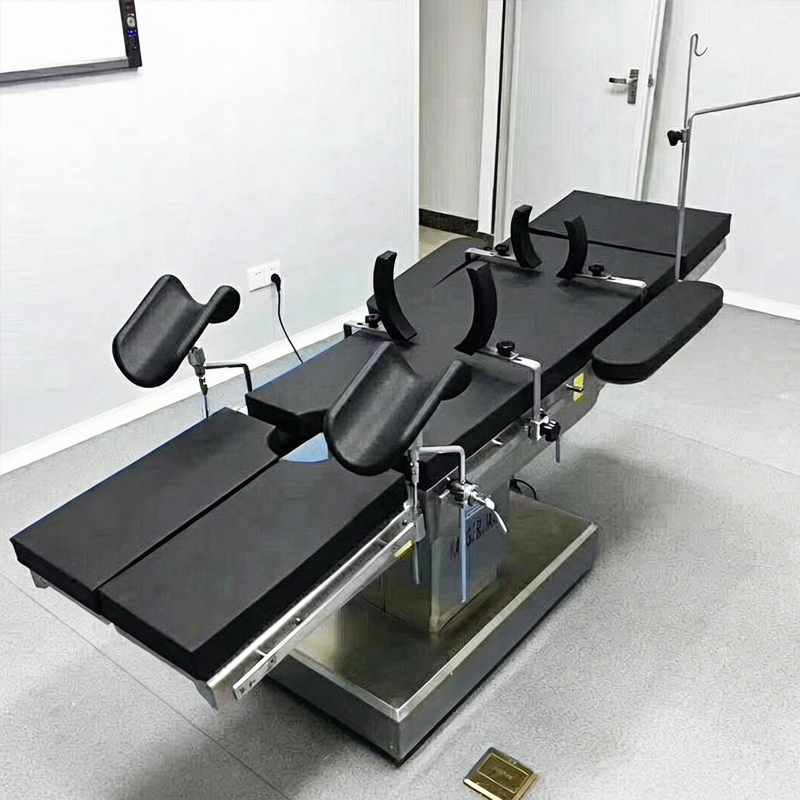
Hydraulic Operating Tables
Hydraulic tables move oil through valves and cylinders to generate motion. On classic models, a foot pump or hand lever pressurizes the system and the operator releases valves to set height, tilt, and Trendelenburg. On electro-hydraulic models, an electric motor drives the pump and the operator uses push buttons — which is why they get marketed as “electric.” The distinction matters: hydraulics deliver very smooth, damped motion and excellent load capacity (300–450 kg working loads are common), which is why they remain the default for bariatric and heavy orthopedic work. The trade-off is the fluid itself: seals age, pumps wear, and a hydraulic table that is losing oil is both a contamination risk and a positioning-drift risk.

Manual (Mechanical) Operating Tables
Manual tables use hand cranks, gas springs, and geared linkages. There is no pump to leak and no battery to die. They are the simplest to clean, the cheapest to buy, and effectively immune to power and electronics failures. The cost is ergonomics and workflow: repositioning a patient mid-case means a nurse cranking handles at the side of the table, which is slow, physically demanding, and impossible to do with the fine precision a pendant offers. For low-volume rural theaters, maternity units, and field or backup applications, that trade-off is often exactly right.
Electric vs Hydraulic vs Manual: Head-to-Head Comparison
This table condenses what we document for customers during tender evaluations. Ranges reflect typical mid-to-premium general surgery tables; specific models vary, so always verify against the manufacturer’s declaration and test reports.
| Criterion | Electric | Hydraulic / Electro-Hydraulic | Manual |
|---|---|---|---|
| Positioning precision & repeatability | Excellent; memory presets, millimeter-level control | Good; very smooth motion, minor drift possible as seals age | Basic; crank-driven, depends on operator |
| Typical safe working load | 200–360 kg (bariatric versions higher) | 300–450 kg; best for bariatric/ortho | 150–250 kg |
| Power dependency | Mains + backup battery required | Foot-pump models: none; electro-hydraulic: mains/battery | None |
| Mid-case repositioning | One-touch via pendant, nurse stays sterile-field aware | Push-button (electro) or pump/valve handling at table side | Slow manual cranking; staff fatigue over long lists |
| Maintenance profile | Actuators, control boards, battery replacement every 3–5 years | Seal kits, oil changes, pump service; leak risk | Lubrication and mechanical checks only; lowest skill bar |
| Infection control | Good; sealed columns, watch cable/remote ingress points | Oil seepage complicates floor and base cleaning | Simplest geometry, easiest full wipe-down |
| Typical price position (FOB factory) | Highest (baseline 100%) | Mid (roughly 60–85% of electric) | Lowest (roughly 25–45% of electric) |
| Best-fit environment | High-volume theaters, MIS, neuro, hybrid ORs | General/orthopedic/bariatric surgery, mid-tier hospitals | Rural, backup, maternity, field and low-volume ORs |
Step 1: Match the Drive System to Your Surgical Mix
The single most reliable predictor of drive-system regret is a mismatch between the table’s motion capability and the case mix. Pull your last twelve months of theater logs and bucket the cases. If more than a third of your volume is minimally invasive, neuro, spinal, or imaging-guided work that demands frequent fine repositioning and C-arm access, an electric table with longitudinal slide and memory presets will pay for itself in turnover time alone. We routinely see five to ten minutes saved per case on repositioning and setup, which compounds into an extra case per theater day on busy lists.
If your mix is dominated by general surgery, trauma orthopedics with heavy patients, or bariatric programs, hydraulic load capacity and smooth damped motion become the priority. And if the theater runs two or three cases a week — a district hospital, a maternity unit doing cesareans, a procedure room — a manual or foot-pump hydraulic table delivers 90% of the clinical function at a fraction of the cost and almost no maintenance infrastructure.
Experience rule: buy for your busiest realistic Tuesday, not for the one complex case you did last year. Over-specifying drive systems is the most common way we see hospitals strand 30% of their equipment budget.
- High-volume multi-specialty theater: electric, with backup battery, memory presets, and C-arm-compatible tabletop.
- Orthopedic and bariatric focus: hydraulic or electro-hydraulic with 350 kg+ safe working load and traction-frame compatibility.
- Low-volume or off-grid facility: manual or foot-pump hydraulic; zero dependence on electronics or battery health.
- Mixed-use regional hospital: electric in the main theater, hydraulic in the second, manual as backup — a combination we configure frequently in turnkey projects.
Step 2: Calculate Total Cost of Ownership, Not Purchase Price
Before the numbers, one more workflow cost deserves a hard look: staff time. An electric table’s one-touch repositioning removes a real physical task from the circulating nurse’s workload on every case, and in regions facing nursing shortages that ergonomic saving is not a luxury — it directly affects how many cases a team can run per shift without fatigue-related errors. Manual cranking under sterile drapes, with a 120 kg patient under anesthesia, is exactly the kind of low-tech task that quietly consumes skilled labor. Factor one to two minutes of staff time per repositioning event, multiplied by your annual case volume, into any honest comparison.
The invoice price is the smallest honest number in this decision. Over a ten-year service life, each drive system carries a distinctly different cost curve. Electric tables need battery replacements roughly every three to five years, periodic actuator service, and — critically — a technician who can read control-board error codes. If the nearest qualified engineer is a two-day journey away, every fault becomes theater downtime. Hydraulic tables need seal kits and oil service on a preventive schedule; skip it and you get drift, then leaks, then a table that cannot hold Trendelenburg under load. Manual tables need grease and the occasional gear inspection, and almost anyone can do it.
When we build TCO models for distributors, the ten-year cost gap between electric and hydraulic typically narrows to 10–20% once service parts, technician visits, and downtime are priced in — far smaller than the 30–40% sticker gap. But that only holds if service is actually available locally. This is why we ask OEM partners about their in-country service capability before quoting configurations, and why our OEM/ODM and localization program includes service documentation, spare-parts kits, and technician training matched to the drive systems being shipped.
Warning: the most expensive operating table is the one that sits unused because nobody within 500 km can service its drive system. Price the service ecosystem before you price the table.
Step 3: Verify Compliance Against the Right Standards
Whichever drive system you choose, the table must demonstrably meet the safety standard written specifically for it. IEC 60601-2-46 — “Particular requirements for the basic safety and essential performance of operating tables” — is the reference document, currently in its third edition (2016, with the European adoption EN IEC 60601-2-46:2019 and updated editions published in the 2023–2024 cycle). It covers, among other things, stability under eccentric loads, safe working load verification, mechanical hazards, and — directly relevant here — the performance of the positioning system, including protection against unintended movement. For electrically driven tables it applies together with the general standard IEC 60601-1 and collateral standards such as IEC 60601-1-2 for electromagnetic compatibility.
For sales into the EU, the table must carry CE marking under the Medical Device Regulation (EU) 2017/745, supported by a quality management system certified to ISO 13485. Practical advice from years of tender support: do not accept a certificate number at face value. Ask for the IEC 60601-2-46 test report summary, confirm the notified body or test lab actually issued it, and check that the certificate scope names the table model and drive configuration you are buying — a factory’s electric table certificate does not cover its hydraulic line. Market analysts tracking the surgical tables segment consistently point to powered tables as the faster-growing category through the late 2020s, driven by minimally invasive and hybrid-OR demand, which means more suppliers are entering the market — and more documentation that needs verifying.

Step 4: Plan for Maintenance, Spares, and Power Resilience
A drive system decision is also a maintenance-planning decision. Before signing, answer these operational questions honestly:
- Power quality: Does the theater have stable mains and a generator or UPS changeover? If brownouts are weekly events, electric tables need healthy backup batteries — and a battery replacement schedule in the biomedical engineering calendar.
- Consumable spares: For hydraulic tables, hold seal kits and hydraulic oil on site. For electric tables, hold a spare hand pendant and control fuse kit — pendants are the single most-damaged component we see in the field.
- Skill base: Who will do first-line troubleshooting? A manual table can be kept alive by a general technician; an electric table needs someone trained on the specific control architecture.
- Parts pipeline: Confirm the manufacturer’s spare-parts lead time in writing. Our own spare parts service exists precisely because drive-system components — actuators, pumps, seal kits, batteries — are the parts hospitals cannot afford to wait eight weeks for.
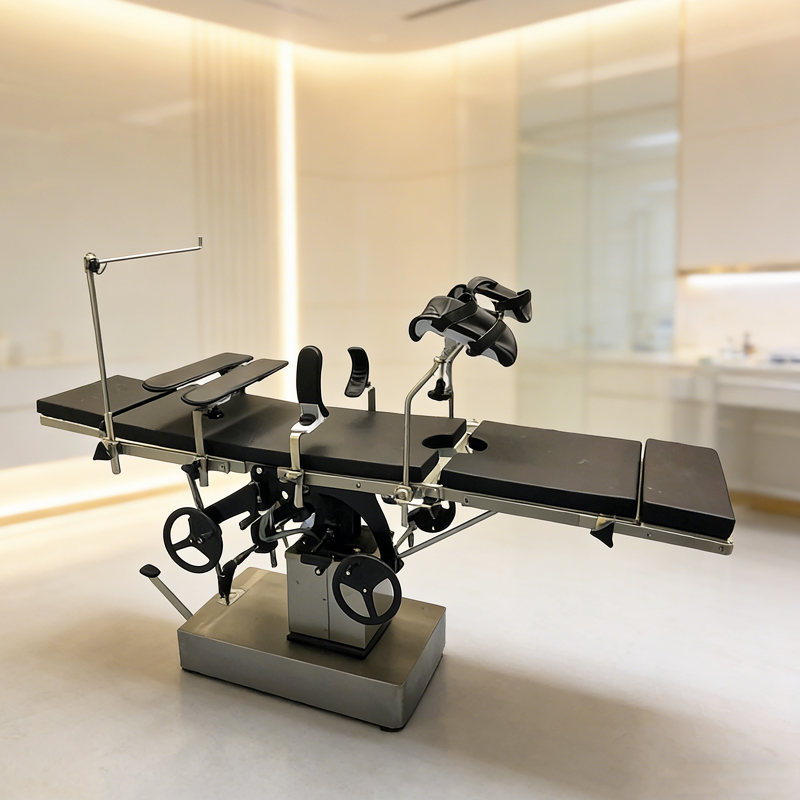
One often-overlooked angle: the drive system interacts with the rest of the room. An electric table’s control electronics share the electromagnetic environment with surgical lights, imaging, and monitoring — another reason IEC 60601-1-2 EMC compliance is non-negotiable. In new-build or renovation projects, we specify the table, lights, and pendant infrastructure together under our turnkey operating room scope so power, grounding, and equipment compatibility are engineered once rather than debugged later.
Conclusion
There is no universal winner in the electric vs hydraulic vs manual operating table question — there is only the drive system whose strengths match your case mix, whose failure modes your team can manage, and whose service ecosystem actually reaches your loading dock. Electric tables win on precision, speed, and integration for high-volume and image-guided surgery. Hydraulic tables win on load capacity, smooth motion, and independence from battery health. Manual tables win on simplicity, cleanability, and total cost where volumes are low and infrastructure is thin.
Run the four steps: map your surgical mix, model the ten-year cost, verify IEC 60601-2-46 and MDR/ISO 13485 documentation against the exact configuration, and lock down a realistic maintenance and spares plan. If you would like a configuration recommendation backed by factory pricing and certification files, browse our electric, hydraulic, and manual operating tables or contact our team — tell us your case mix and your theater count, and we will tell you honestly which drive system we would put in your rooms.
Frequently Asked Questions
Is an electro-hydraulic table the same as an electric operating table?
No. An electro-hydraulic table uses an electric motor to drive a hydraulic pump, so the motion is still generated by oil pressure and cylinders. A fully electric (electro-mechanical) table uses motor-driven linear actuators with no hydraulic fluid at all. Electro-hydraulic designs offer push-button convenience plus hydraulic load capacity, but they still carry the seal-and-oil maintenance profile of hydraulics.
Which drive system is best for bariatric surgery?
Hydraulic and electro-hydraulic tables typically offer the highest safe working loads — commonly 350 to 450 kg — with smooth, damped motion that keeps a heavy patient stable during repositioning. That said, premium electric bariatric models now reach similar ratings; always verify the stated safe working load and the IEC 60601-2-46 stability documentation for the exact model, in every position you intend to use.
What happens to an electric operating table during a power failure?
Quality electric tables include a rechargeable backup battery that maintains full positioning function when mains power drops, and IEC 60601-2-46 addresses protection against unintended movement. The catch is that batteries degrade: without a three-to-five-year replacement schedule, the backup exists on paper only. If your grid is unreliable, test the battery under load quarterly and record it in the biomedical maintenance log.
How long does each type of operating table typically last?
With proper preventive maintenance, all three drive types routinely deliver ten to fifteen years of service. The differences are in what wears: actuator motors and control electronics on electric tables, seals and pumps on hydraulic tables, and gears, cranks, and gas springs on manual tables. In our experience, the tables that fail early are almost always the ones whose preventive maintenance schedule existed only in the purchase file.
What certifications should I demand when importing an operating table?
At minimum: a test report or certificate referencing IEC 60601-2-46 for the table itself (plus IEC 60601-1 and 60601-1-2 for powered models), a manufacturer quality system certified to ISO 13485, and — for the EU market — CE marking under MDR (EU) 2017/745 with the technical documentation to support it. Verify that certificate scopes name your exact model and drive configuration, and confirm issuing bodies directly before paying a deposit.
For a closer look, see our guide on how to choose a treatment cart.
You May Also Like...

Bariatric OR Package: Table, Bed and Trolley Coordination
A bariatric OR package coordinates the operating table, the patient bed and the trolley for...

Lumen vs Lux: What These Surgical Light Units Mean
Lumen and lux are not the same thing. Lumen measures the total light a fixture...

Emergency Department Equipment for Trauma, Resuscitation and Triage
An emergency department is built around speed, and its equipment has to be ready the...