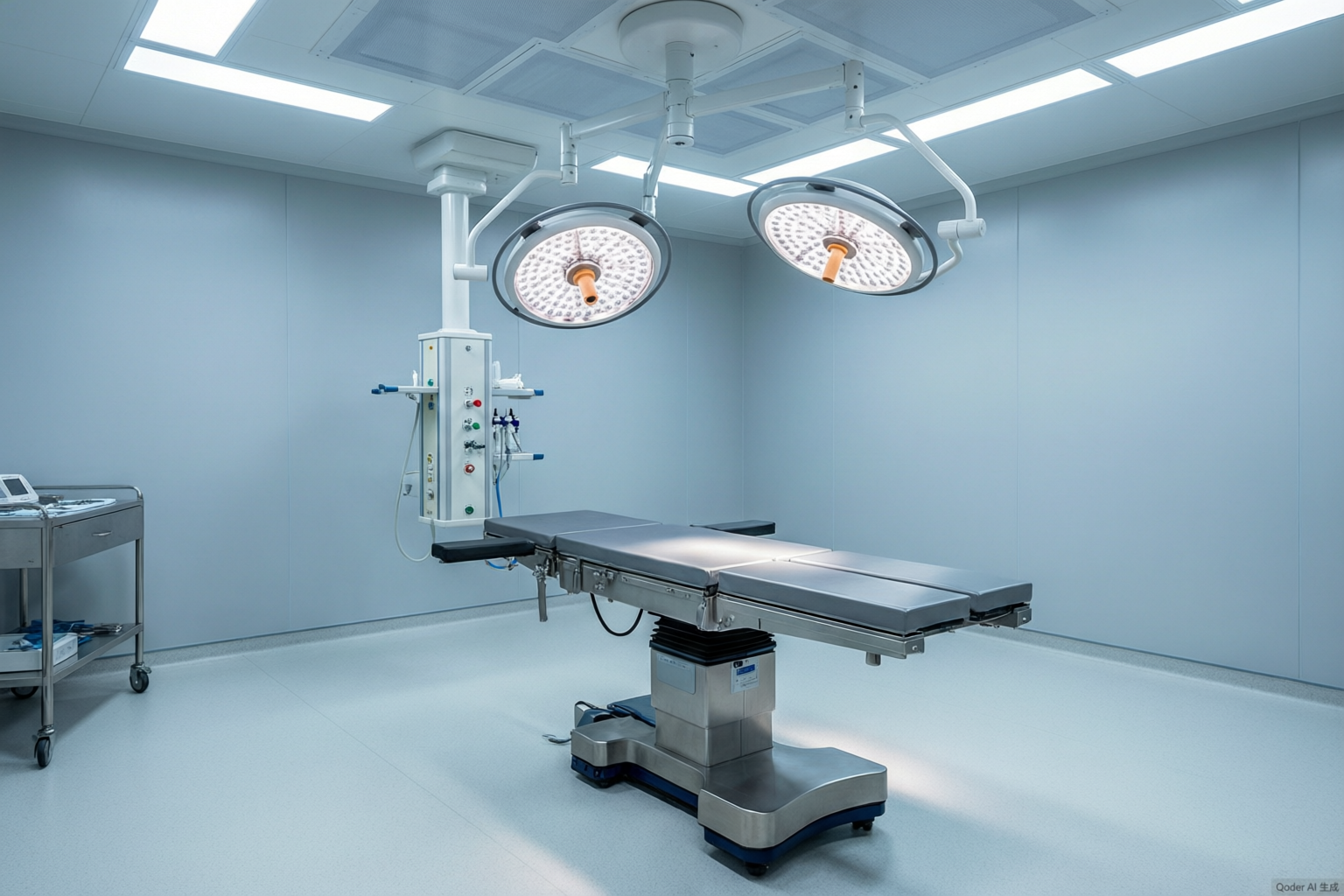

Emergency manual lowering means returning an operating table to a flat top when mains power fails mid-case. The act is mechanical: a release, a controlled descent, a level check, a reset.
The factory supplies three artifacts making the act usable at 3 a.m.: a posted card, a witnessed drill, a signed record. 100% of the lowering path must work with no electronics, because a dead battery is the usual reason the drill exists.
Without the card, a theatre discovers the release point. Without a drill, the card is decoration. Without a record, a hospital cannot show a surveyor what happened in 2026.
Battery backup is a separate subject, covered in the power-failure battery guide. The card is the layer surviving a dead battery, a flat cell and a switched-off table. For example, a table wheeled to a wall socket on a Friday can sit unplugged until Monday.
What Has to Be Printed on the Lowering Card?
A lowering card is a laminated sheet mounted at the table, carrying a theatre team from a dead table to a flat top with no mains supply.
Seven elements earn space, and 100% of them must be readable at arm’s length.
1. The model and serial range covered. 2. The release point, drawn and named. 3. Four numbered steps in performance order. 4. The direction each section travels.
5. The manufacturer’s 24-hour technical line. 6. The revision letter and date. 7. The name of the person who verified the sequence on this table.
According to IEC 60601-2-46:2023, the operating table standard applies to tables with or without electrical parts, so a mechanical path sits inside the standard’s scope.
The revision letter earns a line because fleets buy a second batch a year after the first. A card written for revision A sends a nurse to a handle moved in revision C.
Where Should the Card Be Posted?
Card position is a clinical decision, and the head-end wall wins. The sheet belongs at eye level for a standing adult, within one metre of the head section, clear of the anaesthetic machine’s docking line, and visible from the foot end with the table tilted head-down.
Three placements fail in practice: the anaesthetic room drawer, the theatre manager’s binder, and the wall behind a parked trolley. A card read in eleven seconds wins. A card fetched from another room loses the case.
According to AORN, a new edition of the Guidelines for Perioperative Practice ships each January, and the 2027 edition enters presale in October 2026. A room check written in 2021 is five editions stale.
The posting rule fits one sentence: 100% of theatres running a powered table carry the card at the table.
How Often Does Someone Check the Card?
A card check is a four-line routine, and four checks a year cover 100% of the calendar.
1. Read the revision letter against the label on the table base. 2. Confirm the serial range covers the unit in the room. 3. Test the laminate and legibility under emergency lighting. 4. Initial and date the sticker on the back of the sheet.
Lamination fails faster than paper in a theatre. Chlorhexidine splashes cloud the surface, and a sheet unreadable at arm’s length has stopped being a card.
In practice the 2026 reprint belongs with the annual preventive maintenance visit, because the engineer already holds the current manual.
According to IEC 60601-1, every medical electrical device ships with accompanying documents, and the card is a local extract of those documents.
Responsibility matters more than frequency: one named person per suite keeps 25% of checks from sliding into the next quarter.
Can the Sequence Be Run in the Dark?
A dark-read test is a drill run at emergency lighting only, with one torch taped to the table base and no manual allowed.
Three conditions make the sequence hold. The release point is found by touch, because a handle described in words differs from a handle found in the dark. The descent needs 0% battery. The floor path stays clear for whoever steadies the head section.
Run the test twice in one session: once lit for teaching, once with 100% of room lighting off for proof. The second run predicts the real event.
According to NFPA 99, operating rooms sit on the critical branch of the essential electrical system, so generator power is the first line of defence.
Time the descent to the second and write the figure on the 2026 drill sheet, because a number tracked across quarters shows a worn strut before a surgeon does.

Who Witnesses the Drill?
A witnessed drill is a lowering performed before a second party who signs what was seen. The witness separates a rehearsal from a rumour.
Two signatures belong on 100% of drill lines: the operator at the release, and the witness who timed the descent and checked the top for level.
The first witnessed drill belongs at commissioning, while the factory engineer is on site and the transit fixings are off. Film the descent on a phone, store the file with the equipment record, and the film becomes the reference for later drills.
According to ISO 14971:2019, residual risk is evaluated after risk control, and an unrehearsed lowering is residual risk left unmeasured.
Repeat the drill once a quarter. Fifteen minutes is about 0.03% of a 720-hour quarter, which makes a witnessed run the cheapest evidence in the building.
What Does a Drill Record Line Contain?
A drill record line is one row answering who, when, on which table, and how the descent ended.
Eight fields carry the evidence. Date and start time. Table model and serial. Operator and witness names. Lighting condition during the run. Seconds from release to flat. Level check result. Any noise, drift or fault code. The reset entry.
100% of those fields fit on one line of the quarterly theatre check sheet, and a separate drilling file guarantees the line goes unread.
Record seconds rather than a tick. A descent at 40 seconds in January and 95 seconds in July points at a gas strut, a cable or a hinge, and a tick box hides the trend.
According to IEC 60601-2-46:2023, tables arrive with instructions for use. The drill line is the hospital’s proof that 2026 training acted on those instructions.
Who Attends, and Who Signs?
Attendance has a simple target: one nurse from each shift pattern, one biomedical technician, one theatre manager. First, cover 100% of the shifts that might face the event. Second, name each role on the sheet before the drill starts.
Signatures follow roles rather than seniority. The operator signs for the release. The witness signs for the descent and the level check. The technician signs for the reset and the return-to-service decision.
Three signatures across three roles stop one person closing a drill alone. For example, a night-shift drill with only the nurse present leaves the reset unowned, and the table returns to the list unchecked.
Scan the signed sheet into the equipment record within the week, and file a 2026 line per quarter. Hand the training record pack the same treatment, so competence and drill evidence sit in one folder at survey time.
According to IEC 60601-1, the manufacturer’s accompanying documents define the intended use of the equipment. An attendance list should mirror the roles implied by that use.
What Happens After the Table Is Flat?
Post-lowering recovery is the part the card usually omits. The patient is transferred, power returns, and somebody decides whether the table goes back on the list.
First, reset the table under power and watch the control panel for a fault code. Second, compare travel and lock behaviour against the pre-incident condition. Third, tag the table out of service when a code appears, and write the tag number on the drill line.
0% of tables should return to a list before the reset step is signed. The CPR release verification record applies the same rule to beds, and the logic transfers unchanged.
According to IEC 62353, equipment is retested after repair before return to service. A lowered table with a new strut counts as repaired equipment in 2026.
A tag without a signature is a rumour with a number on it.
How Do You Keep the Card True to the Table?
Card revision control ties the printed sheet to the exact table in the room. The card carries a revision letter. The table carries a model and serial label. The factory datasheet carries its own revision. Three references must agree on the day of the check.
According to ISO 14971:2019, the risk management file is reviewed when production or post-production information changes the risk picture. Lowering instructions sit inside that file.
First, a new table revision in the fleet forces a reprint. Second, a software update changing reset behaviour forces a reprint. Third, an accessory fitted at the head end forces a reprint. Fourth, a swap of tables between theatres forces a reprint. 100% of those events invalidate the old sheet.
Destroy the superseded copy rather than filing it. For example, a drawer of old cards is how a nurse reads a revision from 2021 on a table delivered in 2026.
What Clause Delivers the Card, the Drill and the Proof?
The order clause is one paragraph, and the paragraph turns good intention into a delivered artifact. A workable clause names three deliverables, one date, one acceptance test.
Language surviving procurement review reads like this: the supplier shall deliver a model-specific lowering card, laminated and revision-controlled, for each powered table on the order; shall witness one manual lowering at commissioning and film the sequence for the hospital record; and shall supply a drill record template with the eight fields above.
The clause closes with the test: the witnessed lowering happens before the first case, with theatre staff present, and the signed line is handed over at the same visit.
100% of powered tables need a card of their own, because a generic sheet covering four models helps nobody at 3 a.m.
According to IEC 60601-2-46:2023, the manufacturer supplies instructions for use with each table, and the clause converts a generic document into a room-specific card.
What Does the Register Look Like?
The Card-and-Drill Register, Column by Column
A card-and-drill register is a single sheet per theatre. Three records share the page: the posting check, the quarterly drill, the reset entry. Six columns carry the story, and 100% of entries should be readable without opening another file.
According to NFPA 99, records of equipment testing are kept for the life of the equipment. The register therefore outlives the staff who filled it in.
| Column | Entry | Signed by |
|---|---|---|
| Table | Model and serial from the base label | Theatre manager |
| Card revision | Letter and date on the laminated sheet | Checker, quarterly |
| Drill date | Date, start time, lighting condition | Operator |
| Descent | Seconds release to flat, level yes or no | Witness |
| Reset | Fault code, tag number if out of service | Biomedical technician |
| Return | Date cleared for the operating list | Theatre manager |
Four drill rows a year keep the sheet small. For example, four lines show a descent slowdown long before a fault code appears in 2026, and three signatures per line keep the row honest.
You May Also Like...

Transit Fixings: The Removal Record to Demand
A transit fixing is any bolt, bracket, pin, chock or strap fitted to keep a...

Numbered Document Annex for Equipment Orders
A numbered document annex is a schedule inside the equipment order. The schedule gives every...

Bed Exit Alarms: The Function Sheet to Demand
When your falls committee asks whether the new ward beds can alarm when a patient...