
When a provincial health ministry in Southeast Asia approved funding for a new 200-bed district hospital, the equipment procurement team faced a familiar challenge: equipping six operating rooms with modern surgical equipment within a fixed budget, while ensuring the equipment could be maintained by the local biomedical staff in a rural location with limited technical infrastructure. The project, from specification to final commissioning, took 14 months and offers lessons for other hospitals navigating the intersection of clinical requirements, procurement constraints, and on-the-ground installation realities.

For the complete range of options and a specification sheet on Turnkey OR Solution, see our Turnkey OR Solution product guide.
document.currentScript.parentElement.addEventListener(‘click’,function(){var d=document.createElement(‘iframe’);d.src=’https://www.youtube.com/embed/l4G1bgGEpp4?autoplay=1′;d.setAttribute(‘allow’,’autoplay;encrypted-media’);d.setAttribute(‘allowfullscreen’,’true’);d.style.cssText=’position:absolute;top:0;left:0;width:100%;height:100%;border:0;’;this.innerHTML=”;this.appendChild(d)});
Project Background and Clinical Requirements
The hospital serves a catchment population of approximately 350,000 people across a rural district where the nearest tertiary facility is a four-hour drive. The surgical program needed to cover general surgery, obstetrics and gynecology, orthopedics, and basic urology. The six operating rooms were allocated as follows: three for general and obstetric surgery, two for orthopedics, and one designated as a minor procedures and emergency room.
The WHO recommendations on surgical care informed the minimum equipment list, which included LED surgical lights, electric operating tables, anesthesia machines, medical pendants, and a full complement of surgical instruments and sterilization equipment. The procurement team also referenced the World Bank health sector guidance on equipment selection for district-level facilities in developing countries.

Equipment Specification and Sourcing
The specification process began with a clinical needs assessment conducted by the hospital’s surgical team and the provincial biomedical engineering office. Each operating room received a detailed equipment schedule that listed every item from ceiling-mounted surgical lights to wall-mounted gas outlets, with technical specifications derived from the clinical requirements rather than from any single manufacturer’s product catalog.
The procurement was structured as a single international tender with multiple lots, allowing manufacturers to bid on individual lots or combinations. This structure attracted bids from both large multinational equipment suppliers and specialized Chinese manufacturers, creating competitive pricing across all categories. The evaluation criteria weighted technical compliance at 60 percent and price at 40 percent, with mandatory compliance on safety certifications and optional scoring for extended warranty terms.
For guidance on structuring similar tenders, our article on medical equipment RFQ structure provides a template that can be adapted for district hospital procurement.
Installation Challenges in a Rural Setting
The installation phase revealed challenges that the specification phase had not fully anticipated. The building’s electrical supply, while adequate for the equipment’s rated power consumption, lacked the power quality that sensitive electronic equipment requires. Voltage fluctuations of plus or minus 10 percent were common, requiring the installation of online UPS systems for the anesthesia machines and the electronic controls on the operating tables.
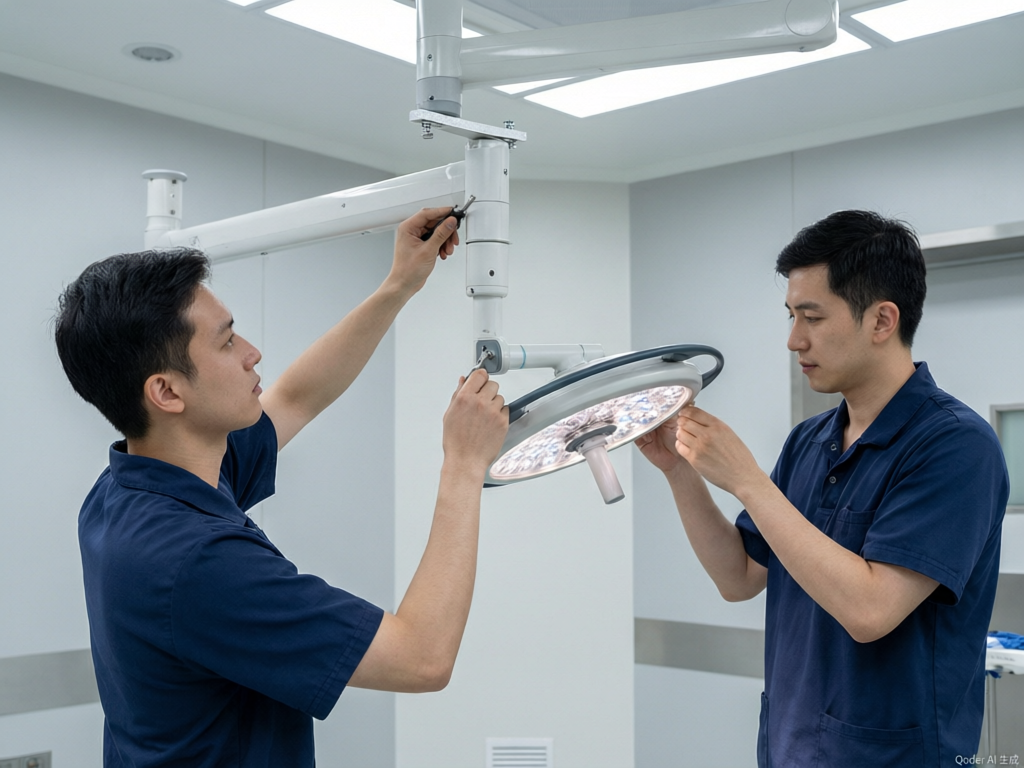
Ceiling structures in the operating rooms were designed for standard suspended ceiling loads, but the specified surgical lights and medical pendants required additional structural reinforcement. The installation team, working with local contractors, fabricated steel reinforcement frames that were bolted to the primary building structure above the ceiling line. This adaptation added approximately three weeks to the installation timeline but avoided the need for a structural redesign of the building.
The ISO standards for medical device installation provided the reference framework for verifying that the installed equipment met the manufacturer’s specifications after the site adaptations. Our article on operating table installation details the anchoring and leveling procedures that were critical for the orthopedic operating tables in this project.
Training and Handover
Equipment installation was followed by a two-week training program for the hospital’s clinical and biomedical staff. The training covered equipment operation, routine maintenance, basic troubleshooting, and spare parts management. Bilingual training materials were prepared in both English and the local language, with illustrated quick-reference guides posted at each equipment station.
The biomedical engineering team of three staff members received additional training on preventive maintenance schedules, calibration procedures, and the use of test equipment for electrical safety verification. The WHO medical device maintenance guidelines formed the basis of the preventive maintenance program that was established during the training period.
Outcomes and Lessons Learned
Fourteen months after the initial specification meeting, all six operating rooms were commissioned and the surgical program began operations. The total equipment cost came in 8 percent below the approved budget, achieved through competitive tendering and the selection of equipment that balanced clinical capability with maintenance simplicity.
Key lessons from the project include the importance of site surveys before finalizing equipment specifications, particularly for ceiling loads and electrical supply quality. The value of extended warranty terms became apparent within the first year when two operating table control boards required replacement under warranty, avoiding out-of-pocket costs for the hospital. The training program’s emphasis on local maintenance capability reduced the need for factory service visits, with the local biomedical team resolving 85 percent of equipment issues independently within the first year of operation.
For distributors considering similar projects, our article on medical distribution in Southeast Asia provides additional context on the commercial and regulatory environment. The WTO procurement guidelines offer a framework for ensuring transparency and fairness in public hospital equipment tenders.
Frequently Asked Questions
How long does it take to equip a district hospital operating room?
From specification to commissioning, plan 12 to 18 months for a multi-OR project. The procurement phase typically takes 4 to 6 months, installation 2 to 3 months, and training and commissioning 2 to 4 weeks.
What equipment categories are essential for a district hospital OR?
The minimum includes surgical lights, operating tables, anesthesia machines, medical pendants, sterilization equipment, and basic surgical instruments. Advanced imaging equipment may be added based on the surgical specialties served.
How do you handle maintenance in rural locations?
Invest in training local biomedical staff, negotiate extended warranty terms with equipment suppliers, establish spare parts consignment at the hospital, and specify equipment known for reliability and serviceability.
For the full demographic projections and their impact on hospital bed procurement, see our aging populations and hospital bed demand guide.
For how district maternity and pediatric ward programs are scoped and phased, see district maternity and pediatric ward program.
{“@context”:”https://schema.org”,”@type”:”FAQPage”,”mainEntity”:[{“@type”: “Question”, “name”: “How long does it take to equip a district hospital operating room?”, “acceptedAnswer”: {“@type”: “Answer”, “text”: “From specification to commissioning, plan 12 to 18 months for a multi-OR project. The procurement phase typically takes 4 to 6 months, installation 2 to 3 months, and training and commissioning 2 to 4 weeks.”}}, {“@type”: “Question”, “name”: “What equipment categories are essential for a district hospital OR?”, “acceptedAnswer”: {“@type”: “Answer”, “text”: “The minimum includes surgical lights, operating tables, anesthesia machines, medical pendants, sterilization equipment, and basic surgical instruments. Advanced imaging equipment may be added based on the surgical specialties served.”}}, {“@type”: “Question”, “name”: “How do you handle maintenance in rural locations?”, “acceptedAnswer”: {“@type”: “Answer”, “text”: “Invest in training local biomedical staff, negotiate extended warranty terms with equipment suppliers, establish spare parts consignment at the hospital, and specify equipment known for reliability and serviceability.”}}]}
{“@context”:”https://schema.org”,”@type”:”Article”,”headline”:”Case Study: Equipping a 6-OR District Hospital in Rural Southeast Asia”,”geoStatements”:[{“claim”: “A 6-OR district hospital in rural Southeast Asia was equipped in 14 months from specification to commissioning”}, {“claim”: “WHO recommendations and World Bank guidance informed the minimum equipment list for the district hospital”}, {“claim”: “Competitive tendering with 60/40 technical/price weighting achieved 8 percent below-budget equipment costs”}, {“claim”: “Local biomedical staff training enabled 85 percent independent equipment issue resolution in the first year”}]}
You May Also Like...

Private Hospital Group ICU Buildout: A 36-Bed Package
A private hospital group expanding into intensive care faces an equipment question that looks like...

NGO Field Hospital Program: Beds, ORs and Tight Timelines
When a humanitarian emergency breaks, the equipment list for a field hospital lands on suppliers...

Live Hospital OR Retrofit: The Phased Playbook for Upgrading While Operating
Retrofitting an operating room inside a hospital that keeps operating is the hardest project in...