
Executive Summary
Shadow dilution predicts how much usable light survives when the surgical team blocks the beam. Learn what IEC 60601-2-41 Edition 3.0 requires and how to verify it before you buy.
Every procurement spec sheet I review lists the same headline number: 160,000 lux. Buyers treat it as the single measure of a surgical light’s worth. But peak lux tells you almost nothing about what the surgeon actually sees once they lean over the table. The moment a surgeon’s head, shoulders, and hands move between the lighthead and the incision, a meaningful fraction of that light is blocked. The metric that predicts how much usable light survives that obstruction is called shadow dilution — and it is the most under-tested specification in surgical light procurement.
I’ve watched a beautifully specified 160,000-lux lighthead get rejected by a surgical team within a week — not because it was dim, but because it threw a hard, dark shadow every time the lead surgeon bent over a deep dissection. The light passed its illuminance test. It failed the shadow test nobody ran. If you are comparing LED surgical lights for a hospital project, shadow dilution is what separates a specification that looks good in a spreadsheet from one that performs in a real cavity.
This guide explains what shadow dilution is, why IEC 60601-2-41 Edition 3.0 put a new test device for it at the center of compliance, and how you can verify it before signing off on a shipment — whether you are a hospital biomedical engineer, a distributor, or a project contractor.

What Shadow Dilution Actually Means on a Surgical Light
The term “shadowless lamp” is a marketing convenience, not a physical description. No surgical light eliminates shadows — that is optically impossible while a solid object stands between the source and the target. What a good surgical light does is dilute the shadow. The formal definition used in the IEC 60601-2-41 family (and mirrored in China’s YY 9706.241 standard) describes shadow dilution as the ability of the equipment to minimize the effect of shadows in the working area caused by the operator partially obstructing the light beam.
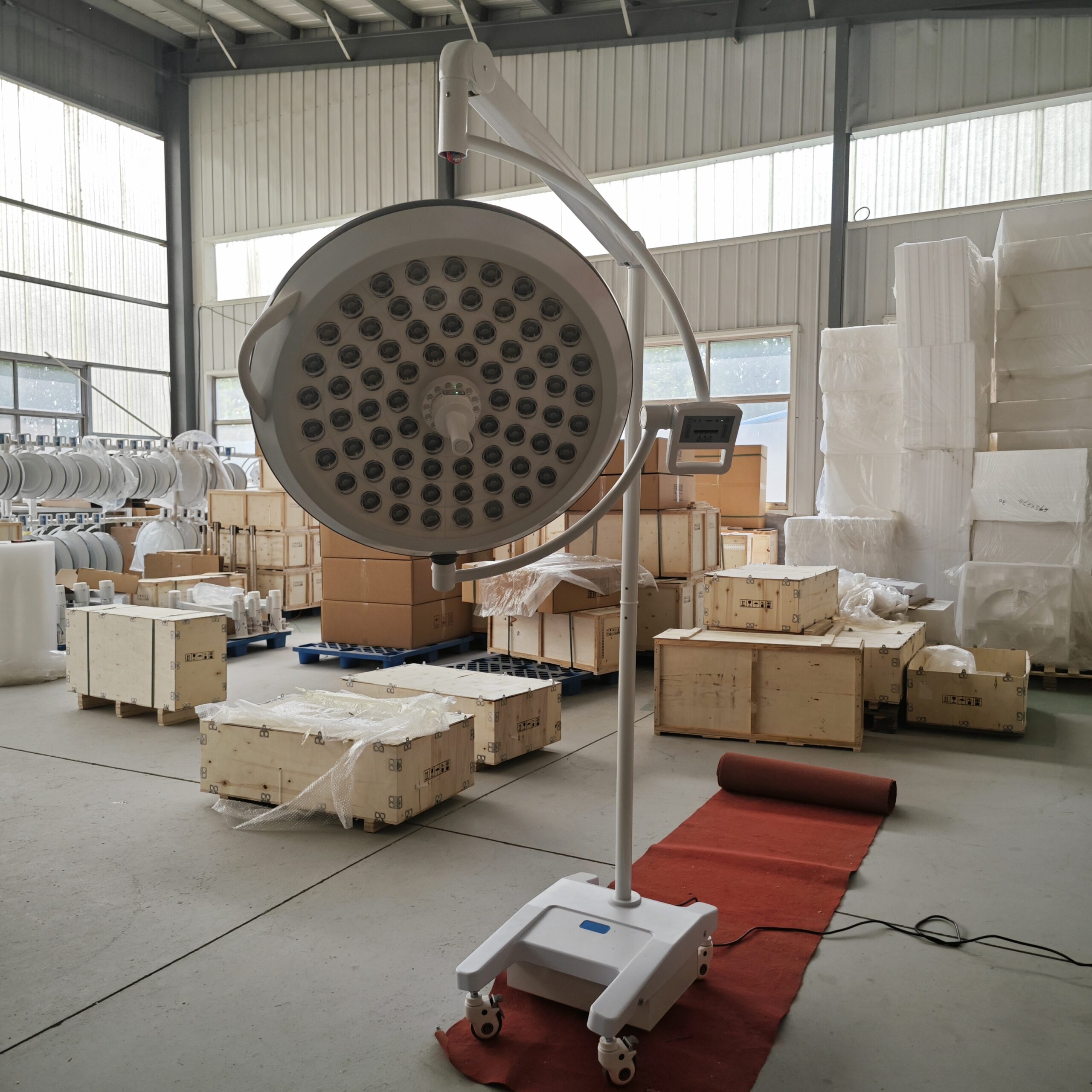
The physics comes straight from classical optics. A single small light source produces a shadow with a fully dark core — the umbra — surrounded by a partially lit fringe, the penumbra. A bare bulb would cast a dense umbra the instant the surgeon’s head crossed the beam. A surgical lighthead instead spreads dozens of LED emitters, each with its own reflector or lens, across a wide aperture. Every emitter illuminates the field from a slightly different angle, so each one’s shadow falls in a slightly different place. Where one emitter’s light is blocked, a dozen others still reach the tissue. The umbra is broken up and flooded with off-axis light, leaving only a faint, diffuse dimming instead of a black hole.
Shadow dilution quantifies that effect. It is expressed as a ratio: the residual central illuminance measured while a standardized obstruction blocks part of the beam, divided by the unobstructed central illuminance, usually reported as a percentage. A lighthead that delivers 120,000 lux unobstructed and 48,000 lux with the test mask in place has a shadow dilution of 40 percent. The higher the percentage, the more light survives the obstruction, and the less the surgical team notices the shadow at all.
A “shadowless” light that casts a hard shadow is not a minor ergonomic complaint. In a deep cavity, a dense shadow can hide a bleeder or a plane of dissection. Shadow dilution is the spec that stands between the surgeon and that moment.
It is worth understanding what shadow dilution is not. It is not illuminance uniformity (how evenly light spreads across the flat field, captured by the d50/d10 ratio), nor depth of illumination (how far the usable light column extends into a wound, measured as L1 + L2), nor color rendering. Those are separate tests in the same standard. Shadow dilution answers one question: when something inevitably gets in the way of the beam, how much light still reaches the surgical site?
Why Shadow Dilution Matters More Than Peak Lux in the OR
Operating rooms are crowded, three-dimensional workspaces. The surgeon’s head sits between the lighthead and the incision for a large share of every procedure. Add an assistant, a scrub nurse, and the overhead boom of a turnkey operating room carrying pendants and monitors — the beam is rarely fully clear. In my experience, a major abdominal case partially obstructs the primary field for well over half of the procedure. A light that only performs well with a clear beam underperforms for most of the surgery.
The consequences cascade through the whole team. When the field dims every time the surgeon leans in, they compensate — by repositioning the lighthead repeatedly, by asking for higher brightness (which pushes irradiance and tissue heating up), or by craning into awkward postures that accelerate fatigue and musculoskeletal injury. Ergonomics research has repeatedly flagged lighting-related repositioning as a persistent source of strain. None of that shows up on a datasheet that only lists peak lux.
There is also a direct patient-safety dimension. The deepest part of many procedures — the bottom of a cavity, the base of a wound, the plane behind a retractor — is precisely where shadows concentrate. If residual illuminance at the bottom of an obstructed cavity collapses, the surgeon operates in relative darkness at the exact moment precision matters most. This is why the latest edition of the standard added a dedicated simulated-cavity device: flat-field testing alone was hiding the failure mode that matters clinically.
What IEC 60601-2-41 Edition 3.0 Actually Requires
The governing document is IEC 60601-2-41, the particular standard for the basic safety and essential performance of surgical luminaires and luminaires for diagnosis. The current Edition 3.0, published 3 September 2021, replaces the 2009 second edition plus its 2013 amendment. In Europe it is harmonized as EN IEC 60601-2-41:2021 under the Medical Device Regulation (MDR 2017/745); China adopted it as YY 9706.241-2020. If a supplier’s CE certificate or test report still references the 2009 edition without addressing the Edition 3.0 changes, that is a red flag to raise before placing an order.
Edition 3.0 made shadow dilution a headline change. Among its listed significant technical revisions, item (i) reads: “specified a new device for measuring SHADOW DILUTION in a simulated cavity.” That line reflects a decade of clinical feedback that flat-field photometry missed real-world performance. The standard now lays out a full family of obstruction tests — Figures 201.108 through 201.114 — covering one mask, two masks, two masks in four positions, and the same configurations repeated at the bottom of a simulated cavity.
Shadow dilution does not sit alone. It is one of several photometric and safety requirements a compliant lighthead must meet, and buyers should read them together because they trade off against each other in optical design. The table below summarizes the performance envelope a hospital should expect from any modern LED surgical light tested to the current standard.
| Parameter | Requirement (IEC 60601-2-41 Ed. 3.0) | Why It Matters to the Buyer |
|---|---|---|
| Central illuminance (EC) | 40,000 to 160,000 lux at the reference distance | Sets the usable brightness band; above 160,000 lux raises tissue-heating risk |
| Light field uniformity (d50 / d10) | d50 must be at least 50% of d10 | A higher ratio means a more homogeneous working area |
| Shadow dilution | Residual illuminance measured with standardized mask(s) and a simulated cavity; a meaningful residual fraction must remain | Predicts how much light survives the surgeon’s head and hands |
| Correlated color temperature | 3,000 K to 6,700 K | Keeps tissue color neutral for accurate diagnosis |
| Color rendering index (Ra) | 85 to 100, with attention to R9 (saturated red) | Critical for distinguishing vessels and perfused tissue |
| Depth of illumination (L1 + L2) | Distance above and below the reference plane where illuminance stays at 60% of EC | Defines the usable “column of light” in a deep wound |
| Backup / power interruption | Restored within 5 s at ≥50% intensity (not below 40,000 lux), full output within 40 s | Keeps the field lit during a mains failure |
| Irradiance limit | Total irradiance at 1 m ≤ 1,000 W/m²; irradiance-to-illuminance ratio limited | Protects exposed tissue from thermal damage |
Notice how the standard treats these as a system. You cannot crank illuminance to compensate for weak shadow dilution, because the irradiance ceiling and the 160,000-lux cap limit how far brightness can be pushed. A lighthead that scores well on shadow dilution achieves its clinical brightness through optical architecture — emitter count, aperture, reflector or lens geometry — rather than raw power. That is the engineering to reward with your purchase order.
When Edition 3.0 added a dedicated simulated-cavity device for shadow dilution, the standards committee was effectively admitting that a light could pass every flat-field test and still fail the surgeon at the bottom of a wound. Test the cavity, not just the field.
How Shadow Dilution Is Measured: The Test Setup Explained
The IEC approach replaces a subjective judgment — “does the shadow look bad?” — with a repeatable, geometry-defined measurement. Every dimension is fixed by the standard so results are comparable across manufacturers and test houses. Here is the sequence a conformity lab follows, which you can adapt for an acceptance check.
Step 1 — Establish the baseline. The lighthead is mounted with its optical axis vertical and warmed up to stable output. A calibrated Class 1 lux meter is placed in the measurement plane — 1,000 mm below the lowest point of the light-emitting surface, or at the manufacturer’s declared reference distance. The photometer is centered on the light field centre — the point of maximum illuminance — and the unobstructed central illuminance is recorded. This is the denominator.
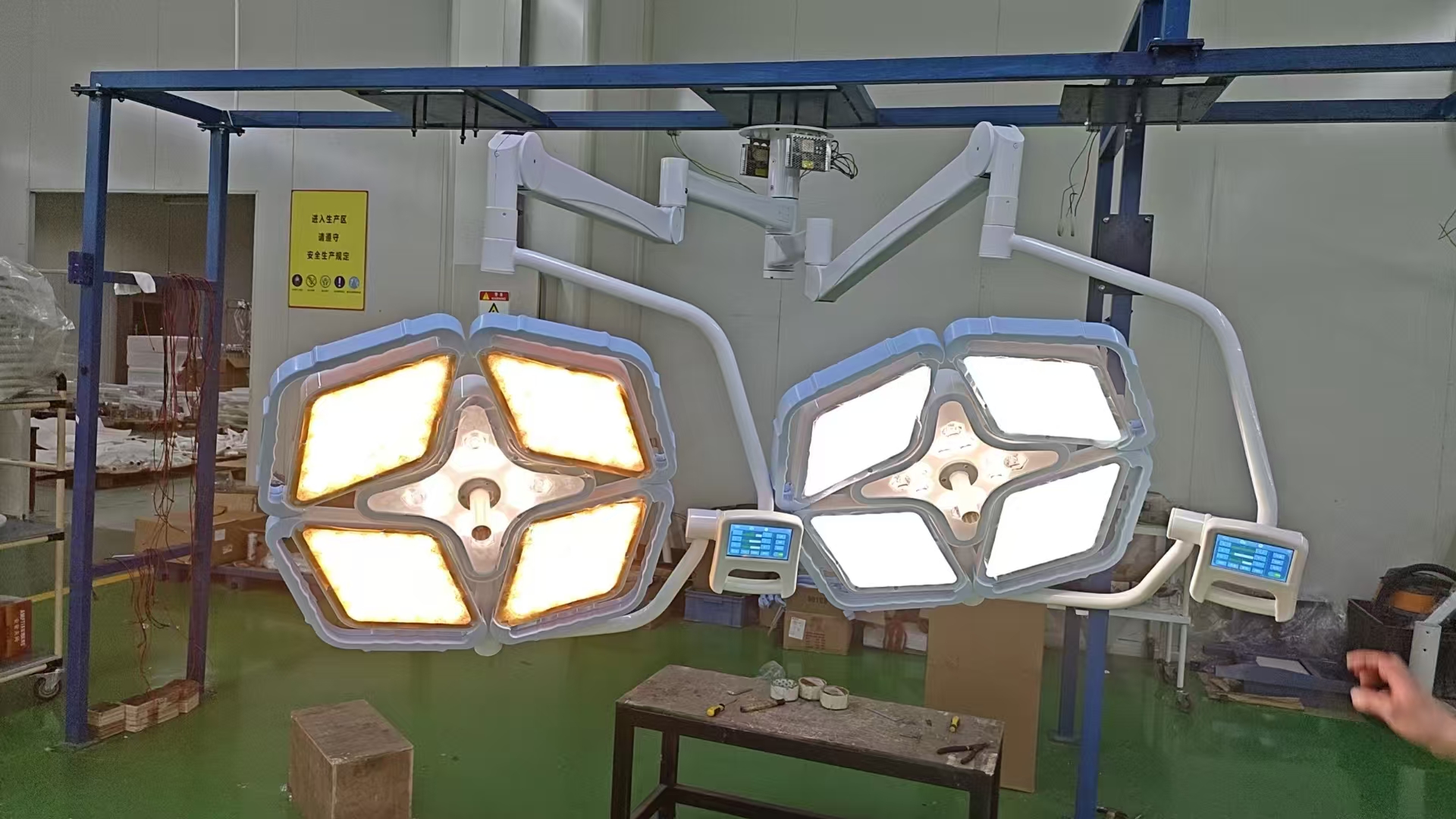
Step 2 — Introduce the obstruction (the mask test). A standardized test mask is positioned between the lighthead and the measurement plane to simulate the surgeon’s head. The standard defines the mask geometry — a 210 mm mask representing a human head — and fixes its location relative to the beam. The single-mask test (Figure 201.108) simulates one operator working directly beneath the lighthead. The two-mask test (Figure 201.109) adds an assistant, and the standard further requires the two masks in four different angular positions around the field (Figure 201.110) so a design cannot game the test by optimizing for one obstruction angle. The residual central illuminance is recorded for each configuration.
Step 3 — Repeat inside the simulated cavity. This is the Edition 3.0 addition that matters most clinically. The standard defines a simulated cavity — a 50 mm diameter tube that reproduces the geometry of a deep, narrow surgical wound — and the illuminance meter is moved to the bottom of that cavity (Figure 201.111). The one-mask and two-mask obstruction tests are then repeated with the photometer at the cavity floor (Figures 201.112 through 201.114). A light that dilutes shadows well on a flat surface can still collapse inside a deep cavity — precisely why this test was added.
Step 4 — Compute the ratio. For each configuration, shadow dilution is the residual central illuminance divided by the unobstructed central illuminance, expressed as a percentage. The results across all mask positions and the cavity condition together describe the lighthead’s real-world shadow behaviour. Industry guidance commonly cites a floor of roughly 10 percent residual illuminance in the worst-case masked condition — but the practical differentiator between good and excellent lightheads sits far above that floor. Premium large-aperture LED heads hold a substantially higher residual percentage than compact, low-emitter-count designs, and the difference is immediately visible to a surgical team.
Two practical notes for anyone replicating this outside a certified lab. Keep your hands and body well clear of the photometer when reading — at these illuminance levels your own shadow contaminates the measurement. And allow the LED driver and emitters to reach thermal stability before recording; output drifts in the first minutes after power-on. For the electrical safety side of the same acceptance test, our companion guide on IEC 60601-1 electrical safety testing covers the earth-bond, insulation, and leakage-current checks that should accompany any photometric inspection.
How to Verify Shadow Dilution During Procurement
Knowing the test is only half the job; the other half is making sure the lighthead you receive actually performs it. Too many buyers discover shadow performance was never tested only after installation, when the remedy is a retrofit rather than a tender line item. Here is the verification sequence I recommend building into every tender and factory acceptance plan.
1. Put the test in the tender documents. Don’t rely on a generic “compliant with IEC 60601-2-41” statement. In the technical schedule, require the bidder to submit shadow dilution results for the one-mask, two-mask, and simulated-cavity conditions, from a type test on the exact model offered. Ask for the test report — not a brochure summary — and confirm it references Edition 3.0 and an accredited test house. A bidder that cannot produce cavity shadow data is almost certainly certified to the superseded edition.
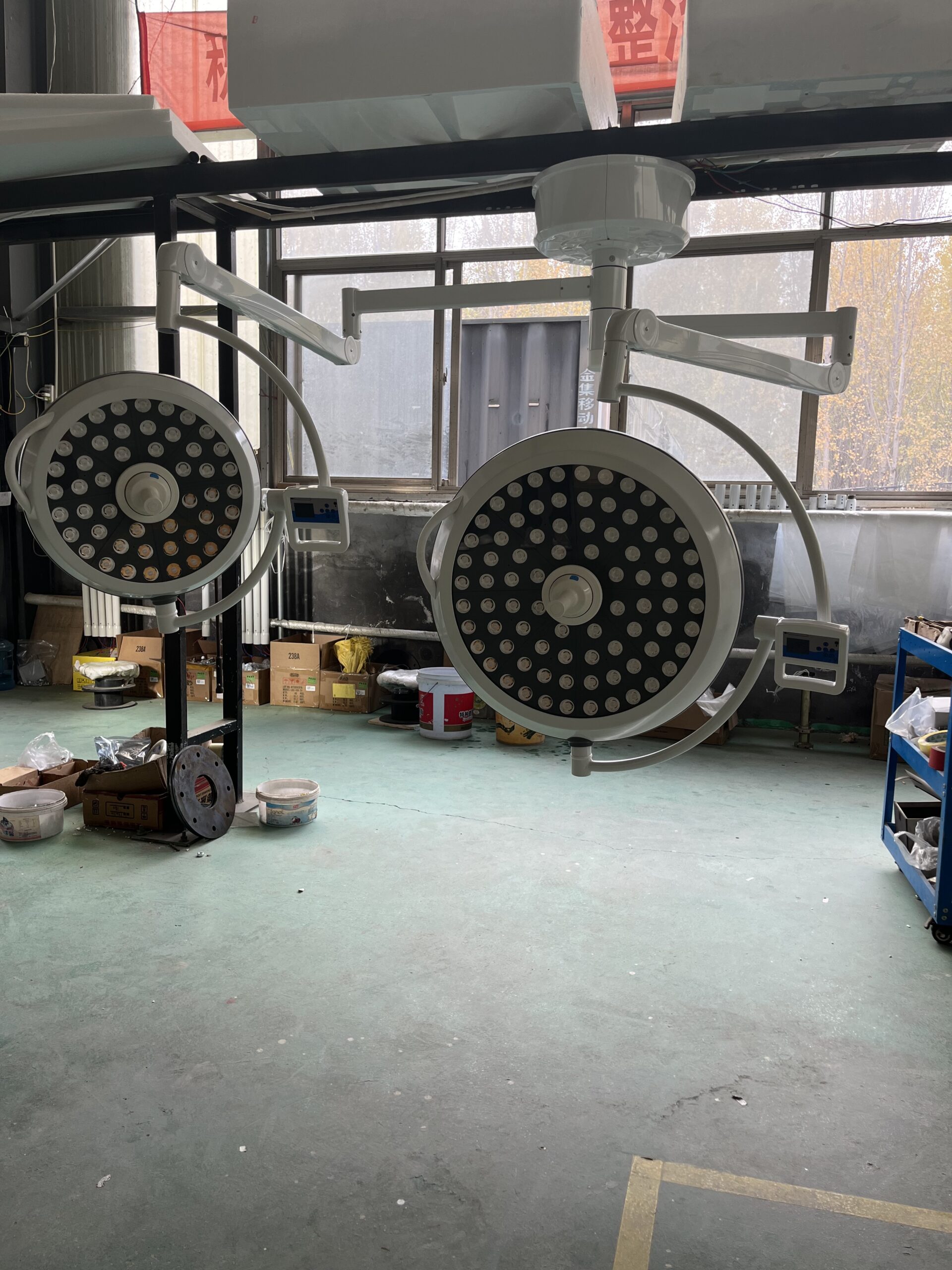
2. Witness or request a factory acceptance test (FAT). Reputable manufacturers run end-of-line photometric testing on every unit before it leaves the factory, because the standard requires verifying essential performance on production units, not just type samples. Ask whether shadow dilution is part of that routine test, and request the per-unit test record that ships with your lighthead. For a first order from a new supplier, witnessing the FAT — in person or by live video — is the highest-leverage quality activity available. Confirm the lux meter used is calibrated and traceable, and that the mask and cavity fixtures match the standard’s dimensions.
3. Run a site acceptance check after installation. Once the light is hung and aligned in the actual OR, repeat a simplified version of the test at the working distance your teams actually use. You don’t need the full four-position matrix for a routine check: measure unobstructed central illuminance, then place a standardized obstruction in the beam and record the residual value at the field centre and, if practical, at the bottom of a cavity simulator. Compare against the factory test record. A large discrepancy usually points to a damaged lighthead, a misaligned optical module, or a driver running out of spec — all warranty items, but only if you document them at commissioning.
4. Build it into periodic preventive maintenance. LED output and driver performance drift over tens of thousands of hours, and optical surfaces degrade with cleaning. A metrology protocol that re-checks central illuminance, light field diameter, color temperature, and shadow dilution on a schedule — the “measure, judge, adjust” closed loop described in recent clinical-engineering calibration literature — turns shadow performance into a managed asset. Pair it with a genuine spare-parts and service agreement so a degraded LED module or driver is replaced before it drags shadow dilution below an acceptable level.
The cheapest surgical light is the one whose shadow test you never had to repeat. Write the test into the tender, witness it at the factory, and re-verify it at the bedside — three checkpoints, one number that protects every case.
Common Myths and Mistakes to Avoid
A few misconceptions keep surfacing in every tender review I sit through. Clearing them up before you write your specification will save you an acceptance dispute later.
- “Shadowless means no shadow at all.” It does not, and cannot. Every lighthead casts some shadow when obstructed; the spec to compare is how much residual light remains. A supplier who promises zero shadow is either misunderstanding optics or misleading you.
- “Higher lux fixes a bad shadow.” Brightness and shadow dilution are independent. Doubling emitter power doubles both values, leaving the ratio unchanged — and pushes you toward the irradiance limits. Optical architecture, not wattage, is the lever.
- “A flat-field test is enough.” The whole point of the Edition 3.0 cavity device is that flat-field performance does not predict cavity performance. Insist on the simulated-cavity numbers, especially for colorectal, gynecologic, and bariatric work.
- “One obstruction position represents real surgery.” Surgeons and assistants move — which is why the standard requires two masks in four positions. A lighthead optimized for one head location will disappoint the moment the team rotates.
- “The type-test report covers my unit.” Type tests prove the design, not the specific unit in your crate. Production variation — a mis-seated LED module, a driver at the edge of tolerance — can degrade individual units. Per-unit end-of-line testing and a site acceptance check both matter.
- “Shadow dilution never degrades.” It does, as LEDs age, drivers drift, and optics collect residue. Treat it as a maintenance metric, not a one-time certificate.
One more habit worth adopting: compare shadow dilution alongside the rest of the photometric envelope, not in isolation. A lighthead with excellent shadow dilution but poor color rendering still misrepresents tissue; one with great color rendering but shallow depth of illumination still leaves deep wounds dark. The standard gives you all of these numbers on a common basis — use the whole table. And if you are still weighing mounting choices, our comparison of ceiling versus wall-mounted surgical lights covers how mounting interacts with beam geometry and obstruction in a crowded OR.
Conclusion
Shadow dilution is the specification that connects a surgical light’s datasheet to the surgeon’s actual visual experience. It measures the one thing peak lux cannot: how much usable light survives when the surgical team gets between the lighthead and the patient. IEC 60601-2-41 Edition 3.0 recognized this by adding a dedicated simulated-cavity device and a full family of mask-based obstruction measurements — and any lighthead offered today should be demonstrably compliant with those tests, not the superseded 2009 edition.
For buyers, the action plan is straightforward. Write the one-mask, two-mask, and cavity shadow tests into your tender. Demand the actual test reports from an accredited house. Witness per-unit end-of-line photometric testing at the factory. Re-verify at the bedside during commissioning, and fold shadow dilution into preventive maintenance. Do those four things and you will never again be the hospital that bought 160,000 lux and received a shadow.
If you are specifying or procuring LED surgical lights and want shadow dilution data — measured on production units, not just type samples — talk to our engineering team. We will walk you through our test fixtures, end-of-line photometric records, and how our lightheads hold residual illuminance at the bottom of a cavity.
Frequently Asked Questions
What is a good shadow dilution percentage for a surgical light?
The standard sets a minimum floor for residual illuminance under obstruction — commonly cited around 10 percent of the unobstructed value in the worst-case masked condition — but that is a compliance baseline, not a target for a busy OR. Premium large-aperture LED lightheads hold a substantially higher residual fraction. Compare actual tested ratios between models rather than just pass/fail.
Is shadow dilution the same as a light being “shadowless”?
No. “Shadowless” is a historical marketing term; no light eliminates shadows entirely. Shadow dilution quantifies how much the shadow is softened when the beam is partially blocked, by measuring residual central illuminance as a percentage of the unobstructed value. A higher ratio means a fainter, more diffuse shadow.
Which standard defines the shadow dilution test?
IEC 60601-2-41 Edition 3.0 (September 2021), harmonized in Europe as EN IEC 60601-2-41:2021 and adopted in China as YY 9706.241-2020. Its Figures 201.108 through 201.114 define the one-mask, two-mask, and simulated-cavity setups. Edition 3.0 specifically added a new device for measuring shadow dilution in a simulated cavity.
Can I test shadow dilution myself without a certified lab?
You can run a reliable acceptance check with a calibrated Class 1 lux meter, a standardized obstruction matching the standard’s mask dimensions, and a 50 mm cavity simulator. Measure unobstructed central illuminance, then the residual value with the obstruction in place, and compute the ratio. For certification and tender compliance, rely on the manufacturer’s accredited type-test report.
Does shadow dilution degrade over the life of the light?
Yes. LED output declines with operating hours, drivers drift, and optical surfaces collect residue. That is why shadow dilution belongs in a scheduled preventive-maintenance protocol — re-measure central illuminance and the obstructed residual value periodically, and replace degraded LED modules or drivers before the ratio falls below an acceptable level.
You May Also Like...

Bariatric OR Package: Table, Bed and Trolley Coordination
A bariatric OR package coordinates the operating table, the patient bed and the trolley for...

Lumen vs Lux: What These Surgical Light Units Mean
Lumen and lux are not the same thing. Lumen measures the total light a fixture...

Emergency Department Equipment for Trauma, Resuscitation and Triage
An emergency department is built around speed, and its equipment has to be ready the...