
Executive Summary
A factory-side guide to becoming a medical equipment distributor with a Chinese manufacturer: vetting ISO 13485 and IEC 60601 certifications, MDR importer duties, distribution agreement clauses, logistics, spare parts, and after-sales strategy.
Every month we get a variation of the same email: “I run a medical supply business in Nairobi / Dubai / Lima. I want to become a medical equipment distributor working with a China manufacturer — where do I start?” The honest answer is that the business model is simpler than people think, but the failure points are not where new distributors expect them to be. Most first-time importers obsess over getting the lowest FOB price. The distributors who actually survive their first three years obsess over regulatory responsibility, spare parts, and whether the factory will still answer the phone after the warranty clock starts.
For teams working through the same decision, see our Southeast Asia distributor case study.
I’ve spent years on the manufacturing side of this equation, watching distributors succeed and fail with operating room equipment — LED surgical lights, electric operating tables, hospital beds, medical pendants, and trolleys. The medical device distribution services market was valued at roughly $197 billion in 2025 and is projected to pass $212 billion in 2026, growing at around 7.7% annually — so the opportunity is real. But this guide is written from the factory floor, not from a market report. Here’s how to build a distributorship with a Chinese medical equipment manufacturer that lasts longer than one container.
Before we get into the steps, one framing note: a distributor is not a trading company. When you put your name on the import declaration and your service phone number on the product label, you take on legal obligations. If you want to understand who you’re dealing with on our side, our company background and factory profile is a fair example of what a transparent manufacturer should be willing to show you.

Step 1: Define Your Market Segment Before You Talk to Any Factory
The most common mistake new distributors make is contacting a manufacturer with no defined segment. “I want to sell medical equipment” is not a segment. A factory can produce forty different product configurations; without knowing your customer base, you’ll be quoted the wrong product at the wrong price point, and you’ll either overbuy features your market won’t pay for or underbuy certifications your market legally requires.
Map your territory by buyer type before you send your first inquiry:
- Public tender hospitals: slow payment cycles (90–180 days), strict documentation requirements, but large volume. You need full CE or local registration dossiers and often local service capability to even qualify.
- Private hospitals and clinics: faster decisions, price-sensitive but margin-tolerant, buy on warranty and service reputation.
- NGO and donor-funded projects: specification-driven, require IEC test reports and often third-party inspection, but pay reliably.
- Sub-dealers: you become a master distributor; margins are thinner but you don’t carry service liability for every installation.
Each segment dictates a different product tier. A general hospital in West Africa doing mostly laparotomies and C-sections needs a reliable electric operating table with a 200–250 kg load rating and good Trendelenburg range — not a 500 kg bariatric orthopedics platform that costs 40% more and requires a reinforced container floor to ship. Matching the tier to the segment is where your margin lives.
Rule of thumb from the field: if you can’t name the ten hospitals or dealers you’ll sell to in your first year, you’re not ready to sign a distribution agreement. Factories can smell an uncommitted distributor, and they’ll quote you accordingly.
Step 2: Vet the Manufacturer Like Your Business Depends on It (Because It Does)
Alibaba star ratings and trade-show booth polish tell you nothing about what happens on the production line in month eight of your partnership. When you’re choosing a medical equipment distributor partner on the China manufacturer side, verify four layers:
1. Quality management system
Ask for the ISO 13485 certificate — then verify it directly with the issuing body, not just by reading the PDF the factory sends. Check the scope line: it should explicitly cover the product category you’re buying (e.g., “surgical luminaires,” “operating tables,” “medical beds”), not just “medical devices” in general. A certificate scoped to syringes does not cover an operating table.
2. Product-level certification
For electrical medical equipment, the baseline is the IEC 60601-1 general safety standard plus the relevant particular standard: IEC 60601-2-41 for surgical lights, IEC 60601-2-46 for operating tables, IEC 60601-2-52 for medical beds. For the EU market, you need CE marking under MDR (EU) 2017/745 with a proper declaration of conformity — and for Class IIa and above, a notified body certificate. Ask which notified body issued it and look up the certificate number.
3. Manufacturing depth vs. assembly depth
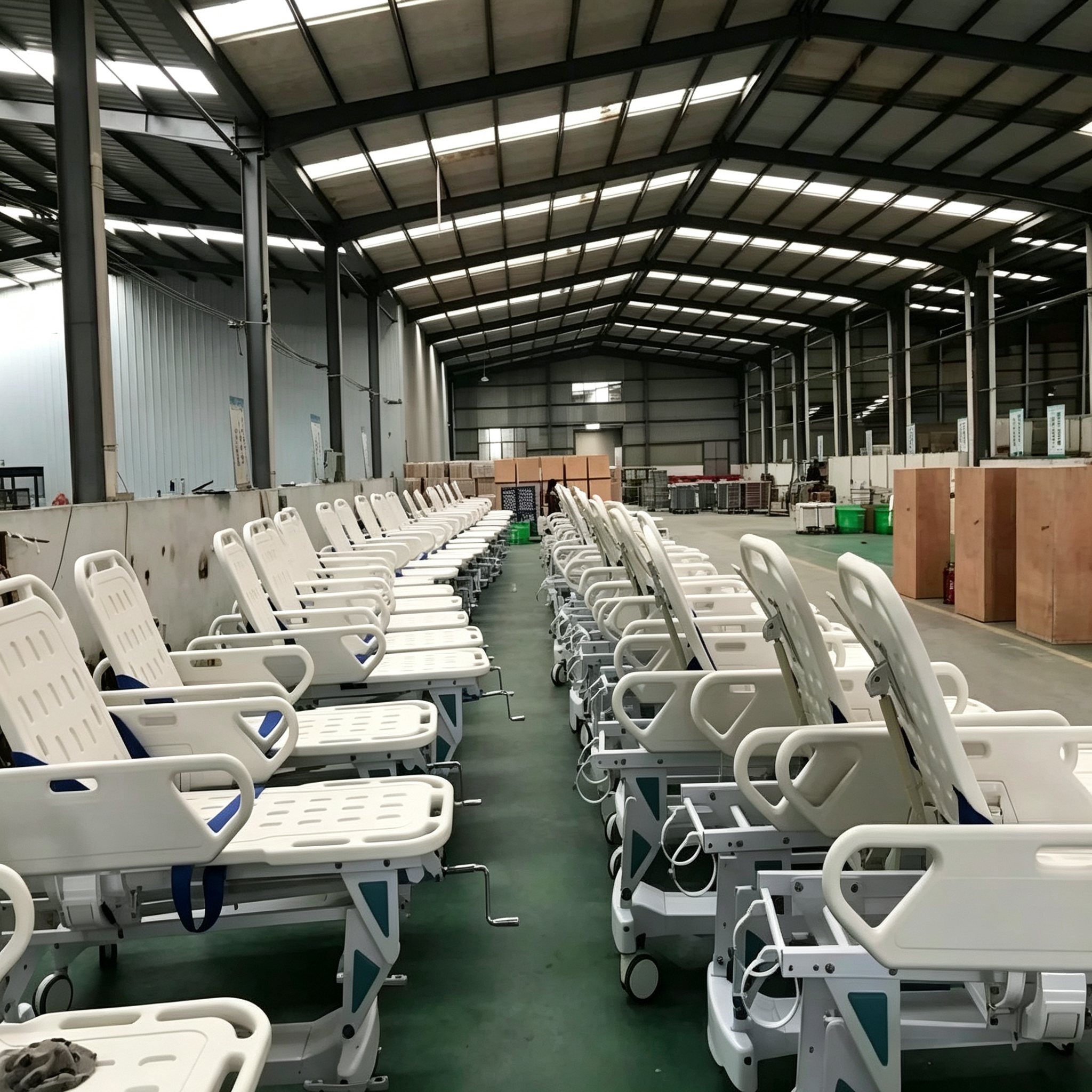
Many “manufacturers” are assembly shops that buy light heads, motors, and control boards from third parties and screw them together. That model breaks down exactly when you need it most: a spare LED driver board in year four, a replacement pendant brake pad, a rewired table handset. Ask for a factory video call and look for in-house processes — welding, powder coating, PCB testing, aging test rooms. A factory that makes its own core components controls its spare parts supply; one that doesn’t will leave your customers stranded.
4. Reference distributors
Any manufacturer with real export experience has existing distributors. Ask for two or three references in markets similar to yours and actually call them. The question that matters: “When you had a warranty claim, how long did resolution take?”

Step 3: Understand Your Regulatory Obligations as an Importer and Distributor
This is the section new distributors skip, and it’s the section that kills businesses. When you import medical equipment, you are not just a reseller — in most jurisdictions you take on defined legal duties.
The EU framework is the clearest example. Under MDR (EU) 2017/745, Article 13 defines importer obligations and Article 14 defines distributor obligations. The European Commission’s Medical Device Coordination Group guidance (MDCG 2021-27) spells these out in detail. In practical terms, an EU importer must verify that the device is CE-marked, that the manufacturer is identified and has drawn up an EU declaration of conformity, that labeling and instructions for use comply, and that a UDI has been assigned where applicable. Distributors must verify CE marking and labeling, maintain storage and transport conditions that don’t compromise compliance, and keep traceability records — they must be able to tell authorities who they bought from and who they sold to.
Outside the EU, the pattern repeats with local variations: SFDA registration in Saudi Arabia, PMDA in Kenya, NAFDAC in Nigeria, INVIMA in Colombia, MOH registration across Southeast Asia and the Middle East. In nearly every scheme, the importer of record carries registration responsibility — which means your manufacturer must supply a complete technical dossier: ISO 13485 certificate, free sale certificate, test reports to IEC 60601 series standards, declaration of conformity, labeling artwork, and instructions for use.
Red flag: a manufacturer who hesitates when you ask for the technical documentation for your local registration is telling you they’ve never supported a real registration before. Walk away, or expect to spend your first year doing their homework for them.
Build a compliance file for every SKU you distribute: registration certificates, test reports, DoC, labeling versions, and complaint/field-action records. Under vigilance requirements in most frameworks, you as the distributor are the reporting channel when a device incident occurs in your territory. If you can’t produce the paperwork trail, you personally absorb the liability.
Step 4: Negotiate the Distribution Agreement — The Clauses That Actually Matter
Distribution agreements with Chinese manufacturers follow predictable structures, and public filings of real distribution agreements (you can read actual examples in SEC exhibits) show the same skeleton: definitions, territory, exclusivity conditions, pricing, ordering and payment, warranty, regulatory cooperation, adverse event handling, term and termination. Here are the clauses where new distributors lose money or protection:
| Clause | What New Distributors Accept | What You Should Negotiate |
|---|---|---|
| Exclusivity | Exclusive territory granted on handshake, no performance condition | Exclusivity tied to annual minimum volume; non-exclusive year one, exclusive from year two if targets met |
| Warranty | “12 months” with parts shipped at distributor’s cost | 24 months on core components; factory covers parts and ships a spare-parts kit (2–3% of order value) free with each container |
| Payment terms | 100% T/T before shipment forever | 30/70 T/T initially, moving to 30/60/10 with inspection holdback or L/C after two or three clean orders |
| Regulatory support | Not mentioned | Written commitment to supply registration dossiers, updated certificates, and technical files within a defined number of working days |
| Marketing support | “We will support you” | Specific deliverables: demo unit discount, exhibition cost sharing, translated materials, training visits |
| Termination | Either party, 30 days | Warranty and spare parts obligations survive termination for the full warranty period of sold units; registration files remain usable by you |
Two practical notes on pricing. First, typical distributor margins on capital medical equipment from Chinese factories run 25–45% over landed cost, depending on whether you carry service responsibility — so negotiate ex-works or FOB pricing that leaves room after freight, duty, registration amortization, and warranty reserve. Second, don’t chase the absolute lowest quote. A factory quoting 15% below everyone else is either substituting components or planning to make margin back on your spare parts later. If you want private labeling, that’s a different conversation — see how structured OEM/ODM localization programs handle branding, manuals, and market-specific configuration.

Step 5: Plan Logistics, Inspection, and Your First Order
Your first order should be small enough to survive a mistake and large enough to matter. For capital OR equipment, that usually means one mixed 20ft or 40ft container: a few operating tables, two or three surgical lights, some trolleys as fill and fast movers. Here’s the sequence that works:
- Pre-shipment inspection: hire a third-party inspector (SGS, TÜV, or a local QC firm — budget roughly $300–500 per inspection day) to check function, accessories, labeling, and packaging against your purchase order before the balance payment. This single step eliminates most “container surprise” disasters.
- Incoterms: FOB is the default and usually right — you control the freight forwarder and the freight cost transparency. EXW hides inland costs; CIF hides freight margin and leaves you with a forwarder you didn’t choose.
- Packaging specs in the PO: export-grade plywood or reinforced carton, moisture protection, drop-test-rated for your destination’s handling reality. A pendant arm that arrives with a bent rail is your problem, not the shipping line’s, unless packaging was specified.
- Customs classification: confirm HS codes (typically 9402 for medical furniture, 9405/9018 for lights and instruments) with your broker before shipment; duty rates and documentation requirements vary enough between markets to move your landed cost by several percent.
Spare parts deserve their own line in every order. Ask the factory for a recommended two-year consumables and spares list — handset controllers, fuses, casters, brake pads, gas springs, LED driver boards — and carry it as inventory. The distributor who can fix a surgical light in 48 hours owns the local market within three years; the one who waits six weeks for a part from China loses the hospital to whoever can.
Step 6: Build the After-Sales Engine That Separates Distributors From Importers
Anyone can import a container. A distributor is defined by what happens after installation. Your after-sales capability is your moat, and it has three components:
Technical capability
Train at least one technician per major product line — ideally with a factory visit or a manufacturer engineer’s visit to your market. For electromechanical equipment like operating tables and surgical lights, 80% of field issues are mechanical (casters, brakes, arms, handsets) and fixable by a competent local technician with parts in stock. The remaining 20% (control boards, motors, LED modules) is where your factory’s remote support and spare parts responsiveness matter.
Installed-base records
Keep a register of every unit you sell: serial number, hospital, installation date, warranty expiry, service history. This is both a regulatory traceability requirement in most markets and your commercial goldmine — warranty expiry dates are your renewal and replacement sales pipeline.
Preventive maintenance contracts
Annual PM contracts on surgical lights and operating tables generate recurring revenue with margins far above equipment sales, and they lock the customer relationship. Offer them from day one, priced against your actual cost of a technician visit plus parts reserve.
We tell every new distributor partner the same thing: your first year profit comes from equipment margin. Your fifth year profit comes from the installed base. Choose a manufacturer whose products still run in year seven, because that’s the base you’ll be living on.
Step 7: Scale From Importer to Regional Brand
Once your first two or three containers have moved and your service loop works, the growth levers are predictable:
- Deepen the line: add adjacent products from the same manufacturer — if tables and lights sell, pendants and beds follow the same buyers. One factory relationship amortizes your vetting and logistics learning across more SKUs.
- Private label: once volume justifies it, OEM branding converts you from a reseller into a brand owner with pricing power.
- Tender qualification: use your completed installations and service records to qualify for public tenders, where volume multiples but documentation standards are unforgiving.
- Sub-distributor network: recruit dealers in neighboring territories and supply them — you’ve already paid the tuition on registration and logistics.
The common thread in all four levers is that they depend on manufacturer stability. A factory that changes ownership, drops your product line, or degrades quality in year three resets your business to zero. That’s why the vetting in Step 2 matters more than the pricing in Step 4.
Conclusion
Becoming a medical equipment distributor working with a China manufacturer is a genuinely accessible business — the market is growing at roughly 7–8% a year, and factories actively want committed regional partners. But the winners and losers are separated by the unglamorous work: verifying ISO 13485 and IEC 60601 documentation before falling in love with a price, understanding your importer and distributor obligations under frameworks like EU MDR Articles 13 and 14, negotiating spare parts and regulatory support into the written agreement, and building an after-sales capability that turns an import business into a durable regional brand. Start with a defined segment, order small, inspect everything, and stock spare parts from day one.
If you’re evaluating manufacturers for OR equipment distribution and want a direct conversation about product ranges, certification dossiers, and distributor terms, reach out to our export team — we answer distributor inquiries with the same documentation we’d want to see if the roles were reversed.
Frequently Asked Questions
How much capital do I need to start as a medical equipment distributor?
For capital equipment like operating tables and surgical lights, a realistic minimum is the cost of one mixed container (often $30,000–80,000 depending on configuration) plus registration costs in your market (anywhere from a few hundred to several thousand dollars per product family), plus enough working capital to survive 90–180 day payment cycles if you sell to public hospitals. Many successful distributors start lean with one container and reinvest rather than starting with a showroom.
What certifications should a Chinese medical equipment manufacturer have?
At minimum: ISO 13485 for the quality management system (verify the scope covers your product category), CE marking under MDR (EU) 2017/745 for European sales, and product test reports to the IEC 60601 series — IEC 60601-1 for general electrical safety plus the relevant particular standard for each product type. For your local market, ask what registration dossiers they’ve previously supported and request reference contacts.
Should I ask for exclusive distribution rights in my country?
Ask for them, but structure them with performance conditions. A responsible manufacturer grants exclusivity tied to annual purchase targets — this protects both sides: you get territory protection, they get a committed partner. Be cautious of factories offering instant lifetime exclusivity; it usually means they don’t expect you to perform and plan to appoint others anyway.
What margin can a medical equipment distributor expect?
For Chinese-manufactured capital equipment, distributors typically work with 25–45% gross margin over landed cost, depending on the segment and how much service responsibility they carry. Tender business compresses margins but multiplies volume. Recurring revenue from preventive maintenance contracts and spare parts often exceeds equipment margin within three to five years.
How do I handle warranty repairs for equipment from China?
Negotiate warranty terms before your first order: 24 months on core components where possible, free spare-parts kits (2–3% of order value) shipped with each container, and a defined response time for technical support. Train a local technician on your main product lines, stock the factory’s recommended two-year spares list, and keep serial-number records so you can claim warranty parts accurately and fast.
You May Also Like...

Pricing Your Imported Equipment as a Distributor
A distributor’s price is not the factory price plus a flat markup. It is the...

Container Loading Plans: Volume and Cargo Protection
Container loading plans for medical equipment are the packing and stowage layout that decides how...

Budgeting for Installation and Training Costs
The invoice price of medical equipment is the smaller half of its cost. The larger...