
Reading a surgical light datasheet without a photometry background is like reading a drug label without knowing the units. The numbers are there, the specifications look precise, but the meaning behind terms like illuminance, color rendering index, and shadow dilution can slip past — and a purchasing mistake at this stage follows a hospital for a decade.
A surgical light datasheet is the single document where a manufacturer’s engineering claims meet a buyer’s procurement requirements. Distributors sourcing from Chinese factories, EPC contractors specifying turnkey operating rooms, and tender officers writing technical specifications all depend on these documents to separate genuine performance from marketing language. The problem is that datasheet terms are standardized under IEC 60601-2-41, but not every manufacturer fills them in honestly — and not every buyer knows which numbers actually matter.
Key Takeaways
- Illuminance (lux) measures light hitting the surgical field, not the bulb’s output. IEC 60601-2-41 sets minimums of 40,000 to 160,000 lux depending on light class.
- Color Rendering Index (CRI) Ra > 95 is the floor for tissue differentiation. Anything below 90 distorts vascular and tissue color perception.
- Suhu warna of 3,500–5,000 K balances tissue fidelity with surgeon preference; most major-OR lights standardize at 4,000–4,500 K.
- Pengenceran bayangan measures how well a light compensates for obstructions — a light head with 40+ individual lenses outperforms a single-dome design.
- Dome diameter and light field determine coverage. A 180–210 mm dome delivering a 120–250 mm light field fits most procedures.
- Backup illumination must auto-switch within 0.5 seconds — anything slower risks a surgical field blackout.
Daftar Isi
- Illuminance (Lux): The First Number Everyone Checks
- Color Rendering Index: Why Ra 95 Matters
- Color Temperature: Choosing the Right Kelvin Range
- Shadow Dilution: What Multi-Lens Design Does
- Light Field Diameter and Uniformity
- Glare Control and Irradiance
- Backup Illumination and Failover
- Mounting Type and Arm Reach
- Datasheet Red Flags: What to Question
- Pertanyaan Umum

Operation Theater Lights | Surgical Lights — Biomedical Engineers TV
Illuminance (Lux): The First Number Everyone Checks
Illuminance is the measure of luminous flux falling on a surface area — in surgical lighting, the surface is the surgical wound. It is expressed in lux (lumens per square meter). This is not the same as luminous flux (total light emitted by the source in lumens). A datasheet stating “160,000 lux” means that intensity lands on the operating field at the specified working distance, typically 1 meter.
IEC 60601-2-41 defines three illuminance classes for major surgical lights: 40,000 lux minimum for examination lights, 80,000 lux for minor surgery, and 160,000 lux for major surgery. A dual-head configuration for a major operating room should deliver 160,000 lux at maximum output, with smooth dimming down to 5% of full intensity. Buyers who only see a total lumen figure without a corresponding lux measurement at working distance should ask the manufacturer to clarify — total lumens can be high while field illuminance is poor if the optics waste light outside the target area.
A common procurement trap is accepting a datasheet that lists “max illuminance 160,000 lux” without specifying the measurement distance or the light field diameter at that intensity. A light head can hit 160,000 lux in a 50 mm spot — useless for abdominal surgery where the field spans 200 mm. The correct datasheet specifies both: illuminance at 1 meter distance and the diameter over which that illuminance holds.
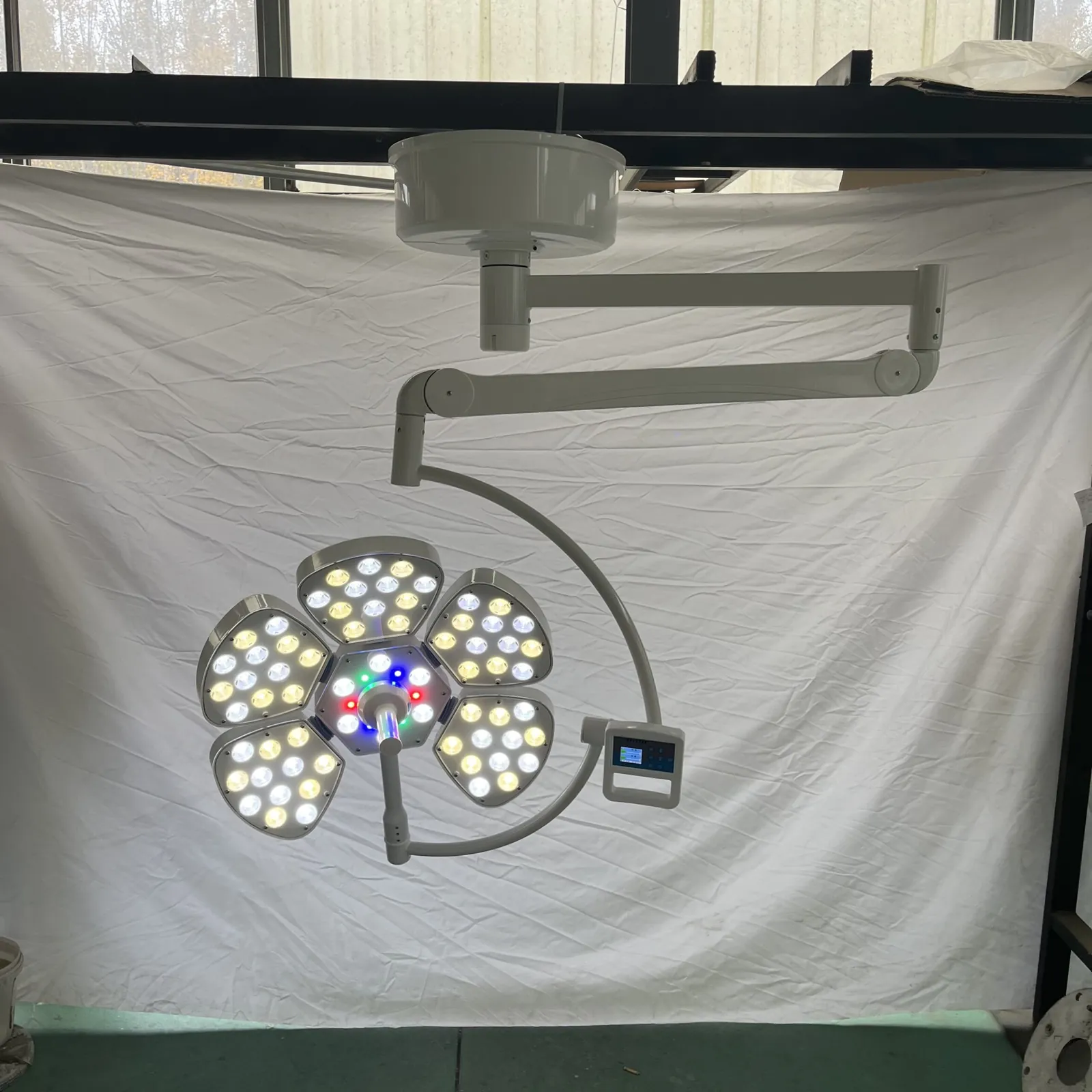
Dimming performance is the second part of the illuminance section. The IEC standard requires continuous adjustment from 40% to 100% of maximum. A light that only steps between “high” and “low” fails this requirement. Surgeons need to dial down to 5–10% for ophthalmic procedures or endoscopy-assisted surgery where the camera provides its own illumination.
Color Rendering Index: Why Ra 95 Matters
The Color Rendering Index (CRI), noted as Ra on most datasheets, measures how accurately a light source reveals the true colors of objects compared to a reference illuminant ( daylight or incandescent). For surgical lighting, this is the difference between distinguishing healthy tissue from compromised tissue, oxygenated blood from deoxygenated blood, and normal mucosa from early-stage inflammation.
A Ra value of 95 means the light renders 95% of the reference color spectrum. The IEC 60601-2-41 standard sets a minimum of Ra 85 for surgical lights, but in practice, no hospital procurement should accept below Ra 90 for a major operating room. The Sanyang Petal Five series specifies Ra > 95, which puts tissue fidelity at a level where a surgeon can rely on visual assessment without second-guessing color shifts caused by the light itself.
One detail that datasheets often bury is the R9 value — the rendering index specifically for deep red, the color of oxygenated blood. A light can score Ra 95 overall but still underperform on R9 because the red component of the LED spectrum is weak. Buyers evaluating LED surgical lights should ask for the R9 sub-score. A light with Ra 95 and R9 > 80 is significantly better for vascular and general surgery than one with Ra 95 and R9 < 50.
Color rendering does not degrade gracefully over time in LED systems — it stays stable until the LED module approaches end-of-life, at which point both illuminance and CRI drop together. This is why LED lifespan (L70, the point where output drops to 70% of initial) matters in conjunction with CRI: a light with L70 at 50,000 hours maintains its color fidelity for the majority of its service life.
Color Temperature: Choosing the Right Kelvin Range
Color temperature, measured in Kelvin (K), describes the apparent warmth or coolness of white light. Surgical lights typically specify a range of 3,500–5,000 K. Lower values (3,500 K) appear warm, similar to halogen lighting; higher values (5,000 K) appear cool, closer to noon daylight.
Most major operating rooms standardize at 4,000–4,500 K because this range balances two competing needs. Warm light (3,500 K) renders skin and tissue tones naturally but can reduce perceived contrast between tissue layers. Cool light (5,000 K) increases contrast but can make tissue look washed out or slightly cyan under prolonged exposure. The 4,000–4,500 K band keeps tissue color close to what a surgeon sees under natural daylight — the reference condition for visual diagnosis.
Some premium surgical lights offer adjustable color temperature, letting the surgeon switch between 3,500 K and 5,000 K during a procedure. This is valuable for multi-disciplinary operating rooms where the same suite handles general surgery, plastic surgery, and ophthalmic procedures. For a single-purpose OR, a fixed 4,300 K output is sufficient and removes a variable that can confuse maintenance staff.
The datasheet should specify whether color temperature is fixed or adjustable. If adjustable, it must list the range and the number of preset steps. A continuous adjustment from 3,500 to 5,000 K is preferable to 3 or 4 fixed presets, because it lets surgeons find the exact color temperature that matches their visual preference.
Shadow Dilution: What Multi-Lens Design Does
Shadow dilution is the measure of how well a surgical light maintains illumination on the surgical field when objects (surgeon’s head, hands, instruments) block part of the light path. This is where single-bulb designs fail and multi-lens LED arrays excel. The IEC standard measures this as “shadow dilution” — the ratio of illuminance with obstruction to illuminance without obstruction, expressed as a percentage.
A surgical light with a single light source casts a hard shadow when the surgeon leans into the field. A multi-lens LED array — for example, the Petal Five’s multi-lens shadowless matrix with dozens of individual LED lenses — distributes the light from many points across the dome. When a surgeon’s head blocks 30% of the dome, the remaining 70% of lenses still illuminate the field, and the shadow is soft and shallow rather than dark and sharp.
The datasheet should report shadow dilution at a standard obstruction geometry — typically a circular obstruction covering 30% of the light path at 70% of the working distance. A shadow dilution of 50% or higher means the obstructed field still receives at least half the unobstructed illuminance. Values below 40% produce visible dark spots that force the surgeon to adjust position — a frustration that compounds over hours of microsurgery.
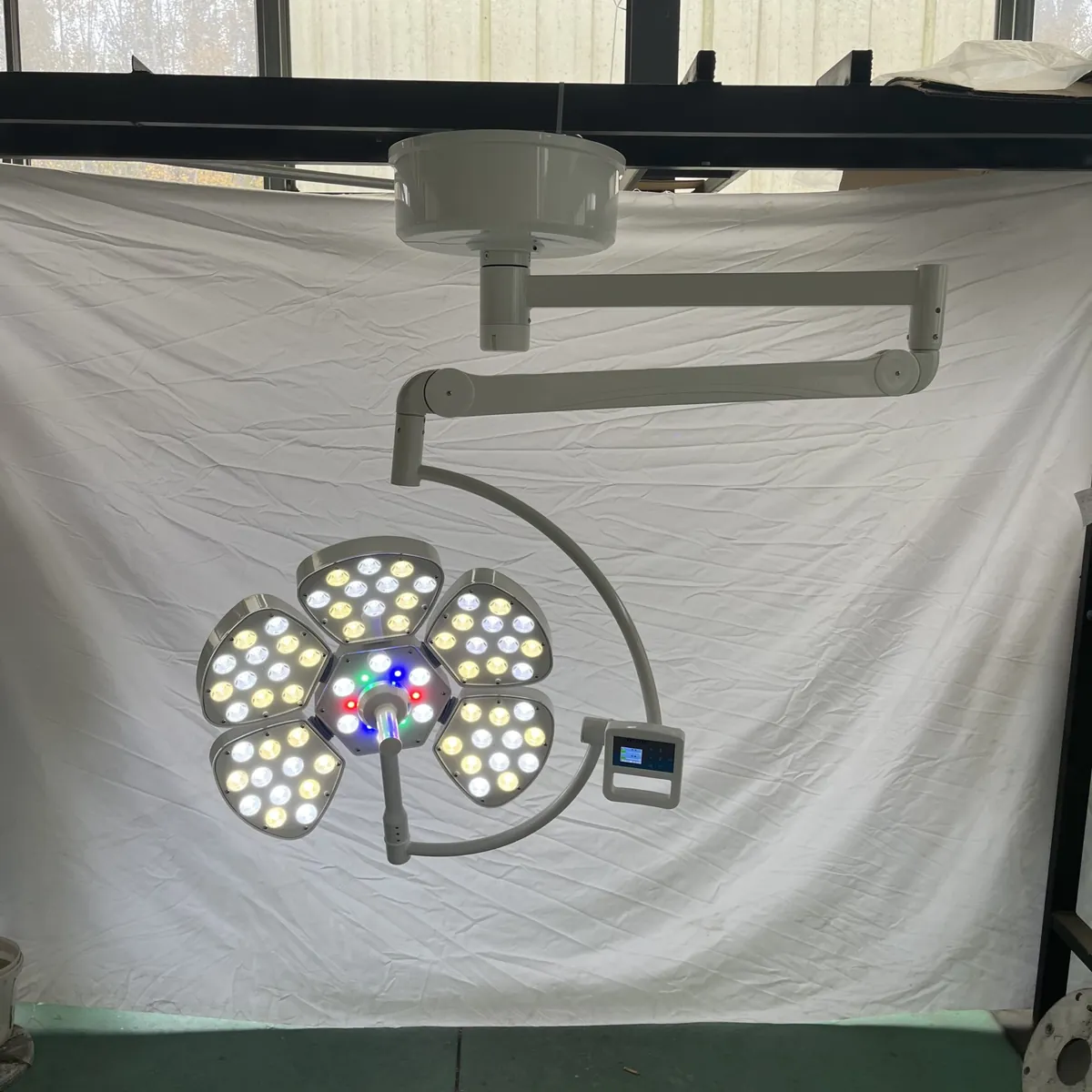
Dome design also affects shadow performance. A larger dome with more LED lenses provides better shadow dilution than a compact dome, because the angular spread of incoming light is wider. The trade-off is ceiling clearance — a 210 mm dome requires more ceiling-to-field height than a 160 mm dome. In rooms with low ceiling clearance, a mobile floor-stand light may be the practical choice, as described in the mobile surgical light buying guide.
Light Field Diameter and Uniformity
The light field is the circular area on the surgical plane where the light delivers clinically useful illuminance. IEC 60601-2-41 defines several measurements: the central illuminance area (where illuminance is at least 50% of the center peak), the total light field (where illuminance is at least 10% of center peak), and the uniformity ratio between them.
A typical surgical light datasheet specifies a light field diameter of 120–250 mm. For general surgery, a 200 mm field at 1 meter working distance is standard. For specialty surgery — ophthalmic, ENT, neuro — a narrower 100–150 mm field with higher central illuminance is preferred. The datasheet should list the light field diameter at the specified working distance, not just the maximum possible field size.
Uniformity is the ratio between the brightest point and the dimmest point in the central light field. A ratio of 1:1.5 means the dimmest point is at least 66% of the brightest point — a smooth field with no hot spots. Ratios worse than 1:3 create visible bright spots that cause eye strain and can wash out fine detail in the brightest areas. The IEC standard does not set a hard minimum for uniformity, but the industry expectation for a major surgical light is 1:2 or better.
Some datasheets list a “light field adjustment” — the ability to change the field diameter by focusing or defocusing the optics. This is useful in a teaching hospital where the same room serves different surgical specialties. In a single-specialty OR, a fixed field diameter tuned to the procedure is simpler and less prone to operator error.
Glare Control and Irradiance
Glare is the visual discomfort caused by excessive brightness in the surgeon’s peripheral vision. The IEC standard measures this as “glare” — the illuminance at a specified angle outside the main beam. A well-designed surgical light keeps glare below 1,000 lux at 30 degrees from the beam axis. Datasheets that omit this figure or list it vaguely should be questioned.
Irradiance (W/m²) measures the thermal energy delivered to the surgical field. Halogen lights were notorious for high irradiance — enough to desiccate tissue during long procedures. LED surgical lights deliver the same or higher illuminance at a fraction of the irradiance because they convert more electrical power to visible light and less to infrared. The Sanyang cold-light output design targets low irradiance specifically to prevent tissue warming — a clinical feature, not just a comfort one.
A datasheet should report irradiance in mW/m² at the standard working distance and illuminance level. If irradiance is not listed, the buyer should ask: “What is the total irradiance at 160,000 lux and 1 meter?” A manufacturer that cannot answer should be treated with caution — this is a safety-critical parameter for the surgical field.
Backup Illumination and Failover
Surgical lights must have a backup illumination system that activates automatically if the primary LED board fails. The IEC 60601-2-41 standard requires that the backup system provides at least 50% of the central illuminance within 0.5 seconds of primary failure. A light without backup — or one where the backup takes 2–3 seconds to engage — creates a momentary blackout that can compromise the surgical field.
The datasheet should specify: (1) whether backup is automatic or manual, (2) the switchover time in seconds, (3) the backup illuminance as a percentage of primary, and (4) whether the backup uses a separate LED board or a redundant circuit on the same board. Separate boards are preferable because a single-board failure (connector, driver) does not take down both primary and backup.
In dual-head configurations, the backup is often the second light head itself — if the primary dome fails, the satellite dome continues to illuminate. This is acceptable but does not meet the IEC 0.5-second requirement for the same head, because it takes time to reposition the second head. A proper dual-head system should have per-head backup as well as cross-head redundancy.
Mounting Type and Arm Reach
The datasheet’s mechanical section specifies the mounting type (ceiling, wall, floor stand), the arm system (single-arm, spring-balanced, multi-joint), and the reach (the horizontal distance from the mounting point to the light head center). These specifications determine which rooms the light can serve and where the surgical field can be positioned.
Ceiling-mounted lights require a mounting point that can support the static load of the light head and arm — typically 25–40 kg for a single-head system and 50–70 kg for a dual-head system. The ceiling structure must also handle the dynamic load when the arm is extended to full reach. A ceiling mount specification should list: mounting flange dimensions, required ceiling clearance, maximum static load, and arm reach in millimeters.
Arm reach determines the surgical field’s usable area within the room. A reach of 1,200 mm from the mounting point lets the light cover a standard operating table (typically 2,000 mm long). A reach of 800 mm may not reach the foot of the table for lower-extremity procedures. Multi-joint arms provide greater flexibility but require more maintenance — the spring tensioners and bearings at each joint wear over time, causing arm droop, a common failure covered in the surgical light arm drooping troubleshooting guide.
For rooms without ceiling structure or where a fixed mount is impractical, a floor-stand light provides a mobile alternative. The trade-off is floor space — the base occupies roughly 0.5 m² — and the need to route power cables. The Sanyang LED 500 mobile surgical light addresses this with a compact base and serviceable battery option for locations without nearby outlets.
Datasheet Red Flags: What to Question
Not every datasheet tells the full story. Buyers should watch for these patterns:
- Missing measurement conditions: A datasheet listing “160,000 lux” without specifying distance and field diameter is incomplete. The number is meaningless without context.
- No CRI sub-scores: If Ra is listed as 95 but R9 is not reported, request it. Low R9 undermines the value of a high overall Ra.
- “Typical” values instead of guaranteed minimums: A manufacturer that lists “Ra 95 (typical)” is telling you the best-case. A guaranteed minimum — “Ra ≥ 95” — is the number you can hold them to.
- No irradiance figure: Omitting thermal irradiance is a red flag for halogen replacements. If the LED datasheet does not report it, ask directly.
- Shadow dilution not reported as a percentage: Vague descriptions like “excellent shadow control” are not measurements. Demand the IEC percentage.
For tender specifications, every photometry term on the datasheet should be matched to a specific IEC 60601-2-41 clause. The daftar periksa spesifikasi tender lampu bedah provides a clause-by-clause mapping for procurement documents.
Pertanyaan yang Sering Diajukan
Berapa angka terpenting pada lembar data lampu bedah?
Illuminance at the working distance, expressed in lux. It tells you the actual light intensity on the surgical field — not the bulb’s raw output. Without this number measured at 1 meter with the light field diameter specified, the datasheet is incomplete.
Apakah CRI Ra 90 dapat diterima untuk lampu bedah?
Ra 90 adalah minimum yang dapat diterima untuk lampu operasi kecil dan pemeriksaan. Untuk ruang operasi besar, Ra 95 atau lebih tinggi adalah standarnya karena diferensiasi jaringan bergantung pada rendering warna yang akurat. Pada Ra 90, perbedaan warna halus antara jaringan sehat dan jaringan yang terganggu dapat terlewatkan.
What color temperature is best for surgical lighting?
4,000 to 4,500 Kelvin is the standard range for major surgery. This band keeps tissue color close to natural daylight. Lights with adjustable color temperature from 3,500 to 5,000 K are useful for multi-specialty rooms but add complexity for maintenance staff.
How does shadow dilution affect surgical performance?
Shadow dilution determines how well the light maintains illuminance when the surgeon’s head or hands block part of the beam. Multi-lens LED arrays with 40 or more individual lenses dilute shadows to 50% or better of unobstructed illuminance. Below 40%, dark spots force the surgeon to reposition — a constant distraction during long procedures.
What is irradiance and why does it matter for surgical lights?
Irradiance (W/m²) is the thermal energy the light delivers to the surgical field. High irradiance can desiccate exposed tissue during long procedures. LED surgical lights produce lower irradiance than halogen at the same illuminance because they convert more power to visible light and less to infrared heat.
Should a surgical light datasheet specify backup illuminance?
Yes. The IEC 60601-2-41 standard requires backup illumination to provide at least 50% of central illuminance within 0.5 seconds of primary failure. The datasheet must list switchover time, backup percentage, and whether the backup is on a separate LED board or a redundant circuit.
Need surgical lights with transparent, IEC-compliant datasheets?
Sanyang Medical surgical lights ship with full photometry specifications — illuminance, CRI, shadow dilution, irradiance, and backup performance. CE and ISO 13485 certified factory in Qufu, Shandong.
Kesimpulan
Reading a surgical light datasheet comes down to matching each photometry term to a clinical consequence. Illuminance determines whether the field is bright enough. CRI determines whether tissue colors are trustworthy. Shadow dilution determines whether the surgeon can work without repositioning. Irradiance determines whether the field stays thermally safe. Backup performance determines whether a component failure becomes a surgical incident or a non-event.
- Always verify illuminance at the specified working distance and field diameter — not just total lumens.
- Request the R9 sub-score for CRI, not just the overall Ra value, for any vascular or general surgery application.
- Demand shadow dilution as an IEC percentage, not a qualitative description.
- Confirm backup illumination meets the 0.5-second switchover requirement on a separate circuit.
If the datasheet in front of you is missing any of these numbers, ask the manufacturer to fill the gap before the purchase order. The alternative is finding out what the light cannot do after it is installed over an operating table — when correction means procurement delays, ceiling rework, or a room sitting idle.
Bacaan terkait: Reading Surgical Light Photometric Specs: Patch Diameter, Focus Depth and Lux
Anda Mungkin Juga Menyukai...

Gas Outlet Colour Coding and Pin Index: What Medical Equipment Importers Must Check
Medical gas systems are built on a simple principle: it must be impossible to connect...

Blood Donation Chairs: Specifying Seating for Donor Safety and Compliance
Blood establishments face a seating problem that ordinary furniture cannot solve: donors sit for 15...

Veterinary Grooming Tables: What Pet-Care Chains Should Spec
Pet grooming chains are scaling faster than their equipment sourcing, and the grooming table at...