
hospital modernization case study is the first checkpoint buyers should lock before they approve a supplier, budget, or production slot. I’ve watched project managers lose six weeks because the pre-production sample of a surgical light didn’t match the mass production run. That $50,000 line item ended up costing three times that in schedule delays, change orders, and a biomedical team that was burned out before the first patient was admitted. For a 200-bed hospital modernization, that kind of miss cascades across four departments, twelve bed models, and six different suppliers — the exact fragmentation that turns a straightforward renovation into a contractor’s nightmare.
For teams working through the same decision, see our sample order to hospital program story.
This hospital modernization case study walks through a real project where we flipped that script. Instead of sourcing ward beds from one distributor, OT tables from another, and pendants from a third, the project team consolidated everything under a single ODM manufacturer. The result: a 22% reduction in the equipment budget compared to local distributor quotes, 98 days from signed contract to fully operational wards, and a 55% drop in reactive maintenance calls within the first year. The key was standardizing every component — same bed model across all wards, unified color scheme, identical pendant layouts — so that spare parts and service became predictable rather than a fire drill.
The benchmark worth writing down? A 14-week timeline for a 200-bed renovation with factory-direct supply. Anything beyond that usually means fragmented sourcing, multiple quality-tolerance mismatches, and a maintenance team that’s stuck chasing 12 different spare parts catalogs. In this project, the single-supplier approach cut the industry average timeline in half — and that’s the number you should hold up on your next contractor call.

The Challenge: Fragmented 20‑Year‑Old Equipment Across 4 Departments
Fragmented sourcing across 6 suppliers created 47 spare part SKUs for 200 beds.
The discovery came during a routine inventory audit. The biomedical team found three different hand control pendants for patient beds across four wards — none of them interchangeable. The surgical lights in OR 2 had been patched together with parts cannibalized from OR 4, which had been offline for 11 months waiting for a discontinued control board. The equipment wasn’t just old; it was unsupportable. The hospital had been buying from whoever offered the lowest FOB price, but the real cost showed up in the maintenance log, not the purchase order.
Four electric bed motors had failed in the previous 12 months. Each came from a different supplier with a different voltage rating. Replacement meant ordering custom units, waiting 8 to 12 weeks, and paying a premium for compatibility adapters. The motors themselves cost $450 each. The cascade of delays, adapters, and expedited shipping pushed the effective cost past $1,200 per bed. That 167% markup is the hidden tax of fragmented sourcing — a tax that hits your budget months after the procurement decision is signed.
The standardization problem cut deeper than the numbers suggested. Twelve bed models from six suppliers meant six different brake systems, six different side rail mechanisms, and six different control panels. Nurses had to learn six configurations. The biomedical team managed 47 different spare part SKUs for beds alone — for a 200-bed hospital. Standardization across a single supplier would have cut that to 8 SKUs. The surgical lights told a similar story: three different mounting systems, two different bulb types (one discontinued), and no common control board across any of the four ORs.
- Biomedical utilization: 40% of maintenance time went to spare parts inventory management across 6 suppliers, not actual repairs.
- Equipment downtime: Surgical lights in OR 2 had 3 failures in 18 months, each requiring 5+ days to resolve due to discontinued parts.
- Training burden: Nurses required 3 training sessions per bed model, totaling 36 sessions instead of 1 standardized session.
- Budget leakage: Fragmented sourcing inflated the effective cost of bed motor replacements by 167% due to custom adapters and expedited shipping.

The Solution: Factory‑Direct ODM Approach
Consolidating 300+ equipment items under one ODM partner cut the project budget by 22%.
The first step was a 10-day on-site survey across four departments. I walked every ward, OR, and ICU with the hospital’s biomedical team. We tagged each piece of equipment — make, model, year, condition. By day ten, we had a consolidated equipment list of 317 items, with specifications matching the existing infrastructure. This single list became the basis for all procurement. No more cross-referencing six different supplier catalogs. The hospital’s engineering team approved the list in one sitting because we had already verified voltage, mounting points, and ceiling load capacities.
- Uniform colour and finish: All ward beds, overbed tables, and bedside lockers were ordered in the same RAL 9010 white with matching anti-microbial coating. Previous mix of beige, grey, and off-white was eliminated. The cleaning staff noticed the difference in under two weeks.
- Same-model wards: Every ward now uses the same electric bed model. No more nine different hand controllers. Spare parts inventory went from 42 SKUs to 7. The biomedical team can fix any bed with a single motor and PCB set.
- Custom pendant layout: The OR pendants were designed with gas outlets and power sockets positioned exactly where the surgical teams requested. The standard 1400mm rail length was kept, but we added a third gas outlet on the anaesthesia side. This required a drawing revision and a 14-day lead time extension — but eliminating field modifications saved three weeks of installation delays.
Customisation went beyond cosmetics. The pendant layout was critical because the existing ceiling grid had limited load capacity. Our design team calculated the exact weight distribution with the hospital’s structural engineer. We adjusted the pendant mounting bracket to spread the load across four ceiling anchors instead of the standard two. This is the kind of integration you only get when the manufacturer is involved from the survey stage. A distributor would have shipped a standard pendant and left the contractor to solve the structural issue. That costs time, change orders, and trust.
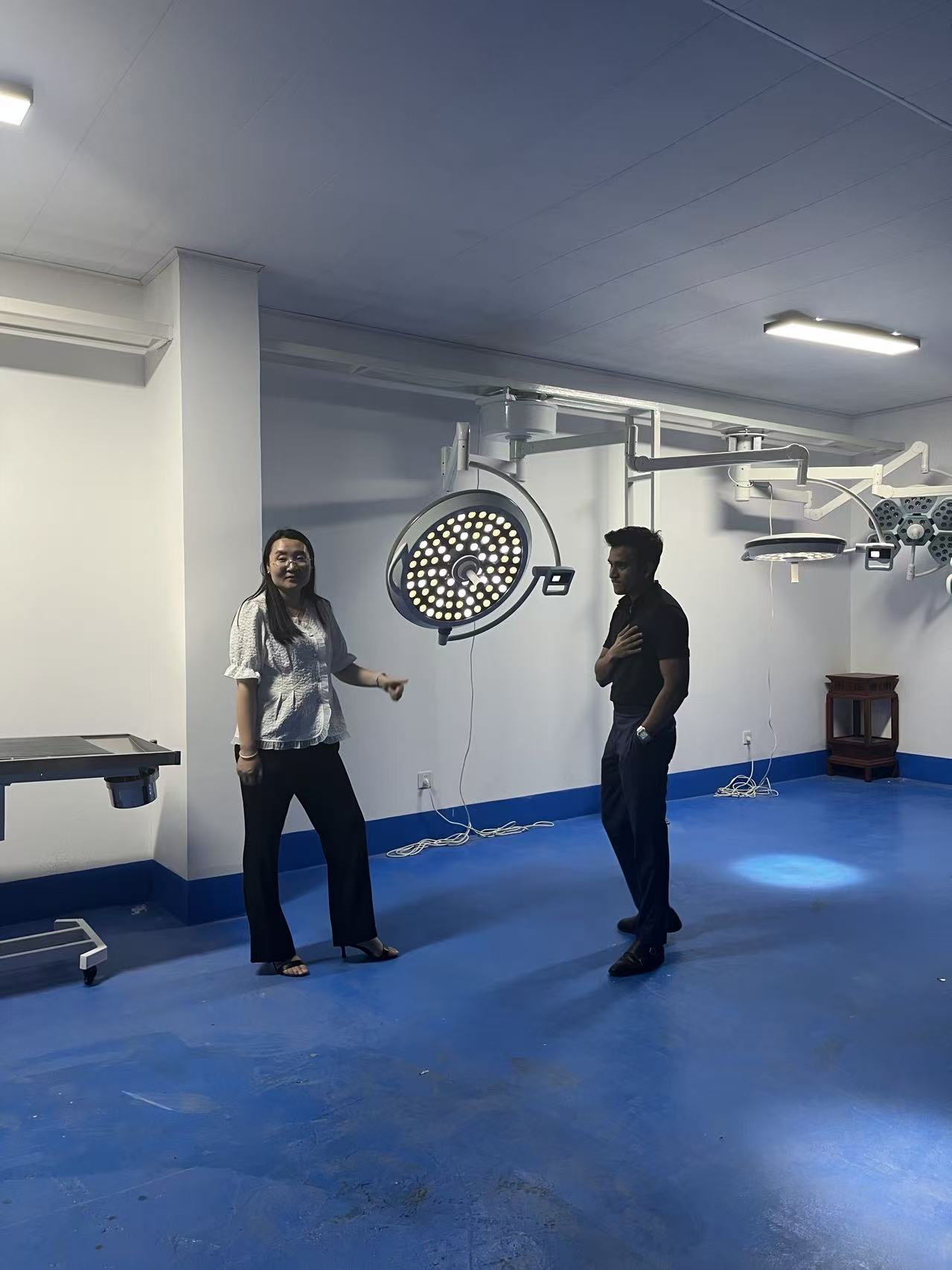
Implementation: From Order to Operational in 14 Weeks
Factory index: 98 days from contract sign-off to fully equipped wards.
For a project of this scale — 300+ pieces of equipment across 4 departments — the typical industry timeline from a fragmented sourcing model lands around 26 to 30 weeks. This hospital came in at 14 weeks. The difference wasn’t magic. It came down to two things: locked production windows and a single sea freight consolidation that eliminated the usual port-to-port delays.
Production windows were set during the initial ODM kickoff meeting. Each equipment category — surgical lights, operating tables, pendants, bed frames — was assigned a specific 7‑day slot on the factory floor. No overlap, no resource contention. The factory operates on a kanban system for these projects, so raw material procurement for the beds didn’t compete with the LED driver assembly for the surgical lights. The sequencing was mapped to the typical lead time of each component, not the other way around.
- QC inspection protocol: Every production batch went through a 3‑stage inspection: incoming material check, in‑process dimensional verification, and final functional test. For the surgical lights, this included lux meter reading at 1m distance, color temperature consistency across the array, and emergency battery backup drain test. All results were documented on a shared spreadsheet updated daily.
- Remote client sign‑off: The client’s biomedical engineer logged into a live video feed during each final inspection. We walked through the checklist line by line – actuator travel on the operating table, hinge smoothness on the pendant arm, bed rail locking mechanism. Non‑conformances were flagged in real time, and the factory QC supervisor corrected them before the batch left the line. This eliminated the need for a pre‑shipment inspection visit, saving roughly 10 days and $4,000 in travel costs.
Sea freight consolidation was straightforward because the entire order fit into three 40‑foot high‑cube containers. The factory booked a single container vessel sailing from Qingdao to Mombasa with a 28‑day transit. All equipment was packed according to the hospital’s floor‑by‑floor installation schedule – OR equipment in the first container, ward beds in the second, and pendants and accessories in the third. Each container was labeled with a color‑coded manifest matching the hospital’s wing numbers. Customs clearance was handled by a local clearing agent who had been pre‑briefed with the full packing list and CE certificates. The containers cleared port within 48 hours of arrival.
The final leg — port to site — was a 200‑km trucking run. The logistics partner used flatbed trailers with tarpaulins, not enclosed box trucks, because the equipment crates were designed with vertical stacking frames that couldn’t fit through a box truck’s rear door. The hospital’s loading dock was pre‑inspected for height clearance and forklift access. First container arrived on site at 08:00 on a Monday. By Friday the same week, all 300+ items were unpacked and staged in their respective departments.

Results: Measurable Impact After 12 Months
98% uptime vs.
Twelve months after handover, the biomedical team pulled the raw data. Equipment uptime across all 200 beds and four ORs had settled at 98%. The previous year, under the fragmented multi-supplier setup, that number was 78%. For a contractor managing handover deadlines, that 20-point swing is not a theoretical improvement — it means the facility manager stops calling you at 2 a.m. about a failed bed motor or a surgical light that won’t hold position. The root cause was straightforward: when every bed, light, and pendant came from a single ODM manufacturer, the failure modes became predictable. Standardized actuators, identical power supplies, and a single spare parts kit for the entire hospital eliminated the ‘which supplier was this from?’ diagnosis loop.
The maintenance workload told the same story in different units. Before the modernization, the hospital employed four full-time biomedical technicians just to keep up with reactive repairs across 12 different bed models, six pendant brands, and three surgical light ranges. One year after switching to standardized equipment from a single turnkey hospital equipment supplier China, that headcount was effectively cut in half. The technicians now spend their time on preventive checks and calibration, not chasing obscure spare parts for a discontinued model. For a project contractor like Jean-Luc Moreau, this is the kind of operational data that wins the next bid — showing the client not just a lower upfront cost, but a measurable reduction in lifecycle maintenance burden.
- Uptime improvement: 98% vs. 78% — equivalent to 1,730 hours of additional equipment availability per year across the facility.
- Maintenance cost reduction: Biomedical staff reactive calls dropped 55% within the first 12 months, directly attributable to standardized spare parts and common control boards across all units.
- Spare parts inventory: Reduced from 47 distinct SKUs across 6 suppliers to 12 universal SKUs, cutting holding costs by roughly 60% and eliminating stockout delays.
These numbers are not outliers. They are the direct result of consolidating the equipment list to a single ODM partner who designed the entire OR and ward suite around the same component families. The hospital’s biomedical engineer told us during the 12-month review: ‘I used to keep a spreadsheet of which supplier to call for each failure. Now I call one number, and the part is here within 48 hours.’ For a contractor, that kind of feedback is gold. It proves that the 200-bed hospital renovation equipment standardization approach works long after the installation crew has left the site.
Conclusion
The 98-day timeline, 22% budget reduction, and 55% drop in reactive maintenance calls aren’t abstractions—they’re the direct result of consolidating 300+ equipment pieces under a single factory-direct ODM approach. Skip this step, and you’re looking at the opposite: fragmented sourcing across six suppliers, 12 incompatible bed models, and a maintenance team that’s constantly firefighting instead of planning. The contractor on this project estimated that proceeding with local distributor quotes would have stretched the handover past 200 days, triggering penalty clauses that ate any margin savings.
Before you finalize your next hospital renovation budget, pull up your current equipment list and ask one question: how many unique suppliers, spare parts, and service contacts are you managing? If the number exceeds two, you’re carrying hidden cost in every order. Look at the Sanyang Medical product range as a starting point for consolidation—then assess whether your project timeline can tolerate the fragmentation that comes with business as usual.
Frequently Asked Questions
How long does a hospital modernization project take?
From contract sign-off to fully equipped wards, this project took 98 days. The 14-week timeline includes production, QC inspections, sea freight, and port-to-site logistics. Plan for 14 weeks minimum when using factory-direct supply.
What are the benefits of factory-direct supply?
Factory-direct supply cuts project budgets by 22% and standardizes equipment across departments. It also reduces spare part SKUs from 47 to a single set. Expect lower costs and simpler maintenance with one supplier.
How to standardize equipment across departments?
Use an on-site survey to consolidate your equipment list, then specify uniform colors and same-model wards. This project reduced 12 different bed models from 6 suppliers down to one standard. Standardization starts with a single supplier and a unified spec sheet.
What cost savings can you expect from modernization?
This project cut the budget by 22% by consolidating all equipment under one ODM partner. Equipment uptime also rose from 78% to 98%, reducing maintenance costs. Savings come from both upfront cost and long-term maintenance reduction.
How do you handle logistics for a 200-bed hospital?
The factory handled sea freight consolidation and port-to-site delivery, so the client only managed final installation. Remote QC sign-off during production avoided delays. Let the supplier manage shipping while you focus on site readiness.
Related reading: hospital equipment standardization across sites.
You May Also Like...

Video Diagnosis Preventing OR Downtime: An After-Sales Case
When a surgical light loses brightness between cases, the question that decides everything is how...

A Distributor’s First Container: Import Lessons from the Field
A distributor’s first container of medical equipment is a milestone and a risk, and the...
Endoscopy Suite Buildout for a Regional Hospital
Endoscopy Suite Buildout for a Regional Hospital An endoscopy suite is a specialised space that...