
Executive Summary
Complete reference for hospital bed platform dimensions, IEC 60601-2-52 side rail gap limits, safe working loads, and department-specific sizing for ward, ICU, and bariatric applications.
Every year, procurement teams specify hospital beds based on a single number—the price—and discover too late that the mattress platform is 30mm too narrow for their pressure-redistribution mattresses, or that the side rail gaps fail the entrapment test their regulatory body now enforces. In our factory, we have watched buyers reject perfectly good beds because the documentation did not reference the correct clause of IEC 60601-2-52, and we have seen facilities retrofit entire wards because the original beds could not accommodate a bariatric patient population that grew faster than anyone forecast.
The hospital bed dimensions standard is not a suggestion. IEC 60601-2-52 defines the minimum platform geometry, the maximum allowable gaps between rails and mattress, the static and dynamic loads a frame must survive, and the braking performance that keeps a 250kg bed stationary on a 3-degree slope. Get these numbers wrong and you face patient entrapment incidents, failed CE or FDA audits, and costly fleet replacements. This guide gives you the exact dimensional requirements, the safety thresholds, and the department-by-department sizing logic you need to specify beds correctly the first time.
If you are building a procurement shortlist right now, start with our hospital bed product range to see how compliant platform dimensions translate into real product configurations.
What IEC 60601-2-52 Covers and Why It Replaced Older Standards
IEC 60601-2-52 is the particular standard within the IEC 60601 family that addresses the basic safety and essential performance of adult medical beds. Published as IEC 60601-2-52:2009 with Amendment 1 in 2015, it consolidated and replaced two earlier documents—EN 1970:2005 for adjustable beds for disabled persons and DIN EN 60601-2-38:2001 for electrically operated hospital beds—into a single internationally harmonized requirement. Since April 2013, every adult medical bed placed on the European market must comply, and the FDA recognizes it as a voluntary consensus standard for U.S. submissions.
The standard applies to beds used in Application Environments 1 through 5, which range from acute care hospitals (Environment 1) to home care settings (Environment 4). Each environment carries different minimum load requirements, but the dimensional safety rules—particularly the entrapment gap limits—apply universally. The updated framework, designated IEC 80601-2-52:2026, is now in transition and will eventually supersede the 2009 edition, but the core dimensional requirements remain consistent between the two editions.
What makes this standard critical for buyers is that it does not merely state “the bed shall be safe.” It provides specific millimeter-level thresholds that a test laboratory can measure with a standardized cone and gauge. If your supplier cannot produce a test report referencing these exact clauses, you are buying an unverified product regardless of what the brochure claims.
Insider warning: We have reviewed dozens of supplier test reports that cite “IEC 60601-2-52 compliant” on the cover page but test only the electrical safety clauses from IEC 60601-1 while skipping the mechanical hazard clauses (201.9) entirely. Always verify that the report explicitly covers Clause 201.9.4 (instability), 201.9.8 (support system strength), and the entrapment gap measurements.
Standard Hospital Bed Dimensions: Platform Size and Height Range
The mattress support platform—the flat surface on which the mattress rests—defines the functional size of a hospital bed. Across North American and European acute care facilities, the standard platform accommodates a mattress measuring approximately 2000mm to 2020mm in length and 880mm to 910mm in width. The Arjo Enterprise 8000X, one of the most widely deployed general ward beds globally, specifies a mattress platform of 2020mm long by 880mm wide with an overall bed width of 1030mm including the side rail structure.
Height adjustment is equally important. The standard range runs from approximately 320mm (low position for fall-risk patients) to 760mm (high position for caregiver procedures) measured from floor to top of mattress platform. This 440mm travel range allows the bed to serve dual purposes: a safe low position that reduces fall injury severity, and an ergonomic working height that protects caregiver backs during wound care, catheterization, and patient repositioning.

The table below summarizes the dimensional parameters across bed types as specified by manufacturers operating within IEC 60601-2-52 requirements:
| Parameter | General Ward Bed | ICU / Critical Care Bed | Bariatric Bed |
|---|---|---|---|
| Mattress platform length | 2000–2020 mm | 2020–2140 mm (extendable) | 2020–2240 mm |
| Mattress platform width | 880–910 mm | 910–1020 mm | 1070–1370 mm |
| Overall width (with rails) | 1000–1050 mm | 1050–1200 mm | 1200–1500 mm |
| Height range (floor to platform) | 320–760 mm | 350–800 mm | 380–780 mm |
| Safe working load (SWL) | ≥200 kg (2000 N) | ≥250 kg (2500 N) | ≥350 kg (3500 N) |
| Backrest angle | 0–70° | 0–70° + cardiac chair | 0–70° |
| Trendelenburg tilt | ±12° | ±12° to ±16° | ±10° to ±12° |
These are not arbitrary numbers. The 880mm platform width traces back to anthropometric data: it accommodates the 95th percentile male shoulder breadth while leaving enough lateral space for a caregiver to reach the patient from either side within a standard 3.6m-wide ward room. When you see a bed specified at 850mm wide, that is a red flag—it will not accommodate standard 900mm pressure-redistribution mattresses without overhang that creates entrapment risk.
Side Rail Safety: Gap Limits That Prevent Patient Entrapment
Patient entrapment between side rails and the mattress platform is one of the most serious hazards in hospital bed design, and IEC 60601-2-52 addresses it with five specific dimensional thresholds. These measurements are based on international anthropometric data and are verified using a standardized testing cone during type testing.
The most critical limit is the 120mm maximum gap between the inside surface of the side rail and the mattress platform. This dimension derives from the 5th percentile Sri Lankan female head breadth—the smallest adult head size in the international reference data—ensuring that no adult patient’s head can enter the space. The standard also requires that gaps between individual side rail bars remain below 120mm for the same reason.
For neck entrapment prevention, the standard mandates a conservative 60mm maximum gap between bed frame components such as the headboard and the end of the side rail. This is significantly less than the 1st percentile female neck measurement of 79mm, accounting for neck compression, age-related muscle loss, and the asymmetrical neck profile of a reclined patient. Between the footboard and the end of a split side rail, the gap must exceed 318mm—based on the 95th percentile male chest depth—so that a patient’s torso cannot become wedged in the opening.

Between any moving parts—such as folding rail hinges or height-adjustment mechanisms—the minimum clearance is 25mm to prevent finger pinching. And the side rail height itself must extend at least 220mm above the mattress support platform along a minimum of 50 percent of the platform length. If a facility uses a thicker mattress or overlay that reduces effective rail height below 220mm, the standard requires a documented risk assessment before the bed remains in service.
Procurement tip: Request the manufacturer’s mattress compatibility list with every bed quotation. IEC 60601-2-52 Clause 201.7.9.2.1 requires manufacturers to specify the exact mattress dimensions that maintain compliance. If a supplier cannot tell you which mattress thicknesses keep the rail-to-platform gap under 120mm, their type testing is incomplete.
Load Capacity, Braking, and Structural Integrity Requirements
The structural requirements in IEC 60601-2-52 Clause 201.9 go far beyond a simple “weight limit” sticker. The standard defines Safe Working Load as the sum of patient weight, mattress weight, and all accessories supported by the bed frame. For Application Environments 1 and 2 (acute care and similar), the minimum SWL is 2000N—approximately 200kg—broken down as 1350N for the patient (135kg), 200N for the mattress (20kg), and 450N for accessories such as IV poles, monitor arms, and drainage systems (45kg). For Environments 3, 4, and 5 (long-term care, home care), the minimum drops to 1700N with a reduced accessory allowance of 150N.
The static proof load test is more demanding still. The bed must withstand twice the declared SWL or 4000N, whichever is greater, applied uniformly to the horizontal mattress platform for a minimum of one minute without permanent deformation that impairs function. For a bed rated at 250kg SWL, that means a 5000N static load test. The lateral stability test places 2200N at the side edge distributed over a 250mm by 950mm area at each corner—simulating two people sitting on the bed edge simultaneously—without the bed tipping.
Braking performance is verified through a threshold test: the loaded bed is pushed at 0.8 m/s over a 20mm-high obstruction ten times, and the castors must lock without the bed drifting, the side rails unlatching, or any structural deformation that would alter entrapment gaps. For beds intended for patient transport, this test is conducted with the full SWL in place; for stationary beds, it is performed unloaded.

ICU Beds vs Ward Beds vs Bariatric Beds: Choosing Dimensions by Department
While all adult medical beds fall under the same IEC 60601-2-52 umbrella, the dimensional requirements diverge significantly by clinical department. Understanding these differences prevents both overspending on capabilities you do not need and underspecifying for the patients you actually serve.
General ward beds prioritize space efficiency. The standard 880–910mm platform width fits within a 3.6m ward room while leaving 900mm clearance on each side for caregiver access and equipment trolleys. Height adjustment from 320mm to 760mm covers fall prevention and ergonomic care. SWL of 200–250kg handles the vast majority of the adult population. Backrest articulation to 70 degrees and knee-break positioning support feeding, reading, and respiratory comfort.
ICU and critical care beds share similar platform dimensions but demand greater surrounding clearance for ventilators, infusion pumps, and monitoring equipment. The platform itself may extend to 2140mm with built-in length extensions for tall patients, and width often reaches 910–1020mm to accommodate lateral rotation therapy. ICU beds typically specify SWL of 250kg or higher, Trendelenburg tilt to ±16 degrees for hemodynamic management, and integrated scales. The room footprint expands to 4.2m by 4.5m minimum to maintain emergency resuscitation access on all four sides.
Bariatric beds represent the most significant dimensional departure. Platform widths of 1070mm to 1370mm (42–54 inches) are constructed from high-tensile steel rather than the aluminum or thin-walled tubing used in standard beds. SWL ratings of 350kg to 450kg are common, with some models exceeding 500kg. The wider platform is not merely about comfort—research correlating BMI with in-bed mobility shows that patients with BMI above 35 kg/m² require substantially more lateral space to turn from supine to side-lying, and insufficient width directly increases pressure injury risk and caregiver musculoskeletal strain.
Mattress-to-Platform Fit and Electrical Safety Integration
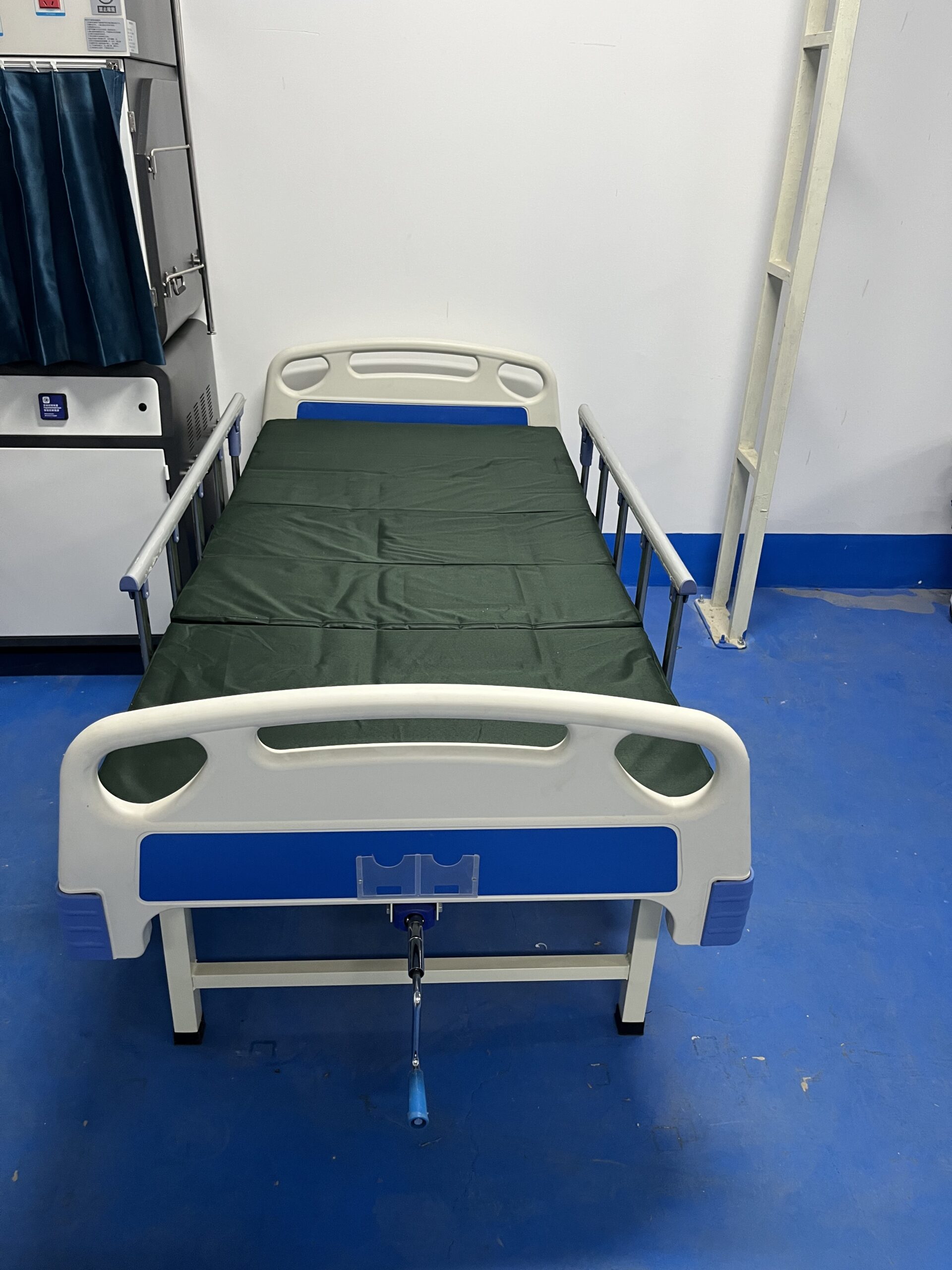
The interface between mattress and platform is where dimensional compliance either holds or fails in practice. IEC 60601-2-52 explicitly requires manufacturers to document which mattress dimensions maintain the 120mm rail-to-platform gap limit. A standard clinical mattress measures 6 inches (approximately 150mm) thick, but pressure-redistribution overlays, alternating-pressure mattresses, and bariatric-specific surfaces can add 50–100mm to that stack. Each additional millimeter of mattress height reduces the effective rail height and changes the geometry of the entrapment zone.
In our factory, we test every bed-mattress combination with the standardized cone gauge before adding it to the compatibility list. The most common failure mode we see is a facility purchasing a 200mm-thick alternating-pressure mattress for a bed whose rails were validated only with a 150mm mattress. The 50mm difference drops effective rail height from 220mm to 170mm—below the standard’s minimum—and opens a lateral gap that the original type test never evaluated. For a detailed approach to selecting mattresses that work with your bed fleet, see our guide on hospital bed mattress selection for pressure injury prevention.
On the electrical side, IEC 60601-2-52 operates as a particular standard under the general requirements of IEC 60601-1. This means every electrically powered bed must also satisfy the general standard’s requirements for protective earthing, leakage current limits, dielectric strength, and electromagnetic compatibility. The bed’s actuators, control electronics, and battery backup system are tested as a complete system. Beds intended for home care (Application Environment 4) additionally fall under IEC 60601-1-11, which addresses the less controlled electrical installations found in residential settings.
How to Verify Compliance During Procurement
Knowing the standard’s requirements is only half the job. The other half is verifying that the beds you purchase actually meet them. Our hospital bed procurement checklist walks through the full documentation package, but the dimensional verification steps deserve specific attention here.
First, request the CB Test Report or CE type examination certificate that explicitly lists IEC 60601-2-52 (or IEC 80601-2-52:2026 for newer certifications) on the cover page. The report must show pass verdicts for Clause 201.9.4 (instability and overbalance), Clause 201.9.8 (support system strength), and the entrapment gap assessment. A report that only covers IEC 60601-1 electrical clauses is insufficient.
Second, verify the mattress compatibility documentation. The manufacturer must provide a list of mattress dimensions—length, width, and thickness—that maintain compliance with the 120mm gap limit and 220mm rail height requirement. If you plan to use mattresses from a third-party supplier, cross-reference those dimensions against the bed manufacturer’s list before issuing the purchase order.
Third, confirm the SWL marking. IEC 60601-2-52 Clause 201.7.2.2.1 requires the bed to be physically marked with both the maximum patient weight and the total SWL in kilograms. If the bed arrives without these markings, it fails the standard’s identification requirements regardless of its structural performance.
For a broader view of how dimensional compliance fits into the overall safety framework, our article on hospital bed safety standards covers the full regulatory landscape including MDR 2017/745 classification and post-market surveillance obligations.
Conclusion
Hospital bed dimensions are not a matter of preference—they are a regulatory requirement with direct patient safety consequences. IEC 60601-2-52 gives procurement teams a precise, measurable framework: platform geometry, entrapment gap limits, structural load thresholds, and braking performance all defined in millimeters and Newtons. The buyers who succeed are the ones who treat these numbers as non-negotiable line items in their specifications rather than optional features buried in a brochure.
Key Takeaways:
- Standard adult hospital bed platforms measure approximately 2000–2020mm long by 880–910mm wide, with height adjustable from 320mm to 760mm—verify these against your mattress and room dimensions before ordering.
- IEC 60601-2-52 mandates side rail-to-mattress gaps below 120mm, headboard gaps below 60mm, and footboard-to-rail gaps above 318mm; always request the manufacturer’s mattress compatibility list to confirm ongoing compliance.
- Minimum SWL is 2000N (approximately 200kg) for acute care and 1700N for long-term care; bariatric applications require 350kg or more with reinforced steel frames.
- Demand a CB Test Report that explicitly covers Clause 201.9 mechanical hazards—not just the electrical safety clauses from IEC 60601-1—before accepting any bed into your fleet.
Ready to specify beds that meet IEC 60601-2-52 from day one? Browse our IEC-compliant hospital bed range or contact our engineering team for department-specific dimension recommendations.
Frequently Asked Questions
What is the standard hospital bed mattress platform size?
The standard adult hospital bed mattress platform measures approximately 2000–2020mm in length and 880–910mm in width. Height adjusts from roughly 320mm to 760mm above the floor. These dimensions accommodate standard 900mm-wide clinical mattresses while maintaining IEC 60601-2-52 side rail gap compliance.
What gap size between side rails and mattress is considered safe?
IEC 60601-2-52 requires gaps between the side rail and mattress platform to remain below 120mm to prevent head entrapment. Gaps between bed frame components must stay under 60mm to prevent neck entrapment. These limits are verified using a standardized test cone during type examination.
How wide should a bariatric hospital bed be?
Bariatric hospital beds range from 1070mm to 1370mm (42–54 inches) in platform width, with safe working loads of 350kg or more. Patients with BMI above 35 kg/m² require the additional lateral space to turn safely, reducing pressure injury risk and caregiver strain.
Does IEC 60601-2-52 apply to home care beds?
Yes. IEC 60601-2-52 covers Application Environments 1 through 5, including home care (Environment 4). Home care beds must meet the same entrapment gap limits but have a reduced minimum SWL of 1700N and additionally comply with IEC 60601-1-11 for residential electrical installations.
What documentation proves a hospital bed meets IEC 60601-2-52?
Request a CB Test Report or CE type examination certificate listing IEC 60601-2-52 with pass verdicts for Clause 201.9 (mechanical hazards). The manufacturer must also provide mattress compatibility dimensions and physically mark the bed with maximum patient weight and SWL per Clause 201.7.2.2.1.
You May Also Like...

Gas Outlet Colour Coding and Pin Index: What Medical Equipment Importers Must Check
Medical gas systems are built on a simple principle: it must be impossible to connect...
Cybersecurity for Connected OR Equipment: What Importers Should Ask
An operating room used to be a set of mechanical systems with a power cable....

Blood Donation Chairs: Specifying Seating for Donor Safety and Compliance
Blood establishments face a seating problem that ordinary furniture cannot solve: donors sit for 15...