
Ask the factory to show you the ISPM 15 mark on every solid wood component before anything goes into the container. The stamped mark, not the treatment certificate, is what a border inspector reads, and it must display four things: the IPPC wheat symbol inside a rectangular border, a two letter country code, a hyphen followed by the treatment provider’s registered number, and a treatment code such as HT. The mark must be permanent, legible, applied after treatment by an authorized provider, and visible on at least two opposite sides of each crate. Collect photos of every mark plus the treatment record before loading; unmarked wood at the border can mean re-export, destruction, or treatment at your expense.
Your crates are being built this week, so the verification window is now. This guide covers what to put in your message to the factory, which photos to demand, and how to read what comes back.
What the Mark on the Wood Must Show
Wood packaging answers to ISPM 15, the international requirements for wood packaging material in export trade, set under the International Plant Protection Convention. Inspectors at ports on every continent recognize one mark format, and every element on it has a job. In the left compartment sits the IPPC symbol, a stylized ear of wheat, separated from the data by a vertical line inside a rectangular border. To its right come the data fields: a two letter ISO country code naming where the wood was treated, then a hyphen and the unique number the national plant protection authority assigned to the treatment provider, then the treatment code.
Read the fields as a chain of accountability. The wheat symbol says this wood entered a regulated system. The country code says where treatment happened, which is not always where the goods were made. The provider number lets any inspector trace the wood back to a registered facility. The treatment code states what was done: HT for heat treatment, the schedule that lifts the wood core to at least 56 degrees Celsius for a minimum of 30 minutes; MB for methyl bromide fumigation, which many markets are phasing out; DH for dielectric heating; SF for sulphuryl fluoride. Destinations accept different subsets of these codes, so ask your customs broker which ones your market recognizes before the crates are fabricated. Heat treatment is the default request, because its acceptance is the widest.
Format failures stop shipments as reliably as missing stamps. The mark must be stamped, branded, or stenciled, never handwritten, and it should be legible, permanent, and placed on at least two opposite sides of the component so it survives handling and stacking. The hyphen between the country code and the provider number is part of the official format, and some border authorities enforce that detail strictly, so a mark where the codes run together deserves a question before loading. Put simply, these are the ISPM 15 mark requirements in full: IPPC logo, country code, treatment provider number, and treatment code, presented inside one bordered rectangle.
The ISPM 15 Requirements for Wood Packaging Reach Past the Crate Walls
Buyers photograph the crate sides and stop there. Inspectors do not. The standard covers any solid wood in the shipment: the floor bearers under the crate, the corner posts, the internal blocking that keeps a surgical light from shifting, the skids, the pallets, and the loose wedges and braces added on loading day. That last category causes a disproportionate share of rejections, because dunnage is often grabbed from whatever stack stands nearest the truck, and it may never have seen a treatment kiln.
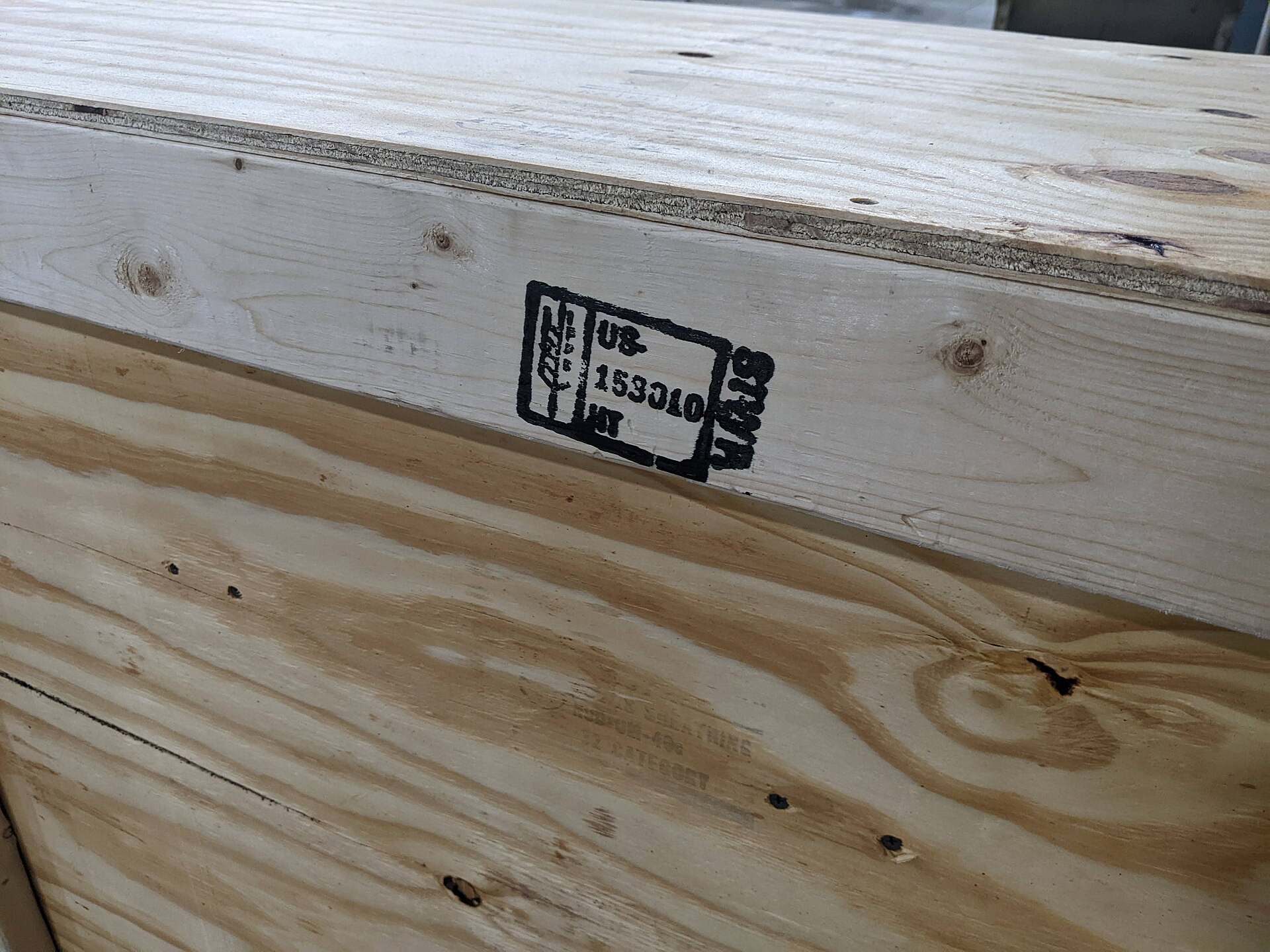
Ask the factory to walk the same floor an inspector would. Every piece of solid wood headed for your container should be accounted for as treated and marked, and the request is easiest to enforce in writing: confirm that all solid wood, including blocking, bracing, skids, pallets, and dunnage, carries a valid mark. Then have the factory separate the rest. Plywood, particleboard, oriented strand board, veneer, and any wood thinner than 6 mm sit outside the standard, because the glue, heat, and pressure that manufacture them destroy pests. A crate can legitimately mix the two, an engineered panel beside a solid sawn frame, and only the solid sawn parts need the stamp. Getting that bill of materials in writing turns a vague compliance conversation into a checklist the factory can execute this week.
Treatment Comes Before Marking, and Repairs Undo Both
The sequence inside the standard is fixed: the wood is debarked, then treated by an authorized provider, then marked. A stamp applied before treatment, or by a crate shop with no authorization, is invalid even when it looks perfect, and an inspector who traces the provider number can question the whole container on that basis. So ask the factory who performed the treatment. Many crate makers never touch a treatment kiln; they buy treated lumber from a licensed facility or send assemblies out for processing. Either way, you want the treatment record, showing the provider and the date, and the number on that record should match the number on the marks.
Repairs are the quiet risk for a container loading this week. When a schedule slips, crews patch crates: a fresh board screwed across a split panel, a new runner under a bearing point. A repair with untreated wood reopens the compliance question, because under the standard a repaired or remanufactured unit must be treated and marked again before it ships. A new board glued over an existing stamp hides the mark and voids compliance in one move. Tell the factory in advance that any repair uses treated and marked wood, or that the repaired unit goes back to the provider for re-treatment and a fresh mark.
Ask about the surface of the wood as well. Debarking happens before treatment, and small residual patches of bark are tolerated within tight limits, but loose flaps of bark are a rejection reason in their own right, even on stamped wood. Inspectors also read the timber for life: round exit holes, feeding galleries under the surface, fine bore dust piled where larvae have been working. No mark rescues wood that shows pest activity, which is why the physical condition of the crates belongs in your pre-loading conversation and not only in the certificate folder.
Why Containers Get Stopped at the Border
Customs requirements for wood packaging markings are enforced physically, not just on paper. A phytosanitary certificate, a fumigation certificate, or a letter from the factory does not substitute for the mark; the stamp on the wood is the compliance document. When an inspector opens a container, the common rejection reasons repeat across ports: a mark that is missing, illegible, or hand drawn; a mark in the wrong format; a stamp painted over or hidden by the way the crate is braced; bark left on a bearer; insect evidence in the timber; and unmarked dunnage sitting in a container whose crates are otherwise in order.
Understand the order of events at a port inspection as well. Officers typically screen documents first, then target containers for physical examination, and wood packaging is one of the first things they see, because it is visible the moment a door opens. An inspector does not need to open a single crate to fail the shipment; illegible marks on the outer bearers, bark on a floor board, or bore dust on the container floor can be enough on their own. That is exactly why the evidence you collect before loading mirrors what the inspector collects at arrival: photographs of every mark, taken while you can still fix a problem.
The consequences land on the importer. The import regulations for solid wood packaging are written destination by destination, but nearly all of them adopt ISPM 15 as the baseline and add local enforcement details on top, so an identical crate can clear one port and be held at the next. Noncompliant wood packaging can be refused entry, and the usual outcomes are re-export of the packaging, destruction of it, or treatment at your expense, with the container held until the issue is resolved. In several destinations, fumigating after arrival is not accepted as a remedy, which removes the cheap fix people imagine at the border. The lesson is uncomfortable but simple: the equipment inside can be flawless and the shipment can still be stopped, because the problem lives in the wood around it. The documents that travel with the goods are a separate discipline; the import document pack for medical devices covers what customs asks for beyond the crates (/import-document-pack-medical-devices/).
The Evidence to Collect Before the Doors Close
Verification has a window, and yours sits between fabrication and loading, which given the timeline means this week. Ask for a photo of every mark, taken close enough that the country code, provider number, and treatment code are readable, with the whole component in frame. Ask for the same on the dunnage before it enters the container. Ask for the treatment record, and compare the provider number on it against the numbers in the photos; a mismatch points to borrowed or reused lumber, and it needs resolving before the truck arrives. Ask for a packing declaration listing which units carry marks, so an inventory of the wood travels with the shipment.
Certificates are where importers waste the most energy. Free sale certificates, apostilles, and consular stamps belong to the export document chain (/free-sale-certificate-ccpit-apostille/); wood packaging is not part of that chain. The mark on the wood, backed by the treatment record, is the system working as designed. One short message to the factory captures the whole audit: every solid wood component in the container, including blocking and dunnage, must carry a legible, permanent ISPM 15 mark applied after treatment by the authorized provider, and photos of every mark plus the treatment record must reach you before loading. A container that passes that audit moves through the border the way it left the factory floor, on evidence rather than assurances.
Vous pourriez aussi aimer...

The As-Built Sheet a Theatre Committee Signs
An as-built sheet is the one page per theatre that records what was installed and...

A Posted Lowering Card and Its Drill Record
Emergency manual lowering means returning an operating table to a flat top when mains power...

Transit Fixings: The Removal Record to Demand
A transit fixing is any bolt, bracket, pin, chock or strap fitted to keep a...