
A surgical pendant with the wrong arm configuration turns an otherwise correct operating room into a daily negotiation: the anesthesia team reaches over the surgeon, the gas hoses cross the sterile field, and everyone works around the equipment instead of with it. Pendant arm length and coverage are the geometry that prevents this, and both are decided on the room drawing before anything is manufactured. This guide walks that geometry.
Arm Segments and What Each Contributes
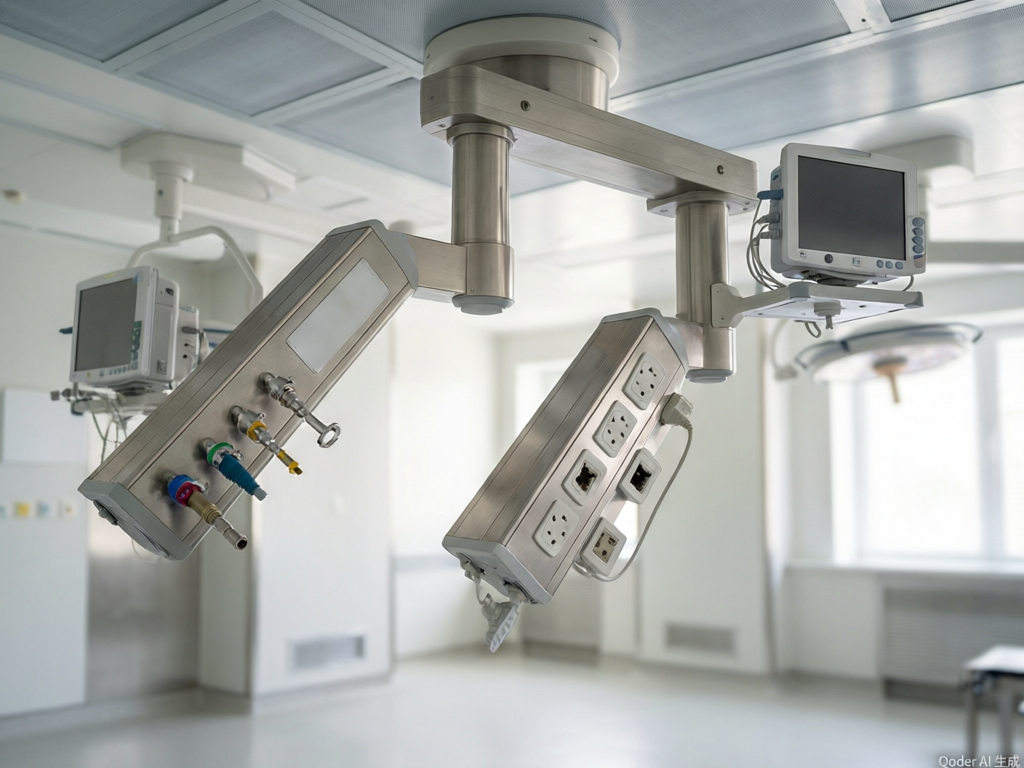
Most pendants carry one or two articulated arm segments on a ceiling column. The column provides rotation; each segment adds reach and another hinge point. Single-arm pendants suit small rooms where the equipment lands close to the ceiling point, typically delivering under a meter of lateral reach. Dual-arm pendants compound their segments: two 800 mm arms can position equipment anywhere in a broad arc several meters across, at the cost of ceiling height, because each articulated joint consumes headroom. The coverage drawing method is the practical check: mark the ceiling point, swing each segment length as an arc, and overlay the equipment positions the room plan demands. If the surgical head, anesthesia machine position and electrosurgical unit all sit inside the swept area with slack, the arm spec is right. The IEC 60601 framework governing these systems indexes its safety and performance requirements through standards bodies whose references are cataloged in the BSI knowledge base, and the geometry decisions live inside that compliance envelope.

Reach Versus Height: The Trade Buyers Miss
Every articulated joint buys reach at the price of ceiling height, and operating rooms rarely have height to spare once lighting and imaging hang from the same ceiling. A dual-arm pendant dropped on a 600 mm column in a 3-meter room can leave the equipment platform at working height with insufficient clearance above, which is why room drawings should fix the platform working height first, then solve for reach within what remains. The alternative for tight rooms is a fixed-column or single-arm configuration with equipment positioned by room layout rather than by arm sweep, a trade documented in our vertical column versus articulated arm comparison.
Matching Reach to Workflow, Not Just the Plan
Two coverage tests catch what drawings miss. The sterile-field test: from each surgical position, the surgeon’s reach envelope must not intersect any pendant arm at any position the room uses, which is checked by swinging the arm through its realistic positions, not its full theoretical sweep. The turnover test: anesthesia pendants must reach their positions without crossing the surgical pendant’s arc, since simultaneous positioning is the daily reality, and our OR ceiling pendant zoning guide draws the gas and power zones that make the separation enforceable. Rooms that pass both tests on paper pass them in clinical use; rooms that fail on paper fail expensively, after installation.
Specifying Arm Length on the Room Drawing
Write the pendant spec as a coverage requirement, not a part number: equipment positions from the room plan, platform working heights, sterile-field constraints, and the swept-area drawing overlaid. Factories with engineering support, including our turnkey OR program documented on the page de bloc opératoire clé en main, return the arm configuration against your drawing before manufacturing. Send the room plan to sanyang10086@gmail.com or WhatsApp +86 195 0862 5836, and the coverage study comes back with the drawing marked up, before the order, not after the ceiling closes.
Lecture connexe : Gas Outlet Colour Coding and Pin Index
Vous pourriez aussi aimer...

Surgical Suite Floors and Equipment Anchoring: The Loads the Building Must Take
An operating suite is a structural project that arrives disguised as an equipment purchase. Booms...

Air Change Rates and Recovery Times in the OR: What Equipment Specs Should Assume
An operating room’s ventilation is invisible until something goes wrong. The air change rate decides...

Surgical Smoke Evacuation: Systems, Filters and Room Planning for OR Teams
Every electrosurgical and laser procedure produces smoke, and the smell in the room after a...