
Executive Summary
How to choose a bariatric hospital bed: safe working load vs patient weight, deck width, IEC 80601-2-52 compliance, key safety features, and a configuration comparison table.
A few years ago I walked into a 400-bed regional hospital that had just admitted a 280 kg patient — and discovered their entire ward fleet topped out at a 170 kg safe working load. The nursing team ended up renting a bariatric bed at emergency rates for six weeks while procurement scrambled. That scene repeats itself more often than most facility managers admit, and it is exactly why bariatric hospital bed weight capacity should be a planned specification, not an afterthought. If you are evaluating hospital beds for a mixed-acuity facility, the bariatric segment deserves its own selection criteria.
Obesity rates keep climbing worldwide — the World Health Organization estimates that roughly one in eight people globally now lives with obesity — and acute-care admissions reflect that curve. Yet many tender documents we review still specify a single “standard” electric bed for the whole ward. When a plus-size patient arrives, the result is unsafe workarounds: two nurses manually boosting a patient on a mattress that is too narrow, side rails that cannot contain a wider body habitus, and casters strained well beyond their design envelope. The clinical risks — pressure injuries, falls, staff musculoskeletal injuries — are well documented. Each year an estimated 700,000 to 1 million patient falls occur in U.S. hospitals alone, and industry analyses suggest around 20% of falls involve patients classified as obese.
This guide distills what we have learned manufacturing and exporting hospital beds to distributors and hospital projects in more than 30 countries. It covers how to read weight capacity claims honestly, how to choose bed width, which safety standards actually matter, and how to compare configurations without overpaying for capacity you will never use.
Step 1: Understand What “Weight Capacity” Really Means
The single most misunderstood number on any hospital bed datasheet is the weight rating. Manufacturers use two different terms, and confusing them is the most common procurement error we see:
- Safe Working Load (SWL) — the total load the bed is designed to carry, including the patient, mattress, and all accessories (IV poles, monitors, side-table, traction frames). This is the number defined in the IEC 60601/80601-2-52 framework for medical beds.
- Maximum patient weight — SWL minus the mattress and a typical accessory allowance. A bed rated 250 kg SWL typically supports a patient of roughly 205–215 kg once you subtract a 20–30 kg pressure-relief mattress and accessories.
When a tender says “bariatric hospital bed weight capacity 300 kg,” ask the vendor to state plainly whether that is SWL or patient weight, and request the load test report. In our factory, every bariatric frame undergoes a static load test at multiples of its rated SWL before shipment — any serious manufacturer should be able to show equivalent documentation.
Field rule: size the bed for the heaviest patient you realistically expect, then add a 20–25% margin on the patient weight figure — not on the headline SWL. Dynamic loads during repositioning and sitting-up can momentarily exceed static body weight.
There is also a dynamic side to the calculation that datasheets rarely explain. When a 250 kg patient pushes up from lying to sitting, or pivots at the bed edge with feet on the floor, the instantaneous load on the backrest actuator and the frame welds spikes well above static body weight. This is why reputable manufacturers test bariatric frames with cyclic loading, not just a single static proof load — and why a bed that technically “holds” 300 kg can still develop cracked welds or a sagging deck within two years of real ward use. Ask suppliers how many actuation cycles the bed is rated for at full SWL, and whether the frame warranty is voided above a stated patient weight.
Practical capacity tiers
Based on the projects we supply, three tiers cover nearly every facility need:
- Standard electric beds (180–250 kg SWL): general wards, roughly 85–90% of admissions.
- Bariatric beds (300–350 kg SWL): ICU step-down, orthopedics, and wards serving patient populations with BMI ≥ 40. Patient weight capacity typically 250–300 kg.
- Heavy bariatric / “plus-size ICU” beds (400–450+ kg SWL): dedicated bariatric surgery units and tertiary ICUs.
Step 2: Choose the Right Bed Width and Deck Dimensions
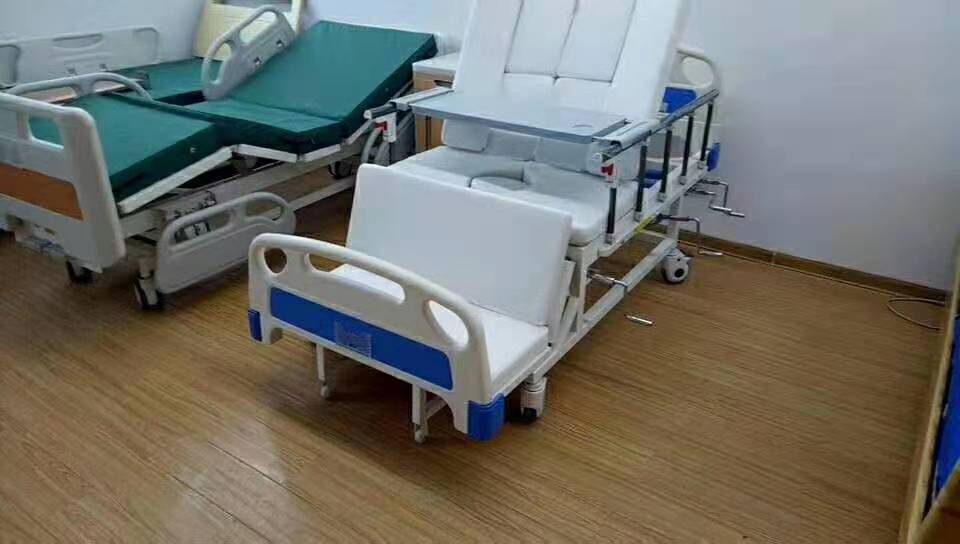
Width is where comfort, dignity, and clinical safety intersect. A standard hospital bed deck is about 90 cm (36 in) wide. For a patient with a BMI over 40, that leaves almost no lateral space: the patient cannot reposition independently, tissue pressure concentrates at the hips and shoulders, and side rails end up pressing against the body — an entrapment and pressure-injury risk rather than a protection.
Common bariatric deck widths are 100 cm, 107 cm (42 in), and 122 cm (48 in). Some expandable designs let staff adjust width at the bedside — useful for facilities that cannot dedicate rooms. Guidelines from bariatric care programs, such as Alberta Health Services’ Guidelines for the Care of Hospitalized Patients with Bariatric Care Needs, emphasize matching equipment width to the patient’s body measurements so the patient can turn and reposition without contacting the rails.
One more width-related detail buyers miss: side-rail length and deck articulation geometry change on wider beds. On a 107 cm deck, a poorly designed backrest pivots the patient toward the rail on one side during sitting-up, compressing tissue against the rail. Well-engineered bariatric decks use an auto-regression or backrest-slide mechanism that pulls the patient back toward the centerline as the backrest rises — a feature worth specifically asking about, because it rarely appears on comparison sheets.
The doorway and elevator reality check
Before you fall in love with a 122 cm bed, measure your building. A 122 cm bed plus push handles needs clear door openings of roughly 140 cm to move between rooms. In older hospitals — especially renovation projects we support in turnkey wards — we often end up specifying 100–107 cm beds purely because the corridor geometry demands it. Bed length matters too: many bariatric patients are also tall, and an 80–85 cm effective deck extension or integrated length extension prevents feet hanging off the end, which worsens heel pressure injuries.

Step 3: Verify the Safety Standards That Actually Apply
Any bed you buy should be designed and tested against the international medical bed standard. Historically this was IEC 60601-2-52; the series has since been renumbered and updated as IEC 80601-2-52 (Medical electrical equipment — Part 2-52: Particular requirements for the basic safety and essential performance of medical beds for adults). The standard governs stability, mechanical strength, side-rail entrapment gaps, electrical safety, and essential performance under load. For electrically adjustable bariatric beds, these requirements are not optional decoration — a frame that flexes excessively under 350 kg changes rail gap geometry, and that is precisely how entrapment incidents happen.
On the regulatory side, check the following before shortlisting a supplier:
- ISO 13485 quality management certification for the manufacturer — the baseline indicator of controlled production.
- CE marking under EU MDR 2017/745 if you sell into Europe; medical beds are Class I devices, but the technical documentation and post-market surveillance obligations are real.
- FDA 510(k) or registration for the U.S. market, where hospital beds are Class I/II devices depending on features.
- Test reports referencing IEC 80601-2-52 (or 60601-2-52) from an accredited lab — ask specifically for the stability and load clauses for bariatric-rated frames.
Red flag: a “bariatric” bed whose datasheet only shows a standard-bed IEC test report. Reinforced frames, wider decks, and upgraded actuators change the test configuration — the certificate must cover the exact model you are buying.
Step 4: Specify the Safety Features That Prevent Incidents
Capacity and width get the headlines, but day-to-day incident prevention lives in the feature set. From incident reviews and distributor feedback, these are the features that matter most on a bariatric bed:
- Low minimum height (ideally ≤ 40 cm to deck): fall injury severity scales with drop height. A bariatric patient who rolls out of a bed at 60 cm faces a very different outcome than at 38 cm.
- Central braking with 150 mm+ dual casters: a loaded 350 kg bed is heavy enough that weak brakes or small casters turn every transport into a risk event. Check caster diameter, bearing quality, and brake engagement force.
- Full-length, gap-compliant side rails with one-hand release and locking positions. Rail gaps must remain within IEC entrapment dimensions at rated load.
- Integrated scale: weight-based drug dosing and fluid management in bariatric patients is routine; a built-in scale accurate under high load saves daily hoist transfers.
- CPR quick-release and Trendelenburg capability: essential if the bed will ever serve step-down or ICU patients.
- Bed exit alarm and under-bed light: falls prevention features that nursing audits consistently flag as underused on bariatric units.
- Actuator duty cycle and battery backup: repositioning a 300 kg patient draws real current; undersized actuators overheat and fail early.
A note on surfaces and transfers: even the best-specified bed fails at the edges of the workflow — literally. The gap between a bariatric bed and a standard-width stretcher or trolley during lateral transfer is where staff injuries cluster. If your bariatric patients will routinely move between ward, imaging, and OR, standardize the transport equipment width at the same time you standardize the bed, and consider friction-reducing transfer sheets or air-assisted lateral transfer devices rated for the same weight class. Several hospital systems we supply now write this transfer compatibility line directly into the bed tender, and it eliminates a whole category of day-one complaints from nursing.

Staff safety deserves equal weight in the specification. Nursing injury data repeatedly show sprains and strains dominate on-the-job injuries, with manual patient handling as a leading cause. A bed with electric backrest, height adjustment across a wide range, and smooth transport casters directly reduces the manual effort per repositioning — and bariatric patients are repositioned more frequently, not less, because of pressure-injury prophylaxis schedules.
Step 5: Compare Configurations Before You Commit
The table below reflects the three configurations we most frequently quote, and the trade-offs buyers should weigh. Numbers are typical industry ranges — always confirm the exact SWL and patient-weight rating on the specific model’s test report.
| Parameter | Standard Electric Bed | Bariatric Bed (Mid-Tier) | Heavy Bariatric / ICU |
|---|---|---|---|
| Safe Working Load | 180–250 kg | 300–350 kg | 400–450+ kg |
| Typical patient weight limit | 135–215 kg | 250–300 kg | 350–400 kg |
| Deck width | ~90 cm | 100–107 cm | 107–122 cm |
| Casters | 125 mm | 150 mm dual | 150–200 mm dual, central lock |
| Integrated scale | Optional | Recommended | Standard |
| Typical use | General wards | Mixed wards, step-down | Bariatric surgery, ICU |

A sizing strategy that works well for mid-size hospitals: equip 5–10% of ward beds at the mid-tier bariatric level rather than buying one or two heavy ICU units. Bariatric admissions rarely arrive on schedule, and a ward-capable mid-tier bed gets used daily, while an oversized 450 kg unit sitting in storage earns nothing.
Electric versus manual adjustment deserves a mention here too. True manual bariatric beds are increasingly rare for good reason: cranking a 300 kg load through a mechanical backrest is both a staff-injury risk and a maintenance headache. Hydraulic assist designs split the difference and remain popular in markets with unstable power supply, but for any ward where repositioning happens more than a few times per shift, a full electric frame with battery backup pays for itself in reduced staff strain and faster patient handling. When you run the total cost comparison, include the nursing time per repositioning — it is usually the largest hidden line item.
Step 6: Plan Procurement, Mattresses, and Lifecycle Costs
The bed frame is only half the system. Pressure redistribution for bariatric patients requires a matched mattress — typically a wider, higher-density foam or alternating-air system rated for the same patient weight. A mattress rated for 150 kg under a 250 kg patient bottoms out within weeks, and the resulting pressure injuries cost far more than the mattress you saved. Confirm mattress width matches the deck exactly; a 107 cm mattress on a 100 cm deck creates rail-gap hazards.
On the commercial side, build your tender around verifiable checkpoints: SWL test reports, IEC 80601-2-52 compliance, actuator brand and duty cycle, spare-part availability, and warranty on welds and motors. Our hospital bed procurement checklist walks through the full verification sequence we recommend to distributors. And because bariatric frames work harder every day, line up a spare parts and service plan for casters, actuators, and handsets before the fleet arrives — these are the three components that wear first under high load.
Budget reality: a properly specified mid-tier bariatric bed typically costs 40–70% more than a standard electric bed, but emergency rental, staff injury claims, and one fall-related lawsuit will each exceed that premium many times over. Falls alone are estimated to cost U.S. hospitals around $17 billion annually.

Conclusion
Selecting a bariatric hospital bed is ultimately an exercise in honest load math and risk planning. Read the safe working load — not the marketing headline — and convert it to a real patient-weight limit. Match deck width to your patient population and your doorways. Demand test documentation against IEC 80601-2-52 for the exact model you are buying. Prioritize the safety features that prevent the incidents bariatric patients are statistically most exposed to: low height, strong brakes, compliant rails, and an integrated scale. Finally, plan the mattress, the spares, and the budget as one system.
If you are sizing a bariatric-capable fleet for a new ward or replacing aging frames, our engineering team can help you match capacity tiers to your case mix and building constraints. Contact Sanyang Medical for datasheets, test reports, and a configuration quote.
Frequently Asked Questions
What weight capacity should a bariatric hospital bed have?
For most facilities, a bariatric bed with a safe working load of 300–350 kg covers patients up to roughly 250–300 kg. Dedicated bariatric surgery units and tertiary ICUs should consider 400–450 kg SWL models. Always confirm whether a quoted figure is SWL or maximum patient weight — they differ by the mattress and accessory load.
How wide is a bariatric hospital bed?
Common deck widths are 100 cm, 107 cm (42 in), and 122 cm (48 in), compared with ~90 cm for a standard bed. Choose based on patient body measurements (the patient should be able to turn without contacting the rails) and your building’s door clearances.
What safety standard applies to bariatric hospital beds?
The key international standard is IEC 80601-2-52 (formerly IEC 60601-2-52), covering basic safety and essential performance of adult medical beds, including stability, mechanical strength under load, and side-rail entrapment dimensions. Depending on your market, also verify CE marking under EU MDR 2017/745 or FDA registration, plus the manufacturer’s ISO 13485 certification.
Do bariatric beds need special mattresses?
Yes. The mattress must match both the deck width and the patient weight rating. Bariatric pressure-redistribution mattresses use higher-density foam or alternating-air cells designed to avoid bottoming out under higher loads. An undersized or underrated mattress negates the bed’s safety features and sharply raises pressure-injury risk.
How many bariatric beds should a hospital own?
A common planning baseline is 5–10% of ward beds at a mid-tier bariatric specification, adjusted for your local obesity prevalence and case mix. Facilities with bariatric surgery programs or high-acuity ICUs should add heavy-duty units on top of that baseline.
You May Also Like...

Bariatric OR Package: Table, Bed and Trolley Coordination
A bariatric OR package coordinates the operating table, the patient bed and the trolley for...

Lumen vs Lux: What These Surgical Light Units Mean
Lumen and lux are not the same thing. Lumen measures the total light a fixture...

Emergency Department Equipment for Trauma, Resuscitation and Triage
An emergency department is built around speed, and its equipment has to be ready the...