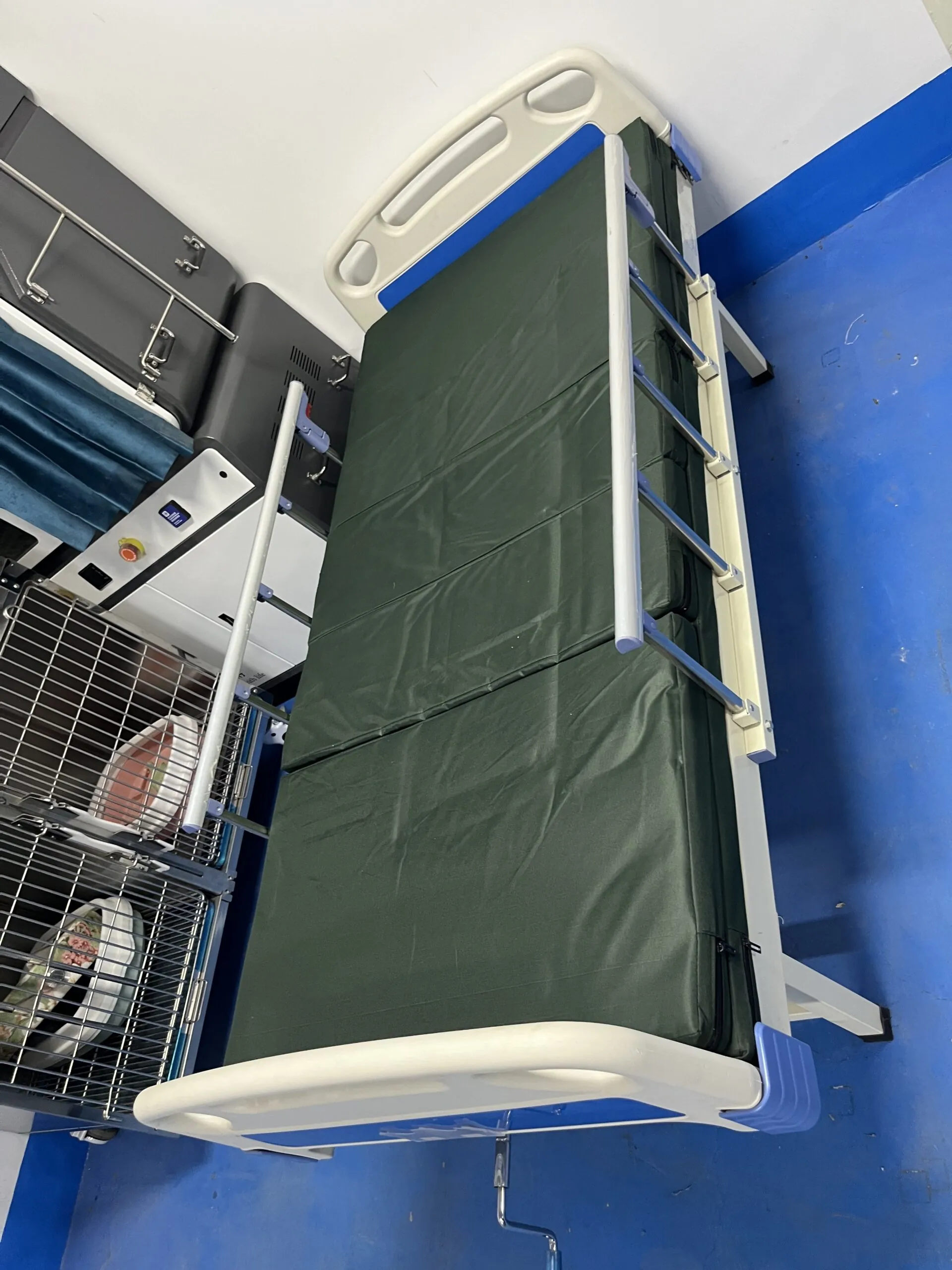

A CPR release that works during a sales demonstration tells your committee nothing about the bed at the bedside. What the committee is actually asking for is evidence: a defined check, performed on each bed, with a recorded result that a reviewer can read two years later. That evidence has three parts. First, the factory supplies a written verification procedure for the model, not a brochure line. Second, your team performs the sequence and writes down what the bed did, including the guard against accidental triggering and the behavior after reset. Third, the record line becomes part of the bed’s acceptance and maintenance file, so every bed in the fleet carries its own CPR history. The tables and sequences below turn that request into document text you can send the factory this week.

What Verified Means on an ICU Bed
Demonstration and verification answer different questions. A demonstration shows that one bed, on one day, in the hands of the person who knows it best, can drop to the CPR position. Verification asks four narrower questions per bed: does the release operate within the stated method; does the deck reach the defined flat position; does anything else move that should not; and does the bed return to its working state cleanly afterwards. Each answer is written next to the bed’s serial number. Framed this way, the request to the factory is not “prove the function works” but “give us the procedure, the acceptance values and the record format so our own staff can verify every bed”. Manufacturers working to the safety standard for electrically operated hospital beds, IEC 60601-2-52, already test CPR related motions in type testing; the factory’s job is to hand over enough of that material for bedside checks, which is why the written procedure should reference the same definitions used in the IEC 60601 2 52 standard for electric hospital beds. If the function page in the manual is all you receive, you have received marketing, not a procedure.
Symptoms, Causes and Handling During Verification
Verification on a real fleet rarely produces clean pass or fail. More often a bed behaves oddly, and the crew needs a rule for what an oddity means before the bed returns to service. The table below lists the behaviors that surface most often during CPR checks, the usual underlying cause, and the handling that keeps the record honest.
| Symptom during check | Likely cause | Handling and record entry |
|---|---|---|
| Release operates but deck stops short of flat | Obstruction, an unrouted cable, or gas spring degradation | Repeat once after visual check; if still short, tag out and log as failed with the measured shortfall |
| Release needs both levers or repeated presses | Two stage guard misadjusted or linkage wear | Do not train around it; log as failed, because hesitations in an emergency exceed the design intent |
| Bed drifts or creeps after reaching flat | Valve not fully seating after reset | Log as failed, keep out of service until service confirms valve condition and retests |
| Release triggers during routine positioning | Guard ineffective or staff using the release as a positioning control | Log as a mis trigger protection failure; brief the unit, recheck after retraining |
| Everything passes but no one can find last year’s record | Records kept per ward, not per bed | Restart from the serial numbered line; note the gap in the fleet file |
The last row is the quiet one: most fleets fail verification not on mechanics but on filing. A bed with three years of passed checks that nobody can produce has, from the committee’s view, never been verified. The record line in the next section is what prevents that outcome.
The Verification Sequence, Step by Step
A procedure the factory writes and your staff can actually run has three checkpoints. Each checkpoint produces one fact, and each fact gets its own column in the record. Keep the whole sequence under five minutes per bed so it survives contact with a real ICU schedule, and perform it on every bed at commissioning and on the interval your maintenance plan sets.
Release and Flat Position
Trigger the release exactly as the manual describes, using the hands the checklist names, and let the deck reach its end state without assistance. The checker records two facts: whether the release operated with the stated action, and whether the deck reached the flat, firm surface the manual defines for resuscitation. If the manual gives no measurable definition of flat, ask the factory to add one before the first fleet wide check, because “looked flat” cannot be audited.
Mis-trigger Protection
Before touching the release, the checker performs the routine positioning motions the bed is used for every day, including backrest and height changes from the nurse panel. The fact to record is simple: did any routine action produce a CPR release? A bed that confuses daily controls with an emergency function will teach staff to fear the panel, and the failure belongs in the record even if the clinical effect was only a startled nurse. This checkpoint is where the distinction between a guarded release and a poorly guarded one becomes visible on paper.
Reset and Return to Service
After the check, reset the bed to its working position and confirm three returns: full function from the nurse panel, correct height memory behavior, and no alarms or fault indications left active. The reset fact closes the loop, because a bed that passes the drop but limps back into service is not verified, it is broken in a new way. Our guide to CPR release malfunctions, checks and fixes covers the fault side in depth; this article’s sequence exists so those faults are caught by a scheduled check instead of by an emergency.
The Record Line That Survives an Audit
Every checkpoint above collapses into one line per bed per check. Fix the columns now, print them on the fleet’s check card, and refuse any software export or paper form that drops a column, because each column answers a question an auditor actually asks.
| Column | Content | Question it answers later |
|---|---|---|
| Bed serial number | As printed on the rating plate | Which physical bed is this history about |
| Date and checker | Date plus name or staff ID | Who saw the bed behave this way |
| Release result | Operated as described / failed | Did the emergency function respond to the stated action |
| Flat result | Reached defined flat / shortfall noted | Was the surface usable for resuscitation |
| Mis-trigger result | No routine action triggered release / triggered | Was the guard effective during daily use |
| Reset result | Clean return to service / fault logged | Did the bed come back whole |
| Action | None / tag reference and ticket number | What happened to the failures |
Seven columns, one line, five minutes. Fleets that adopt this format usually bind it to existing paperwork rather than inventing new forms: the CPR line joins the delivery check, and later the periodic checks, in the same file. That is also how the line earns its keep in disputes, because a warranty conversation about a release mechanism behaves very differently when the hospital can show dated results before and after the fault appeared.
Where Commissioning Evidence Comes From
The first verification line for every bed should be born at commissioning, not months later. When the beds are assembled and handed over, the installing technician runs the CPR sequence once per bed with your staff watching, and that run populates the first record line. If you are specifying the handover, our walkthrough of bed assembly and commissioning, from rails to handset lists the checks the installation visit should include, and the CPR run belongs on that list explicitly. The same visit is the right moment to collect the factory’s written procedure and the acceptance values, so the bedside checks and the factory’s own type testing speak the same language. For the payment milestone, tie the signed first lines to the unit file described in our article on the unit acceptance record a hospital signs before final payment, which keeps the evidence inside a document the finance team already requires.
Closing Perspective
Verification is a small mechanical exercise and a large administrative one. The bed work takes five minutes; the discipline is in the columns, the serial numbers and the filing. Committees that ask for “verified, not demonstrated” are really asking whether the hospital can produce, per bed, a dated answer to four narrow questions. Give the factory the procedure request, give the crew the sequence, give the auditor the record line, and the CPR function becomes one of the best documented behaviors in the fleet instead of a demo memory. A bed that can show its own history is also the bed the fire marshal’s per bed evacuation verification and every later safety review will build on, because the habit of per bed evidence, once started, spreads. Schedule the first lines at commissioning, keep the card in the room until the fleet file exists, and the committee’s phrase becomes a fact the whole hospital can point to.
You May Also Like...

A Posted Lowering Card and Its Drill Record
Emergency manual lowering means returning an operating table to a flat top when mains power...

Transit Fixings: The Removal Record to Demand
A transit fixing is any bolt, bracket, pin, chock or strap fitted to keep a...

Numbered Document Annex for Equipment Orders
A numbered document annex is a schedule inside the equipment order. The schedule gives every...