
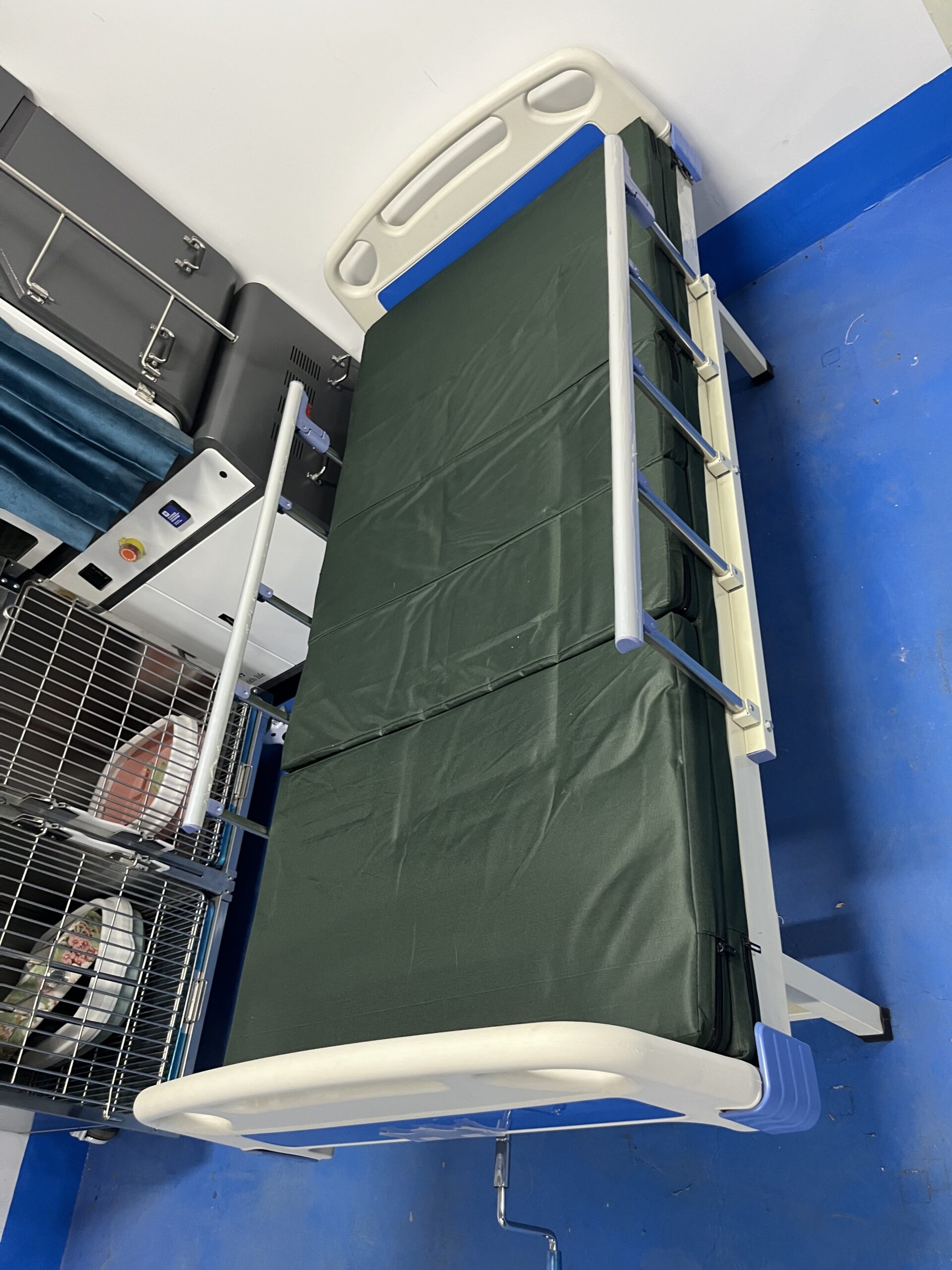

Executive Summary
Electric or hydraulic? Compare hospital bed linear actuator types by thrust, stroke, IP rating, noise, and cycle life, plus the maintenance and acceptance checks that keep beds adjusting for years.
Most procurement teams spec a hospital bed by the mattress, the side rails, and the caster wheels. The single component that actually determines whether that bed is still adjusting reliably in year five gets a single line in the datasheet: “electric actuator.” That line is where budgets quietly die. I have watched a 200-bed ward replacement program turn into a recurring spare-parts drain because the buyer compared sticker price and ignored the hospital bed actuator failure troubleshooting reality that the actuators were rated for a duty cycle the ward simply could not respect. The beds did not break. The actuators were simply specified for the wrong workload.
A hospital bed linear actuator is the muscle of the bed. It converts the rotation of a small DC motor into the straight-line push and pull that raises the height, tilts the backrest, and lifts the leg section — every adjustment a nurse makes runs through these actuators. Get the type, thrust, stroke, ingress protection, and lifecycle right and the bed disappears into the background of clinical work. Get them wrong and you inherit a fleet of beds that drift, creep, hum at 3 a.m., and fail just outside warranty.
This guide breaks down the actuator decision the way a biomedical engineer and a distributor actually have to make it: electric versus hydraulic, the five specifications that predict service life, how to read a cycle-count claim, and what to put in a purchase order so the actuator you receive is the actuator you specified. The goal is the same whether you are outfitting a new ICU or standardizing a mixed fleet — buy the bed once, not three times. If you are still comparing whole bed platforms, start with our hospital bed product range, then come back here to pressure-test the actuator spec underneath it.
What a Hospital Bed Linear Actuator Actually Does
Strip the plastic shrouds off a modern electric bed and you will find between three and five linear actuators, each dedicated to one movement. The height actuators lift the entire deck, usually in a paired scissor-column arrangement. The backrest actuator pivots the head section from flat to roughly 70 degrees for sitting and feeding, while the leg-section actuator raises the knee break; on five-function beds, further units handle Trendelenburg tilt. Each one is a self-contained unit: a reversible DC motor, a gearbox, a lead screw or ball screw, a traveling nut, and an inner tube that extends and retracts.
This matters for procurement because “the actuator” is never one part — it is a system of parts that fail in different ways and on different schedules. Motor brushes wear, plastic gearboxes strip under overload, the lead screw wears and the bed begins to drift, and the position sensor can lose calibration in damp, washdown-heavy environments. When a supplier quotes you an actuator, you are buying the sum of those sub-components, and the cheapest quote is almost always the one that cut corners on the screw, the seals, or the gear material.
- Motor: Typically a 24 V DC brushed or brushless motor. Brushless designs cost more but remove the brush-wear failure mode and tend to run quieter and longer in high-cycle wards.
- Gearbox: Reduces motor speed and multiplies torque. Plastic gears are quiet and cheap; steel or powdered-metal gears survive overload and high cycle counts far better.
- Screw: A lead screw is economical and self-locking; a ball screw is more efficient and longer-lived but costs more and may need a brake to hold position.
- Feedback and limits: Internal limit switches and a position sensor let the control box synchronize paired actuators and stop travel at the ends. This electronics package is a common failure point in damp, washdown-heavy environments.
A bed is only as dependable as its weakest actuator. Spec the actuator to the worst-case ward, not the average patient, and the rest of the bed tends to take care of itself.
Electric vs Hydraulic Linear Actuators: The Core Trade-Offs
The first fork in the road is the drive technology. The overwhelming majority of new acute-care and long-term-care beds ship with electric linear actuators, but hydraulic systems still have a defensible niche, and a buyer who understands why will not be talked into the wrong choice by a salesperson. The honest answer is that electric has won the mainstream hospital bed market on cleanliness, control, and total cost of ownership, while hydraulic survives where very high force, harsh environments, or unreliable power make its simplicity attractive.
Electric actuators are self-contained. There is no pump, no reservoir, no hose, and no fluid to leak onto a ward floor. Positioning is precise and repeatable because the control box drives each actuator to a commanded position using feedback — which is what makes one-touch CPR, cardiac chair positioning, and synchronized height adjustment possible. Maintenance is largely inspection and cleaning rather than fluid management. The trade-off is a higher unit component cost and a dependence on the bed’s low-voltage supply and control electronics. For a facility with reliable power and a biomedical team that values programmable positioning and clean floors, electric is the default for good reason.
Hydraulic actuators generate very high force from a compact cylinder and tolerate shock loads and overloading gracefully. They can hold position without continuous power and are relatively tolerant of rough handling. But a hydraulic bed needs a pump unit, fluid, and a sealed circuit, all of which introduce leak paths and routine fluid maintenance. Over a multi-year horizon, the ongoing maintenance burden of hydraulic systems is generally higher, and the precision positioning that modern clinical workflows expect is harder to achieve without adding electronic control on top. In practice, you will see hydraulic more often in heavy-duty bariatric platforms, certain operating tables, and older or budget installations than in new general ward beds.
| Decision Factor | Electric Linear Actuator | Hydraulic Actuator |
|---|---|---|
| Typical force range | Commonly up to about 8,000 N per unit in healthcare designs | Very high force from a compact cylinder; suits heavy bariatric loads |
| Positioning precision | High and repeatable; enables programmable and one-touch positions | Lower without added electronic control; harder to synchronize |
| Routine maintenance | Mostly inspection and cleaning; self-contained, no fluid | Fluid checks, seal and hose inspection, leak management |
| Leak / cleanliness risk | None; clean for infection-control-sensitive wards | Fluid leaks possible; a slip and contamination hazard |
| Noise | Low; quiet gear and motor designs suit night wards | Pump noise during adjustment; quieter at rest |
| Power dependence | Needs low-voltage supply and control electronics; battery backup common | Can hold position without power; tolerant of unreliable supply |
| Best-fit application | Modern acute, ICU, and long-term-care beds with programmable positioning | Heavy-duty bariatric platforms, harsh settings, budget or legacy installs |

The Five Specifications That Predict Actuator Service Life
Once you have chosen electric, the real work begins: reading the actuator datasheet for the numbers that actually predict how long the bed will stay in service. Five parameters do almost all of the predictive work, and a buyer who can interpret them will out-specify a competitor who only reads the price.
1. Thrust (force), measured in newtons
Thrust is the pushing force the actuator can deliver, expressed in newtons (N). Healthcare actuators commonly reach up to about 8,000 N per unit, the figure you will see quoted across the medical actuator market. The trap is matching thrust to the patient population. A general ward bed serving an average patient mix needs less per actuator than a bariatric platform designed for a 250 kg or 320 kg safe working load. Always confirm actuator thrust against the bed’s rated safe working load with the mattress and a high-percentile patient included, not against an empty deck — undersized thrust is the fastest route to stripped gears and a bed that cannot lift heavier patients.
2. Stroke length
Stroke is how far the actuator extends, and it sets the bed’s range of motion — how low it can go for safe patient transfer and how high it can rise for clinical work. Match stroke to the clinical requirement, but resist over-specifying: a longer stroke means a longer, more expensive actuator and a larger retracted envelope that has to fit inside the bed frame. Always confirm both the stroke and the retracted length, because an actuator that delivers the right stroke but will not physically fit the mounting geometry is useless.
3. Ingress protection (IP rating)
The IP code tells you how well the actuator keeps out dust and water, and in a hospital it is arguably the most underrated lifecycle number on the sheet. The first digit is solid ingress (6 is dust-tight); the second is water. A ward that is mopped and wiped down can live with something like IP66, which handles powerful water jets. A facility that pressure-washes or uses aggressive washdown protocols should look for IP69K, the highest ingress protection rating. Most actuator failures in “waterproof” beds are not motor failures — they are washdown fluid getting past a seal rated for a gentler environment than the one it actually lives in. Specify the IP rating to your real cleaning protocol, not the brochure default.
4. Noise level
Noise is a clinical and patient-experience issue, not a luxury. Beds are adjusted at night, in shared bays, and next to patients who cannot sleep. Medical-grade actuators are engineered for low noise, and a quiet bed is a marker of good gear design, good motor selection, and tight assembly. Ask for the noise figure in decibels measured at a defined distance, and treat any supplier who cannot provide a number with suspicion.
5. Duty cycle
Duty cycle is the single most-misunderstood spec, and it is where good beds are quietly destroyed. It expresses the ratio of running time to rest time, commonly written as something like 10 percent, meaning roughly two minutes of movement followed by eighteen minutes of rest. Medical bed actuators are not designed for continuous running. A high-turnover ward — an emergency department, a busy ICU, a bariatric unit where the bed is repositioned constantly — pushes the actuator toward and past its duty cycle, generating heat that degrades the motor, the gear lubricant, and the seals long before the cycle-count rating is reached.
Duty cycle kills more actuators than overload does. A bed that is adjusted forty times a day in a busy ED ages in months what a general ward bed ages in years. Spec for the workload, not the label.

Lifecycle and Cycle Count: How Long Does an Actuator Really Last?
Suppliers express actuator durability as a cycle count — the number of full extend-and-retract cycles the unit is rated to complete before performance degrades. You will see figures in the thousands to tens of thousands of cycles for medical-grade units. The number is genuinely useful, but only if you translate it into the language your facility actually operates in: adjustments per bed per day, multiplied by beds, multiplied by years.
Do the arithmetic before you trust the number. If a bed is adjusted fifteen times a day across its functions, that is roughly five thousand cycles a year. An actuator rated for ten thousand cycles would, on paper, last about two years in that bed before reaching its rated life — and that is before duty-cycle heat, overloading, and washdown ingress, all of which shorten real-world life below the lab rating. The lab figure is measured under controlled load, temperature, and rest conditions; your ward supplies none of those controls. Treat the rated cycle count as a best-case ceiling, then derate it for your actual environment, and build the actuator into your preventive maintenance schedule as a wear item with an expected service interval — the way you would a battery or a caster.
- Convert cycles to calendar life: Multiply adjustments per day by 365, then divide the rated cycle count by that annual figure to estimate years of service per bed.
- Derate for harsh use: High heat, frequent washdown, and chronic overloading all shorten real life below the lab rating — apply a safety margin.
- Ask how it was tested: Load, duty cycle, and temperature during the cycle test tell you how comparable the rating is to your conditions.
- Treat it as a wear item: Schedule inspection and replacement intervals rather than waiting for failure.
Maintenance, Replacement, and Spare Parts Planning
Actuators are consumables over a long enough horizon, and the facilities that handle them well plan for replacement on day one rather than scrambling when a bed goes flat in a fully occupied ward. The good news is that electric linear actuators are generally modular: a failed unit can usually be swapped as a complete assembly without disturbing the rest of the bed — but “modular” only helps if you can actually get the right part, fast, at a price that does not punish you for an emergency.
Standardization is the highest-leverage maintenance decision you will make. If your fleet runs three bed brands with four actuator variants each, you are stocking twelve slow-moving spare parts and training technicians on twelve mounting geometries, connector types, and control-box behaviors. Standardize on fewer bed platforms with common actuators and your spare-parts inventory shrinks, your technicians get faster, and your mean time to repair drops — and it pays back fastest precisely because actuators are the part that fails often enough to matter.
When you do replace an actuator, replace it correctly. Match thrust, stroke, retracted length, mounting geometry, connector, and — critically — the control-box compatibility and feedback type. An actuator that is mechanically identical but electrically incompatible can desynchronize a paired height system or throw a fault the control box cannot clear. Keep a small on-hand stock of the highest-failure actuators (height units usually lead), and confirm lead time for the rest. Our spare parts and service program is built around exactly this — keeping the wear items moving so a single failed actuator never takes a bed out of service for weeks.

Procurement and Acceptance: How to Verify Before You Buy
Everything above only protects you if it lands in the purchase order and gets verified at acceptance. The actuator is the part most likely to be quietly downgraded between sample and production run, so it deserves explicit, measurable acceptance criteria rather than a vague “electric actuator, medical grade” line — write the spec down, attach it to the PO, and test against it when the beds arrive.
Start by naming the actuator parameters in the technical specification: thrust in newtons against the rated safe working load, stroke and retracted length, IP rating matched to your cleaning protocol, a noise ceiling in decibels, the duty cycle, and the rated cycle count with the test conditions stated. Require the supplier to provide a datasheet for the exact actuator fitted, not a generic brochure, and require that production units match the approved sample. Our hospital bed procurement checklist walks through the full documentation set — certification, test reports, and the compliance trail — and the actuator datasheet belongs squarely inside it.
At acceptance, do not just power the bed up and watch it move — run it under load. Verify that paired height actuators rise and lower in sync without racking the deck. Confirm the bed holds position under a sustained load with no audible drift or creep, since drift is the early signature of a worn or undersized screw. Listen for noise across the full range of motion, check that the IP-rated seals and cable entries are intact, and confirm the control box reports positions correctly and one-touch functions land where they should. A thirty-minute loaded acceptance test per bed model catches the problems that would otherwise surface as warranty disputes six months later. For the financial framing — warranty, spares, and replacement intervals rolled into one number — see our guide to hospital bed total cost of ownership.
- Name the numbers in the PO: Thrust, stroke, retracted length, IP rating, noise ceiling, duty cycle, and cycle count with test conditions.
- Require the exact datasheet: The fitted actuator’s datasheet, not a generic brochure, with production matching the approved sample.
- Test under load at acceptance: Check synchronization, position-hold and drift, noise, seal integrity, and control-box feedback.
- Anchor the documentation: Certification and test reports that trace the actuator back to a compliant, audited build.
If the actuator datasheet is not attached to the purchase order, you did not buy a specification — you bought a hope. Write it down, then test against it under load before you sign the acceptance form.
Conclusion
The hospital bed linear actuator is the component that quietly decides whether your beds are an asset or a recurring expense. Electric actuators have earned their place as the mainstream choice for new wards because they are clean, precise, programmable, and lower-maintenance than hydraulic systems. But “electric” is not a specification. The real specification lives in five numbers — thrust, stroke, IP rating, noise, and duty cycle — and in a cycle-count claim that you have to translate into your own ward’s adjustments-per-day reality.
Buy on those numbers, not on the price column. Plan for actuators as scheduled wear items, standardize your fleet so spare parts and technician time stay lean, and put measurable acceptance criteria in the purchase order so the actuator you receive is the actuator you specified. Do that and the bed disappears into the background of clinical work, which is exactly what good equipment should do. When you are ready to pressure-test a platform against these criteria, explore the Sanyang Medical hospital bed range and talk to our team about the actuator spec underneath it.
Frequently Asked Questions
Are electric or hydraulic linear actuators better for hospital beds?
For most new acute-care and long-term-care beds, electric linear actuators are the better default. They are self-contained, leak-free, precise, and support programmable positioning with lower routine maintenance. Hydraulic actuators still make sense for very heavy bariatric platforms, harsh environments, or settings with unreliable power, where their high force and ability to hold position without power are advantages. Match the technology to the patient mix and the facility’s power and cleaning reality rather than choosing on price alone.
How long does a hospital bed linear actuator last?
Service life is usually expressed as a rated cycle count, often in the thousands to tens of thousands of full extend-and-retract cycles. To estimate calendar life, multiply your bed’s adjustments per day by 365 and divide the rated cycle count by that figure, then derate for heat, washdown, and overloading. In a high-turnover ward an actuator can reach its rated life in a couple of years, while the same unit in a low-acuity ward can last far longer. Treat the rating as a best-case ceiling and plan a preventive maintenance and replacement interval around it.
What IP rating should a hospital bed actuator have?
It depends on your cleaning protocol. A ward that is mopped and surface-wiped can typically use an actuator rated around IP66, which resists powerful water jets. A facility that pressure-washes or uses aggressive high-temperature washdown should specify IP69K, the highest ingress protection rating. Most “waterproof” actuator failures are actually fluid getting past a seal rated for a gentler environment, so match the IP rating to how the bed is really cleaned rather than accepting the brochure default.
What does duty cycle mean and why does it matter?
Duty cycle is the ratio of running time to rest time, commonly around 10 percent for medical bed actuators — roughly two minutes of movement followed by eighteen minutes of rest. These actuators are not built for continuous running. A busy emergency department or ICU that repositions beds constantly pushes the actuator past its duty cycle, generating heat that degrades the motor, gears, and seals well before the cycle-count rating is reached. If your ward adjusts beds far more often than a general ward, ask for an actuator rated for the heavier workload.
How do I verify the actuator before accepting a bed delivery?
Put the actuator parameters in the purchase order — thrust, stroke, retracted length, IP rating, noise ceiling, duty cycle, and cycle count with test conditions — and require the exact fitted datasheet. At acceptance, run the bed under load: confirm paired actuators stay synchronized, the bed holds position without drift or creep, noise is acceptable across the full range of motion, seals and cable entries are intact, and the control box reports positions correctly. A short loaded acceptance test per model catches downgraded or mismatched actuators before they become warranty disputes.
You May Also Like...

Hospital Bed Motor Troubleshooting: 3 Checks for Slow Movement
When you’re searching for electric hospital bed motor troubleshooting, the first thing to know is...

Manual vs Electric Hospital Bed: How to Choose the Right Power Type for Your Facility
Compare manual, semi-electric, and fully electric hospital beds across drive mechanisms, clinical use cases, cost...

Hospital Bed Dimensions and Ward Layout: A Planning Guide for Safer, Compliant Wards
Standard hospital bed dimensions, bed spacing, corridor widths, and area-per-bed ratios explained from the manufacturer's...