
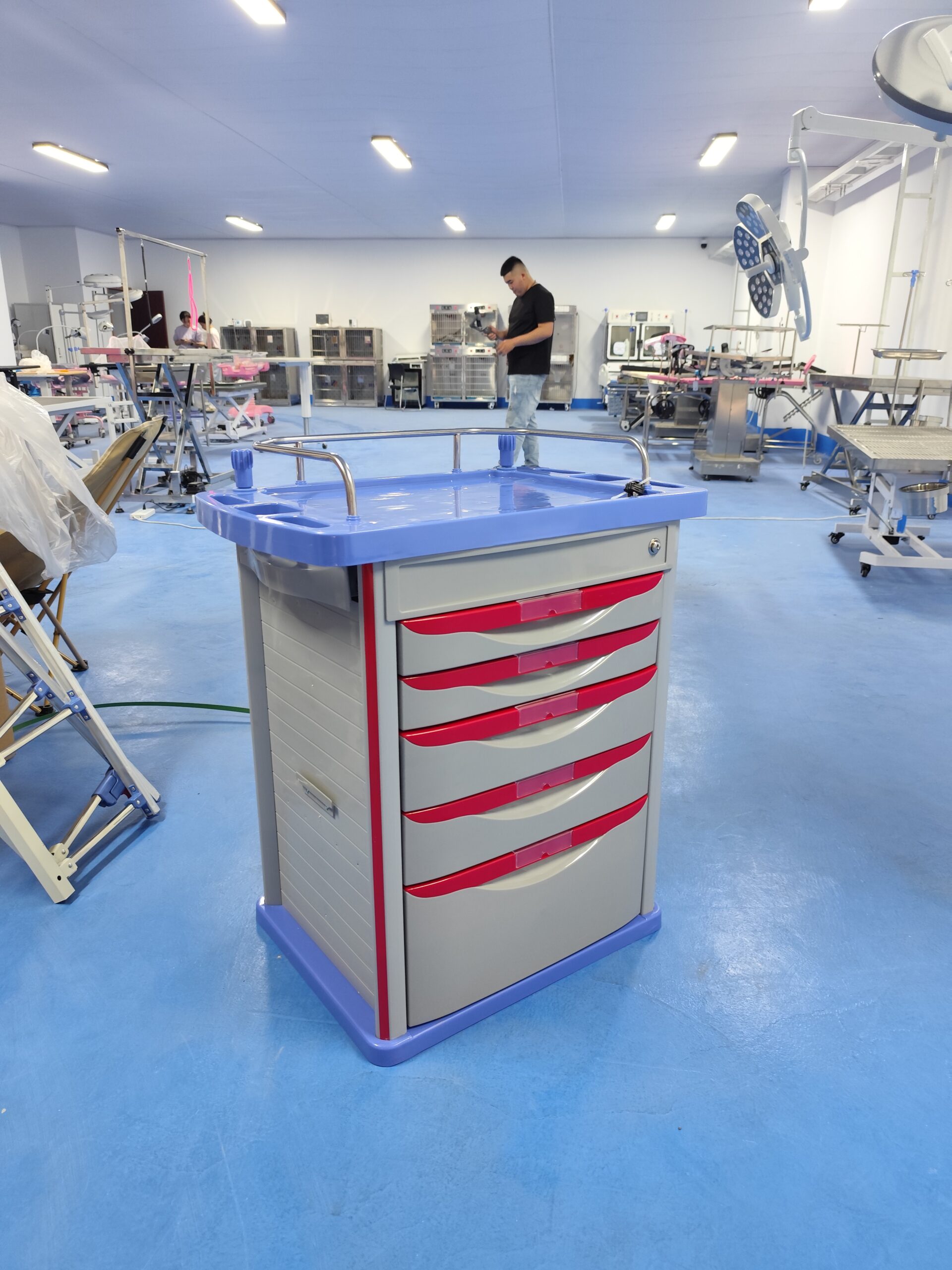

Executive Summary
How initial and sustained push force, caster selection, and handle height drive musculoskeletal injury risk on medical trolleys, with a procurement and acceptance checklist for biomedical engineers, distributors, and facilities managers.
Most hospitals buy a medical trolley by comparing drawer count, worktop material, and price. Almost nobody measures how hard a nurse has to push it. That is the mistake that quietly fills your occupational health log. A trolley that looks identical on a datasheet can demand three times the pushing effort of a well-engineered one once it is loaded with medication and fluids and rolled across a corridor with a floor slope and a couple of door thresholds. The nurse who pushes it forty times a shift does not feel the difference on day one; she feels it in her shoulder and lower back six months later.
Medical trolley ergonomics is a measurable engineering discipline with two numbers at its core: the initial push force needed to get the trolley moving from rest, and the sustained push force needed to keep it rolling. Get those two numbers right, choose the casters deliberately, and set the handle height to match the people who actually use the cart, and you cut the musculoskeletal injury risk that drives staff sickness and turnover. Get them wrong, and no amount of antimicrobial worktop compensates, because staff simply stop using the trolley as designed.
In this guide I will walk through how push force works, why caster selection changes the equation more than any other component, how handle height interacts with posture and injury risk, and how to turn all of it into a procurement checklist you can hand to a supplier. Whether you are a biomedical engineer specifying a fleet, a distributor sourcing from an OEM factory, or a facilities manager reducing injury claims, the goal is the same: buy trolleys your staff can move safely for an entire career, not just for the demo day.
Why Push Force Is the Ergonomic Number That Actually Matters
Ergonomics guidance for healthcare equipment, including the widely referenced AORN Ergonomic Tool 7 on pushing, pulling, and moving equipment on wheels, keeps returning to one theme: the force a worker applies through the hands is the single best predictor of injury risk in cart-handling tasks. Pushing and pulling load the shoulder, wrist, and lumbar spine in ways that accumulate. A thousand hard pushes a week, performed at an awkward handle height against a trolley that resists starting, is how a rotator cuff complaint becomes a long-term absence.
The trap for buyers is that push force is invisible on a product page. Drawer slides, worktop edges, and lock quality are easy to photograph and compare; rolling resistance is not. Two trolleys with the same dimensions and drawers can behave completely differently because one uses a larger-diameter caster with a precision bearing and the other uses a small, stiff swivel caster that scrubs against the floor on every direction change. The datasheet will not tell you this, but a force gauge will.
If you only add one line to your trolley tender, make it this one: the supplier must declare the measured initial and sustained push force at a defined load, and you must be allowed to verify it on delivery with a force gauge. Everything else is negotiable. This is not.
Initial Push Force vs. Sustained Push Force: The Two Numbers to Specify
These two terms get used interchangeably in marketing copy, and that is a problem, because they describe different physical challenges controlled by different parts of the trolley. The initial push force, or breakaway force, is the peak effort required to overcome static friction and get a stationary trolley rolling. The sustained push force, or rolling force, is the much smaller effort needed to keep it moving at a steady pace once it is already rolling.
The initial force is almost always the larger of the two, and it loads the shoulder and spine most heavily because the worker must generate a sharp peak of effort from a standing start. It is dominated by caster design: small wheels, plain bearings, and stiff swivel mechanisms all raise the breakaway force. The sustained force is dominated by rolling resistance, which depends on wheel diameter, wheel material, floor condition, and total load. A trolley can have an acceptable sustained force but a punishing initial force, or vice versa, which is why you must specify and test both.
- Initial (breakaway) force: The peak hand force to start the trolley from rest. This is the higher-risk number for shoulder and back strain because it is a sudden peak, and it is most sensitive to caster swivel stiffness, bearing type, and wheel diameter.
- Sustained (rolling) force: The steady hand force to keep the trolley moving on a straight, level path. It is governed by rolling resistance, which rises with load and with soft or uneven floors, and falls as wheel diameter increases.
- Direction-change force: Often overlooked, this is the effort to steer the trolley around a corner or reorient the swivel casters. Tight doorways and corridor turns make this a large part of real-world effort, and it is where a poor swivel caster punishes the wrist.
In a specification, set a target for both forces at a stated load and floor condition, and require the supplier to test with a calibrated push-pull force gauge rather than estimating. Guidance from bodies such as CCOHS and the NIOSH-backed AORN Tool 7 emphasises that acceptable force limits depend on the task, the frequency, the posture, and the workforce expected to perform it. Rather than memorising a single universal limit, require the lowest practicable force for your loaded condition and verify it on a sample unit before committing to a fleet order.
How Caster Selection Changes the Push Force Equation
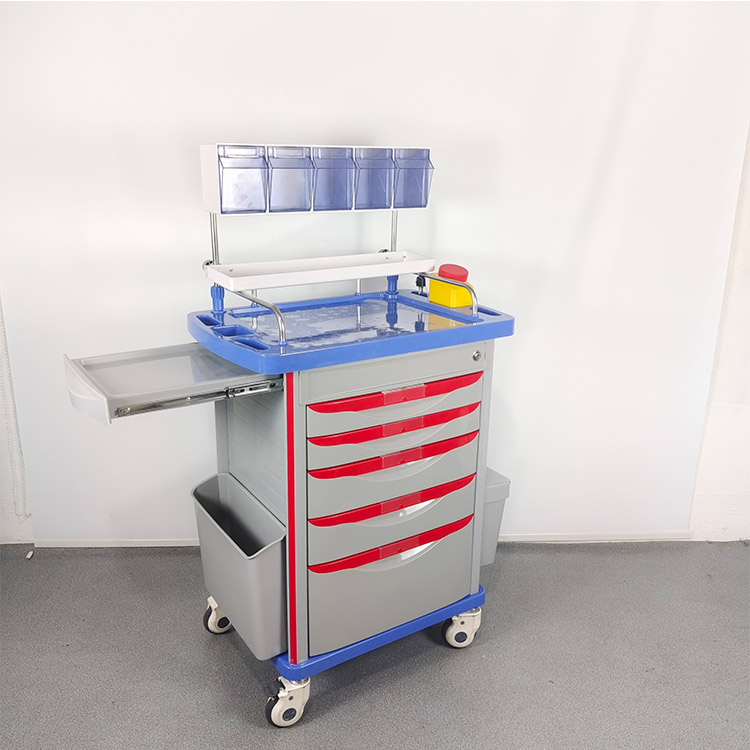
If push force is the number that matters, the caster is the component that controls it. Wheel diameter is the single biggest lever: a larger wheel rolls over floor joints, cable covers, and small debris with far less resistance than a small wheel, because it bridges the obstruction instead of climbing it. Bearing type is the second lever: a precision ball-bearing wheel rolls with a fraction of the resistance of a plain bushing, and the difference shows up most clearly in the initial breakaway force that loads the shoulder.
Swivel geometry is the third lever and the one most often ignored. Swivel casters give manoeuvrability in tight clinical spaces, but a stiff or poorly sealed swivel head resists reorienting, which spikes the direction-change force at every doorway and forces constant small corrections that add up across a shift. Choosing casters is therefore not a cost line to optimise in isolation; it is an ergonomic decision made alongside the handle and the load case.
| Caster Feature | Effect on Push Force | Best For | Procurement Watch-Out |
|---|---|---|---|
| Larger wheel diameter | Lowers both initial and sustained force; bridges floor joints and thresholds | Corridors with thresholds, cable covers, uneven floors | Larger wheels raise deck height; confirm it still suits the user |
| Precision ball bearing | Sharply reduces breakaway and rolling resistance versus plain bushing | High-frequency, high-load trolleys moved many times per shift | Sealed bearings resist washdown; specify if disinfected often |
| Soft elastomer wheel tread | Quieter and gentler on floors but can raise rolling resistance slightly | Wards and theatres where noise and floor marking matter | Balance noise against effort; test on your actual floor finish |
| Swivel vs. fixed layout | More swivels improve manoeuvrability but raise direction-change force if heads are stiff | Tight clinical rooms and crowded bays | Ask for sealed, easy-turn swivel heads; check tracking on a straight run |
One detail that surprises buyers is how much the floor matters. The same caster set that rolls effortlessly on a smooth resin floor can demand noticeably more force on textured vinyl or across a tiled joint, so the most meaningful push-force test is the one performed on your own floor, at your own load, not the one in the supplier’s showroom. If you are sourcing from an OEM factory, describe your floor finish precisely and ask the engineering team to recommend a caster matched to it, exactly the kind of application-specific detail a serious OEM/ODM partner will engage with rather than handing you a generic spec sheet.
Handle Height: Fixed vs. Adjustable and Why It Affects Injury Risk
Push force numbers only tell half the story, because the same force applied at the wrong height is far more damaging than the same force applied at the right height. The handle height sets the worker’s posture. Push at a handle that is too low and the nurse bends forward, loading the lumbar spine; push at one that is too high and the shoulders rise, the wrists extend awkwardly, and the worker loses the ability to drive force through the legs. In both cases the measured force might be identical, but the injury risk is not.
Ergonomic guidance for manual handling generally recommends a push handle positioned so the worker keeps a neutral spine, elbows comfortably bent, and force directed roughly at or slightly below elbow height. For a mixed workforce, a single fixed handle height is always a compromise that fits the average user well and the shortest and tallest users poorly. That is the core argument for an adjustable-height handle, or at minimum for choosing a fixed height deliberately based on the actual staff population rather than accepting whatever the standard model ships with.
- Match the workforce, not the average: A handle height that suits a 175 cm porter will force a 158 cm nurse into a raised-shoulder posture. If your staff range is wide, an adjustable handle removes the compromise entirely.
- Consider the push direction: A handle that lets the worker push with a straight back and bent elbows transfers effort through the larger leg and trunk muscles instead of the smaller shoulder and wrist muscles, reducing fatigue per trip.
- Two-handed vs. one-handed use: Many clinical pushes are one-handed while the other hand holds a door or a record. A handle that supports a secure one-handed grip at the correct height reduces the asymmetric spinal loading that drives one-sided back complaints.
A low push force measured at the wrong handle height is still an injury waiting to happen. Always evaluate force and handle height together, with a representative member of your actual staff doing the pushing, not an engineer in a showroom.
Musculoskeletal Injury Prevention: What This Means for Procurement
Healthcare consistently ranks among the highest-risk sectors for work-related musculoskeletal disorders, and manual handling of equipment on wheels is a recognised contributor. The cost lands in three places at once: staff sickness absence, the slower pace of care when a trolley is hard to move, and the long-term compensation and turnover that follow a chronic shoulder or back injury. Framed this way, the small price difference between a basic caster set and a precision one, or between a fixed and an adjustable handle, starts looking like insurance. The most effective prevention is engineered in at the design stage, by specifying low force at the intended load, choosing casters matched to the real floor, setting handle height to the workforce, and keeping the loaded centre of gravity low.
- Specify by task, not by object: Describe how the trolley will actually be used, load, distance, frequency, floor, and turns, and let the supplier engineer to that task rather than to a generic spec.
- Keep load within rating: Overloading raises every force number and accelerates caster wear. State the maximum intended load and buy a trolley rated comfortably above it.
- Plan for maintenance: A trolley that starts easy on day one can become hard to push as bearings collect hair, lint, and disinfectant residue. Specify sealed bearings and a cleaning routine that protects them.
Fleet consistency also pays off. If every trolley in a department behaves the same way, staff build safe handling habits that transfer from one cart to the next, while a mixed fleet forces constant re-adaptation. Standardising on a well-specified ergonomic platform is one reason many hospitals consolidate their trolley range, a topic we cover in depth in our guide to medical trolley fleet standardization.
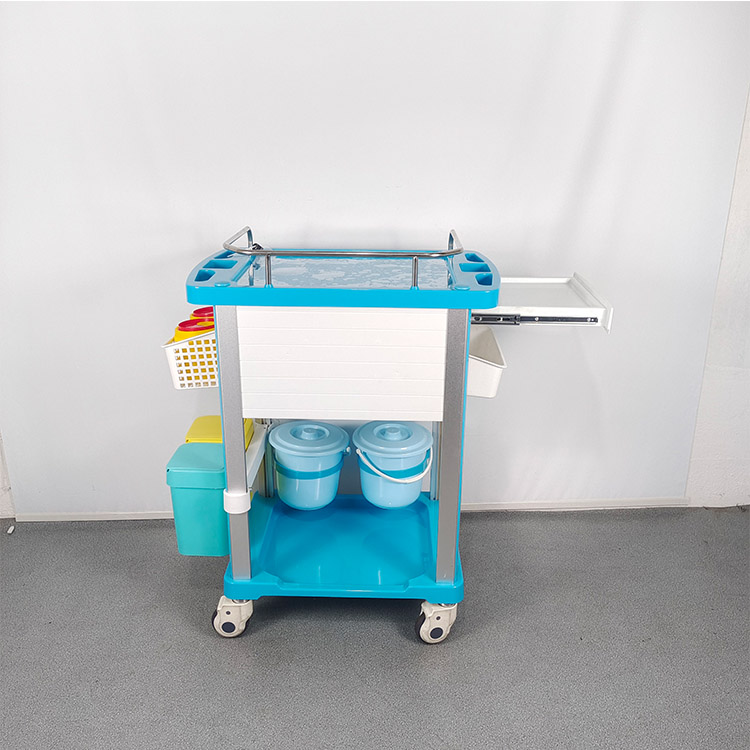
A Procurement and Acceptance Checklist for Ergonomic Trolleys
Turning all of this into a usable procurement process is simpler than it sounds. You need a short checklist that you attach to the tender, that the supplier must answer with evidence, and that you re-run on a sample unit at acceptance. The point is to move the conversation from subjective claims like “easy to push” to verifiable measurements.
- Declared push force: Require the supplier to state both initial and sustained push force, measured with a calibrated gauge at a defined load and floor condition. Reject vague “lightweight” or “easy-roll” language.
- Caster and handle specification: Wheel diameter, bearing type, swivel layout, tread material, and brake type, plus the fixed handle height in millimetres or the adjustment range. Confirm both suit your actual staff and floor.
- Rated working load and stability: The maximum load the trolley is designed to carry, with a margin above your real-world maximum, and how the loaded trolley behaves on a turn and a slight slope. Heavier items should sit low. Cross-check against our medical trolley stability guidance.
- Maintenance and cleanability: Sealed bearings, a cleaning routine that will not degrade the casters, and available spare casters and handles. See our disinfection protocols for compatible cleaning.
- Compliance documentation: For electrically equipped trolleys, confirm relevant safety standards such as the IEC 60601 series apply, and that the manufacturer operates an ISO 13485 quality system with CE marking where required.
- Sample verification: Test a sample on your own floor, at your load, with your staff, before committing to the full order. Measure, do not assume.
The acceptance test itself should be quick and repeatable. Load the trolley to its intended working weight, attach a push-pull force gauge to the handle at the normal grip height, and record the peak force to start it moving and the steady force to keep it rolling over a measured straight section of your actual floor. Repeat with the casters at random angles to capture the direction-change effort, then compare the readings against the supplier’s declared figures. If the numbers are not there, the trolley does not pass.
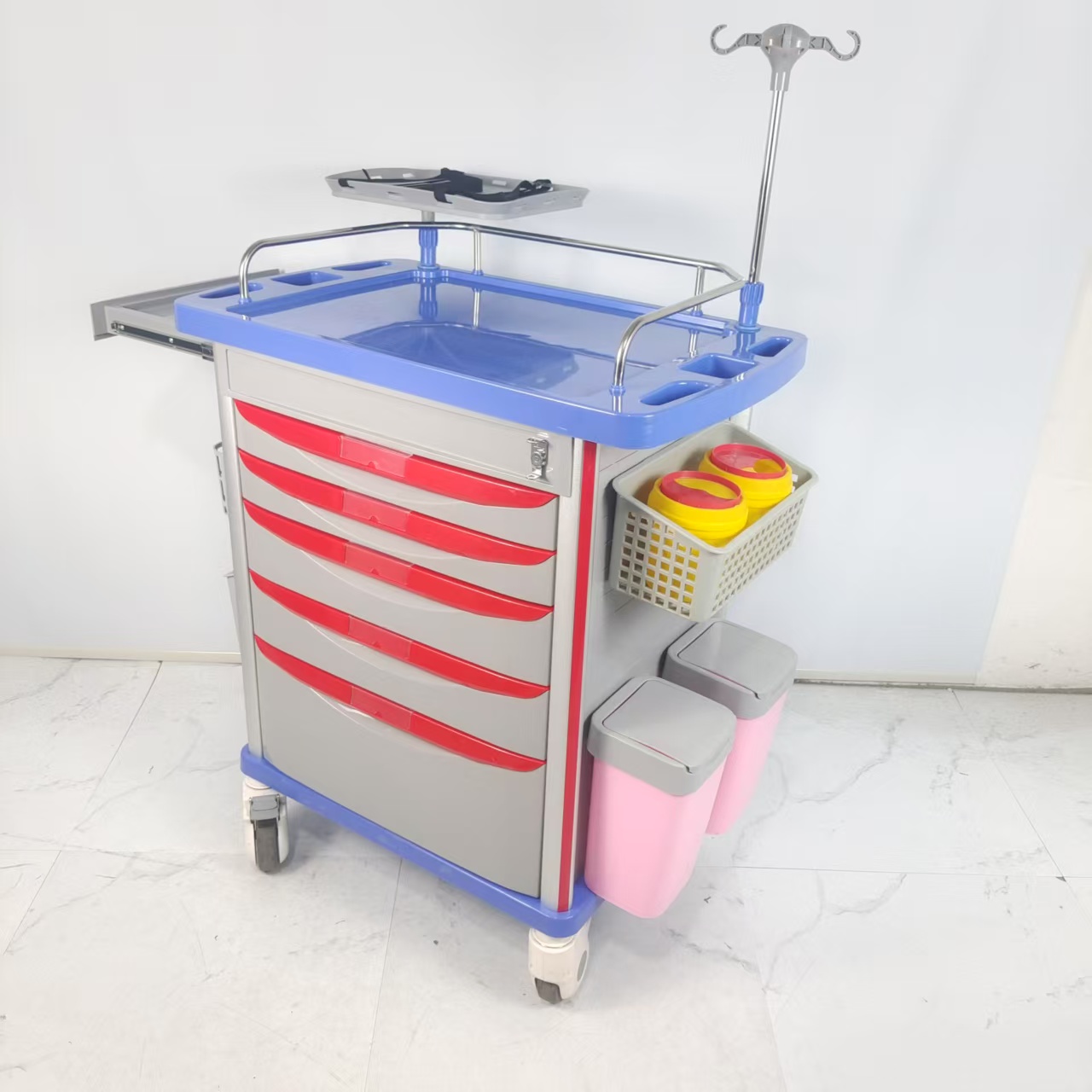
Working With an OEM to Engineer Ergonomics In
If you are a distributor or a hospital group buying at volume, the most reliable way to get a genuinely ergonomic trolley is to specify it at the design stage with the manufacturer, rather than choosing from a fixed catalogue and hoping. An OEM that builds medical trolleys as its core business can adjust caster size and bearing grade, change the handle height or add an adjustment mechanism, reposition drawers to keep the centre of gravity low, and tune the platform to your floor conditions and load profile, changes that are far cheaper to make on the drawing than to retrofit after tooling is set.
When you brief an OEM, lead with the task description and the force targets, not just the dimensions: the loaded weight, the typical push distance and frequency, the floor type, the number of doorways and turns, and the height range of the users. Ask them to recommend a caster and handle combination that meets a stated push-force target, and to provide a sample you can verify. A manufacturer with an ISO 13485 quality system and experience across multiple markets will treat this as a normal engineering conversation, because they have solved it before. That depth of application experience is what separates a component supplier from a real manufacturing partner, as we describe further on our about us page.
The commercial logic is straightforward. The incremental cost of a better caster set or an adjustable handle is a small fraction of a single long-term injury claim, and a tiny fraction of the staffing cost of a department known for back-breaking equipment. Buy on total cost of risk rather than unit price, and the ergonomic specification pays for itself many times over. If you would like a trolley specification tuned to your facility, our team can walk through your task profile through the contact page.
Conclusion
Medical trolley ergonomics comes down to a small set of measurable decisions. Specify both the initial and sustained push force at a defined load and floor condition, and verify them with a force gauge. Choose casters deliberately, larger wheels, precision bearings, and a swivel layout matched to your floor, because the caster controls the force more than any other component. Set the handle height to your actual workforce, or choose an adjustable handle, so that low force is also force applied in a safe posture, and build all of it into a procurement checklist you test on a sample unit before you commit to a fleet.
Do this and you protect the people who move the trolley forty times a shift, keep the safe-handling behaviour your workflow depends on, and avoid the slow accumulation of shoulder and back injuries that quietly drains a healthcare budget. The trolley is one of the most common and most overlooked pieces of equipment in any hospital. Treating its push force and handle height as first-class specifications, rather than afterthoughts, is one of the highest-leverage ergonomic improvements a facility can make. Start with a sample, measure it on your own floor, and let the numbers decide.
Frequently Asked Questions
What is the difference between initial push force and sustained push force on a medical trolley?
Initial push force, or breakaway force, is the peak effort needed to get a stationary trolley rolling, and it is usually the higher of the two because it must overcome static friction. Sustained push force, or rolling force, is the smaller steady effort needed to keep it moving. The initial force loads the shoulder and back most heavily and is most affected by caster design, while the sustained force depends mainly on wheel diameter, wheel material, floor condition, and load. Specify and test both, because a trolley can perform well on one and poorly on the other.
How do casters affect how hard a medical trolley is to push?
Casters are the single biggest influence on push force. Larger wheel diameters roll over floor joints, thresholds, and debris with less resistance, and precision ball bearings roll far more easily than plain bushings, which lowers the breakaway force most. The swivel layout affects steering effort, since a stiff swivel head spikes the force needed to change direction at doorways. Because the same caster behaves differently on different floors, the best choice is one matched to your actual floor finish and tested at your real load.
What handle height is best for a medical trolley?
The best handle height lets the user push with a neutral spine, comfortably bent elbows, and force directed around or slightly below elbow height, so effort transfers through the larger leg and trunk muscles rather than the smaller shoulder and wrist muscles. Because staff heights vary, a single fixed height is always a compromise, so an adjustable-height handle is the safest choice for a mixed workforce. Confirm the height with a representative member of your staff, including one-handed pushing, rather than relying on an average figure.
How can I test push force before buying a fleet of trolleys?
Use a calibrated push-pull force gauge attached to the handle at the normal grip height. Load the trolley to its intended working weight, then record the peak force needed to start it moving and the steady force needed to keep it rolling over a measured straight section of your actual floor. Repeat with the casters at random angles to capture the direction-change effort, and compare the readings against the supplier’s declared figures. Always test on your own floor and at your own load, because showroom results rarely match real clinical conditions.
Which standards should an ergonomic medical trolley meet?
For trolleys that carry electrical medical equipment, the IEC 60601 series is the relevant safety framework, and the manufacturer should operate an ISO 13485 quality management system with CE marking where your market requires it. Ergonomic push-force and manual-handling expectations are described in occupational health guidance such as the AORN Ergonomic Tool 7 on pushing, pulling, and moving equipment on wheels, and in resources from bodies like NIOSH and CCOHS. Rather than chasing a single universal force limit, require the lowest practicable force for your loaded condition and verify it on a sample.
You May Also Like...

Medical Trolley Corrosion Resistance Guide: Salt Spray Testing for Humid Wards
A practical buyer's guide to medical trolley corrosion resistance: 304 vs 316 stainless steel, powder...

Hospital Utility Trolley Types: A Complete Guide to Selection, Zoning, and Procurement
Discover the six main hospital utility trolley types, their structural differences, infection control zoning rules,...

Medical Trolley Lock Security: A Complete Guide to Controlled Drug Safety
A practical guide to medical trolley lock security covering central locks, electronic access control, crash...