
Executive Summary
A practical guide to specifying a sterilizable surgical light handle: detachable vs. fixed designs, autoclave tolerance, IP sealing, intraoperative contamination control, and a procurement acceptance checklist.
Every infection control team knows the drill: scrub the instruments, flash-sterilize the trays, wipe down every surface. Yet one of the most frequently touched objects in the operating room often slips through the reprocessing protocol — the surgical light handle. The surgeon grabs it with a gloved hand to reposition the light field dozens of times during a case, adjusts it after touching the patient, and then the next case begins. If that handle is only wiped down between cases, it becomes a quiet vector for cross-contamination. This is exactly the gap that a well-engineered sterilizable surgical light handle is designed to close — the single point of contact between a sterile field and a piece of ceiling-mounted equipment that cannot itself be autoclaved.
The problem is that “sterilizable” is one of the most loosely used words in operating room procurement. A datasheet may claim a handle is autoclavable while the sealing, the polymer grade, and the locking mechanism quietly fail after a few dozen cycles. I have watched hospitals buy lights on lux figures and color rendering index, only to find eighteen months later that the focus handles are cracking and sterile-processing is improvising with wipes never validated for the material. The lighting performance held up; the infection-control interface did not. After more than a decade of specifying operating room equipment, I evaluate the handle as a standalone subsystem — with its own sterilization tolerance, ingress-protection rating, and replacement interval.
This guide walks through the engineering and procurement realities of the sterilizable surgical light handle: what detachable versus fixed really means for your reprocessing workflow, how to read autoclave tolerance claims, why sealing and IP ratings matter, and how to build an acceptance checklist that catches failures before the equipment reaches your operating room. The goal is the same for a biomedical engineer, an infection preventionist, or a distributor — a handle that stays sterile, functional, and safe through hundreds of sterilization cycles.

Why the Surgical Light Handle Is an Infection-Control Blind Spot
The operating room is designed around zones of cleanliness, and the surgical light sits awkwardly between them. The light head hangs over the sterile field, but it is not a sterile object — it is a large, warm device full of electronics that cannot be submerged, autoclaved, or aggressively sprayed. The handle is the bridge: the one component the surgeon may touch with a sterile glove to move that large non-sterile object without breaking the field — the highest-touch, highest-risk interface in the lighting system, and the one most likely to be under-specified.
Consider the contact pattern during a typical procedure. The surgeon or assistant repositions the light field repeatedly — at the start, after draping, whenever the field is retracted, and again when a second surgeon takes over. Each contact transfers glove-borne moisture, proteins, and microorganisms onto the handle. If the handle cannot be removed and sterilized, the only option is a chemical wipe between cases, and wipes have well-documented limits: contact time is rarely achieved, crevices trap bioburden, and repeated exposure to quaternary ammonium or chlorine-based disinfectants degrades many plastics.
A surgical light handle that can only be wiped is a handle that can only be partially cleaned. The geometry that gives a surgeon grip — knurling, ridges, finger recesses — is the same geometry that shelters microorganisms from a wipe.
This is not a theoretical concern. Surgical luminaires are governed by IEC 60601-2-41, the particular standard for the basic safety and essential performance of surgical lights, and its current edition (IEC 60601-2-41:2021, Edition 3.0) places explicit emphasis on cleanability and on the ability of clinical surfaces to withstand decontamination. Notified bodies now expect manufacturers to declare how each externally exposed part is intended to be cleaned or sterilized. A handle marketed as “sterilizable” without a validated method, a stated cycle limit, and compatible disinfectant data is a gap that will surface during an audit — and during an outbreak investigation.
- High touch frequency: The handle is repositioned many times per case, far more often than fixed surfaces that receive routine terminal cleaning.
- Sterile-field contact: It is touched with sterile gloves, so any surface contamination transfers directly into the operative workflow.
- Difficult geometry: Grip features that improve ergonomics also create crevices that resist wipe-based decontamination.
- Material sensitivity: Many handle polymers craze, crack, or discolor under repeated disinfectant exposure, failing exactly where cleanliness matters most.
Detachable vs. Fixed Handles: Choosing the Right Sterilization Strategy
The first architectural decision is whether the handle is detachable or fixed. This single choice determines your reprocessing workflow, your spare-parts burden, and your residual infection risk. The right choice depends on case volume, sterile-processing capacity, and how aggressively your infection-control policy treats high-touch surfaces, but the trade-offs are worth understanding before you sign a purchase order.
A detachable, sterilizable handle is the gold standard for high-volume operating rooms. The circulating nurse removes it at the end of the case, sends it through the same washer-disinfector and autoclave cycle as the instruments, and a sterile handle is fitted for the next case. Because it is a small part with no electronics, it tolerates full prevacuum steam sterilization. The cost is logistical: you need enough handles to rotate through reprocessing (two to three per light head), a defined replacement interval, and a tracking system so they do not migrate to other departments. Some manufacturers publish a replacement interval — one European maker advises replacing its sterilizable focus handle after roughly 1,000 cycles, a useful benchmark for consumable budgets.
A fixed handle stays attached to the light head and is decontaminated in place with chemical wipes or a validated surface-disinfection process. The advantage is simplicity: nothing to lose, nothing to track, no spare inventory. The disadvantage is that cleaning is inherently less reliable, and the material must survive years of chemical exposure rather than a defined number of thermal cycles. Fixed handles are common on lower-cost lights and where sterile-processing capacity is limited, but they shift the burden onto disciplined wipe technique and disinfectant-resistant materials.

| Criterion | Detachable Sterilizable Handle | Fixed (Wipe-Down) Handle |
|---|---|---|
| Decontamination method | Full washer-disinfector + autoclave cycle with instruments | Chemical surface wipe or validated spray in place |
| Reliability of cleaning | High — validated thermal cycle reaches all surfaces | Variable — depends on contact time and technique |
| Spare-parts burden | Higher — 2-3 handles per head, replacement interval | Lower — no rotating inventory |
| Failure mode | Wear of locking detent, polymer fatigue over cycles | Disinfectant-induced crazing, cracking, discoloration |
| Best fit | High-volume ORs with mature sterile-processing | Lower-volume suites, limited reprocessing capacity |
Do not buy a detachable handle and then run it like a fixed one. If your team will not actually remove and autoclave the handle between every case, you are paying a premium for a workflow you will not follow — and a fixed, well-wiped handle would serve you better.
A hybrid approach is increasingly common: a detachable sterilizable handle for the sterile field, paired with a smooth, sealed light-head housing that tolerates wipe-down for everything else. When you evaluate a surgical light system, ask the manufacturer to describe the intended decontamination method for the handle separately from the housing — and to supply the supporting validation data for each.
Autoclave Tolerance: What “Sterilizable” Really Means for a Handle
“Autoclavable” is a claim that needs unpacking. Steam sterilization is a harsh environment: saturated steam under pressure, temperatures well above boiling, and aggressive condensate. A handle that survives ten cycles may craze, warp, or lose its locking tolerance after two hundred. The difference between a handle rated for a few dozen cycles and one rated for a thousand-plus is the difference between a consumable you budget for and a chronic failure you troubleshoot.
The most common method for reusable surgical instruments is prevacuum (dynamic air removal) steam sterilization, typically run at 134 degrees Celsius with a short hold, or at 121 degrees Celsius with a longer hold for heat-sensitive loads. These are the cycles a detachable handle is most likely to encounter alongside the instrument trays. A handle rated only for 121 degrees may not tolerate the 134-degree cycle many hospitals standardize on, so the rated temperature matters as much as the word “autoclavable.”

The number that matters most is the validated cycle limit, and it should come from the manufacturer’s own testing rather than a generic material claim. A handle machined from a high-performance polymer such as PPSU (polyphenylsulfone) or reinforced PEEK tolerates far more steam cycles than one molded from standard polycarbonate or ABS, which are prone to stress cracking under repeated autoclaving. Ask for the test protocol: how many cycles, at what temperature, and what end-of-life criterion was used. A manufacturer that can state “rated for 1,000 prevacuum cycles at 134 degrees Celsius with no loss of locking function” makes a far stronger claim than one that simply prints “autoclavable” on the box.
- Rated temperature: Confirm the handle is rated for the exact cycle your sterile-processing department runs, especially 121 C versus 134 C.
- Validated cycle count: Request the test-backed number of sterilization cycles, not an unqualified “autoclavable” label.
- Polymer grade: High-performance resins (PPSU, PEEK) dramatically outlast commodity plastics under repeated steam exposure.
- End-of-life criterion: Know what failure looks like — cracking, detent wear, dimensional drift — so your team retires handles before they fail in use.
Sealing and IP Protection: Keeping Moisture Out of the Light Head
The handle does not exist in isolation — it mounts to the light head, and the interface between the two is where moisture ingress becomes a safety issue. Every time a handle is fitted, removed, or wiped, the mounting region is exposed to fluids and cleaning chemistry. If that interface is not properly sealed, moisture migrates into the light head, where it can corrode contacts, fog optics, degrade the LED driver, and — in the worst case — compromise the electrical insulation that IEC 60601-2-41 requires. Sealing is the boundary that keeps a cleanable exterior from becoming a contaminated interior.
Ingress protection ratings, the IP code defined by IEC 6060529, quantify this. For a surgical light that must tolerate cleaning and occasional fluid exposure, you will see ratings from IP43 for splash resistance up to IP65 or IP66 for dust-tight enclosures that withstand water jets. A sealed, gasketed luminaire rated to IP65 or higher is increasingly the expectation in modern surgical suites, specified alongside cleanable, antimicrobial surfaces to support infection control.
A handle can be perfectly sterilizable and still fail the system if its mounting interface lets condensate wick into the light head. Specify the IP rating of the enclosure and the seal integrity of the handle mount as a pair, not separately.
For a detachable handle, the sealing challenge is the receptacle: the socket must stay sealed when no handle is fitted and reseal each time one is inserted. That demands a robust gasket or membrane that survives repeated insertion without tearing, and a handle shaft that does not score the seal over time. For a fixed handle, the challenge is the permanent joint between handle and housing — a crevice here is a permanent trap for bioburden and moisture. In both cases, ask how the seal is validated: is the IP rating tested on a production unit, and re-tested after a defined number of cleaning or sterilization cycles? A rating measured on a brand-new sample tells you little about the seal at cycle five hundred.

- Enclosure IP rating: Look for IP65 or higher on the light head where the suite requires washdown-level decontamination.
- Receptacle seal (detachable): The socket must stay sealed with no handle fitted and reseal reliably on every insertion.
- Joint design (fixed): Avoid crevices at the handle-to-housing joint that trap bioburden and moisture.
- Seal durability: Ask whether the IP rating is re-validated after a defined number of cleaning or sterilization cycles.
Avoiding Intraoperative Contamination: Workflow and Handling Practices
Even the best-engineered sterilizable surgical light handle cannot compensate for a broken workflow. Intraoperative contamination usually happens in small, unguarded moments: a surgeon repositions the light, then touches the patient, then repositions it again; a handle is dropped onto a non-sterile surface and refitted without reprocessing; a spare handle is stored unsealed and assumed sterile. Engineering reduces the probability of these events, but operating room discipline around the handle determines whether the engineering actually delivers sterility at the point of use.
The first principle is to treat the detachable handle as a sterile instrument, because functionally that is what it is. It should leave the sterilizer in the same sealed packaging discipline as the rest of the tray, be fitted with aseptic technique, and be removed for reprocessing at the end of the case rather than wiped and reused. The second principle is to minimize intra-case contact. Many modern lights reduce handle contact by offering sterile-field controls — wall panels, foot switches, or a sterile disposable sleeve. The fewer times a gloved hand touches the handle during a case, the lower the contamination burden it carries into the next cycle.
The cleanest handle is the one nobody touches. Sterile-field controls, foot switches, and disposable handle sleeves reduce contact frequency — and contact frequency is the multiplier on every other contamination risk.
Storage and rotation matter just as much. A detachable-handle program needs enough handles to keep at least one sterile and ready while others are in reprocessing, plus a tracking method — color-coded, logged by cycle count, or barcoded — so handles do not migrate between departments and quietly exceed their cycle limit. Worn handles must be retired on a clear criterion, not when they visibly break: a softened locking detent may still look serviceable yet slip during a case or fail to seat fully. This is also where a reliable spare-parts and service program protects uptime: predictable handle consumption is easy to stock for, but unexpected failures are not.
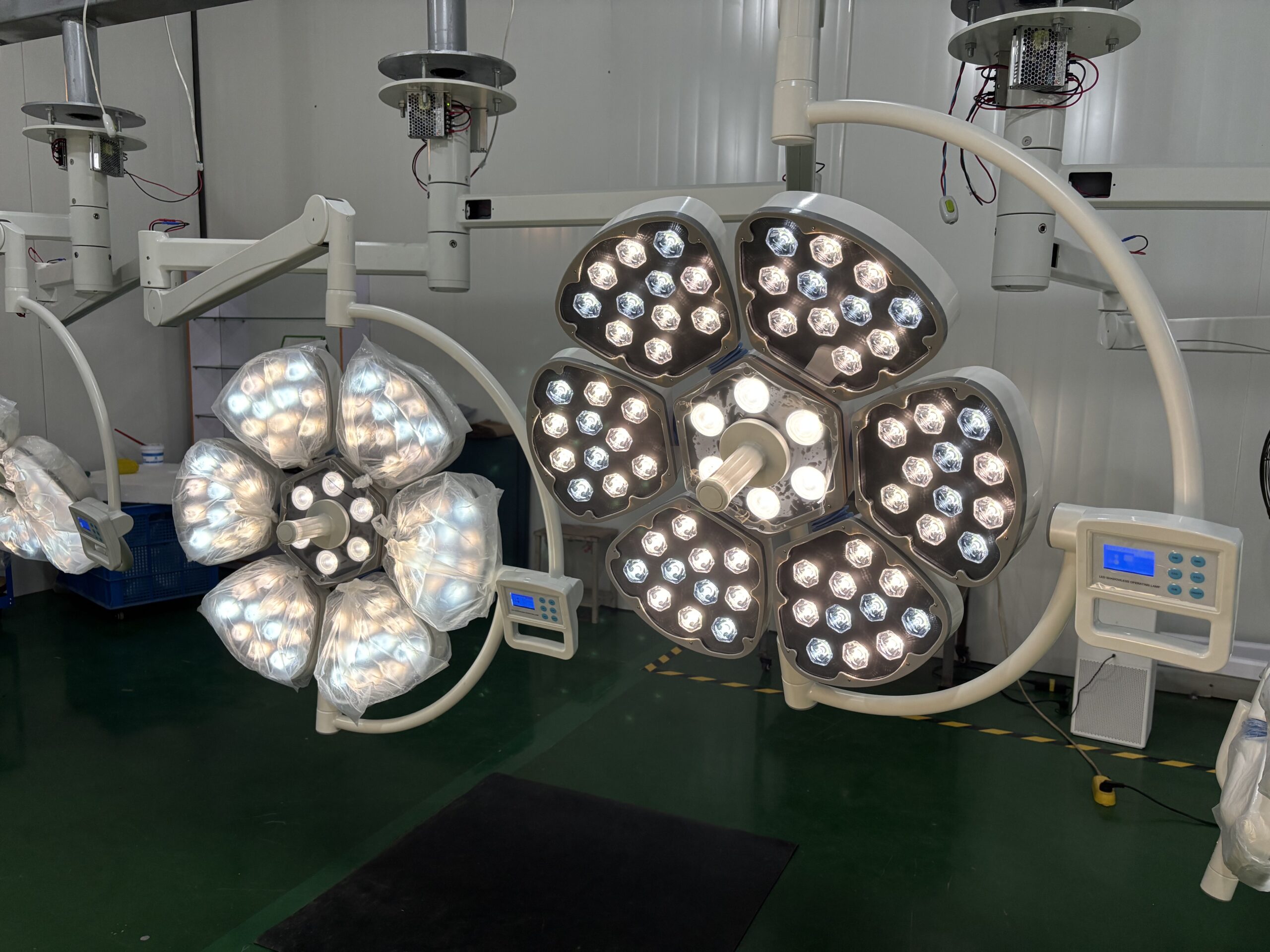
Procurement and Acceptance Checklist for Buyers
All of the engineering only protects patients if it survives procurement. The handle is easy to overlook when a tender is dominated by lux, color temperature, color rendering index, and field diameter — yet it is the component most directly tied to infection control and the one most likely to drive long-term consumable cost. The buyers who avoid trouble specify the handle explicitly, demand documentation up front, and verify it at acceptance rather than discovering the gap during the first audit or the first handle failure.
Start with documentation. A credible manufacturer will provide, without prompting, the handle’s decontamination method, the validated sterilization cycle and temperature, the published cycle limit, a disinfectant-compatibility list, and the IP rating of the light-head enclosure and handle interface. Under the EU Medical Device Regulation (MDR 2017/745) and an ISO 13485 quality system, this is part of the technical documentation a manufacturer must maintain, so a supplier that cannot produce it signals a compliance gap, not a missing datasheet. If you are sourcing lights as part of a larger fit-out, fold these handle requirements into the room-by-room specification so they are evaluated alongside the equipment in a turnkey operating-room project.
| Checklist Item | What to Verify | When to Check |
|---|---|---|
| Decontamination method | Detachable-autoclave or fixed-wipe, stated per component | Tender / specification stage |
| Sterilization rating | Validated cycle type, temperature (121 C / 134 C), cycle limit | Tender / specification stage |
| Disinfectant compatibility | Published list of approved cleaning and disinfection chemistry | Tender / specification stage |
| Enclosure IP rating | IP code for light head and handle interface; seal re-validation | Specification and acceptance |
| Compliance documentation | IEC 60601-2-41 report, ISO 13485 certificate, MDR technical file | Supplier qualification |
| Spare-parts plan | Handles-per-head, replacement interval, availability, lead time | Contract and acceptance |
| Physical acceptance test | Fit, locking detent, seal condition, finish on delivered units | Incoming inspection |
At incoming inspection, do not rely on paperwork alone. Fit and remove the handle several times to confirm the locking detent is positive and repeatable, inspect the seal and receptacle for defects, and verify the finish is smooth and free of crevices. Then run a sample handle through your actual sterilization cycle — the same one your sterile-processing department uses — and inspect it afterward for warping, discoloration, or loss of locking force. Pairing it with a planned surgical-light maintenance and total-cost-of-ownership review ensures the handle’s consumable cost is captured over the life of the asset, not discovered as an unbudgeted surprise.
The cheapest handle to buy is often the most expensive to own. A low-rated handle that fails at two hundred cycles, multiplied across every light head and every year of service, will out-cost a higher-rated handle many times over — and the failure arrives as an infection-control incident, not a line item.
Conclusion
The sterilizable surgical light handle is a small component with an outsized role: it is the one point where a sterile field meets a large, non-sterile piece of equipment, and the one most likely to be under-specified in a procurement dominated by optical performance, so treat it as a subsystem of its own. Decide deliberately between a detachable autoclavable handle and a fixed wipe-down handle based on your case volume and sterile-processing capacity. Look past the word “autoclavable” to the validated temperature, cycle type, and cycle limit, and favor high-performance polymers that survive hundreds of steam cycles. Specify the sealing and IP rating of the light head and handle interface as a pair, and build the operating-room discipline — aseptic handling, contact minimization, rotation, and a defined replacement interval — that converts good engineering into reliable sterility.
Above all, carry the handle requirements into your tender and your acceptance inspection. Demand the decontamination method, sterilization rating, disinfectant-compatibility list, IP data, and compliance documentation up front, and verify them on a delivered unit run through your own sterilizer. A manufacturer that supplies that documentation cleanly — backed by IEC 60601-2-41 testing, ISO 13485 quality systems, and MDR technical files — is a partner you can trust with the rest of the operating room too. If you are specifying or sourcing surgical lights and want to evaluate the handle as rigorously as the light field, talk to the Sanyang Medical team about handle options, sterilization ratings, and spare-parts planning, or learn more about our manufacturing and quality background.
Frequently Asked Questions
What does “sterilizable” actually mean for a surgical light handle?
It means the handle is designed to withstand a validated sterilization process — most commonly prevacuum steam sterilization — for a defined number of cycles without losing function. The claim is only meaningful when backed by a stated temperature (for example 121 C or 134 C), a cycle type, and a published cycle limit. A handle labeled simply “autoclavable” with no test data should be treated as unverified.
Should I choose a detachable or a fixed surgical light handle?
A detachable, autoclavable handle gives the most reliable cleaning because it travels through the same washer-disinfector and sterilizer as your instruments, but it requires a rotation of spare handles and a replacement interval. A fixed handle is simpler and needs no spare inventory, but relies on disciplined wipe-down and on materials that resist long-term disinfectant exposure. High-volume operating rooms with mature sterile-processing usually favor detachable handles; lower-volume suites may prefer fixed.
How many sterilization cycles should a quality handle survive?
It varies by material and design, so always ask for the manufacturer’s validated number rather than assuming. High-performance polymers such as PPSU or PEEK can tolerate many hundreds to over a thousand steam cycles, while commodity plastics fail far sooner. Some manufacturers publish a replacement interval — one European maker advises replacing its sterilizable focus handle after roughly 1,000 cycles — a useful benchmark for consumable budgets.
Why do sealing and IP ratings matter for the handle?
Because the handle mounts to the light head, its interface is a potential path for moisture and cleaning fluids to enter the enclosure. If that interface is not well sealed, condensate can corrode contacts, fog optics, and compromise the electrical insulation required by IEC 60601-2-41. A light head rated to IP65 or higher, with a seal re-validated after repeated cleaning or sterilization cycles, keeps the cleanable exterior from becoming a contaminated interior.
What should I check at acceptance when surgical lights are delivered?
Beyond the paperwork — decontamination method, sterilization rating, disinfectant-compatibility list, IP data, and IEC 60601-2-41 / ISO 13485 / MDR documentation — physically test the handle. Fit and remove it several times to confirm a positive, repeatable locking detent, inspect the seal and receptacle for defects, and run a sample handle through your own sterilization cycle, then inspect it for warping, discoloration, or loss of locking force. Testing against your real conditions catches problems a datasheet review will miss.
You May Also Like...

Bariatric OR Package: Table, Bed and Trolley Coordination
A bariatric OR package coordinates the operating table, the patient bed and the trolley for...

Lumen vs Lux: What These Surgical Light Units Mean
Lumen and lux are not the same thing. Lumen measures the total light a fixture...

Pricing Your Imported Equipment as a Distributor
A distributor’s price is not the factory price plus a flat markup. It is the...