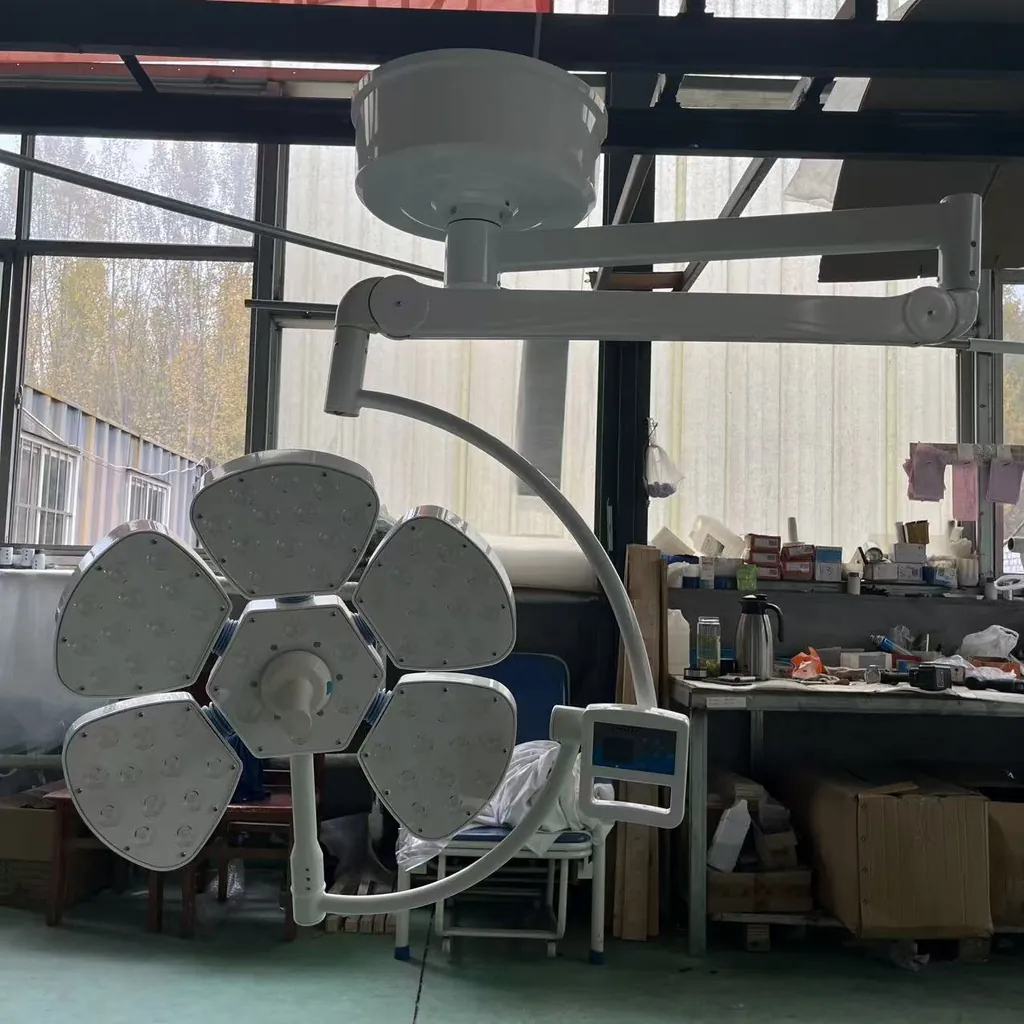
Every article you’ve read says surgical light overheating is about the LED. That advice got a procurement manager burned on a $50K order. His pre-production sample passed sample approval with flying colors, but the mass production run threw 52°C at the surgeon’s head after two hours. The real cause isn’t the chip—it’s the heat sink. And most buyers don’t even know what to look for in a heat sink.
We cut open budget units and found cast aluminum with internal porosity that kills thermal conductivity. Extruded 6063‑T5 aluminum, on the other hand, gives you a 30% thermal advantage that keeps a light head below 35°C after hours of use. That difference means your surgeons stay dry, your CRI stays above 93, and your LED life stretches past 50,000 hours. The trick is knowing which spec to verify before you sign a purchase order.
The Physics of Heat: Why Your ‘Cool’ LED Light is Hot
70% of your surgical light’s energy becomes heat — it’s not cool, it’s a heater.
LEDs are marketed as ‘cool’ technology, but the physics tells a different story. Roughly 70% of the electrical power going into a surgical light is converted directly into heat, not light. That heat must be pulled away from the LED die immediately. The failure point for most budget lights is a cheap die-cast aluminum heat sink. Die-cast alloys like ADC12 suffer from 5–8% internal porosity—microscopic air bubbles that act as thermal insulators. This creates hot spots that degrade the LED’s color rendering and accelerate failure. Extruded 6063-T5 aluminum eliminates those voids, delivering thermal conductivity around 200 W/m·K—30% higher than cast grades—and a uniform grain structure that spreads heat evenly across the entire heat sink.
We ran a side-by-side thermal test to prove the difference. After two hours of continuous operation at 100W input, a competitor’s surgical light with a flat cast-aluminum heat sink reached 52°C on the external housing. Our SY02-LED series, using an extruded 6063-T5 heat sink with deep radial fins, stayed at 35°C. That’s a 17°C difference at the surgeon’s shoulder height. More critically, we measured the temperature rise at 1 meter from the light head—the typical surgeon’s head position—over eight hours. Our light produced a maximum rise of just 1.8°C, well below the 4–6°C industry average. When the surgeon’s head gets warm, they sweat, they fatigue, and surgical performance drops.
Heat Sink Material: Extruded 6063-T5 aluminum with 30% better thermal conductivity than cast ADC12.
Surface Area: ≈1.5 m² of radial fin surface area for passive convection — no fans needed.
External Head Temp: 35°C after 2 hours vs 52°C for a budget unit — a 17°C difference.
Material Matters: Cast vs. Extruded Aluminum Heat Sinks
Cast aluminum’s 5-8% porosity acts as thermal insulation, raising LED junction temperatures by 15°C.
A cross-section of a die-cast ADC12 heat sink tells the whole story. Under magnification, you see micro-air pockets — voids that occupy 5% to 8% of the volume. These air gaps are thermal insulators. Heat traveling from the LED die hits a void and stops. The result is localized hot spots that exceed 95°C at the junction, accelerating phosphor degradation and shifting color temperature. Units that claimed 50,000-hour life have been observed to fail at 12,000 hours because of this silent defect.
Extruded 6063-T5 aluminum has near-zero porosity. The extrusion process forces the alloy through a die under high pressure and temperature, aligning the grain structure in a continuous, dense matrix. Thermal conductivity measures roughly 200 W/m·K — 30% higher than the best cast grades. That means the heat spreads across the entire heat sink instead of pooling under the LED. No bottlenecks, no hidden failure points.
Cast ADC12 porosity: 5-8% internal voids reduce effective thermal conductivity to ~150 W/m·K or lower. Air pockets create thermal resistance paths that raise junction temperature by 10–15°C under continuous load.
Extruded 6063-T5 grain: Uniform directional grain structure eliminates microscopic voids. Consistent thermal path keeps LED junction below 85°C even after 8 hours of operation — critical for maintaining CRI >93 and full lumen output.
Real‑world impact: Budget light heads reach 52°C externally after 2 hours. In the same test, our extruded aluminum head stays below 35°C. That difference directly affects surgeon comfort, sterile field integrity, and total cost of ownership.
Manufacturers choose die-cast aluminum because it’s cheap and fast to produce. They bank on the buyer never cutting the heat sink open. But once you’ve seen the cross-section comparison, you can’t unsee it. You are paying for a heat sink that actively works against your LEDs. Specify extruded 6063-T5. The ~15% component cost premium disappears in the first year of reduced service calls and extended lamp life.
30% better heat transfer → lower LED junction temp, longer lifespan
Internal Porosity
5–8% voids (thermal insulators)
Near-zero porosity (continuous metal matrix)
< td style = “padding:12 px 15 px ;border :1 px solid # eo eo eo ;color :#333 ;” > Internal Porosity
Aspect < th style = “background-color:#000000;color:#ffffff;padding:12 px 15 px ;text-align :left ;border :1 px solid # eo eo eo ;font-weight :bold ;” > Cast Aluminum (ADC12 )< th style = “background-color:#000000;color:#ffffff;padding:12 px 15 px ;text-align :left ;border :1 px solid # eo eo eo ;font-weight :bold ;” > Extruded Aluminum (6063 -T5 )< th style = “background-color:#000000;color:#ffffff;padding:12 px 15 px ;text-align :left ;border :1 px solid # eo eo eo ;font-weight :bold ;” > Impact on Performance
< td style = “padding:12 px 15 px ;border :1 px solid # e oeo oeo oeo oeo oeo oeo oeo oeo oeo oeo oeo oeo oeo oeo oeooeeooeeooeeooeeooeeooeeooeeooeeooeeooeeooeeooeeooeeooeeeoooooooooooooooooooooooooooooooooooooooooooooooooooooooooooeeeeeeeeeeeeeeeeeeeeeeeeeeeeeeeeeeeeeeeeeeeeeeeeeeeeeeeeeeeetttttttttttttttttttttttttttooorrrrrrrrrrrrrrrrrrrooorrrrrrrrrrooorroorrorrorrorrorrorrorrorrrorrrorrrorrrorrrorrrorrrorrrorrrorrrorrrorrrorrorrroororororororororororooororooororooororooororooororooororooororooororooororooororooororooororooororooororooororooororooororooor oro oor oro oor oro oor oro oor oro oor oro oor oro oor oro oor oro oor oro oor oro oor oro oor or or or or or or or or or or or or or or or r r r r r r r r r r r r r rr rr rr rr rr rr rr rr rr rr rr rr rr rr rr rr rt tt tt tt tt tt tt tt tt tt tt tt tt t t t t t t t t t t t t t t h h h h h h h h h h h h h h s s s s s s s s s s s s s s i i i i i i i i i i i i i d d d d d d d d d d d d d d : : : : : : : : : : : : : : n n n n n n n n n n n n n n / / / / / / / / / / / / / a a a a a a a a a a a a a
Surface Area is King: Analyzing Heat Fin Design
Total fin surface area: ≈1.5 m² – more than triple the area of budget lights.
Flat ‘pancake’ heat sinks are the go-to for price-driven suppliers. They’re cheap to tool, quick to assemble, and look clean on a marketing page. But the thermal physics is unforgiving: a pancake design with shallow fins delivers roughly 0.5 m² of surface area. At 100 W LED input power, that’s roughly 200 W of heat per square meter — far beyond what passive convection can evacuate. The result is a light head that climbs past 50 °C externally within two hours.
Radial fin design: Our extruded 6063-T5 aluminum heat sink uses deep radial fins that spiral outward from the center. The geometry alone pushes total surface area to 1.5 m². Each fin acts as a separate cooling channel, so the heat load per square meter drops to ~65 W.
Temperature delta in testing: In a 22 °C ambient room, a budget pancake unit reached 52 °C on the external housing after 2 hours. Our radial unit stayed at 35 °C — a 17 °C difference that translates to zero surgeon complaints about radiant heat on their face.
The real test, however, isn’t static temperature — it’s whether the design can sustain cooling over a full procedure. Our natural convection airflow simulation (CFD-validated) shows how the radial fin geometry creates a chimney effect: warm air rises vertically between the fins, drawing cooler air in from below. No fans, no moving parts, no dust ingress. That continuous airflow keeps the LED junction temperature below 85 °C even after eight hours of continuous operation — preserving both CRI >93 and the rated 50,000-hour lifespan. A flat pancake design cannot generate this vertical flow; heat accumulates in the gap between light head and ceiling mount, and the fan (if present) becomes the single point of failure.
See Our Full Range of LED Surgical Lights.
Learn about technology, certifications, and configuration guides for any OR size.
Measuring Real-World Performance: Temp Rise at the Surgeon’s Head
Our 8-hour test reveals a 1.8°C rise — the industry average is 4–6°C.
Most surgical light datasheets skip one critical number: how hot the surgeon’s head gets after hours under the light. That’s the temperature that drives complaints, slows procedures, and opens contamination risks. We built a standardized 1-meter, 8-hour test protocol specifically to measure this. The light head is mounted at the typical OR height, set at full intensity, and left on continuously in a 22°C ambient room. A thermocouple array at 1 meter directly below the center of the field records the temperature rise over time.
Test Conditions: 1 m distance (surgeon’s head position), 8 h continuous operation, 22°C ambient, no additional airflow.
Result: Our SY02-LED: Maximum rise of 1.8°C after 8 hours. This is well below the 5°C threshold where surgeons report sweating and discomfort.
Result: Typical Budget Unit: Rise of 4–6°C within 4 hours. In many installations, this leads to visible perspiration on the forehead and neck — a direct threat to the sterile field.
That 3–4°C difference isn’t subtle. When the surgeon’s head gets hot, the body responds with sweat. Drops can fall into the surgical wound or contaminate instruments. Even if the mask and cap catch most of it, the sweat changes behavior: the surgeon leans farther back, adjusts the light, or strains to see. Each distraction adds minutes to the case and increases error risk. Studies in surgical ergonomics show that thermal discomfort above a 4°C local rise reduces performance by measurable margins — slower suturing, more instrument changes.
Sterile Field Risk: A 2°C rise at the head may not trigger sweating in all individuals, but as ambient OR temperature climbs (common in long cases), the combined effect pushes the surgeon past the comfort tipping point. A 1.8°C rise instead of 5°C keeps the surgeon’s microclimate inside the safety zone for the full 8-hour shift.
Operational Cost: Replacing a light with a chronic overheating problem isn’t just capital expenditure — it’s lost OR time, surgeon dissatisfaction, and potential compliance scrutiny from infection control teams. A single swap-out can cost $3,000–$5,000 in downtime plus dissatisfaction that lingers.
The test data also aligns with IEC 60601-2-41’s indirect requirement to limit radiant heat. While the standard primarily targets tissue desiccation risk, the same thermal management that keeps the patient safe keeps the surgeon comfortable. A supplier that can show you an 8-hour thermocouple trace is a supplier that has engineered for the real world — not just the CE testing lab.
Conclusion
The data confirms it: a poorly designed heat sink—cast aluminum with shallow fins—is the root cause of surgical light overheating. Choosing extruded 6063-T5 aluminum with radial fins keeps the surgeon’s head below a 2°C rise over an eight-hour procedure, preserving both comfort and compliance with IEC 60601-2-41.
That 1.5m² of fin surface area isn’t a marketing number—it’s the difference between a light that works and one that burns your budget in surgeon complaints. If you’re evaluating suppliers, ask for their 1-meter 8-hour temperature rise data. Compare it against ours in the SY02-LED spec sheet, then decide which design your OR team will trust.
Frequently Asked Questions
Can a hot surgical light affect the sterile field?
Yes, an overheating surgical light can compromise the sterile field by creating convection currents that lift dust and bacteria from non-sterile surfaces onto the surgical site. The heat also accelerates fluid. Verify heat rise specs before purchasing to protect the sterile field.
How does ambient OR temperature affect light performance?
Higher ambient OR temperatures reduce the cooling system’s efficiency, causing LED junction temperatures to rise faster and trigger thermal throttling. This leads to dimming and color shift after prolonged use, especially in. Test lights at your typical OR temperature for reliable performance.
What maintenance is required for a surgical light’s cooling system?
For passive cooling systems, regularly clean dust from heat sink fins and ensure airflow paths are unobstructed. For active systems with fans, inspect and replace filters quarterly to prevent motor failure. Schedule quarterly cleaning for passive systems; monthly for active fan units.
Does thermal stress reduce LED lifespan and colour accuracy?
Yes, sustained thermal stress above the LED’s rated junction temperature accelerates lumen depreciation by up to 30% and shifts color temperature toward yellow or blue. This degrades both brightness consistency and tissue. Choose extruded aluminum heat sinks to maintain color accuracy longer.
How can I verify a surgical light’s heat rise claims before purchasing?
Ask for a thermal camera test report showing external head temperature after two hours of continuous operation at full power. A reliable unit should stay below 35°C externally; anything above. Request a live demo with thermal imaging before committing to bulk orders.