
Executive Summary
A practical compatibility guide to operating table accessories and patient positioning: side rail standards (EU 25x10 mm, US, UK), IEC 60601-2-46:2023, AORN positioning guidance, pads, clamps, and spare parts planning.
A hospital in East Africa once called us about a brand-new orthopedic attachment that would not lock onto their operating table. The attachment was fine. The table was fine. The problem was a 3-millimeter mismatch: the table carried a European 25 x 10 mm side rail, and the clamp on the attachment was machined for the American 1-1/8″ x 3/8″ rail. Six weeks of surgery scheduling, wasted. I have seen some version of this story dozens of times over the past decade, and it is almost never about quality — it is about compatibility. When buyers evaluate operating tables, they scrutinize lift capacity, Trendelenburg range, and price. Almost nobody measures the side rail.
Operating table accessories and patient positioning devices are a system, not a shopping list. Arm boards, leg holders, anesthesia screens, shoulder braces, body straps, and gel pads all interact with the table, with each other, and with the patient. Get the combination right and a single general table can cover general surgery, gynecology, urology, and orthopedics. Get it wrong and you own a very expensive piece of furniture that forces your team into improvised, unsafe positioning. This guide walks through the compatibility logic we use when configuring tables for distributors and turnkey projects in more than 15 countries — rail standards, load ratings, pad materials, and the ordering checklist that prevents expensive surprises.
For where accessories attach to the top sections, see our five-section operating table top guide.
Why Accessory Compatibility Fails in Real Operating Rooms
Most compatibility failures trace back to one of four root causes. First, mixed fleets: hospitals buy tables from one manufacturer, accessories from a second, and replacement parts from a third-party catalog. Each vendor assumes the other components follow “the standard” — but as we will see, there are at least three competing side rail standards in active use worldwide. Second, legacy equipment: a table installed in 2009 may carry a rail profile or accessory socket pattern that current catalogs no longer list. Third, private-label confusion: the same table sold under three brand names may have three different accessory manuals, and procurement staff assume the accessories are interchangeable when they are not. Fourth, and most common in price-sensitive markets, buyers substitute a cheaper clamp or pad to hit a budget line, then discover the cheaper part slips under load.
The clinical consequences are not abstract. AORN’s Guideline for Positioning the Patient, effective since May 17, 2022, treats positioning equipment selection, use, and maintenance as a core perioperative safety function. Positioning injuries — pressure ulcers, nerve compression, brachial plexus damage — are among the most litigated adverse events in surgery, and a meaningful share of them involve equipment that was mismatched, improvised, or used outside its rated envelope. From the manufacturing side, IEC 60601-2-46:2023 (Edition 4, published May 2023; adopted in Europe as EN IEC 60601-2-46:2024) sets particular requirements for the basic safety and essential performance of operating tables, including mechanical strength, stability, and the safe attachment of accessories under rated load. A table tested with its native accessory set is not automatically compliant when you hang a third-party leg holder off a rail it was never tested with.
Experience note: the most dangerous accessory is the one that “almost fits.” A clamp that grips 90% of the rail profile will hold through setup and fail at the worst possible moment — usually during a position change with the patient already anesthetized.
Step 1: Identify Your Side Rail Standard Before You Buy Anything
The side rail is the backbone of the entire accessory ecosystem, and there are three dominant profiles in the global market. Before ordering any clamp-mounted accessory — arm boards, anesthesia screens, leg holders, retractor posts, instrument trays — confirm which profile your table actually carries. Do not trust the catalog photo; measure with calipers.
| Rail Standard | Profile Dimensions | Common Markets | Clamp Marking | Compatibility Risk |
|---|---|---|---|---|
| European (EU / metric) | 25 mm x 10 mm rectangular | Europe, Middle East, Africa, most of Asia, Latin America | Usually stamped “EU” or “25×10” | US/UK clamps grip loosely or not at all |
| American (US / imperial) | 1-1/8″ x 3/8″ (approx. 28.6 mm x 9.5 mm) | USA, Canada, parts of Latin America | Usually stamped “US” | Clamp body too wide for EU rail; over-travel on locking cam |
| British (UK / imperial) | 1-1/4″ x 1/4″ (approx. 31.8 mm x 6.4 mm) | UK, Ireland, some Commonwealth legacy fleets | Usually stamped “UK” | Thin rail profile; EU clamps bottom out before locking |
Manufacturers in the export business, including our own factory, typically machine rails to the EU 25 x 10 mm profile because it dominates emerging-market tenders — but we can produce US-profile rails on request, and we always ask before assuming. Some accessory makers now sell “universal” clamps with interchangeable jaws; in our testing these work acceptably for light loads like anesthesia screens but are a false economy for load-bearing accessories such as leg holders or lateral supports. If your surgical mix includes lithotomy or lateral positioning, buy the clamp that is machined for your rail, full stop.
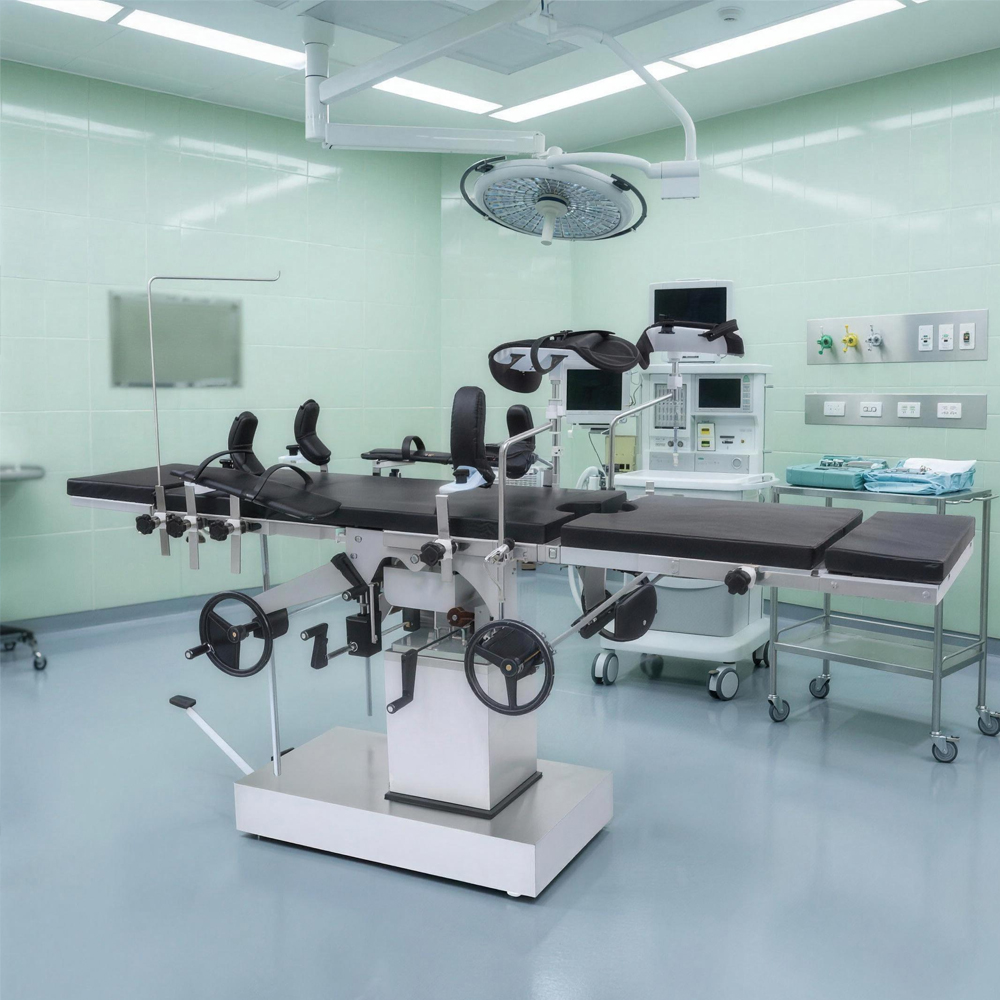
One more rail detail buyers miss: rail coverage. Some economy tables run the rail only along the torso section, leaving the leg section without mounting points. That is fine until the day you need bilateral leg holders for a urology case. When specifying a table, ask for rail drawings showing the full rail run, the position of rail gaps at section joints, and the rated load per rail section.
Step 2: Match Each Accessory to the Table — and to the Procedure
Not all operating table accessories carry the same compatibility burden. Below is how we group them when configuring a table package.
Clamp-mounted positioning accessories
Arm boards, anesthesia screens, shoulder supports, lateral body supports, and leg holders (stirrups) all hang off the side rail. Beyond the rail profile, check two numbers: the accessory’s rated patient load and the table’s maximum rail-mounted accessory load. IEC 60601-2-46:2023 requires the table to remain stable within its declared configuration envelope — a 250 kg-rated table with a heavy boot-style leg holder and a 180 kg patient in high lithotomy is a different stability case than the same table in supine. Reputable manufacturers publish a configuration matrix; if your supplier cannot provide one, that is a red flag.
Tabletop-mounted and sectional accessories
Head rests, back plate extensions, kidney bridges, and orthopedic traction frames interface with the table sections themselves, usually via keyed sockets or dovetail joints. These are almost never cross-brand compatible. A head rest designed for one table’s socket spacing will not seat correctly in another’s, and forcing it damages the socket liner. When we quote a table for a distributor, we always ask which specialty attachments the market demands — orthopedic traction for fracture work, gynecological leg supports for obstetrics, neurosurgery head frames — because retrofitting these later costs two to three times more than specifying them at the factory.
Soft goods: pads, mattresses, and straps
Table pads look commodity but are not. Pad thickness affects the effective working height of every clamped accessory; a 75 mm pad on a table specified for 50 mm pads pushes the patient 25 mm higher relative to arm boards and lateral supports, which changes pressure-point geometry. Material matters clinically: viscoelastic (memory) foam and gel pads redistribute pressure better than standard polyurethane, which is why AORN-aligned facilities increasingly specify pressure-redistributing surfaces for cases expected to exceed two hours. And the cover must tolerate your disinfectants — we have seen pad covers craze and crack within a year when hospitals switched to aggressive hydrogen-peroxide wipes without checking chemical compatibility. Straps deserve the same scrutiny: width, buckle type, and anchor point spacing differ between tables.

Step 3: Build the Positioning Plan Around the Patient, Not the Catalog
Every standard surgical position — supine, Trendelenburg, reverse Trendelenburg, prone, lateral, lithotomy, sitting — imposes a specific accessory load case and a specific injury risk profile. AORN’s positioning guideline is explicit that equipment must be selected for the patient’s body habitus and the procedure’s duration, then assessed before, during, and after the case. Translate that into procurement language and you get three rules.
- Rule 1 — size for your heaviest realistic patient plus margin. If your market’s bariatric cases run to 180 kg, your table should be rated 250 kg or more, and every load-bearing accessory (leg holders, arm boards, lateral supports) should be individually rated for the same envelope, not just the table frame.
- Rule 2 — standardize one accessory set per table, per specialty. A general surgery table needs: one pair of arm boards, one anesthesia screen, one body strap set, one pair of knee crutches or boot stirrups, and a pressure-redistributing pad set. Lithotomy-heavy facilities add heel-supporting boot stirrups rather than candy-cane stirrups, which reduce peroneal nerve compression risk.
- Rule 3 — never improvise interfaces. Towels taped to rails, clamps from another table “temporarily” borrowed, gel pads doubled up to gain height — every one of these appears in incident reports. If a position cannot be achieved with the rated accessory set, the answer is a different accessory, not a workaround.
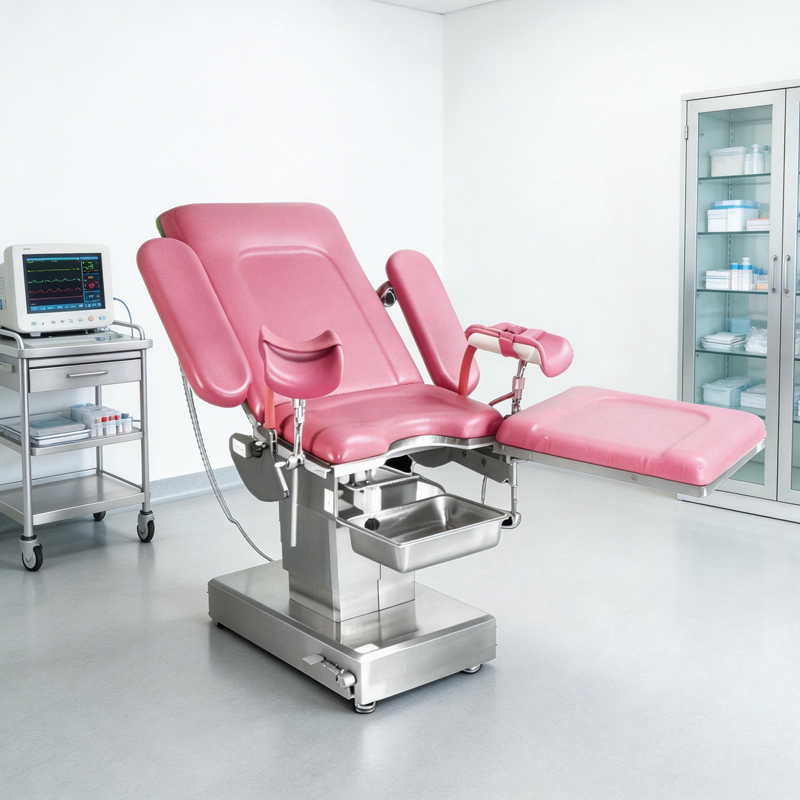
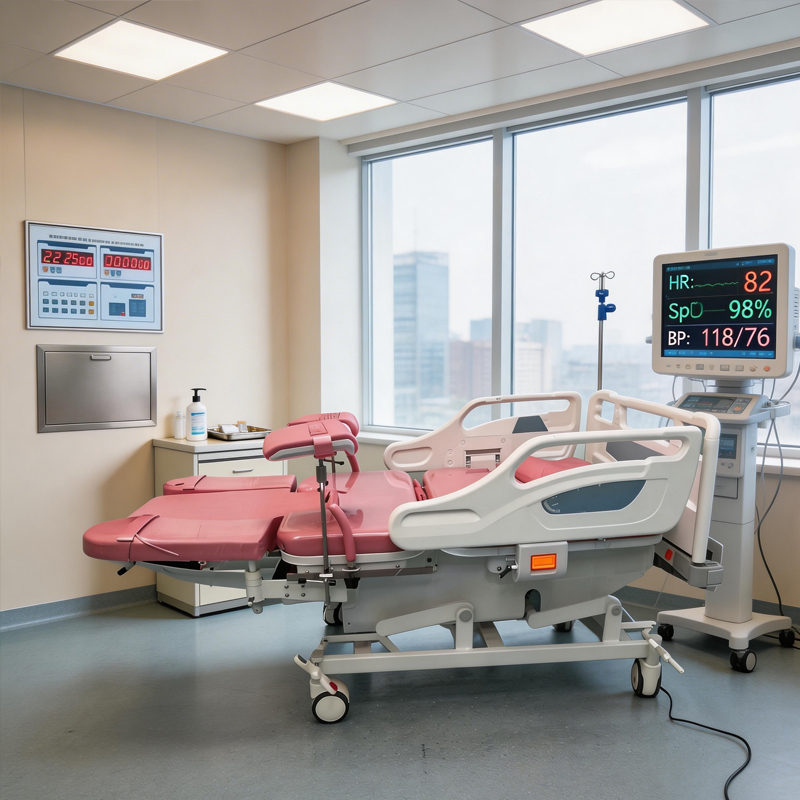
Obstetric and gynecological work illustrates the point well. A dedicated delivery bed or a general table with a proper leg section and lithotomy supports both work, but the positioning hardware — leg supports, perineal cut-out, grab handles, fluid collection — must be designed as a set. Mixing a general table’s short leg plates with a third-party stirrup kit usually leaves the patient’s hips unsupported at exactly the flexion angle the surgeon needs.

Procurement warning: accessory kits bundled at suspiciously low prices almost always cut corners on the clamps and the pad foam density. The table frame survives; the patient interface is where cheap kits fail first.
Step 4: Verify Regulatory and Test Documentation
For tenders and regulated markets, compatibility is also a paperwork problem. Under EU MDR 2017/745, accessories for a medical device are themselves devices and must carry their own conformity assessment — an operating table leg holder sold into the EU needs CE marking in its own right, and the table manufacturer’s technical file should list which accessories were included in the IEC 60601-2-46 verification. Ask any supplier for three documents before signing: the IEC 60601-2-46 test report (Edition 3 or, preferably, the current Edition 4 from 2023), the declared accessory configuration list with load ratings, and the ISO 13485 certificate of the factory that actually manufactures the accessories — because many table brands outsource clamps and pads to third parties. If the accessories and the table come from the same factory quality system, your life during audits and incident investigations gets significantly simpler. Our full product range is manufactured under one ISO 13485 quality system for exactly this reason.
Step 5: Plan for Spare Parts and Service From Day One
Accessories are wear items. Clamp jaws wear, strap buckles crack, pad covers split at the seams, leg holder gas springs lose pressure. The hospitals that keep positioning equipment safe for 10-plus years are the ones that treat accessories as a maintained fleet, not as permanent fixtures. Practically, that means three things. Keep one spare clamp per accessory type in the CSSD store — a single failed clamp can cancel a surgical list. Replace pads on condition, not on calendar: check foam recovery and cover integrity quarterly, and budget for pad replacement every two to four years depending on case volume and disinfectant exposure. And source spares from a supplier who can actually identify your table generation. We keep accessory spares for tables we shipped more than a decade ago, because a rail clamp is worthless if the factory cannot tell you which jaw geometry your 2014 model needs. If uptime matters to your facility, look at the supplier’s spare parts and service program before you compare sticker prices — the cheapest table with no parts pipeline is the most expensive table you will ever own.
A quick maintenance checklist we give to biomedical engineering teams:
- Monthly: verify clamp locking action on every rail-mounted accessory; any clamp that does not lock with positive tactile feedback comes out of service.
- Quarterly: inspect pad covers for cracking, seam separation, and foam compression set; check strap stitching and buckle springs.
- Annually: load-test leg holders and arm boards against their rated capacity, and torque-check all accessory socket fasteners on the tabletop sections.
- After any incident or dropped accessory: retire and inspect before returning to service — clamps that have been dropped on a hard floor can have hairline cracks in the casting.
Conclusion
Operating table accessories and patient positioning are a compatibility problem before they are a purchasing problem. Measure the side rail. Match every accessory to the table’s tested configuration envelope under IEC 60601-2-46. Size the soft goods for your real patient population and your real case durations, following the positioning principles in the AORN guideline. And buy from a supplier whose accessory ecosystem, documentation, and spare parts pipeline will still be there in year eight. Do that, and one well-configured table will safely serve general surgery, obstetrics, urology, and orthopedics for a decade. If you are configuring a table fleet or trying to match accessories to tables already in service, send us your table model and rail measurements — our engineering team will confirm compatibility and quote a matched accessory set.
Frequently Asked Questions
Are operating table accessories universal between brands?
No. Clamp-mounted accessories depend on the side rail profile — EU 25 x 10 mm, US 1-1/8″ x 3/8″, or UK 1-1/4″ x 1/4″ — and tabletop-mounted accessories like head rests and traction frames use proprietary socket patterns. Some “universal” clamps exist, but they are best limited to light loads such as anesthesia screens. Always verify the rail profile and the accessory’s rated load before mixing brands.
What side rail size do most operating tables use?
Globally, the European 25 x 10 mm rectangular profile is the most common, especially in tender-driven markets across Asia, Africa, the Middle East, and Latin America. North American fleets predominantly use the 1-1/8″ x 3/8″ imperial profile, and older UK-made tables use 1-1/4″ x 1/4″. Measure your rail with calipers rather than assuming from the brand.
How often should operating table pads be replaced?
There is no fixed regulatory interval; replacement should be condition-based. Inspect pad covers and foam recovery quarterly. In a busy OR with daily cases and aggressive disinfectant use, expect a two-to-four-year service life. Pads showing cover cracks, permanent compression set, or fluid ingress should be replaced immediately because they become both a pressure-injury and an infection-control risk.
Does IEC 60601-2-46 cover accessories?
The current edition, IEC 60601-2-46:2023, sets particular requirements for operating table safety and essential performance, including mechanical strength and stability with accessories attached within the declared configuration. Separately, under EU MDR 2017/745, accessories are devices in their own right and require their own conformity assessment. Always request the test report and the manufacturer’s declared accessory configuration list.
What is the minimum accessory set for a general operating table?
For a general surgery table we recommend: one pair of arm boards, one anesthesia screen, a body strap set, one pair of leg holders (boot-style stirrups for lithotomy work), a pressure-redistributing pad set, and at least one spare rail clamp per accessory type. Specialty work — orthopedic traction, neurosurgery head frames, obstetric supports — should be specified at order time, because retrofitting later typically costs two to three times more.
Related reading: Operating Table Sizing: Tabletop Length vs Patient Population.
You May Also Like...

Bariatric OR Package: Table, Bed and Trolley Coordination
A bariatric OR package coordinates the operating table, the patient bed and the trolley for...

Lumen vs Lux: What These Surgical Light Units Mean
Lumen and lux are not the same thing. Lumen measures the total light a fixture...

Emergency Department Equipment for Trauma, Resuscitation and Triage
An emergency department is built around speed, and its equipment has to be ready the...