
Executive Summary
How medical pendant load capacity is really defined, and how to calculate safe working load, safety factors and arm length for ICU and OR pendants.
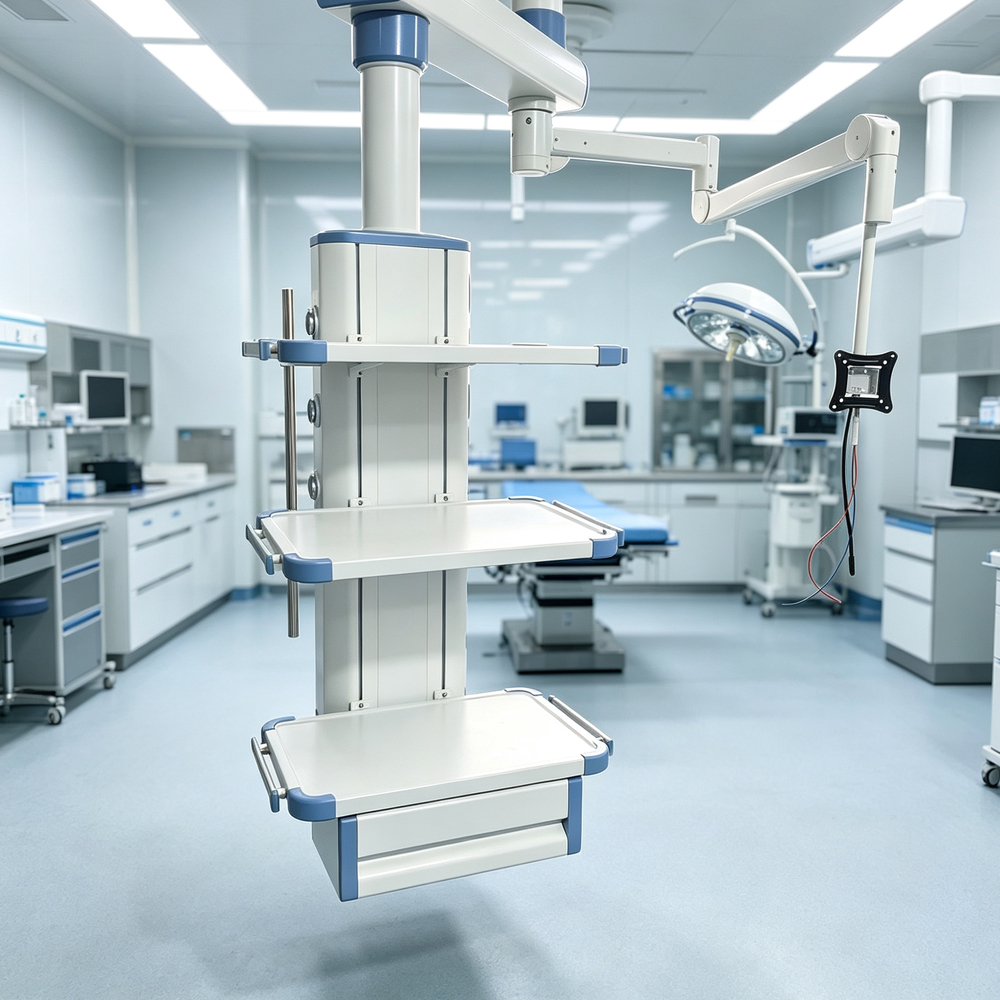
Every intensive care bay and operating room I walk into, the ceiling pendant is doing quiet heavy lifting: an ICU ventilator, a patient monitor, four infusion pumps, a suction canister, shelves, drawers, and a tangle of gas hoses and power cables — all hanging over a sedated patient. When a ceiling-mounted medical pendant is specified correctly, nobody ever thinks about it. When it is specified wrong, the problems show up fast: the arm drifts out of position mid-shift, the brake can no longer hold the ventilator where the anaesthetist left it, bearings wear out in two years instead of ten, and in the worst case the suspension point on the ceiling was never rated for the load that was actually hung from it.
The single most misunderstood number on a pendant datasheet is load capacity. Buyers compare “220 kg” against a ventilator that weighs 25 kg and assume there is enormous headroom. In practice, that headline figure is usually the gross maximum payload of the bare arm — before shelves, drawers, infusion poles, drop tubes, hose bundles and cable looms have consumed a large share of it. And the number shrinks further the longer the arm gets, because a pendant arm is a lever: what matters at the bearing is torque, not just kilograms.
This guide walks through how medical pendant load capacity is actually defined, which standards govern it, how to run the load calculation step by step, and how arm length changes the picture for ICU, OR and endoscopy suites. It is written from the manufacturer’s side of the table — the same checks we run when a hospital sends us an equipment list and asks, “will this configuration hold?”
What “Load Capacity” on a Medical Pendant Datasheet Really Means
The first thing to understand is that there is no single universal label. Depending on the manufacturer, the same physical limit may be called maximum payload, safe working load (SWL), rated load, or load capacity — and two of those numbers on the same datasheet can differ by a factor of two or more. On a typical European ICU pendant you will see a maximum pendant payload in the region of 220 kg per arm, but the same configuration sheet will list a remaining net payload of perhaps 149–164 kg once the configured shelves, drawers and infusion poles are accounted for. Both numbers are true; they answer different questions.
Three figures matter in practice:
- Maximum (gross) payload — the total load the arm structure and bearings are designed to carry, including the weight of every accessory mounted on the pendant.
- Remaining net payload — what is left for clinical devices after the configured accessories (shelves, drawers, infusion poles, monitor arms, keyboard trays) have been subtracted.
- Vertical force at the ceiling — the total downward force the ceiling fixing must resist, which is the payload plus the pendant’s own structure. A fully configured ICU twin-arm pendant can push close to 7,000 N (roughly 700 kg-force) into the ceiling point, even though the “payload” is only 220 kg.
Brake technology also changes the rated number. A mid-range double-arm pendant may be rated at 60 kg with friction brakes but 130 kg with an electromagnetic e-brake on the same arm geometry — the structure is identical, but the holding mechanism sets the usable limit. Pneumatic brakes, friction brakes and e-brakes each have different holding behaviour under sustained load, so always compare ratings within the same brake type.
Datasheet rule of thumb: never compare two pendants by their headline kilogram figure alone. Compare the remaining net payload in the exact arm length and brake configuration you are buying — and ask what the vertical force at the ceiling point will be, because that is the number your structural engineer actually needs.
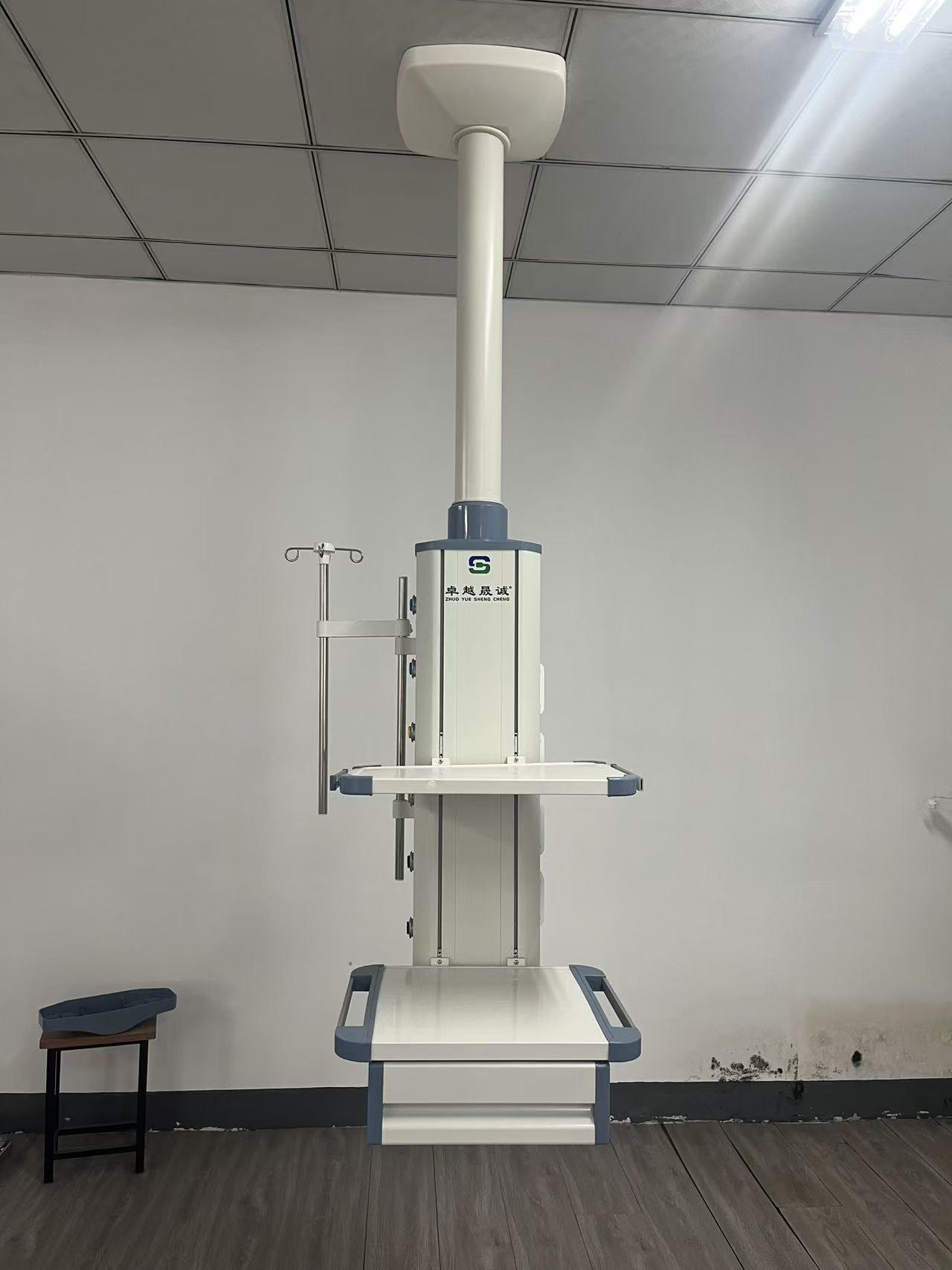
One more specification deserves attention: initiating force — the push needed to start the arm moving. Well-engineered single-arm pendants move with under 30 N of force even near full load, and dual-arm systems under 50 N. If a pendant needs a two-handed shove to reposition, it is either overloaded for its bearing package or the bearings are past their service life.
The Standards Behind the Numbers: ISO 11197 and IEC 60601-1
Medical pendants — formally “medical supply units” — are governed by ISO 11197, the particular standard for basic safety and essential performance of medical supply units. The current edition is ISO 11197:2019 (fourth edition), which layers specific requirements onto the IEC 60601-1 general safety standard and references ISO 14971 for risk management. A fifth edition is already moving through the ISO pipeline — the final draft (FDIS) was registered in 2026 — so buyers specifying pendants for multi-year projects should confirm which edition the manufacturer’s type testing follows.
The mechanical heart of the standard sits in IEC 60601-1 clause 9.8, which deals with mechanical strength of supporting means and suspended parts. The practical effect: load-bearing structures that could cause injury if they fail are verified with test loads that are a multiple of the rated load — a safety factor of 4 against yield is the common benchmark in the industry. Arm manufacturers demonstrate this with type testing: heavy-duty pendant bearings, for example, are type tested to 40,000 revolutions under full load conditions at a safety factor of 4 before a design is released. That combination — cyclic endurance and static overstrength — is what separates a pendant rated for a decade of ICU service from one that develops drift in year two.
A safety factor of 4 does not mean you may load the pendant to a quarter of its test value and ignore the rest. The factor covers material scatter, fatigue and the occasional shock load — not chronic overloading, which quietly consumes the bearing and brake life that the type test was meant to guarantee.
Depending on your market, additional documents apply. UK projects reference HTM 2022 and HTM 02-01 for pendant systems and medical gas pipelines; US facilities follow NFPA 99 for the gas side. Gas hose assemblies should be manufactured to BS EN ISO 5359 with connectors to BS EN 15908 (NIST) or the regional equivalent — DISS, Ohmeda, BS or AFNOR — because a pendant is as much a gas distribution device as a mechanical arm. Electrically, pendants are Class I equipment under IEC 60601-1 and, in Europe, Class I medical devices under MDR 2017/745, manufactured under an ISO 13485 quality system. Our companion guide on IEC 60601-1 electrical safety testing covers the electrical verification side in depth.

Step-by-Step: Calculating the Load Your Pendant Must Carry
The calculation is simple arithmetic, but it must be done with real weights, not guesses. Here is the three-step method we use when reviewing a hospital’s equipment list.
Step 1 — Build a device inventory with verified weights
Pull the datasheet weight of every device that will hang on the pendant, including mounting hardware. Weights vary more than most planners expect: a modern turbine-driven ICU ventilator splits into a ventilation unit of about 10.5 kg and a 17-inch interaction panel of about 7.8 kg (roughly 10 kg with its shelf mount), while a larger modular high-end ventilator with monitor and shelf mount reaches about 38 kg. A compact 10-inch patient monitor is only 3.7 kg, but a 15-inch monitor with parameter modules and mounting hardware is easily three times that. Transport ventilators sit around 6.5 kg, and mainstream critical care units with screens around 23 kg.
| Device typically mounted on a pendant | Typical datasheet weight | Planning note |
|---|---|---|
| ICU ventilator, turbine-driven (unit + panel, shelf-mounted) | approx. 20–25 kg | Count the shelf mount and humidifier if fitted |
| High-end modular ICU ventilator + monitor + shelf | approx. 38 kg | Heaviest single item on most ICU pendants |
| Critical care ventilator, main unit only | approx. 23 kg | Add display/trolley hardware if pendant-mounted |
| Compact patient monitor (10-inch class) | approx. 3.7 kg | Add module rack and arm clamp |
| Transport/portable ventilator | approx. 6.5 kg | Often moved on and off the pendant |
| Infusion/syringe pumps (per device) | typically 2–5 kg | ICU bays mount 4–8 of them — they add up |
| Suction canister + holder, wet area | typically 3–6 kg | Full canister, not empty |
Always use the weight of the device as it will hang — with shelf clamps, monitor arms, baskets and full consumables — and verify against the manufacturer’s datasheet rather than rounding from memory.
Step 2 — Add the pendant’s own accessories
Every accessory bolted to the service head consumes payload: stainless shelves, drawers, infusion poles with extensions, keyboard trays, monitor arms, light mounts. A drop tube adds roughly 12 kg per metre of length on heavy-duty systems. This is exactly why configuration sheets quote a “remaining net payload” — a 220 kg-class twin-arm ICU pendant with three shelves, a drawer, two infusion poles and a keyboard tray per side may have only 149–164 kg left for devices.
Step 3 — Apply headroom and check the result
Sum the device weights from Step 1 and compare against the remaining net payload from Step 2 — but do not plan to sit at 100% of it. Leave 10–20% headroom for the devices that will inevitably join the bay later: an ECMO console one winter, a second monitor for a teaching case, an additional pump rack when protocols change. If your calculated load exceeds roughly 85% of the net payload, move to the next arm class up or redistribute devices across two pendants.
Field lesson: the load a pendant carries on day one is the lowest load it will ever carry. Departments add devices; they almost never remove them. Size the pendant for the equipment list the hospital will have in five years, not the one it has today.
Arm Length and Load Capacity Move in Opposite Directions
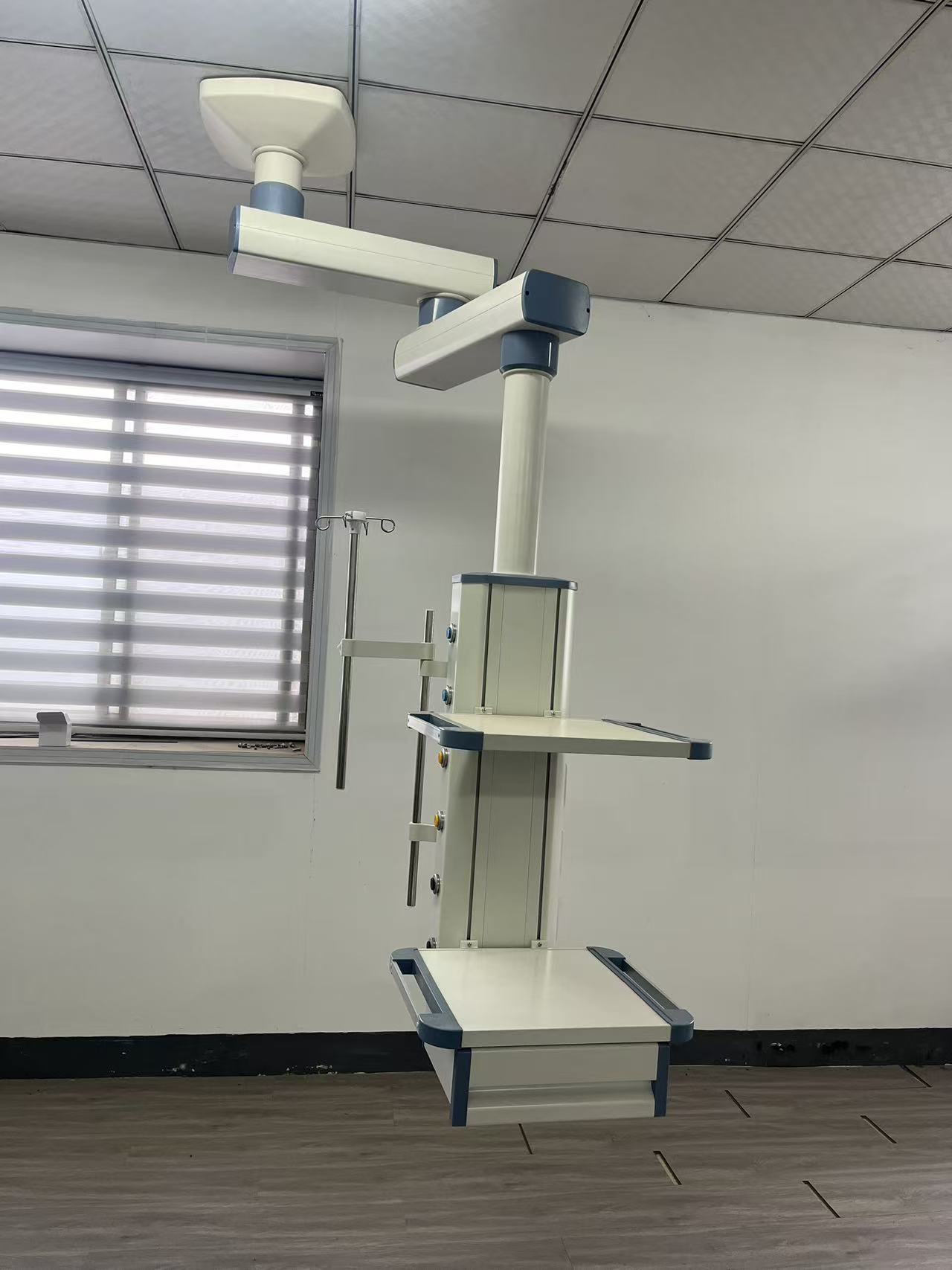
Here is the relationship that surprises first-time buyers: the same pendant arm carries less the longer it gets. A pendant arm is a cantilever, and the bending moment at the main bearing equals the load multiplied by its distance from the bearing axis. Double the arm length and you double the torque from the same equipment — so manufacturers derate the maximum load as arm length grows, and derate it again for dual-arm configurations where the second joint adds another lever.
Published figures from a European heavy-duty pendant line illustrate the gradient clearly:
| Arm configuration | Max load — heavy-duty series | Max load — standard-duty series |
|---|---|---|
| Single arm, 600 mm | 1,000 kg | 580 kg |
| Single arm, 800 mm | 730 kg | 420 kg |
| Single arm, 1,000 mm | 570 kg | 320 kg |
| Single arm, 1,200 mm | 450 kg | 260 kg |
| Dual arm, 600 + 600 mm | 440 kg | 260 kg |
| Dual arm, 800 + 800 mm | 300 kg | 180 kg |
| Dual arm, 1,000 + 1,000 mm | 220 kg | 130 kg |
| Dual arm, 1,200 + 1,000 mm | 170 kg | 110 kg |
Read two things out of that table. First, going from a 600 mm to a 1,200 mm single arm costs the heavy-duty series more than half its headline capacity. Second, a dual-arm system at 1,000 + 1,000 mm carries only about as much as a single arm at half the reach — the second joint is expensive in torque terms. Mid-range lines show the same shape at lower absolute values: single-arm systems around 500 kg, twin-arm around 320 kg, and motorised height-adjustable variants around 280 kg, because the lift mechanism adds its own derating.
The practical rule: choose the shortest arm that covers the required working envelope. Measure the actual positioning range the clinicians need — from the parking position to the furthest point over the patient — and add a modest margin, rather than buying maximum reach “just in case”. Every unnecessary centimetre of arm is capacity you paid for and then threw away. Where reach genuinely matters, such as twin-bay ICU rooms where one pendant serves two bed positions, accept the derating explicitly and move up an arm class to compensate.
Typical Load Scenarios: ICU Bridge, OR Anaesthesia Pendant, Endoscopy Suite
The same pendant platform gets configured very differently by department, and each has its own load profile.
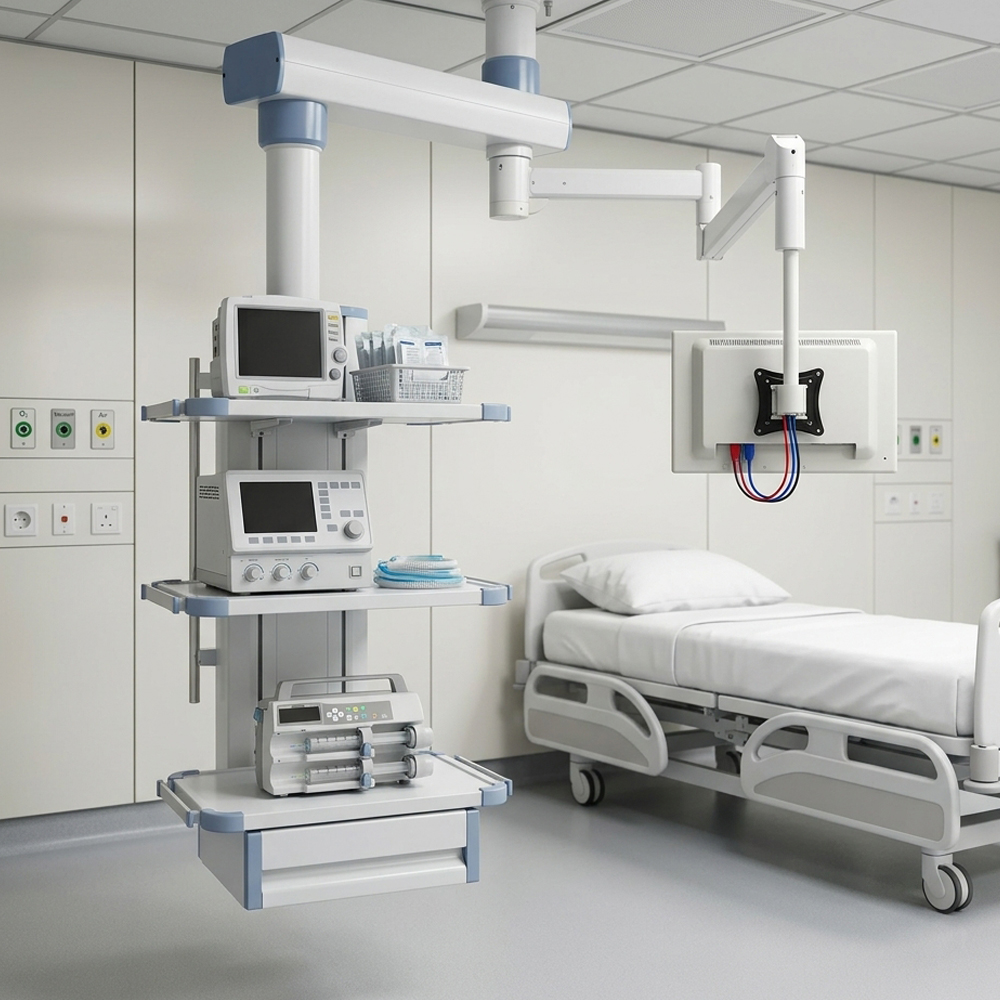
ICU — the heavyweight. A twin-arm ICU pendant (often called a bridge, with wet and dry sides separating suction and drainage from power and data) carries the heaviest sustained load in the hospital: a ventilator on one arm, monitors and 4–8 infusion pumps on the other, plus shelves, drawers, two infusion poles and a keyboard tray. Reference configurations in this class run at a maximum pendant payload of 220 kg per side with a remaining net payload of roughly 149–164 kg, and push a vertical force of about 6,800 N into the ceiling fixing. That ceiling number is why ICU pendants need engineered attachment points — a standard suspended ceiling grid will not do.
Operating room — coordinated, not maximal. In the OR the anaesthesia pendant carries the anaesthesia machine or its components, a monitor, suction and gas outlets, typically in the 80–150 kg class. The design challenge is less about raw capacity and more about coordination with the rest of the room: the pendant’s working envelope must not collide with the surgical light heads, the C-arm’s travel path, or the table movement range of the operating table beneath it. OR pendants are usually specified with the anaesthetist’s reach envelope in mind — devices at eye level, hoses short enough to avoid the sterile field.
Endoscopy and day surgery — monitor-heavy, lighter. Endoscopy suites hang two or three displays, a light source cart interface and suction, but rarely a ventilator. Loads are modest — often 40–80 kg — but the pendant cycles far more often per day as rooms turn over between procedures, so bearing endurance and brake consistency matter more than ultimate capacity.
| Department | Typical mounted equipment | Typical payload class | Design priority |
|---|---|---|---|
| ICU (twin-arm bridge) | Ventilator, monitors, 4–8 pumps, shelves, poles | 150–220 kg per side | Net payload headroom, ceiling fixing strength |
| OR (anaesthesia) | Anaesthesia components, monitor, suction | 80–150 kg | Envelope coordination with lights and table |
| Endoscopy / day surgery | 2–3 displays, light source, suction | 40–80 kg | High-cycle bearing and brake durability |
| Monitor-only suspension | Single display + arm | under 30 kg | Positioning precision, low initiating force |
Procurement Checklist: What to Verify Before You Sign Off
When a quotation lands on your desk, these are the items we would expect a serious buyer — or an independent planner — to verify before approval:
- Rated payload per configuration — ask for the maximum payload and the remaining net payload for the exact arm lengths, brake type and accessory list being quoted, in writing on the configuration sheet.
- Vertical force at the ceiling point — pass this to the structural engineer early; retrofitting a stronger fixing after the ceiling is closed is far more expensive than specifying it on day one.
- Brake type and holding behaviour — friction, pneumatic or electromagnetic, and the rated holding load for each; confirm initiating force figures for repositioning ergonomics.
- Type test evidence — cyclic endurance (e.g., 40,000 revolutions under full load) and the safety factor applied, consistent with IEC 60601-1 clause 9.8 and ISO 11197.
- Gas and electrical compliance — gas hoses to BS EN ISO 5359, connectors matching your hospital standard (DISS / NIST / BS / AFNOR), electrical build to IEC 60601-1, and the applicable regional pipeline code (HTM 02-01, NFPA 99).
- Regulatory status — MDR 2017/745 classification for Europe, ISO 13485-certified manufacturing, and which edition of ISO 11197 the type file follows.
- Future expansion margin — confirm the quoted configuration still meets your five-year equipment plan at 85% or less of net payload.
If your project bundles pendants with lights, tables and beds, it is usually cleaner to hold one supplier to the full load-and-envelope coordination — which is exactly how turnkey operating room projects are structured. Manufacturers with OEM/ODM capability can also adapt arm lengths, console layouts and gas standards to local requirements; see our OEM/ODM localization services for how that works in practice. And if you already have an equipment list, send it over via our contact page — a load check against a real configuration sheet takes a day and can prevent a very expensive change order.
Conclusion
Medical pendant load capacity is not one number — it is a small system of numbers: gross payload, remaining net payload, vertical ceiling force, and the derating curve that ties all of them to arm length. Get the arithmetic right and the pendant disappears into the background for a decade: brakes hold, arms move with one finger, and the ceiling fixing never becomes a conversation. Get it wrong and every symptom is visible from the corridor — drifting arms, overloaded bearings, and a structural retrofit nobody budgeted for.
The discipline is simple: inventory every device with its real datasheet weight, count every accessory, leave 10–20% headroom for the equipment that has not been bought yet, and choose the shortest arm that covers the clinical working envelope. Then hold the manufacturer to written figures — net payload per configuration, vertical force, type test evidence and standards compliance — before sign-off. That is the difference between buying a pendant and engineering a suspension system.
Frequently Asked Questions
What is a typical medical pendant load capacity?
It depends on the class. Monitor-only suspensions are rated under 30 kg, endoscopy and day-surgery pendants typically run at 40–80 kg, OR anaesthesia pendants at 80–150 kg, and twin-arm ICU bridges at 150–220 kg payload per side. Heavy-duty structural platforms exist in load classes from 30 kg all the way up to 1,000 kg. The figure that matters for planning is the remaining net payload after accessories, not the headline maximum.
Does arm length really reduce a pendant’s load capacity?
Yes — an arm is a cantilever, so load capacity is derated as length grows. Published heavy-duty data shows a single arm dropping from 1,000 kg at 600 mm to 450 kg at 1,200 mm, and dual-arm systems derate further because the second joint adds another lever. Always ask for the rated load at the exact arm length being quoted, and choose the shortest arm that covers the required working envelope.
What safety factor do ISO 11197 and IEC 60601-1 require?
IEC 60601-1 clause 9.8 requires mechanical strength of supporting means and suspended parts to be verified with test loads that are multiples of the rated load; a safety factor of 4 against yield is the industry benchmark, and pendant bearings are commonly type tested to 40,000 revolutions under full load at that factor. ISO 11197 (current edition 2019, fifth edition in the FDIS stage as of 2026) layers the medical-supply-unit-specific requirements on top, with risk management per ISO 14971.
Do infusion pumps, shelves and cables count toward the payload?
Everything counts. Shelves, drawers, infusion poles, monitor arms and keyboard trays consume payload before any clinical device is mounted — which is why configuration sheets distinguish maximum payload from remaining net payload. Even gas hoses and cable looms routed through the drop tube add kilograms per metre. Build the full inventory into your calculation, including mounting hardware and full consumables.
Can I retrofit a longer arm onto an existing pendant?
Sometimes, but not by arm length alone. A longer arm multiplies the torque at the main bearing, so the manufacturer must confirm the bearing, brake and drop tube are rated for the new configuration — and the ceiling fixing must be re-checked for the higher vertical force and overturning moment. In many cases the correct answer is to move up an arm class rather than extend the existing one. Always get the revised rated load in writing before approving a retrofit.
You May Also Like...

Bariatric OR Package: Table, Bed and Trolley Coordination
A bariatric OR package coordinates the operating table, the patient bed and the trolley for...

Lumen vs Lux: What These Surgical Light Units Mean
Lumen and lux are not the same thing. Lumen measures the total light a fixture...

Emergency Department Equipment for Trauma, Resuscitation and Triage
An emergency department is built around speed, and its equipment has to be ready the...