
Surgical light datasheets are full of numbers: illuminance in lux, patch diameter in centimeters, focus depth, color rendering. Most tender documents quote a few of them, and most buyers compare them without knowing what the manufacturer is actually measuring. Understanding the photometric terms turns a datasheet from marketing into a comparable engineering document, and it changes purchasing decisions: two lights with identical peak lux can behave completely differently across the working distance a surgical team actually uses. This article explains the key photometric terms, how they interact, and the datasheet lines worth negotiating over.
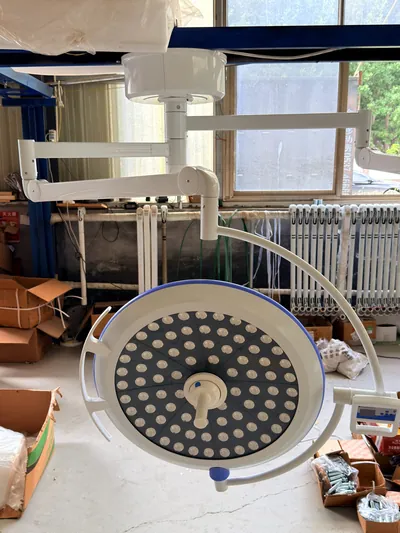
Illuminance: The Central Number, Measured at Working Distance
Illuminance, expressed in lux, is the light delivered onto the wound plane. Surgical standards commonly work in the forty to one hundred sixty thousand lux range at the standard working distance, and the first datasheet question is where that number was measured: a peak lux quoted at the light’s ideal focus distance means little if the surgical team works twenty centimeters higher or lower. Real use lives along the lux curve, the falloff of illumination as distance changes, and a light with a flatter curve is more forgiving of the positioning reality of a live OR. Buyers should ask for the illumination value at the distance their typical table height and surgeon position actually produce, not only the headline maximum, and should compare that against the illuminance requirements for the surgery types the suite performs, which our guide to illuminance by surgery type breaks down by specialty.
Patch Diameter and Focus Depth: The Usable Field
Light patch diameter describes the diameter of the area receiving a defined share of peak illumination, typically quoted as the diameter at half of peak intensity, the D50 convention. Focus depth is the range of distances over which the patch holds useful size and intensity, sometimes called depth of focus. Together they describe the usable field: a large patch with shallow focus behaves well only at one precise mounting height, while a design with a genuinely deep focus holds its patch as the team changes table height for Trendelenburg positioning or works at different tissue depths. The interplay matters in practice: a very tight, intense patch gives dramatic center lux and poor peripheral visibility for the assistant, so the balance between patch size and peak intensity is a surgical-workflow decision, not just a photometric one. The terminology here follows the conventions documented by the International Commission on Illumination, whose definitions keep datasheet terms comparable across manufacturers.

The Supporting Numbers: R9, Shadow Dilution and Uniformity
Three supporting specs complete the picture. Color rendering, and especially the R9 red-rendering value within the CRI family, determines whether tissue perfusion and blood oxygenation read correctly on the table; a high general CRI with poor R9 still skews reds, which matters in vascular and general surgery. Shadow dilution describes how well the multi-dome or multi-lens design fills shadows cast by hands and heads, and it is best judged with a test object rather than a datasheet claim. Uniformity describes how even the illumination is across the patch, and it pairs with the numbers above in the photometry vocabulary our guide to surgical light datasheet terms explains term by term. Uniformity and patch behavior together also determine how the light performs over a full shift, which our guide to illuminance uniformity treats as a comfort and fatigue issue for the surgical team, not only a measurement.
Negotiating the Datasheet
Buyers who understand these terms can convert a datasheet into contractual commitments: lux measured at a stated distance, patch diameter at the D50 convention, focus depth across a stated range, R9 above a stated value, and shadow dilution demonstrated with a standard test object at acceptance. Two practical additions strengthen the position. First, request the measurement conditions in writing, because photometric numbers carry an implied test setup and two setups rarely match. Second, benchmark against the incumbent: measure the lights the surgical team already uses, at the heights and positions they actually work in, and treat that measured performance as the acceptance floor for the new light. The demonstration matters more than the paper for the subjective terms, so the acceptance protocol belongs in the purchase: a live demo over an operating table at working heights, with the surgical team present, is the final test that no photometric table replaces.
الأسئلة الشائعة
What lux level should an operating light deliver?
Surgical standards commonly work between about 40,000 and 160,000 lux at the working distance. Ask where the quoted value is measured, and compare lux at your real working height, not only the headline peak.
What is patch diameter D50?
The diameter of the area receiving at least half of peak illumination. It describes the usable lit field, and it changes as the light’s focus and distance change.
Why does R9 matter more than general CRI?
R9 measures red rendering specifically. Tissue perfusion and oxygenation read through reds, so a light with high general CRI but poor R9 still distorts the tones surgeons judge by.
What is focus depth on a surgical light?
The range of distances over which the light holds useful patch size and intensity. Deep focus tolerates real-world table height and positioning changes.
How should photometrics be verified at acceptance?
A live demo over an operating table at working heights, shadow dilution tested with a standard object, with the surgical team present.
Video: Operation Theater Lights Explained
Comparing surgical light quotations with photometric commitments? Our LED surgical light line datasheets state the measurement distances and D50 conventions behind every number.
قد يعجبك أيضًا...

Gas Outlet Colour Coding and Pin Index: What Medical Equipment Importers Must Check
Medical gas systems are built on a simple principle: it must be impossible to connect...

Blood Donation Chairs: Specifying Seating for Donor Safety and Compliance
Blood establishments face a seating problem that ordinary furniture cannot solve: donors sit for 15...

Veterinary Grooming Tables: What Pet-Care Chains Should Spec
Pet grooming chains are scaling faster than their equipment sourcing, and the grooming table at...