
A distributor in Lagos sends a first inquiry for 40 hospital beds and expects the factory to laugh at the quantity. Instead, the reply asks about the model, the destination port, and whether the beds should share a container with the trolleys from the same catalog. The MOQ and delivery conversation with a Chinese medical equipment factory looks nothing like the rigid minimums many buyers assume.
The practical reality across the sector is a spectrum, not a rule. A factory with flexible production can accept a sample order, a trial order, or a mixed project container, while a factory tooled for one high-volume line will hold firm on its minimum. Delivery schedules follow the same pattern: standard products move in days, custom work takes weeks. This guide explains how MOQ and delivery timing actually work, where the numbers come from, and how buyers can structure orders to get better terms.
النقاط الرئيسية:
- Medical equipment MOQ from Chinese factories is often flexible: sample orders, trial orders, and project mixed loading are standard practice.
- Standard products typically ship in 3 to 7 days after confirmation; custom production runs 15 to 20 days.
- The delivery schedule divides into production, quality control, packing, and freight booking, and each stage can add days if not coordinated.
- Payment follows a common pattern of 30 percent T/T deposit and 70 percent before shipment, with L/C at sight for large orders.
- Buyers compress total delivery time by freezing specifications early and consolidating multiple categories into one container.
جدول المحتويات
- What MOQ Really Covers
- Lead Time Anatomy: From PO to Port
- Why Standard and Custom Lead Times Differ
- Sample Orders and Trial Orders
- Payment, Incoterms and Scheduling
- How Buyers Compress Lead Times
- Questions to Ask Before You Sign
- الأسئلة المتكررة
What MOQ Really Covers
MOQ is a production planning number, not a commercial wall. A factory sets a minimum because a production run has fixed costs: tooling setup, material cutting, batch quality control, and packing line changeover. Below a certain quantity, those fixed costs make the unit price unreasonable, so the factory quotes a minimum or a higher unit price. Understanding that logic lets a buyer negotiate around it instead of against it.
Quality gates like the pre-shipment inspection belong in the factory relationship: see our pre-shipment inspection guide.
Three order types sit below a full container load. A sample order is one to a few units for evaluation, documentation, and local registration. A trial order is a small commercial batch that tests the sales channel. A project mixed load combines different products into one shipment, which is how a distributor fills a container while keeping each line’s quantity low. Sanyang Medical, founded in 2015 in Qufu, applies all three: flexible MOQ across its five product lines, with sample orders and project mixed loading as standard practice.
The minimum-order question buyers should ask is not “what is your MOQ” but “what order structures can you support at my quantities.” The answer reveals whether the factory thinks in production batches or in customer projects. For the sourcing strategy behind these structures, our guide on becoming a medical equipment distributor in China maps the entry path from first inquiry to repeat container.
Lead Time Anatomy: From PO to Port
| المرحلة | Typical duration | What can delay it |
|---|---|---|
| Order confirmation | 1 to 2 days | Unclear specifications or payment delays |
| Production | 3 to 7 days standard | Custom parts or busy season capacity |
| مراقبة الجودة | 1 to 3 days | Batch failures or rework |
| Packing and export | 1 to 3 days | Document preparation, container booking |
| Freight booking | 2 to 7 days | Port congestion, sailing frequency |
A quoted lead time usually covers the factory’s own stages: confirmation, production, quality control, and packing. Freight booking and sailing schedules sit outside the factory’s control, which is why the number a buyer hears from the factory is always shorter than the number they should plan with. When a supplier quotes 3 to 7 days for standard products, that is the factory-to-port figure, not the door-to-door figure.
The export documentation stage deserves its own attention. Medical equipment files include commercial invoice, packing list, certificate of origin, and for many destinations, the free sale certificate and any notarized or apostilled documents. A delay in any one document holds the shipment at the port, and the fix is usually to confirm the document list before production ends rather than after. The full import and customs picture deserves its own review, and the document list should be confirmed against destination-country requirements.
Why Standard and Custom Lead Times Differ

Standard products ship in 3 to 7 days because the parts, fixtures, and test procedures already exist. The factory pulls components from stock, assembles to a released drawing, and runs the routine quality checks. Custom production runs 15 to 20 days because something in the chain changes: a private label, a color, a cable length, a control interface, or a packaging design.
The single largest driver of custom delivery time is the spec freeze. Every day spent debating a detail after the order is placed is a day added to the 15 to 20 days, because production cannot start on a moving target. Factories that run OEM work, like Sanyang’s OEM and ODM program, freeze the specification in a written file before production begins, and that file becomes the acceptance reference for the whole order.
Buyers should ask the factory to break the custom schedule into components: drawing confirmation, sample approval if required, material procurement, production, and QC. A 15 to 20 day quote that spends 10 days in drawing review tells you where the delay lives and what to do differently next order. The sourcing mistakes that inflate this stage are catalogued in our five critical sourcing mistakes guide.
Sample Orders and Trial Orders
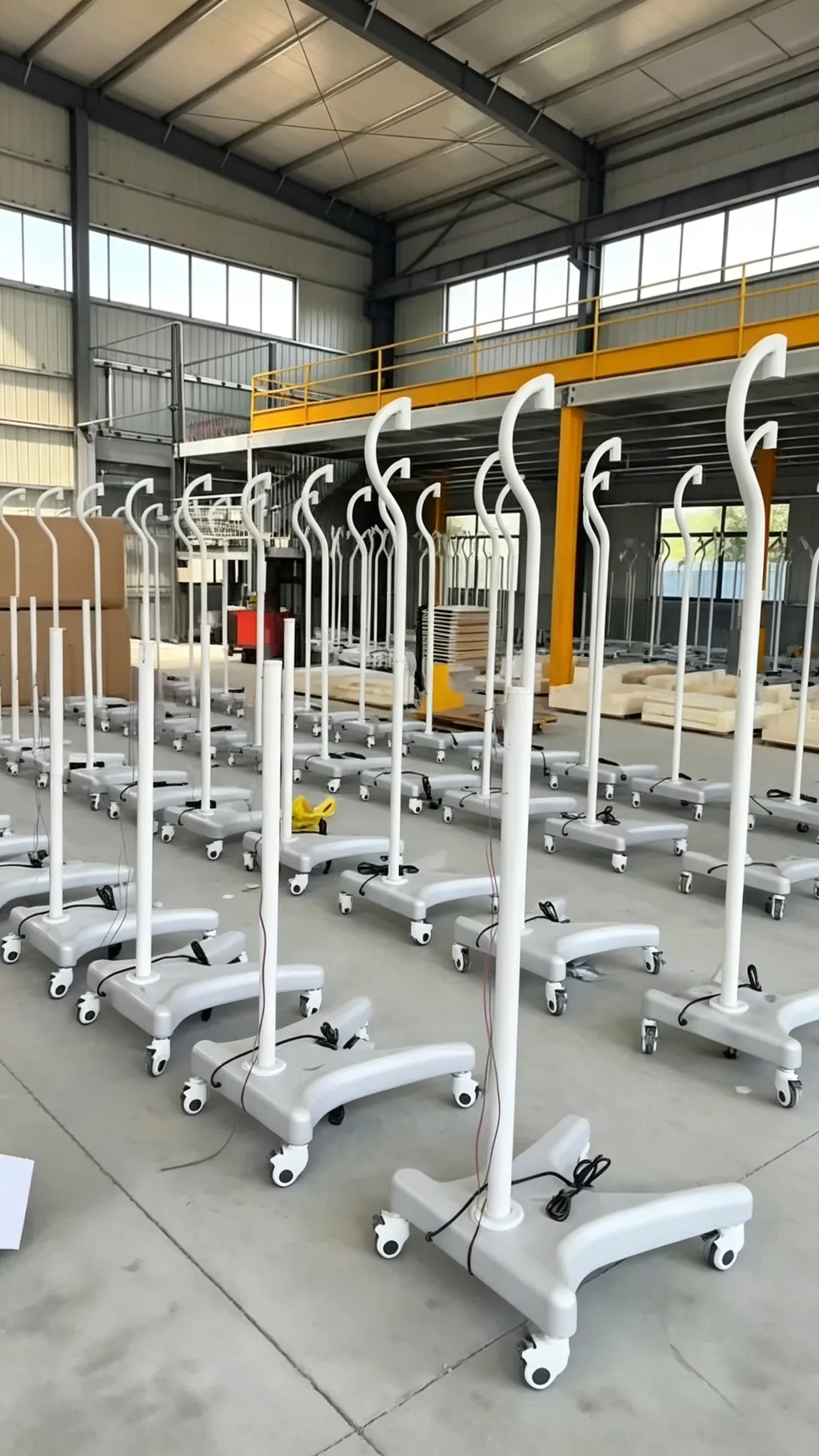
The sample order is the cheapest insurance a distributor buys. One unit of a surgical light or operating table lets the buyer verify the build quality, test the documentation, run local registration, and photograph the product for the local catalog. The sample also tests the factory itself: response speed, packing care, and the accuracy of the documents that arrive with the box.
Trial orders step up from samples in quantity and purpose. A trial order of five to ten units tests the market at a scale where the distributor can still afford a mistake, and it moves the relationship from evaluation to transaction. Factories price trial orders above container-rate pricing, but the premium buys the distributor information, not just stock.
Sample and trial orders follow the standard 3 to 7 day pattern for catalog models. The practical trap is evaluating the sample in isolation: a sample that arrives quickly and beautifully tells you nothing about batch consistency. The factory audit route, with its 15 control points, is the systematic way to verify what a sample cannot show, and our medical equipment factory audit guide covers the full checklist.
Payment, Incoterms and Scheduling
Payment terms and delivery timing interact more than most buyers expect. The factory’s production slot starts at order confirmation, and most factories confirm after the deposit arrives. The standard structure is 30 percent T/T deposit with 70 percent before shipment, and for large orders, an L/C at sight replaces the final payment risk. A buyer whose deposit clears the bank a week late has quietly moved their production slot a week later.
Shipping terms define where the factory’s responsibility ends and the buyer’s begins. FOB is the standard basis for most Chinese medical equipment quotes, with CIF and DDP assistance arranged through long-term freight partners. The choice changes the schedule: under FOB, the buyer’s forwarder controls the booking, while DDP pushes most logistics work to the factory. The ICC Incoterms rules define each term precisely, and our comparison of FOB vs CIF vs DDP for medical equipment applies them to real shipment decisions.
Scheduling discipline pays in every mode. Wire the deposit on the day the PO is signed. Confirm the document list before production ends. Book the container when QC starts, not when the goods are ready. Each of these moves compresses the gap between the factory’s quoted production time and the arrival date the buyer promised their customer.
How Buyers Compress Lead Times

Five levers compress total delivery time, and none of them requires a miracle. First, freeze the specification before the PO: every open question answered on paper cuts days from confirmation. Second, consolidate product categories into one container, which is why multi-line factories matter; Sanyang’s five product lines fill a mixed container that would otherwise ship as several small parcels. Third, align payment mechanics with the factory’s bank so the deposit lands without chasing. Fourth, request the export document set during production, not after. Fifth, book freight early and share the sailing schedule with the factory so packing aligns with the container slot.
The procurement side of the same discipline treats delivery dates as contract terms rather than promises. For project buyers, the same logic extends to the whole equipment schedule, where table, light, and pendant deliveries must align with the room construction program.
The second-order effect of consistent scheduling is negotiation power. A distributor whose payments land on time and whose specifications arrive complete gets priority in busy seasons, because factories schedule for reliability, not for the size of the order alone.
Questions to Ask Before You Sign
- Order structure: Can you support sample orders, trial orders, and mixed project containers at my quantities?
- Schedule breakdown: What is the production time versus QC versus packing within your 3 to 7 day standard quote?
- Custom work: For custom items, when does the 15 to 20 day clock start, and what happens if the spec changes mid-production?
- Payment mechanics: Does the production slot start at PO signature or at deposit clearing?
- المستندات: Which export documents are included, and can the free sale certificate and apostille be prepared before the goods are ready?
- Consolidation: Can different product lines share one container without extra handling fees?
- Capacity: What is your current production load, and does the quoted schedule reflect it?
Ask these seven questions in the first conversation and the second conversation gets faster. The answers separate factories that quote from factories that plan, which is exactly the distinction that determines whether the container arrives when the distributor promised their customer it would.
Sanyang Medical, a hospital equipment manufacturer founded in 2015 in Qufu, Shandong, publishes its commercial terms openly: flexible MOQ, standard lead times of 3 to 7 days, custom production of 15 to 20 days, 30 percent T/T with 70 percent before shipment, and L/C at sight for large orders. Its medical equipment product range spans surgical lights, operating tables, medical pendants, hospital beds, and trolleys, which is the consolidation advantage behind its mixed-container orders.
الأسئلة المتكررة
ما هو الحد الأدنى النموذجي لكمية الطلب (MOQ) للمعدات الطبية من الصين؟
يختلف الأمر حسب المصنع وخط الإنتاج، لكن الهياكل المرنة شائعة: طلبات عينات من وحدة واحدة إلى بضع وحدات، وطلبات تجريبية لدفعات تجارية صغيرة، وشحنات مشاريع مختلطة تجمع عدة منتجات في شحنة واحدة.
كم من الوقت يستغرق المصنع الصيني لإنتاج المعدات الطبية؟
منتجات الكتالوج القياسية تُشحن عادةً خلال 3 إلى 7 أيام بعد تأكيد الطلب. الإنتاج المخصص مع وضع العلامات الخاصة أو التكوينات المعدلة يستغرق عادةً من 15 إلى 20 يومًا، اعتمادًا على مدى سرعة تجميد المواصفات.
هل شروط الدفع قابلة للتفاوض مع مصانع المعدات الطبية الصينية؟
الهيكل الشائع هو 30% دفعة مقدمة عبر التحويل البنكي (T/T) مع 70% قبل الشحن. للطلبات الكبيرة، يُعد الاعتماد المستندي عند الاطلاع (L/C at sight) بديلاً قياسياً يحمي كلا الطرفين، ويمكن للعلاقات طويلة الأمد أن تفتح مجالاً لمزيد من المرونة.
Does a sample order count toward the minimum?
عادةً ما يتم تسعير العينة بشكل منفصل ولا تُحتسب ضمن الحد الأدنى للإنتاج لاحقًا.
هل يمكنني دمج معدات طبية مختلفة في حاوية واحدة؟
نعم، عندما ينتج المصنع فئات متعددة. تجمع الحاويات المختلطة أضواء الجراحة، والطاولات، والأسرة، والمعلقات، أو العربات في شحنة واحدة، مما يقلل تكلفة الشحن لكل وحدة ويتيح للموزعين اختبار عدة خطوط في وقت واحد.
الخاتمة
MOQ and lead time from Chinese medical equipment factories follow a pattern any buyer can navigate: flexible order structures, standard production in 3 to 7 days, custom work in 15 to 20 days, and payment terms of 30 percent T/T with 70 percent before shipment. The variance between factories comes from planning discipline, not from magic.
النقاط الرئيسية:
- Ask about order structures, not just minimums; samples, trials, and mixed containers cover most distributor scenarios.
- Split the quoted schedule into factory stages and freight stages, and plan with the longer number.
- Freeze specifications, align payment timing, and consolidate categories to compress every stage you control.
If you are structuring a first order or a mixed project container and want the minimums and delivery timing confirmed in writing, send us your product list and we will reply with quantities, timing, and the document set included.
Payment method selection depends on order size; the T/T vs L/C comparison explains when to use each.
قد يعجبك أيضًا...

Service Contracts and SLAs for OR Equipment: What Buyers Should Negotiate
A service contract looks like a maintenance formality until a light fails at 02:00 before...

Import Document Pack: What Customs Asks for Medical Devices
A medical equipment shipment stops at customs for one reason more than any other: the...

برنامج ضوء الجراحة OEM: من العينات إلى العلامة الخاصة
Private-label surgical lights are how distributors and hospital groups put their own brand on a...