
Every medical equipment order has two moments when defects are cheap to fix: before the crate closes at the factory, and at first power-up on site. Those moments are the Factory Acceptance Test (FAT) and the Site Acceptance Test (SAT), and skipping either one converts a specification problem into a warranty dispute on installed equipment.
This guide covers what each test should contain for OR and ward equipment, the documents that make results traceable, and how to schedule both tests so they protect the project instead of delaying it.
What a FAT actually tests
The Factory Acceptance Test happens at the manufacturer before shipment, with the buyer or a third-party inspector present or delegated. Its scope is mechanical and functional, against the purchase specification: serial numbers and configuration match the order, every powered function runs through its full range, accessories and mounts fit, and the electrical safety bench results are on file. For an operating table that means cycling the tabletop through all positions under rated load; for a surgical light, verifying illumination levels, color temperature and the standby intensity ladder; for a pendant, gas outlet flow and pressure behavior, which we detail in our gas outlet testing guide.
The FAT is also the documentation gate. The test protocol should be agreed at order time, not improvised at the factory: a checklist per unit listing each test with pass or fail, the instrument used, the operator, and the date, signed by both sides. Photographs of the tested configuration and the nameplate close the record. Equipment bound for regulated markets should also show its conformity file at FAT, the CE technical documentation relationship covered in our CE MDR versus MDD recheck guide.
What a SAT adds on site
The Site Acceptance Test runs after installation, with the equipment connected to the building’s real power, gas and ceiling infrastructure. The SAT answers the questions a factory cannot: does the pendant hang plumb and rotate freely on the actual ceiling arm, does the light head clear the door route it will travel, does the table sync with the room’s imaging geometry, does the whole system hold up through a simulated case. Installation-dependent measurements, rail loads, ceiling reinforcement checks, gas pressure at the outlet under flow, belong here; the structural side is covered in our ceiling reinforcement guide.
The SAT protocol is a functional repeat of the FAT plus site checks: full function cycling, alarm and battery drop-over tests, and a handover section covering user training hours, spare parts handover and the service contact. Commissioning a full room package multiplies the list, and the sequence is shown end to end in our لغرفة العمليات الجاهزة (turnkey operating room program). Regional health systems publish equipment acceptance and maintenance references openly; the Pan American Health Organization’s institutional repository carries practical guidance used across Latin American hospitals.

The electrical safety bench
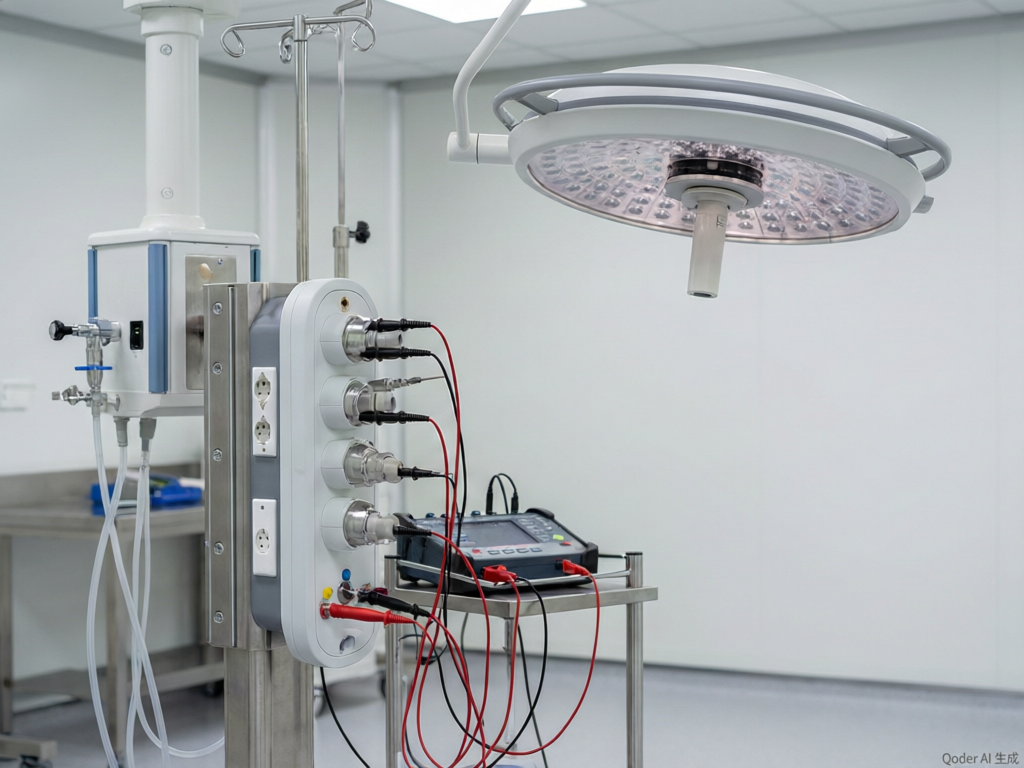
Electrical safety testing anchors both acceptance stages. At FAT, the manufacturer’s bench results should exist per unit: protective earth continuity, typically measured below 0.1 to 0.2 ohm depending on standard and equipment class, insulation resistance, and dielectric strength, the hipot test pictured above. At SAT, the same measurements repeat on site with the hospital’s analyzer, because transport vibration, humidity and installation wiring change the numbers. EMC behavior, radiated and conducted emissions and immunity, is type-tested rather than unit-tested, and the certificates should reference the exact configuration delivered, a topic we unpack in our IEC 60601-1-2 EMC guide.
Failure handling and the paper trail
Acceptance tests are only worth running if failure means something. Write the rule into the purchase contract: a failed FAT item stops shipment until retested; a failed SAT item starts a fix window, commonly 5 to 15 working days depending on severity, before payment milestones or rejection rights trigger. Log every deviation with photographs and a disposition, accepted as-is, rework, or replace, signed by both parties. This is the record that protects both sides when a light module dims at month six, because the module’s FAT and SAT entries show whether the behavior is new or was present at handover; module-level economics are covered in our LED module replacement guide.

Scheduling both tests around the shipment
Sequence the FAT at 100 percent completion and at least 3 to 5 working days before the planned container date, so a failure does not fight the booking. The SAT follows installation logically, not calendar-fixed: for a container program, rooms commission in phase order, and the SAT for each room should complete before the room enters service. Budget one SAT day per major OR room, plus half a day per ward zone for bed and trolley lots. Third-party inspection can stand in for the buyer’s engineer at either stage; the same logic that governs phased rollouts in our phased rollout case study applies to acceptance scheduling.
Frequently asked questions
What is the difference between FAT and SAT?
FAT tests the equipment at the factory against the order before shipment; SAT tests the installed system on site with real power, gas and ceiling infrastructure before it enters service.
Can I skip the FAT and rely on the SAT?
Skipping FAT means discovering factory defects after freight and installation, when rework means return shipment; the factory test is the cheap one.
How long does a site acceptance test take?
About one day per major OR room and half a day per ward zone for beds and trolleys, run after installation and before clinical use.
What documents close an acceptance test?
A signed per-unit checklist with instrument references, photographs, deviation dispositions, training and spare parts handover records, and electrical safety measurements.
Two signatures that protect the whole project
The FAT signature protects the shipment; the SAT signature protects the room. Sanyang runs documented FAT protocols at the factory and supports SAT commissioning worldwide through its turnkey OR programs و قطع الغيار والخدمة team, reachable at the صفحة الاتصال.
For a practical monthly checklist that keeps beds in service, see hospital bed maintenance checklist.
لمزيد من التفاصيل، راجع أنماط الأعطال في السنة الأولى لمعدات غرفة العمليات.
قد يعجبك أيضًا...

After-Hours Maintenance Strategy: Minimizing OR Downtime
Operating room downtime is expensive because an idle OR still burns staff, overhead and scheduled...

Operating Table Battery Replacement: Procedure and Intervals
Operating table battery replacement is the routine swap of the integrated backup battery that keeps...

Trolley Lock Cylinder Maintenance: Keyed and Push-Lock Types
Medical trolleys fail at the lock. Not the frame, not the casters, not the drawers...