
Executive Summary
A definitive comparison of medication trolleys and crash carts across purpose, layout, locking, materials, and department fit—helping hospital procurement teams specify the right ward cart.
Walk into any hospital ward and you will see wheeled carts parked outside patient rooms, tucked into alcoves, or stationed beside nursing desks. To an untrained eye, they all look alike: metal or plastic boxes on casters with a handful of drawers. But confuse a medication trolley with a crash cart during a code blue, and the consequences are measured in seconds that cost lives. We often see buyers—especially those new to hospital procurement—treat these two cart categories as interchangeable. They are not.
The distinction matters because each cart is engineered around a fundamentally different clinical mission. A medication trolley optimizes for security and routine efficiency: it must keep controlled drugs locked between scheduled rounds while letting nurses access the right patient dose quickly. A crash cart optimizes for speed under chaos: every drawer, every latch, every centimeter of countertop real estate is designed so that a team of strangers can perform resuscitation within the first critical minute. Choosing the wrong cart for a department creates workflow bottlenecks, compliance gaps, and—worst case—delayed defibrillation.
This guide breaks down the medication trolley vs crash cart decision across six dimensions: purpose, internal layout, locking, materials, color coding, and department fit. Whether you are a hospital procurement officer specifying a fleet of medical trolleys for a new wing or a distributor advising a clinic, the framework below will help you match cart to clinical environment with confidence.
Defining the Two Cart Types: Purpose and Design Philosophy
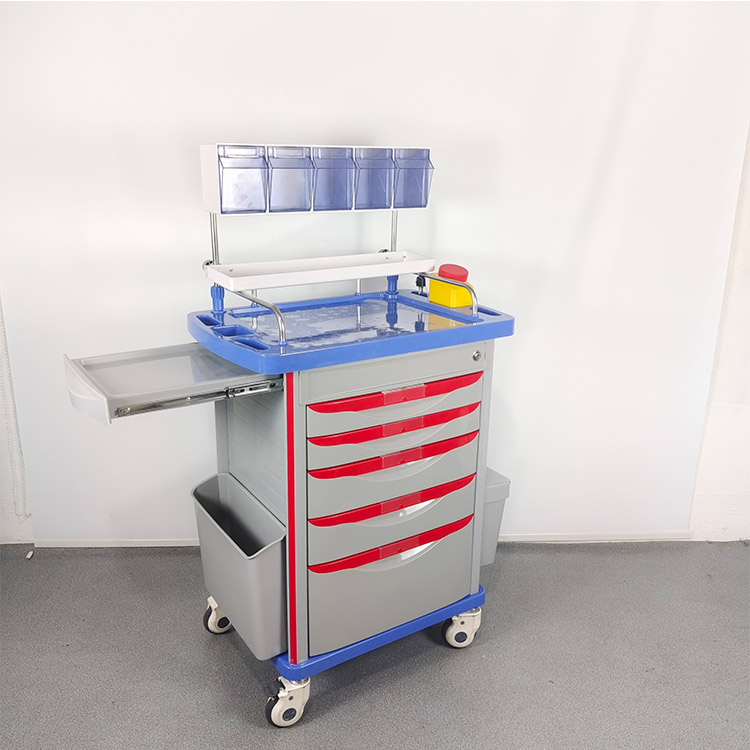
A medication trolley—sometimes called a medicine cart or drug distribution cart—is a mobile storage unit purpose-built for the safe, organized, and efficient distribution of medications during daily nursing rounds. Its design centers on controlled access: multiple lockable drawers, patient-specific cassette systems, and a worktop surface for medication preparation. The cart moves from bedside to bedside on a predictable schedule, and its entire ergonomics serve that repetitive workflow.
A crash cart—also known as a code cart, emergency trolley, or MAX cart—serves the opposite scenario. It sits stationary in a designated location until a cardiac arrest, severe hypotension, anaphylaxis, or major trauma triggers a code blue. The original crash cart was designed by Dr. Joel J. Nobel at Pennsylvania Hospital in 1965, and nurse Anita Dorr refined the concept in 1967 at Meyer Memorial Hospital in Buffalo, New York. Since then, the format has become universal: a waist-high or chest-high wheeled cabinet with a defibrillator and monitor mounted on top, multiple drawers organized by clinical priority, and external quick-access locking.
In our factory, we manufacture both cart types on the same production line, but the engineering briefs are opposites. For a medication trolley, the first question is “How do we prevent unauthorized access?” For a crash cart, the first question is “How do we eliminate every possible delay?” That single difference cascades into every design decision that follows.
The practical implication for procurement is stark: you cannot specify one cart type and expect it to serve both functions. A medication trolley with a central lock will delay a code team. A crash cart with breakaway seals offers zero security for scheduled narcotics. Hospitals that attempt to “double up” typically end up with audit failures from pharmacy inspectors and delayed response times during emergencies.
Internal Layout and Drawer Configuration
The internal arrangement is where the two cart types diverge most visibly. A crash cart follows a standardized drawer hierarchy that resuscitation teams memorize during ACLS training. According to the arrangement documented by DSI Direct (2025), the typical five-drawer configuration places medications in the top drawer for fastest access, airway and intubation supplies in the second drawer, IV access equipment (lines, needles, stopcocks, dressings) in the third, high-alert emergency medications in the fourth, and procedure kits or IV fluid bags in the bottom drawer. The defibrillator/monitor, suction unit, and bag valve mask sit on the countertop or upper shelf.
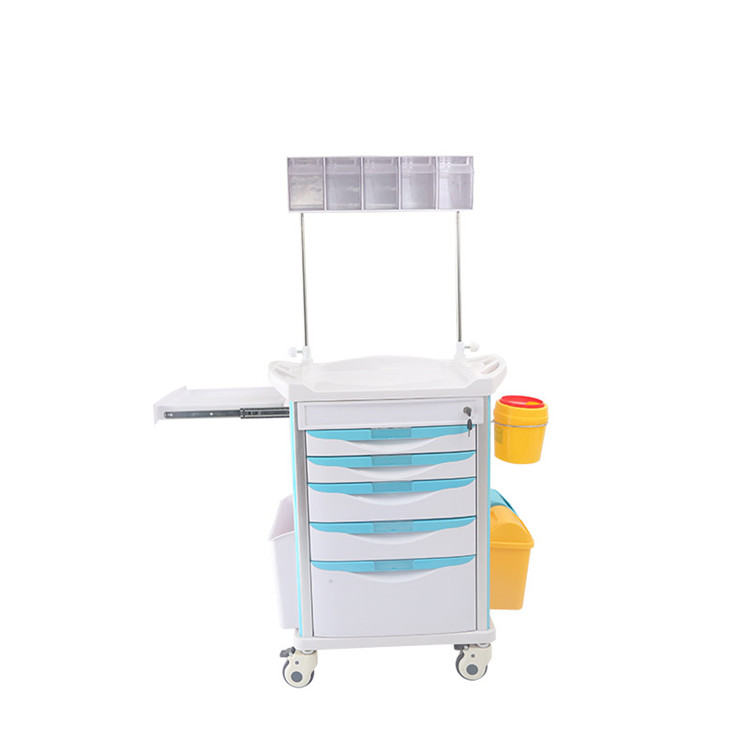
A medication trolley, by contrast, organizes drawers by patient assignment or drug classification. A typical 30-bed ward cart might carry 30 individual cassettes or bins—one per patient—each holding that patient’s scheduled oral and injectable medications for the current shift. Controlled substances (opioids, benzodiazepines) occupy a separate locked compartment, often a top drawer with an independent key or electronic lock. The worktop surface includes a medication administration record (MAR) clip, a barcode scanner holster, and sometimes an integrated waste bin for sharps.
The critical difference is sequence versus assignment. Crash cart drawers follow a universal clinical sequence that any trained responder can navigate blind—literally, in low-light code scenarios. Medication trolley drawers follow a facility-specific patient map that only the assigned nurse knows. Mixing these logics creates dangerous confusion.
Locking Systems and Security Requirements
Locking philosophy is perhaps the single sharpest distinction between the two cart types. Crash carts use breakaway seals, external hasp locks, or quick-release latches that any staff member can open in under two seconds without a key. The rationale is simple: during a code blue, the responding team may include personnel who have never seen that specific cart before. Every second spent fumbling for a key is a second without chest compressions or defibrillation. Many facilities use a numbered tamper-evident seal that is checked during daily inspection—if the seal is intact, the cart is stocked and ready.
Medication trolleys require the opposite: robust, multi-point central locking that prevents unauthorized access to controlled drugs between rounds. A central locking system engages all drawers simultaneously with a single key turn or electronic code. In our production experience, the most requested configuration for general ward medication trolleys is a five-drawer cart with a central cam lock plus a separate keyed compartment for Schedule II narcotics. Some facilities now specify electronic locking with audit-trail logging to satisfy pharmacy compliance requirements.
We once had a distributor in Southeast Asia order 200 “crash carts” with central locking because the hospital’s pharmacy department insisted on it. Within three months, the emergency department reported two delayed code responses because nurses could not find the key during night shifts. The hospital ended up replacing every ED cart with breakaway-seal units. The lesson: locking must match the clinical scenario, not the administrative preference.
Anesthesia carts occupy a middle ground: they require dual-locking mechanisms (per DSI Direct’s 2025 selection guide) because they store potent anesthetic agents that demand security, yet must be accessible within seconds during an airway emergency. This dual requirement is why anesthesia trolleys are specified as a distinct category rather than repurposed from either standard medication or crash cart designs.
Material Selection: ABS Polymer vs Stainless Steel
The two dominant construction materials for ward carts are ABS (acrylonitrile butadiene styrene) polymer and austenitic stainless steel (typically grade 304 or 316). Each carries distinct advantages depending on the clinical environment, and the choice directly affects infection control outcomes, cart weight, and total cost of ownership.
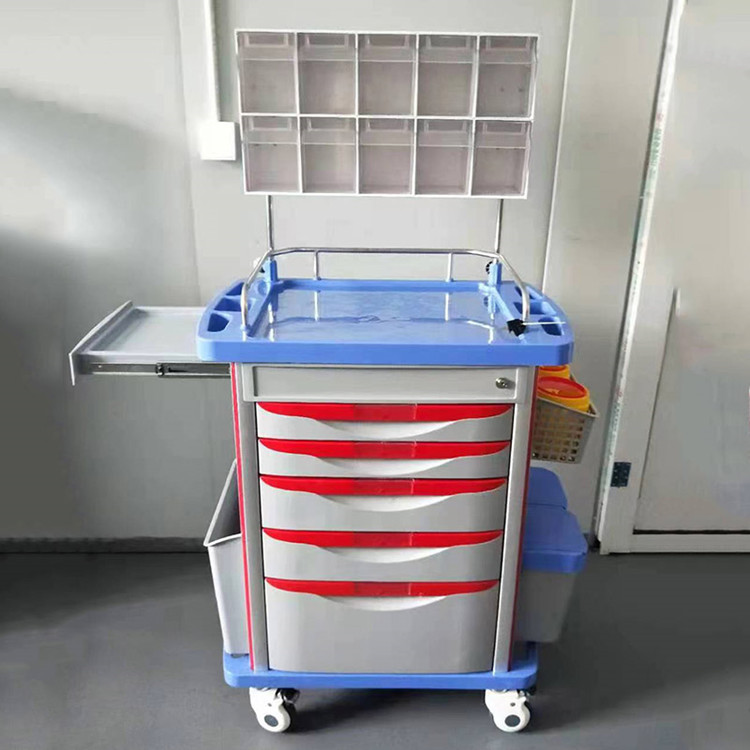
ABS polymer carts are lightweight (typically 25-35 kg fully loaded versus 45-60 kg for steel equivalents), maneuver easily through narrow ward corridors, and accept integral color coding during molding—no painting or labeling required. The smooth, non-porous ABS surface resists most hospital disinfectants and does not corrode. For general wards, pediatric units, and outpatient clinics where carts are pushed long distances multiple times per shift, ABS reduces nurse fatigue and noise.
Stainless steel carts dominate in ICUs, emergency departments, and operating theatres. Research from the University of Milan’s Department of Food, Environmental and Nutritional Sciences confirmed that austenitic stainless steel exhibits the lowest microbial adherence among all tested hospital cart materials—outperforming anodized aluminium, painted steel, chrome-plated steel, and polymers including polystyrene and Corian. The material resists scratching, does not develop cavities or cracks that harbor pathogens, and withstands aggressive chloride-based disinfectants without surface degradation.
However, DSI Direct’s February 2026 analysis notes that 304 stainless steel has a critical pitting temperature of 23.5 degrees Celsius—within the standard hospital operating range of 22-26 degrees Celsius—when chloride-containing cleaners are used repeatedly. In high-humidity environments or facilities using sodium hypochlorite disinfection protocols, 316 grade steel (with molybdenum addition) is the safer specification. For most general ward applications where quaternary ammonium disinfectants are standard, 304 grade performs adequately over a 10-15 year service life.
Color Coding and Visual Management Systems
Color coding serves different functions in each cart type. In medication trolleys, color identifies drug class or patient group: a common scheme uses red drawers for controlled substances, blue for oral medications, yellow for injectables, and green for IV supplies. Some facilities assign a unique cassette color per ward or per patient room number, enabling nurses to verify they are accessing the correct patient’s medications at a glance. The color is molded into the ABS drawer front or applied as a powder-coat finish on steel carts.
In crash carts, color coding follows resuscitation priority rather than drug class. The American Heart Association’s ACLS framework and most national resuscitation councils standardize drawer labels: red for cardiac medications (epinephrine, atropine, amiodarone), blue for airway equipment, yellow for IV access supplies. The countertop defibrillator is universally identified by its size and position rather than color, but many facilities add a red “CRASH CART” banner and reflective striping to the cart exterior so it is instantly identifiable from across a crowded ward.
From a manufacturing standpoint, ABS carts hold a decisive advantage here: color is integral to the polymer, so it cannot peel, fade, or be stripped by disinfectant wipes. Painted or labeled steel carts require periodic re-marking, and in our experience, faded labels on a crash cart create exactly the ambiguity that resuscitation protocols are designed to eliminate.
Department-by-Department Selection Guide
The following table summarizes our recommended cart specification by clinical department, based on the functional requirements discussed above. This framework aligns with the selection criteria published in DSI Direct’s November 2025 Medical Cart Selection Guide.
| Department | Primary Cart Type | Locking | Material | Key Configuration |
|---|---|---|---|---|
| General Ward | Medication Trolley | Central cam lock + narcotic compartment | ABS polymer | 30-patient cassettes, MAR clip, barcode scanner mount |
| ICU / Critical Care | Crash Cart + Medication Cart | Breakaway seal (crash); electronic lock (med) | 316 Stainless Steel | Defibrillator/monitor top, 5-drawer ACLS layout, suction mount |
| Emergency Department | Crash Cart (multiple) | Breakaway / quick-release | 304 or 316 SS | Pediatric + adult configs, Broselow tape, IO drill |
| Operating Theatre | Anesthesia Trolley | Dual-lock mechanism | ABS + SS frame | Customizable dividers, airway equipment, anesthetic agents |
| Pediatric Ward | Pediatric Medication Trolley | Central lock + child-resistant | ABS polymer | Weight-based dosing guides, smaller cassette size, bright colors |
| Isolation Unit | Isolation Cart | Minimal (PPE access) | Microbe-resistant polymer | PPE storage, ABHR mount, dedicated per room |
Two procurement principles emerge from this matrix. First, most departments need both cart types—a medication trolley for routine drug rounds and a crash cart for emergency response. Budgeting for only one creates either a security gap or a resuscitation gap. Second, material selection should follow the infection-risk profile of the department, not a one-size-fits-all policy. A general ward with standard quaternary ammonium cleaning does not need 316 steel; an ICU using hypochlorite protocols should not accept 304.
Infection Control and Cleaning Protocols
Every cart in a hospital is a potential fomite. Alberta Health Services’ 2026 Infection Prevention and Control guideline specifies that clinical carts must have solid, smooth, non-absorptive, non-porous surfaces that can be cleaned with an approved disinfectant. The guideline explicitly warns against repurposing equipment with damaged surfaces, because cracks and chips become microbial reservoirs that standard wiping cannot address.
The stakes are quantifiable. DSI Direct’s 2026 material analysis reports that corroded or rough hospital surfaces can harbor microbial loads up to 4.3 x 10^6 CFU/cm2—densities that standard disinfectants cannot reliably eliminate. This is why surface integrity matters more than material brand: a scratched ABS cart is as dangerous as a pitted steel one. Facilities should inspect cart surfaces during every weekly audit and retire any unit showing visible cracking, pitting, or delamination.
For medication trolleys, cleaning frequency is typically once per shift (every 8-12 hours) plus spot-cleaning after any spillage. Crash carts require cleaning after every use and verification during the daily seal-check inspection. In practice, this means crash carts in busy emergency departments may be cleaned 3-5 times per week, making chemical resistance a higher priority than in a general ward where the same cart might be wiped down once daily.
Our manufacturing recommendation: specify carts with welded (not riveted) joints, removable drawer liners for autoclaving, and casters with sealed bearings that tolerate immersion cleaning. For facilities standardizing a fleet across multiple departments, our guide to medical trolley fleet standardization covers how to balance department-specific needs with procurement efficiency.
Conclusion
The medication trolley vs crash cart decision is not a matter of preference—it is a matter of clinical physics. One cart is engineered to keep drugs locked and organized during predictable routines; the other is engineered to surrender its contents in seconds during unpredictable emergencies. Specifying the wrong type, or attempting to merge both functions into a single unit, creates measurable risk: delayed defibrillation, narcotic diversion, or audit failure.
Key Takeaways:
- Purpose dictates design: Medication trolleys optimize for security and routine efficiency; crash carts optimize for speed and universal accessibility. Never substitute one for the other.
- Locking must match the scenario: Central locks for controlled drug storage; breakaway seals for emergency access. Anesthesia carts require dual-locking to satisfy both demands.
- Material follows infection risk: ABS polymer suits general wards (lightweight, integral color, chemical-resistant); stainless steel (304 or 316) suits ICUs and EDs where microbial resistance and durability are paramount.
- Standardize layout, customize configuration: Adopt a universal drawer sequence for crash carts across all departments; tailor medication trolley cassette counts and colors to each ward’s patient census.
If you are specifying ward carts for a new facility or refreshing an aging fleet, our team at Sanyang Medical manufactures both ABS and stainless steel medical trolleys to CE and ISO 13485 standards, with OEM customization for drawer count, locking type, and color scheme. For emergency cart setup details, see our emergency crash trolley setup checklist, and for theatre-specific guidance, our anesthesia trolley organization guide covers dual-lock configurations in depth.
Frequently Asked Questions
Can a medication trolley be used as a crash cart in a small clinic?
No. Medication trolleys lack the quick-access locking, standardized ACLS drawer sequence, and countertop space for a defibrillator that resuscitation protocols require. Small clinics should keep a dedicated compact crash cart sealed and inspected separately from the daily medication cart.
How often should a crash cart be inspected and restocked?
Most hospital policies mandate a daily seal-check plus full content inspection after every use. Expired medications and depleted supplies must be replaced immediately. The tamper-evident seal number is logged each shift to confirm the cart has not been accessed.
What is the typical service life of an ABS medication trolley versus stainless steel?
ABS carts typically serve 8-12 years with routine cleaning; stainless steel carts last 15-20 years or more. However, surface damage (cracking in ABS, pitting in steel) can shorten either lifespan if inspection protocols are neglected.
Do crash carts need to comply with IEC 60601-1?
The cart itself does not, but the defibrillator/monitor mounted on it must comply with IEC 60601-1 and IEC 60601-2-4. Custom cart designs integrating powered components (charging docks, lighting) may trigger IEC 60601-1 evaluation for the assembly.
What color coding standard applies to medication trolley drawers?
No single international standard mandates specific colors. Most facilities adopt national pharmacy society recommendations or internal policy. Common schemes: red for controlled substances, blue for oral meds, yellow for injectables, green for IV supplies.
You May Also Like...

Infant Bassinets and Baby Trolleys: Specifying for Maternity Units
A maternity unit buys infant bassinets in small numbers and uses them continuously. The cot...

Gas Outlet Colour Coding and Pin Index: What Medical Equipment Importers Must Check
Medical gas systems are built on a simple principle: it must be impossible to connect...

Blood Donation Chairs: Specifying Seating for Donor Safety and Compliance
Blood establishments face a seating problem that ordinary furniture cannot solve: donors sit for 15...