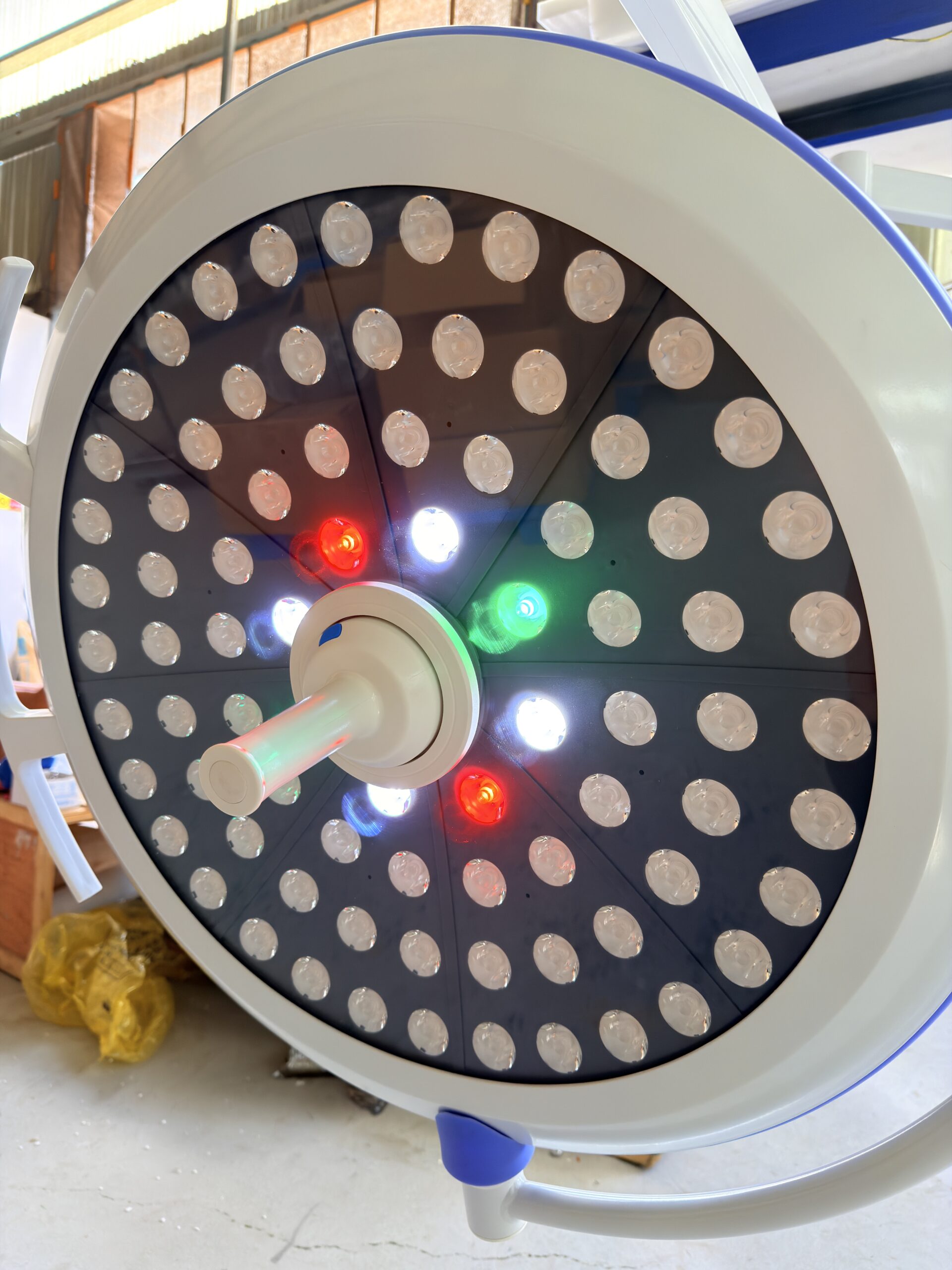

Executive Summary
A procedure-by-procedure guide to surgical light illuminance per IEC 60601-2-41: lux ranges, CRI, color temperature, and shadow dilution for every surgical discipline.
Every hospital procurement team we work with asks the same question within the first five minutes: “How many lux do we actually need?” The answer is never a single number. A cardiac surgeon working inside a narrow mediastinal cavity needs a fundamentally different light field than a dermatologist excising a superficial lesion under the same ceiling. Yet most specification documents we review copy a generic “160,000 lux” line from a competitor brochure and call it done. That single-number approach wastes budget on procedures that never need peak output and, worse, leaves deep-cavity teams fighting shadows at the bottom of a 25-centimeter wound.
The problem is not a lack of data. IEC 60601-2-41, the international standard governing surgical luminaires and diagnostic lights, defines precise boundaries for illuminance, color temperature, color rendering, and shadow behavior. What is missing is a practical translation of those boundaries into procedure-specific guidance that a procurement officer or biomedical engineer can drop straight into a tender document. That is exactly what this article delivers.
If you are building a specification from scratch, our LED surgical light buying guide walks through the full evaluation framework. Here, we focus specifically on the illuminance axis: what the standard demands, what each surgical discipline actually needs, and where buyers most commonly get it wrong.

IEC 60601-2-41 at a Glance: The Numbers That Govern Your Specification
The current edition, IEC 60601-2-41:2021 (Edition 3), sets the particular requirements for basic safety and essential performance of surgical luminaires and luminaires for diagnosis. It does not prescribe a single lux value for every operating room. Instead, it defines an envelope within which manufacturers must operate and within which buyers must select. The central illuminance measured at a 1-meter reference distance along the light axis must fall between 40,000 lux and 160,000 lux. Below 40,000 lux, the luminaire cannot legally be marketed as a surgical light in IEC-harmonized jurisdictions. Above 160,000 lux, the standard considers the output a thermal and photobiological hazard to exposed tissue.
Color rendering index Ra must sit between 85 and 100. Correlated color temperature after filtration must land between 3,500K and 6,700K. The homogeneity ratio, expressed as d50 divided by d10, must exceed 0.5, meaning the diameter at which illuminance drops to 50% of center must be at least half the diameter at which it drops to 10%. Shadow dilution testing requires the luminaire to maintain no less than 10% of its central illuminance when a standardized obstruction simulates a surgeon’s head or hand. And in a power interruption, backup illumination must restore within 5 seconds at no less than 50% of the previous intensity and never below 40,000 lux.
Here is the mistake we see in roughly half the tender documents that cross our desk: the buyer writes “minimum 160,000 lux” as if peak output were a quality marker. It is not. IEC 60601-2-41 sets 160,000 lux as the ceiling, not the target. Specifying maximum output for every room means your surgeons will spend entire cases dialing the intensity down, and your energy and thermal load will run higher than necessary for superficial work.
These parameters are not independent. As RIMSA’s technical documentation notes, pushing illuminance to its extreme can diminish CRI if the LED array is not spectrally optimized. Cooler color temperatures improve perceived brightness but erode color fidelity, while warmer temperatures enhance Ra at the cost of depth visibility. A well-engineered luminaire balances all three across its dimming range rather than hitting a peak number on one axis.

Illuminance Requirements by Surgery Type: A Graded Reference Table
The standard gives you the envelope. Clinical practice determines where within that envelope each procedure lives. Based on published guidance from surgical lighting manufacturers and the procedural categories recognized in IEC 60601-2-41’s scope, the following table maps common surgical disciplines to their typical working illuminance ranges, color temperature preferences, and shadow-management priorities. These are not arbitrary numbers; they reflect the geometry of the wound, the depth of the cavity, and the color-discrimination demands of the tissue involved.
| Surgery Type / Discipline | Typical Working Illuminance | Preferred CCT | Key Lighting Priority |
|---|---|---|---|
| Deep-cavity (cardiac, thoracic, spinal) | 120,000 – 160,000 lux | 4,500 – 5,000K | Maximum shadow dilution; depth penetration into cavities 20-30 cm below surface |
| Orthopedic / joint replacement | 100,000 – 160,000 lux | 4,000 – 5,000K | High intensity with wide field for deep bony cavities; strong shadow management |
| General / abdominal surgery | 80,000 – 130,000 lux | 4,000 – 4,500K | Balanced output with adjustable spot size; versatile across procedure mix |
| Neurosurgery / microsurgery | 80,000 – 120,000 lux | 4,500 – 5,500K | High CRI (Ra ≥ 95, R9 ≥ 90) for vascular differentiation; minimal heat |
| Obstetric / gynecological | 60,000 – 100,000 lux | 3,500 – 4,500K | Moderate intensity; warm-neutral tone for tissue assessment |
| Superficial / minor surgery / wound care | 40,000 – 80,000 lux | 3,500 – 4,000K | Lower intensity sufficient; emphasis on CRI accuracy over raw output |
| Examination / diagnostic procedures | Below 50,000 lux | 3,500 – 4,000K | Procedure-light class; simpler optics, no deep-cavity shadow dilution needed |
Notice the gradient. Deep-cavity cardiac and thoracic procedures sit at the top of the IEC range because the surgeon is working 20 to 30 centimeters below the skin surface, where the inverse-square law and the surgeon’s own torso conspire to starve the field of photons. Orthopedic work demands similar intensity but across a wider field diameter, because joint replacements expose broad bony surfaces rather than narrow channels. General surgery occupies the middle band: the procedural mix in a typical general OR spans everything from laparotomy to hernia repair, so adjustable spot size matters more than peak lux.
At the bottom of the table, examination and diagnostic procedures fall below the surgical-light class entirely. These units, often called procedure lights, cap around 50,000 lux and use simpler optical systems that do not manage deep-cavity shadows. Specifying a 160,000-lux surgical head for a dermatology clinic is like buying a Formula 1 car for school runs. The capital cost, the thermal management, the maintenance burden, all scale with output you will never use.
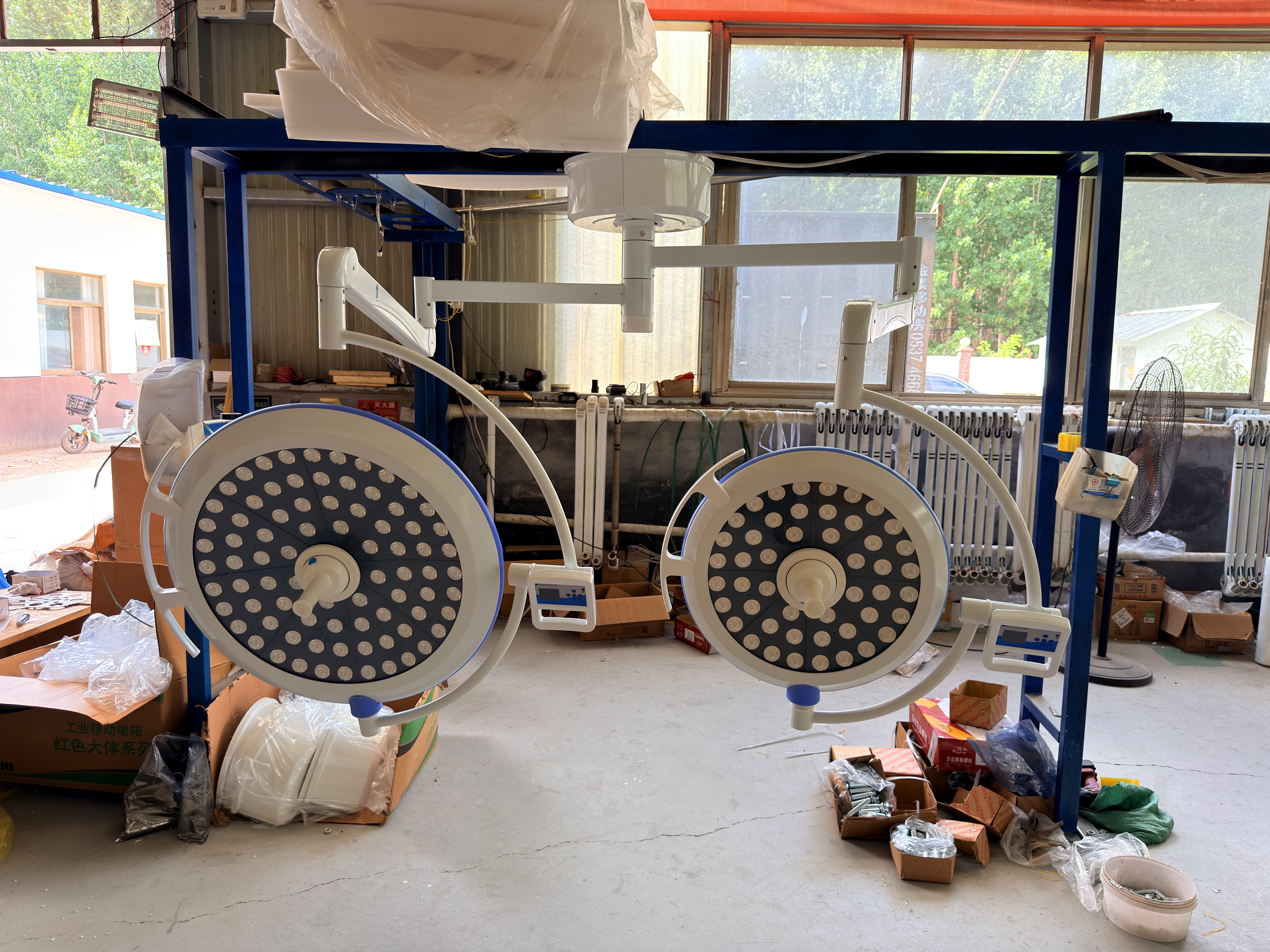
Color Temperature and CRI: Why Lux Alone Tells You Almost Nothing
A buyer who specifies only lux is specifying only half the story. IEC 60601-2-41 requires Ra between 85 and 100, but the clinical difference between Ra 85 and Ra 96 is enormous when a surgeon is trying to distinguish a pale tumor margin from healthy fascia. High-end surgical lighting systems now routinely exceed 95 Ra, and the best units push R9 (saturated red rendering) above 90, which is critical for vascular surgery where the difference between an artery and surrounding tissue is a subtle shift in red saturation.
Color temperature interacts with this directly. The standard permits 3,500K to 6,700K, but most surgical teams cluster around 4,000K to 5,000K. Below 4,000K, the warm cast makes blood appear darker and can mask early signs of tissue ischemia. Above 5,500K, the blue shift improves perceived sharpness but fatigues the eye over a long case and can distort the appearance of perfused versus non-perfused tissue. Cardiology and neurosurgery suites, where spectral accuracy determines whether a surgeon can differentiate a vessel from a nerve, typically lock CCT at 4,500K to 5,000K and demand Ra no lower than 95.
We had a distributor in Southeast Asia lose a hospital tender because their quoted light hit 160,000 lux but only Ra 88 at full output. The hospital’s cardiac team tested it against a competitor running 130,000 lux at Ra 96. The surgeons unanimously preferred the lower-lux, higher-CRI unit because they could see vessel boundaries more clearly. Lux wins spec sheets. CRI wins surgeries.
This interdependence is why IEC 60601-2-41 avoids imposing rigid single values and instead focuses on a balanced envelope. When you write your specification, demand that the manufacturer report CRI and CCT at the illuminance level your surgeons will actually use, not only at maximum output. Some LED arrays shift color temperature by several hundred kelvin as they dim, and a unit that reads Ra 96 at 160,000 lux may drop to Ra 89 at 60,000 lux. Our detailed analysis of this phenomenon is in our article on surgical light color rendering degradation.
Shadow Dilution and Uniformity: The Physics Behind the d50/d10 Ratio
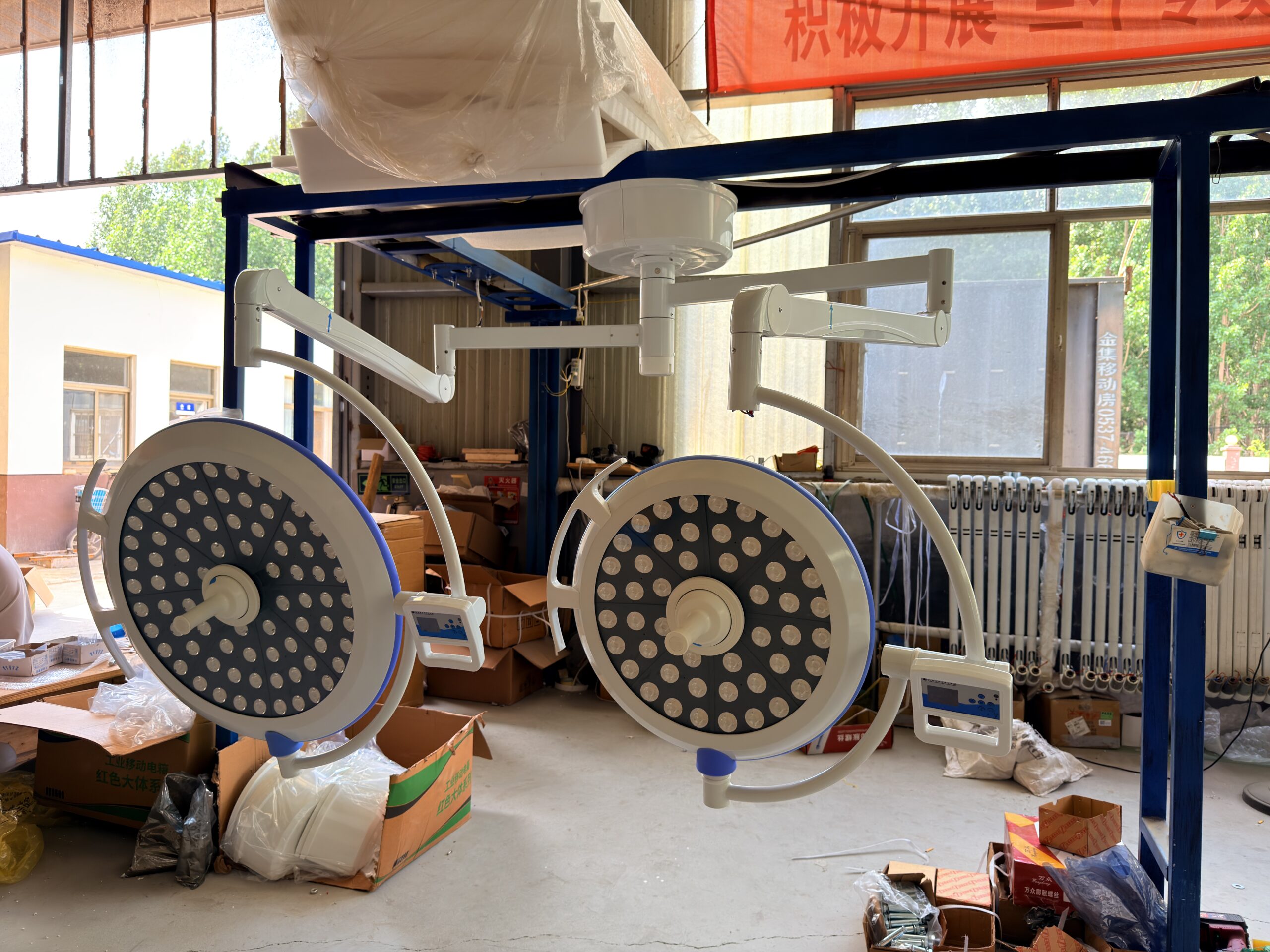
The word “shadowless” in surgical lighting is aspirational, not literal. No overhead system eliminates shadows entirely. What a well-designed luminaire does is dilute them: by distributing light sources across a wide head diameter and aiming them from multiple angles, the system ensures that when the surgeon’s hand blocks one ray path, dozens of others still reach the field. IEC 60601-2-41 quantifies this with two tests. First, the homogeneity ratio d50/d10 must exceed 0.5, confirming that the light field does not collapse into a hot center surrounded by darkness. Second, with a standardized obstruction in place, the luminaire must still deliver at least 10% of its unobstructed central illuminance.
High-end systems now achieve shadow dilution rates approaching 98%, meaning the obstructed field retains nearly the same lux as the open field. But here is the geometric limit that no marketing brochure will tell you: shadow dilution works for surface and moderate-depth procedures. Once the surgical field extends 20 to 30 centimeters into the body, the surgeon’s torso and arms occupy the entire cone between the overhead light and the tissue. No amount of multi-angle ray distribution helps when the light source is fully occluded. This is why deep-cavity teams increasingly supplement overhead luminaires with lighted retractors or in-cavity LED systems.
The practical implication for procurement: if your case mix includes a high volume of deep-cavity cardiac, thoracic, or spinal work, specify not only peak lux but also the shadow dilution percentage measured per IEC 60601-2-41, and budget for adjunctive in-cavity lighting. A 160,000-lux head with poor shadow dilution geometry will underperform a 120,000-lux head with superior multi-lens optics in every procedure where the surgeon’s hands are in the beam path.
Surgeon Fatigue, Glare, and the “More Lux Is Better” Myth
A peer-reviewed review published in the NIH’s PMC archive (PMC7305019) makes the point bluntly: a consistently applied light source that is too intense causes glare, washes out detail, and mitigates contrast. The relationship between illumination and visualization is not linear. It is an inverted curve where both insufficient and excessive lux degrade surgical performance. The same review notes that OR lights are adjusted on average every 7.5 minutes during a case, and that 50% of previously sterile light handles were found to foster bacterial growth, a contamination vector directly proportional to how often the team touches the fixture.
The fatigue dimension is equally underappreciated. Halogen-era surgeons used dark cloth drapes to shield their eyes from glare when looking up from the field. Modern LED systems eliminated most infrared heat, but they did not eliminate the visual adaptation problem. When a surgeon looks from a 140,000-lux field into ambient OR lighting at 500 lux and back again, the pupil must re-adapt. Over an eight-hour case list, that repeated adaptation accumulates into measurable eye strain and slower re-acquisition of fine detail. Specifying a light with a wide, smooth dimming range and a homogeneous field (d50/d10 well above the 0.5 minimum) reduces the adaptation penalty because the surgeon can run the minimum lux that still provides adequate contrast rather than oscillating between extremes.
The human cost of getting this wrong is not theoretical. A Lifebox Foundation survey of 100 surgeons across 39 countries found that 18% had direct experience of poor lighting contributing to negative patient outcomes, while 32% reported delayed or cancelled operations due to lighting failures. These are not developing-world-only statistics. The survey included well-resourced facilities where the lighting was technically functional but poorly specified for the procedure being performed.
How to Specify Illuminance in Your Procurement Document
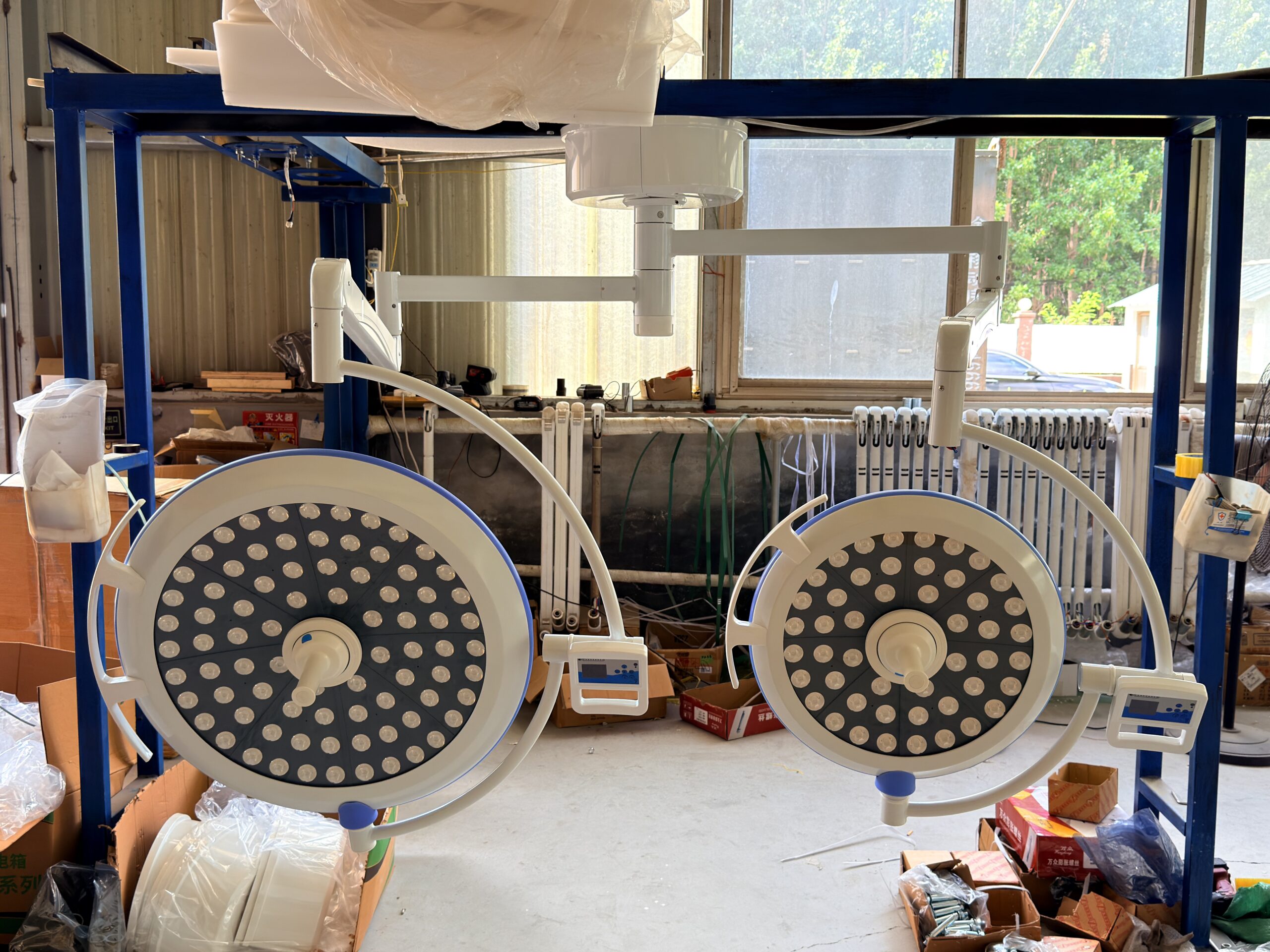
Based on the patterns we see across hundreds of tender documents, here is a specification framework that avoids the common traps. First, do not write a single lux number. Write a range per room or per procedure category, referencing the table above. Second, require the manufacturer to report Ec (central illuminance), d10, d50, d50/d10 ratio, Ra, R9, and CCT at three dimming points: 100%, 60%, and 30% output. This exposes units whose color shifts or CRI drops at lower settings. Third, specify shadow dilution performance as a percentage measured per IEC 60601-2-41 with the standard obstruction mask, not a marketing claim of “shadowless.”
Fourth, include the backup requirement verbatim from the standard: restoration within 5 seconds at no less than 50% of previous intensity and never below 40,000 lux. Fifth, if your facility runs mixed disciplines in a single OR, specify adjustable color temperature across at least 3,500K to 5,000K rather than a fixed CCT. Sixth, demand that the light field diameter be stated at the working distance your ceiling height dictates, typically 1 to 1.5 meters from the light face. A unit that produces a 25-centimeter field at 1 meter is useless for open abdominal surgery even if its center lux reads 160,000.
Finally, factor in the total cost of ownership, not just the purchase price. LED arrays degrade over tens of thousands of hours, and the illuminance and CRI you measured at commissioning will drift. Our breakdown in surgical light maintenance and TCO covers the service intervals, LED replacement economics, and calibration schedules that determine whether your specification still holds true in year five. For a complete product range that meets these IEC requirements across every discipline, review our surgical lights product line and request a procedure-matched quotation.
Conclusion
Surgical light illuminance is not a single-number decision. It is a multidimensional specification where lux, color temperature, CRI, shadow dilution, and field geometry must be matched to the procedural reality of each operating room. IEC 60601-2-41:2021 gives you the legal envelope: 40,000 to 160,000 lux, Ra 85 to 100, CCT 3,500K to 6,700K, d50/d10 above 0.5, and shadow maintenance above 10%. Your job as a buyer is to select the right operating point within that envelope for each surgical discipline your facility serves.
Key Takeaways:
- IEC 60601-2-41 sets 40,000-160,000 lux as the legal range, not a target. Deep-cavity surgery needs the upper band; superficial and exam work needs the lower band or a procedure-light class unit.
- CRI and color temperature matter as much as lux. Demand Ra and R9 data at your actual working dimming level, not only at maximum output.
- Shadow dilution has geometric limits. For cavities deeper than 20 cm, supplement overhead luminaires with in-cavity lighting regardless of how high the head’s lux rating is.
- Specify ranges, not single numbers, and require performance data at multiple dimming points to expose color shift and CRI degradation.
If you are preparing a tender or upgrading an existing OR suite, our engineering team can match illuminance specifications to your exact procedure mix. Contact Sanyang Medical for a procedure-by-procedure lighting assessment and quotation.
Frequently Asked Questions
What is the minimum lux required for a surgical light by international standard?
IEC 60601-2-41 requires a minimum central illuminance of 40,000 lux at a 1-meter reference distance. Below this threshold, a luminaire cannot be classified or marketed as a surgical light in IEC-harmonized regulatory jurisdictions.
Do all operating rooms need 160,000 lux?
No. 160,000 lux is the maximum permitted by IEC 60601-2-41, not a requirement. Superficial procedures and examination rooms function well at 40,000 to 80,000 lux. Only deep-cavity work such as cardiac or orthopedic surgery benefits from the upper range.
What CRI should a surgical light have for vascular surgery?
For vascular and neurosurgery where tissue color differentiation is critical, specify Ra no lower than 95 and R9 above 90. The IEC minimum is Ra 85, but clinical best practice for vessel identification significantly exceeds that floor.
How does shadow dilution differ from shadow elimination?
Shadow dilution reduces shadow contrast by distributing light from multiple angles so obstructed areas still receive illumination. IEC 60601-2-41 requires at least 10% maintenance under obstruction. True elimination is physically impossible with overhead sources in deep cavities.
How often should surgical light illuminance be recalibrated?
LED output degrades gradually over tens of thousands of hours. Annual photometric verification against the commissioning baseline is industry-standard practice, with full recalibration recommended if measured Ec drops more than 10% from the original value.
Specialty surgery has different illuminance needs; the ophthalmic and ENT surgical light guide covers low-intensity requirements.
Related reading: Reading Surgical Light Photometric Specs: Patch Diameter, Focus Depth and Lux
Related reading: Patient Warming in the Operating Room
You May Also Like...

Medical Device Labelling for Export: UDI, Language and Symbol Requirements
A medical equipment label is a regulated document. It carries the manufacturer’s identity, the device...

Infant Bassinets and Baby Trolleys: Specifying for Maternity Units
A maternity unit buys infant bassinets in small numbers and uses them continuously. The cot...

Gas Outlet Colour Coding and Pin Index: What Medical Equipment Importers Must Check
Medical gas systems are built on a simple principle: it must be impossible to connect...