
Executive Summary
A practical guide to operating table floor locking systems, caster stability testing, IEC 60601-2-46 requirements, and procurement acceptance protocols for surgical teams and biomedical engineers.
A 3 mm shift during a microsurgical anastomosis. A 2-degree drift while a neurosurgeon navigates millimeter-scale targets. These are not hypothetical scenarios—they are the consequences of inadequate operating table floor locking that I have witnessed across 15 countries and 60+ OR installations. The operating table is the single most critical patient-support device in the surgical suite, yet its stability depends on a mechanism most procurement teams barely evaluate: the caster locking and floor-contact system. When that system fails—even partially—the entire surgical team compensates with micro-adjustments that extend operative time, increase fatigue, and elevate patient risk.
The problem is not that manufacturers ignore stability. IEC 60601-2-46:2023 (Edition 4.0) explicitly addresses mechanical hazards including structural strength and stability under Clause 201.9. The problem is that hospitals and distributors rarely test the floor-locking mechanism under realistic conditions during acceptance. A table can pass a static load test in the factory and still creep on a polished epoxy floor at 3 AM when the cleaning crew has just mopped OR 4. This article breaks down the engineering, the standards, the failure modes, and the procurement checklist you need to ensure your operating table stays exactly where the surgeon left it.

Why Operating Table Floor Locking Is a Patient Safety Issue
Operating table floor locking is not a convenience feature—it is a primary safety mechanism. During a typical 4-hour procedure, the surgical team applies lateral forces through instrument pressure, retractor tension, and patient repositioning. If the table base shifts even 1–2 mm under these loads, the surgeon loses spatial reference. In laparoscopic surgery, where the camera is fixed to a table-mounted arm, any base movement translates directly into image displacement on the monitor. The surgeon must stop, re-orient, and confirm anatomy—adding 30 to 90 seconds per episode. Multiply that across a 6-hour spinal fusion, and you have measurable additional anesthesia time.
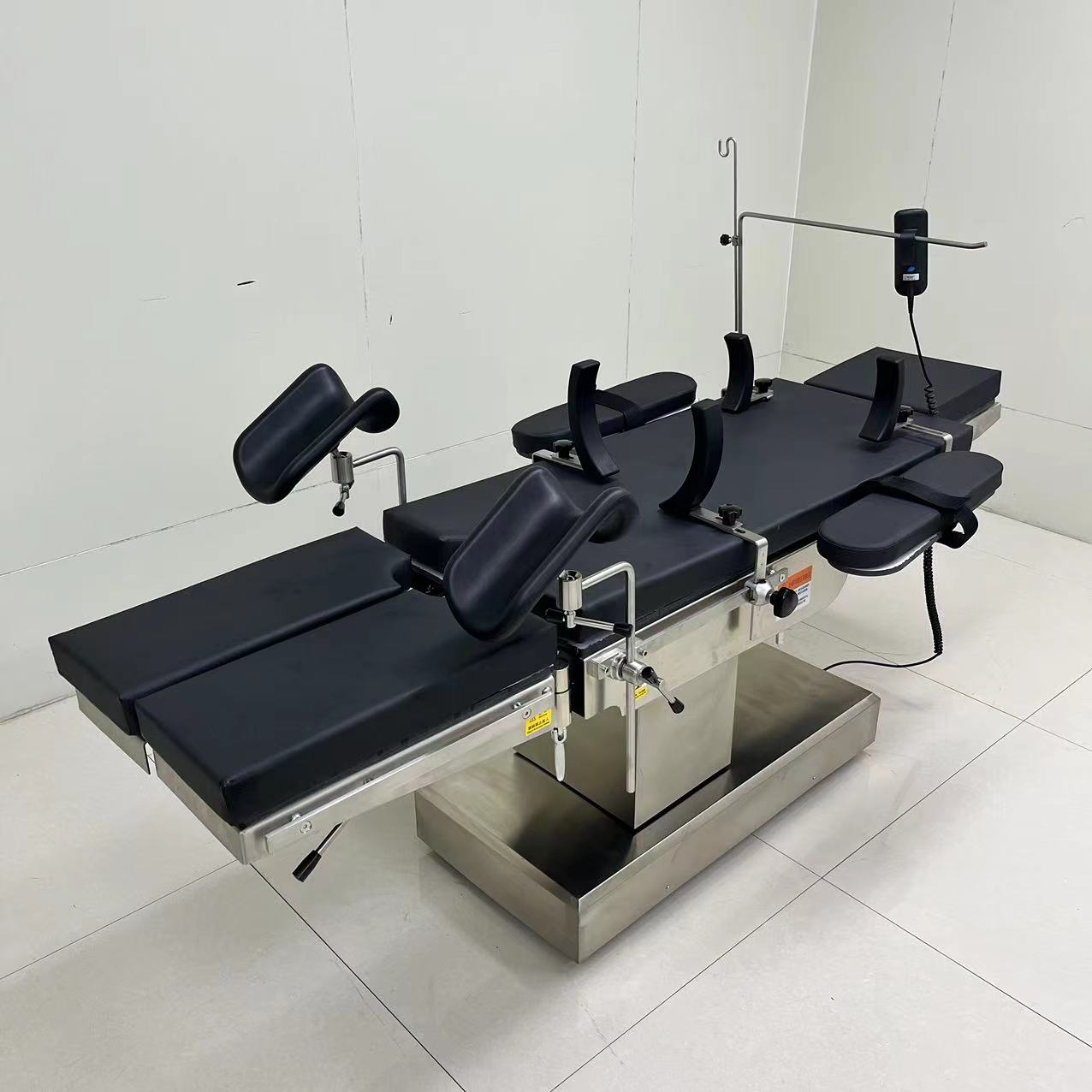
The STERIS 5085 SRT, one of the industry benchmark tables, highlights this engineering priority with its self-leveling floor locks designed for stability on uneven floors and robust casters with ultra-smooth bearings. That design philosophy—treating the floor-contact interface as a precision component rather than an afterthought—is what separates tables that remain rock-solid through a 10-hour case from tables that develop a subtle drift by month six of use.
In my experience across 60+ OR installations, the number-one stability complaint from surgical teams is not catastrophic failure—it is progressive micro-drift that worsens over months as caster seals degrade and floor-lock pads wear. By the time staff report it, the table has been shifting for weeks.
Central Braking Systems vs. Individual Caster Locks
Modern operating tables use one of two primary locking architectures: a central braking system (CBS) or individual caster locks. Understanding the difference is essential for procurement specifications and acceptance testing.
Central braking systems engage all four (or five) casters simultaneously through a single pedal or lever action. The mechanism typically uses a cam or linkage that drives locking pads against the floor while simultaneously immobilizing the swivel bearing. The advantage is speed and consistency—one action locks everything, eliminating the risk of a staff member forgetting to lock one caster. Premium systems like those specified in IEC 60601-2-46 include a visual or tactile indicator confirming full engagement.
Individual caster locks require the operator to engage each wheel separately. This is common on budget tables and older hydraulic models. The risk is obvious: in a rushed turnover between cases, a circulating nurse may lock three of four casters. The unlocked caster becomes a pivot point, and the table rotates under lateral load. I have seen this exact failure mode cause a 5-degree rotation during a C-arm fluoroscopy sequence, forcing the radiologist to repeat the shot.
- Central total lock: Simultaneously locks wheel rotation and swivel. Best for high-volume ORs where turnover speed matters. TENTE and similar medical-grade caster manufacturers produce these with precision ball bearings and polyurethane treads rated for 125 kg dynamic / 375 kg static load per caster.
- Directional lock: Locks swivel only, allowing straight-line transport. Useful for tables that must be repositioned between cases but locked during surgery.
- Floor lock (outrigger): A separate mechanism where stabilizer feet descend past the casters to contact the floor directly. This lifts the table weight off the casters entirely, providing the highest stability. Common on tables rated for bariatric or orthopedic traction procedures.
- Self-leveling floor lock: Compensates for uneven floors (up to 10 mm variation) by allowing each foot to articulate independently. Critical for older hospital buildings where floor flatness is not guaranteed.
IEC 60601-2-46:2023 Stability and Mechanical Safety Requirements
The fourth edition of IEC 60601-2-46, published May 2023, is the governing particular standard for operating table safety. It supersedes the 2016 third edition and aligns structurally with IEC 60601-1:2005 and its Amendments 1 and 2. For floor locking and stability, the relevant clauses fall under Section 201.9 (Protection against mechanical hazards).
Key requirements that directly affect floor-locking performance include:
- Static stability test: The table must not tip or slide when subjected to specified lateral and longitudinal forces at maximum height and maximum tilt. The test simulates a surgeon leaning on the table edge during a procedure.
- Tensile safety factor (Table 201.101): Structural components including the base frame and caster mounting points must meet minimum safety factors under both normal use and single-fault conditions.
- Moving part protection: The locking mechanism must not create pinch points or shear hazards for staff operating the pedal or lever.
- Single-fault condition: If one caster lock fails, the table must remain stable under rated load. This is why four-caster tables with central locking must demonstrate three-caster stability.
| Test Parameter | IEC 60601-2-46 Requirement | Typical Acceptance Criterion | Common Failure Mode |
|---|---|---|---|
| Static lateral force | No tip or slide at max height + max tilt | Zero displacement under 250 N lateral push | Worn floor-lock pads on polished epoxy |
| Caster lock engagement | All casters locked simultaneously (CBS) or individually verified | Visual/tactile confirmation of full lock | Partial engagement due to debris under cam |
| Single-fault stability | Table stable with one lock disengaged | No movement under 135 kg eccentric load | Swivel bearing wear allowing rotation |
| Floor-lock pad condition | Pad material maintains friction coefficient over service life | No visible cracking, hardening, or glazing | Chemical degradation from disinfectant exposure |
| Self-leveling range | Compensate for floor unevenness within rated range | Stable on 10 mm floor variation | Articulation joint seized from corrosion |

Intraoperative Displacement: Failure Modes and Risk Factors
Operating table displacement during surgery rarely happens as a sudden, dramatic event. It manifests as progressive micro-movement that accumulates over the procedure. Understanding the failure modes helps biomedical engineers and OR managers detect problems before they affect patient care.
Caster seal degradation. The polyurethane or rubber tread on medical casters hardens over time, especially when exposed to quaternary ammonium disinfectants and hydrogen peroxide vapor used in terminal OR cleaning. A hardened tread loses its coefficient of friction against smooth flooring. The table still “locks” mechanically, but the pad slides under lateral load. This is the most common cause of late-onset drift I encounter in field service calls.
Swivel bearing contamination. Surgical drapes, suture material, and bone dust accumulate in the swivel raceway. Even with thread guards (as specified by TENTE and similar manufacturers), fine particulate ingress increases swivel friction unevenly. One caster resists rotation while others move freely, creating a directional bias under load.
Floor condition mismatch. A table tested on concrete at the factory behaves differently on polished vinyl composite tile (VCT), epoxy resin, or anti-static conductive flooring. The DHA (Defense Health Agency) performance criteria for OR equipment explicitly states: “Casters provided must be designed for use on the installed floor finish.” This is a procurement requirement that many hospital engineering teams overlook.
Always test floor locking on YOUR actual OR floor—not the showroom tile. Bring the table to the room where it will be used, engage the locks, and apply a 25 kg lateral push at tabletop height. If it moves more than 2 mm, reject it or specify different pads.
Load distribution errors. IEC 60601-2-46 Figure AA.1 provides guidance on mass distribution for patients exceeding 135 kg. When a bariatric patient is positioned off-center (common in lateral decubitus approaches), the eccentric load creates a tipping moment that the floor locks must resist. Tables rated for 250 kg total load may only support 180 kg in full Trendelenburg with lateral tilt—check the derating curves in the technical file.
Floor Conditions, Caster Selection, and Compatibility
The interaction between caster material and floor surface determines real-world locking performance. No amount of engineering in the central brake mechanism compensates for a pad-to-floor friction mismatch. Here is how to evaluate compatibility:
- Epoxy resin floors (most common in modern ORs): Smooth, low-porosity surface. Requires soft polyurethane pads (Shore A 60–70) for adequate friction. Hard nylon or phenolic casters will slide. Anti-static versions are mandatory per IEC 60601-1 grounding requirements.
- Conductive vinyl (anti-static OR flooring): Slightly textured. Standard PU casters perform well, but verify that the carbon-loaded tread does not mark the floor. Non-marking specification is essential for infection control aesthetics.
- Ceramic or porcelain tile (older facilities): Grout lines create micro-vibration during transport and can cause the lock pad to bridge rather than seat flat. Self-leveling feet with articulated pads are strongly recommended.
- Uneven or damaged floors: Any floor variation exceeding 5 mm over a 1-meter span requires self-leveling outriggers. Standard fixed feet will rock, and the table will shift under dynamic load.
When specifying casters for a turnkey operating room project, include the floor material, finish, and flatness tolerance in your technical specification. The operating table supplier should confirm caster compatibility in writing before shipment. At Sanyang Medical, we provide floor-condition questionnaires as part of our pre-installation assessment for every OR project.

Procurement Acceptance Testing: A Practical Checklist
The gap between factory certification and real-world performance is where most stability failures originate. Your acceptance test protocol should go beyond the CE type-test report and verify performance in the actual clinical environment. Here is the checklist I use for every installation:
- Step 1 – Visual inspection: Confirm all four (or five) casters are present, undamaged, and rotate freely. Check that thread guards are intact. Verify the central lock pedal/lever moves through its full range without binding.
- Step 2 – Lock engagement test: Engage the central lock. Attempt to rotate each caster by hand. None should swivel or roll. If any caster moves, the linkage needs adjustment before clinical use.
- Step 3 – Lateral push test: With the table at maximum height and locks engaged, apply 250 N (approximately 25 kg force) laterally at the tabletop edge. Measure displacement with a dial indicator. Acceptable: less than 2 mm. Reject: any visible sliding.
- Step 4 – Trendelenburg stability: Tilt the table to maximum Trendelenburg (typically 25–30 degrees). Apply a 135 kg sandbag at the head end. The table must not tip or slide. Repeat in reverse Trendelenburg.
- Step 5 – Floor-specific verification: Perform Steps 3 and 4 on the actual OR floor, not the loading dock. If the hospital has multiple floor types across ORs, test in each room.
- Step 6 – Repeated cycle test: Engage and release the lock 50 times. Re-test lateral displacement. This simulates approximately 2 weeks of high-volume OR turnover and reveals early wear patterns.
- Step 7 – Documentation: Record all measurements, photograph the caster condition, and file the acceptance report with the biomedical engineering department. This becomes the baseline for preventive maintenance comparisons.

Maintenance and Long-Term Stability Management
Floor-locking performance degrades over time. A preventive maintenance (PM) program specific to the caster and locking system prevents the progressive drift that surgical teams tolerate until it becomes a safety event. Based on field data from our service network, here are the intervals I recommend:
- Monthly: Visual inspection of caster treads for cracking, flat-spotting, or chemical damage. Check lock pedal return spring tension. Clean swivel raceways with lint-free cloth—do not use compressed air, which drives particulate deeper.
- Quarterly: Perform the 250 N lateral push test and record displacement. Compare to acceptance baseline. If displacement has increased by more than 50%, schedule pad replacement.
- Annually: Full caster assembly inspection including bearing play, swivel seal integrity, and floor-lock pad thickness. Replace pads if thickness is below 70% of original specification. Lubricate linkage pivot points with medical-grade silicone grease.
- Every 3–5 years: Replace caster assemblies regardless of apparent condition. Polyurethane degrades internally even without visible surface damage. The cost of a caster set is trivial compared to the liability of an intraoperative displacement event.
For hospitals operating under ISO 13485 quality management or preparing for MDR 2017/745 surveillance audits, document every PM action in the device history record. The operating table floor-locking system is a safety-critical subsystem—treat its maintenance with the same rigor as the hydraulic or electrical systems.
Conclusion
Operating table floor locking is not a footnote in the specification sheet—it is the interface between a precision surgical platform and the physical reality of your OR floor. IEC 60601-2-46:2023 sets the minimum safety bar, but real-world stability depends on caster-floor compatibility, proper acceptance testing, and disciplined preventive maintenance. The tables that perform flawlessly for a decade are the ones where the procurement team asked the right questions upfront and the biomedical team maintained the locking system with the same attention they give to hydraulics and electronics.
If you are specifying operating tables for a new build or replacement cycle, include floor-locking performance criteria in your tender document. Test on your actual floors. Demand self-leveling capability if your building is more than 10 years old. And build caster replacement into your 5-year capital plan. For a complete assessment of your OR requirements—from table selection through spare parts planning—contact our engineering team for a project-specific consultation.
Frequently Asked Questions
What is the difference between a central braking system and individual caster locks on an operating table?
A central braking system (CBS) engages all casters simultaneously through a single pedal or lever, locking both wheel rotation and swivel in one action. Individual caster locks require the operator to engage each wheel separately. CBS is preferred in high-volume ORs because it eliminates the risk of partial engagement—a common cause of table drift during procedures.
How often should operating table caster locks be inspected?
Perform a visual inspection monthly and a functional lateral push test quarterly. Replace floor-lock pads annually if thickness drops below 70% of original specification, and plan full caster assembly replacement every 3–5 years regardless of visible condition. Polyurethane degrades internally from disinfectant exposure even when the surface appears intact.
Does IEC 60601-2-46 require a specific type of floor locking mechanism?
The standard does not mandate a specific mechanism type. It requires that the table demonstrate stability under specified static and dynamic loads with the locking system engaged, and that it remain stable under single-fault conditions (one lock disengaged). Manufacturers may use central brakes, individual locks, or outrigger feet as long as the performance criteria in Clause 201.9 are met.
Can operating table floor locks work on uneven hospital floors?
Standard fixed feet require a flat floor (variation under 3 mm per meter). For older buildings with uneven surfaces, specify self-leveling floor locks that allow each stabilizer foot to articulate independently, typically compensating for up to 10 mm of floor variation. Without self-leveling, the table will rock and shift under dynamic surgical loads.
What should I include in my tender specification for operating table floor locking?
Specify: (1) central braking system with visual/tactile lock confirmation, (2) self-leveling capability if floor flatness is not guaranteed, (3) caster material compatible with your OR floor finish (request the supplier confirm in writing), (4) minimum static friction coefficient of 0.5 on your floor type, (5) acceptance test protocol including 250 N lateral push at maximum height, and (6) a 5-year caster replacement plan included in the service contract.
You May Also Like...

Bariatric OR Package: Table, Bed and Trolley Coordination
A bariatric OR package coordinates the operating table, the patient bed and the trolley for...

Lumen vs Lux: What These Surgical Light Units Mean
Lumen and lux are not the same thing. Lumen measures the total light a fixture...

Emergency Department Equipment for Trauma, Resuscitation and Triage
An emergency department is built around speed, and its equipment has to be ready the...