
Executive Summary
A factory playbook for shipping medical equipment from China: ISTA 3A and ASTM D4169 packaging validation, container rain prevention, freight method selection, compliance documents, and damage claim discipline.
A distributor once sent me photos of a brand-new electric operating table that had arrived in Mombasa with a cracked base casting and a salt-water tide line across the column cover. The table had passed every factory test — IEC 60601-2-46 electrical safety, 10,000-cycle lift testing, full functional inspection. None of that mattered, because the carton had spent 38 days in a container that “rained” on it every night. When you are shipping medical equipment from China, the factory gate is only the halfway point. The journey is where margins — and reputations — are lost.
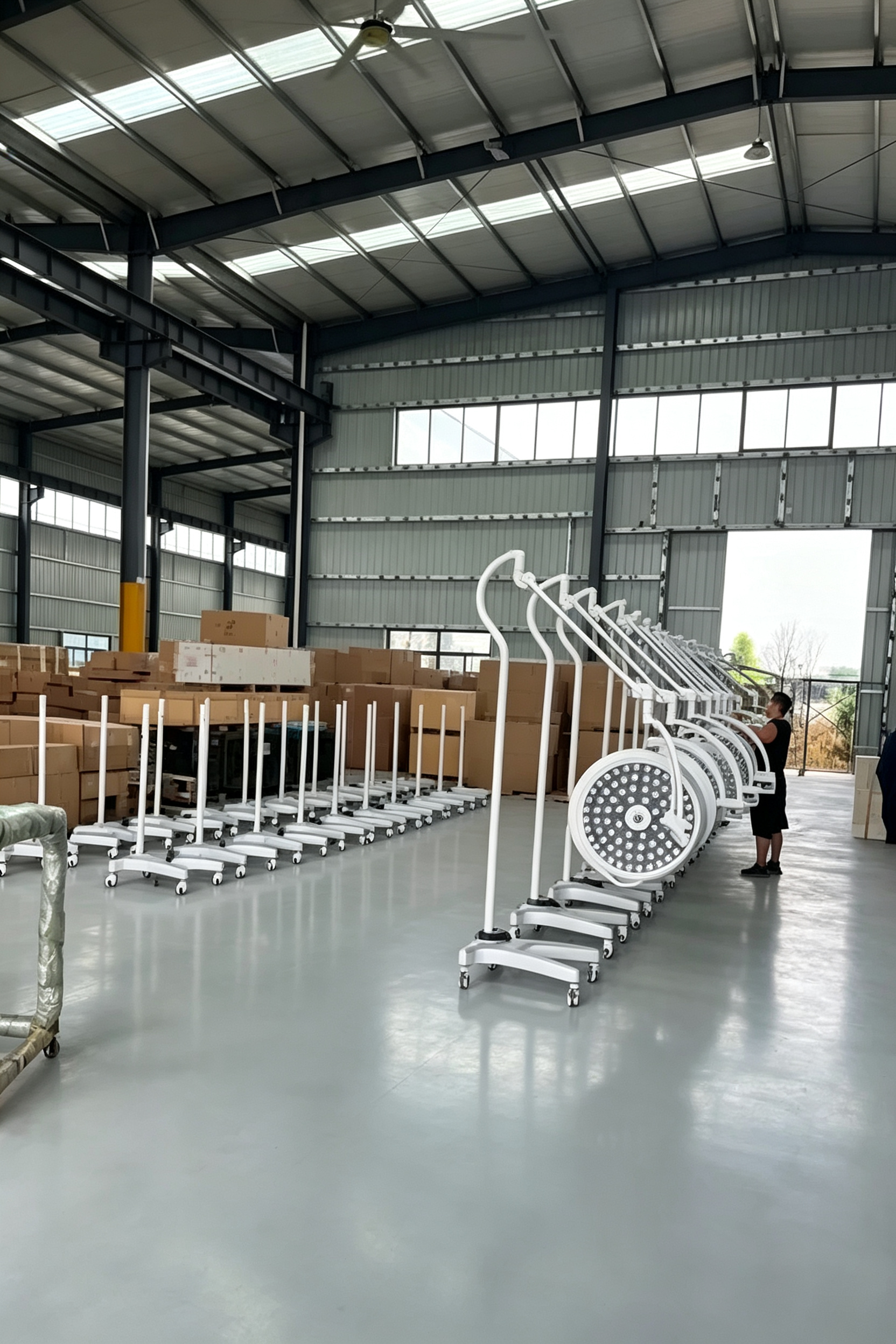
Over the past decade our team at Sanyang Medical has shipped operating tables, LED surgical lights, hospital beds, and medical pendants to more than 60 countries by sea, air, and rail. We have made — and fixed — almost every freight mistake there is to make. This guide is the playbook we now run on every export order: how to choose the freight method, engineer the packaging, defeat condensation, prepare compliant documentation, and handle damage claims without losing the customer.
If you are sourcing customized equipment, note that packaging and freight decisions should be locked in during the design stage, not after production. Buyers running OEM/ODM localization programs get the best results when the shipping plan is written into the product specification sheet alongside voltage, language, and branding requirements.
Why Shipping Is the Most Underestimated Risk in Medical Equipment Sourcing
Most buyers negotiate hard on unit price and certification, then accept whatever packing the factory offers by default. That is backwards. A 2% saving on FOB price evaporates the moment one operating table in a 20-unit container arrives with a bent side rail — replacement, air-freighted spares, and a hospital installation delay will cost you far more than the saving.
The physics are unforgiving. Roughly 250,000 containers cross the world’s oceans every day, and industry estimates put the cost of condensation-related cargo damage — so-called “container rain” — at $6–8 billion per year. Medical equipment is particularly exposed: electric operating tables contain motors, control boards, and foam pads; surgical lights contain precision optical assemblies; hospital beds combine steel frames with electronics. Corrosion, mildew on PU pads, and cracked polymer housings are the classic failure signatures we see in damage claims.
Field rule: if your supplier cannot tell you which transit test standard their export cartons are validated against, assume the cartons are validated against nothing. Ask the question before you sign the PI, not after the claim.

Step 1 — Choose the Right Freight Method for Your Order Profile
There is no universally “best” way of shipping medical equipment from China — there is only the best match between your order volume, urgency, and product fragility. Here is how we advise distributors to think about it:
| Freight Method | Typical Transit (China to major ports) | Best For | Main Damage Risks | Cost Level |
|---|---|---|---|---|
| Sea freight, FCL (20GP / 40HQ) | 18–45 days depending on route | Full container orders: operating tables, hospital beds, pendant batches | Container rain, condensation, long vibration exposure, stacking pressure | Lowest per unit |
| Sea freight, LCL | 25–50 days (adds consolidation handling) | Trial orders, 2–10 units of trolleys or spare parts | Extra handling at CFS, co-loading with unknown cargo, crush risk | Low–medium |
| Air freight | 3–8 days | Urgent tenders, surgical light heads, high-value low-volume shipments | Pressure changes, rough ramp handling, limited carton size | High (5–8x sea) |
| Rail (China–Europe) | 15–22 days | EU distributors balancing cost and lead time | Temperature swings across continental routes, shunting shock | Medium |
| Express courier (DHL/UPS/FedEx) | 3–7 days | Spare parts, control boards, hand pendants, documents | Parcel drops; use ISTA 3A-grade cartons | Highest per kg |
A word on container loading math, because it changes the freight decision more often than buyers expect. A 40HQ container gives you roughly 76 CBM of usable space; a typical export-crated electric operating table occupies about 1.8–2.2 CBM, and a hospital bed around 1.2–1.5 CBM. That means a mixed 40HQ can carry around 30–35 tables or 50+ beds — enough to drive the per-unit freight cost down to a level air freight can never approach. If your order only fills half a container, either consolidate SKUs (tables plus trolleys plus pendants ship very well together, since trolley cartons fill the void spaces between crated equipment) or wait and combine two purchase orders. Half-empty containers are not just wasteful — loosely loaded cargo shifts, and shifting cargo is how castings crack.
Two practical notes from experience. First, FCL beats LCL for anything with a motor or a gas spring. In LCL, your cartons share a container with unknown cargo — we have seen medical trolley cartons crushed under a pallet of ceramic tiles at a consolidation warehouse. Second, air freight is worth the premium for tender deadlines, but remember that most airlines limit single-piece dimensions; a 2,100 mm operating table top usually cannot fly as one piece, so the table must be designed (and packed) for on-site reassembly.
Step 2 — Engineer the Packaging, Don’t Just “Add More Foam”
Serious medical device packaging is validated, not improvised. The two transit test protocols that matter for our product category are:
- ISTA 3A — a performance test for individually packaged products up to 150 lb (68 kg) shipped through parcel systems. It simulates drops, random vibration with and without top-load compression, and environmental conditioning. This is the right reference for spare parts, control boards, and trolley-class products that may ship by courier.
- ASTM D4169 — the standard practice for performance testing of shipping containers. For medical devices, labs typically run Distribution Cycle 13 (motor freight, single package up to 150 lb) or DC-3/DC-2 variants for palletized freight, at Assurance Level II. Both ISTA 3A and ASTM D4169 are referenced in ISO 11607 and recognized by the FDA as consensus standards for device packaging validation.
- ISO 11607 — while primarily aimed at sterile barrier systems, its validation mindset (define the worst-case distribution cycle, then test against it) is exactly how non-sterile capital equipment packaging should be specified.
For heavy capital equipment like electric operating tables, our standard export specification looks like this:
- Inner protection: EPE foam blocks CNC-cut to the table’s geometry, with extra density at the base casting and column — the two highest-mass points that punch through packaging first.
- Corrosion barrier: VCI (volatile corrosion inhibitor) film wrapping all exposed steel and machined surfaces, plus sealed PE bagging of electronic modules.
- Outer carton: double-wall or triple-wall corrugated (BC-flute or heavier) rated for the stacking load of a 40HQ container, edge protectors on all vertical corners, and steel or PET strapping.
- Pallet: fumigation-free plywood or heat-treated (ISPM 15 stamped) timber; many destination ports will reject or fumigate non-compliant wood at your expense.
- Shock and tilt indicators: Shockwatch-style impact labels and tilt indicators on every crate. They cost almost nothing and transform damage claims from “your word against the carrier’s” into documented fact.
A 25 mm increase in foam density at the base casting costs about $4 per table. Replacing one cracked casting air-freighted to East Africa costs about $900 plus your credibility with the hospital. Packaging math is always this one-sided.

One more packaging detail that separates serious exporters from the rest: palletization pattern. Column-stacked cartons (aligned vertically, not interlocked) retain more compression strength over a 40-day voyage, and cartons must never overhang the pallet edge — even a 20 mm overhang cuts effective stacking strength dramatically and concentrates clamp-truck pressure on the overhanging wall. We photograph every pallet before wrapping and keep the photos on file for two years; twice, those photos have settled insurance disputes in our customers’ favor within days instead of months.
Step 3 — Defeat Container Rain: Moisture Control on Long Sea Voyages
Container rain is pure physics. A container loaded in humid southern China, crossing the equator and then cooling at night in temperate latitudes, will see its internal air temperature swing daily. When the container’s steel walls cool below the dew point of the trapped air, water condenses on the ceiling and walls — and drips onto your cargo. Cardboard loses most of its stacking strength when wet, VCI protection gets overwhelmed, and corrosion starts on any unprotected steel.
The countermeasures are well established and cheap relative to the cargo value:
- Container desiccants: calcium-chloride hanging strips (not silica gel sachets — they saturate within days on a 30+ day voyage). Size the quantity to route length and season; monsoon-season sailings from South China need roughly double the desiccant load of winter sailings.
- Dry container selection: insist on a container grade check — no floor damage, door gaskets intact, no visible rust trails that indicate prior water ingress.
- Load dry, load fast: cartons loaded in afternoon rain carry that moisture into the box. We load containers under cover and record loading photos with timestamps.
- Pallet spacing: leave airflow gaps between carton rows and the container walls; cartons pressed against the steel wall are the first to wick condensation.
- Avoid “sweating” at destination: if the container arrives in cold weather, let the cargo acclimatize before unboxing where possible — cold equipment pulled into warm humid warehouse air will condense moisture directly onto electronics.
Step 4 — Documentation, Compliance, and Insurance
Freight paperwork for medical equipment is heavier than for general cargo, and mistakes here cause customs holds that cost more than the freight itself. The core checklist we run on every shipment:
- Commercial invoice and packing list with accurate HS codes (e.g., 9402 for medical/surgical furniture, 9405 for luminaires where applicable — confirm with your broker for destination-specific rulings).
- Certificate of origin — and where an FTA applies (RCEP, China–ASEAN, China–Chile, etc.), the correct preferential origin document can cut import duty significantly.
- Regulatory certificates: CE certificate and Declaration of Conformity under MDR 2017/745 for the EU; ISO 13485 certificate for the manufacturer; IEC 60601-series test reports (60601-1 general safety, plus particular standards like 60601-2-46 for operating tables and 60601-2-41 for surgical lights) on request. Our ISO 13485 test report checklist explains what buyers should demand from any Chinese factory.
- Free-sale certificate where the destination requires it (common in the Middle East, Latin America, and parts of Africa).
- Product manual and labeling in the destination language, with UDI where required — for EU-bound equipment, see our guide on CE MDR vs FDA import requirements.
- Marine cargo insurance: Institute Cargo Clauses (A), not the carrier’s default limited liability. Carrier liability under Hague-Visby is roughly 2 SDR per kg — for a $4,000 operating table that weighs 220 kg, you would recover a small fraction of the value. Full-value ICC(A) cover typically costs a few tenths of a percent of cargo value. Never skip it.
On Incoterms: for first-time orders we generally recommend CIF or DAP so the factory manages export logistics; experienced distributors with their own forwarders often move to FOB for cost control. Avoid EXW unless you have a trusted China-side agent — under EXW you own the export declaration risk, and Chinese export customs is not a place for improvisation.

Step 5 — Receiving, Inspection, and Winning Damage Claims
The claim is won or lost in the first 48 hours after the container door opens. Train your receiving team on this sequence:
- Photograph everything before moving anything: container number and seal, the load as the doors open, each carton’s exterior, and the shock/tilt indicators.
- Note exceptions on the delivery receipt before signing — “received in apparent good order” with no exceptions almost kills a later claim.
- Unbox high-value items within 7 days even if installation is months away; most insurance policies and carrier rules have short notification windows (often 3–14 days) for concealed damage.
- Keep the packaging until the claim is settled — insurers routinely send surveyors, and discarded packaging weakens your case.
- Report to the factory with evidence immediately: photos, indicator status, carton condition. A good manufacturer will ship replacement parts or a replacement unit under insurance while the claim processes — our spare parts service exists precisely for these situations.
The distributors who almost never lose money on freight damage share one habit: they treat the shock indicator photo as a mandatory step of goods receipt, on the same level as counting cartons. It is a 10-second habit that has saved six-figure arguments.

Conclusion
Shipping medical equipment from China is not a lottery. Damage, delays, and customs holds follow patterns, and every one of those patterns has a known countermeasure: pick FCL over LCL for motorized equipment, validate packaging against ISTA 3A or ASTM D4169, load proper container desiccants against container rain, ship with ICC(A) insurance and complete regulatory documentation, and run a disciplined receiving inspection. Buyers who build these steps into their purchase specification get factory-direct pricing and first-world delivery reliability. If you are planning an order — a single tender shipment or a full turnkey operating room project — talk to our export team about packaging specs and freight options before you finalize the PI.
Frequently Asked Questions
How long does shipping medical equipment from China usually take?
Sea freight to major ports typically takes 18–45 days port-to-port depending on destination (shorter to Southeast Asia and the Middle East, longer to South America and West Africa), plus 5–10 days for export customs, consolidation, and destination clearance. Air freight is 3–8 days door-to-door. Add production lead time — for customized OEM equipment, plan on 90–120 days from design lock to arrival.
What packaging standard should I require from a Chinese medical equipment factory?
For cartons up to 68 kg shipped via parcel or express channels, require ISTA 3A validation. For heavier or palletized equipment, require ASTM D4169 testing at Assurance Level II against the appropriate distribution cycle. Also specify ISPM 15-compliant (heat-treated or fumigation-free) pallets, VCI corrosion protection for steel parts, and shock/tilt indicators on every crate.
Sea freight or air freight for operating tables and surgical lights?
For orders above roughly 3–4 cubic meters, sea freight FCL is almost always the right answer — the unit freight cost is a fraction of air. Use air freight only for urgent tender deadlines, light high-value items like surgical light heads, or replacement parts needed to keep an installation on schedule. Note that oversized items like full-length operating table tops may not fit standard air freight dimensions.
How do I prevent moisture damage during sea shipping?
Combine four measures: hang calcium-chloride container desiccant strips sized to the route and season; wrap steel components in VCI film; verify the container is dry and undamaged before loading; and keep cartons off the container walls with airflow gaps. These steps cost well under 1% of a typical container’s cargo value.
What documents are needed to import medical equipment from China?
At minimum: commercial invoice, packing list, bill of lading/airway bill, certificate of origin, and the destination market’s regulatory documents — CE certificates and MDR Declaration of Conformity for the EU, ISO 13485 certification for the manufacturer, free-sale certificates where required, and IEC 60601-series test reports on request. Your customs broker should confirm destination-specific requirements before the shipment sails.
You May Also Like...

Pricing Your Imported Equipment as a Distributor
A distributor’s price is not the factory price plus a flat markup. It is the...

Container Loading Plans: Volume and Cargo Protection
Container loading plans for medical equipment are the packing and stowage layout that decides how...

Budgeting for Installation and Training Costs
The invoice price of medical equipment is the smaller half of its cost. The larger...