
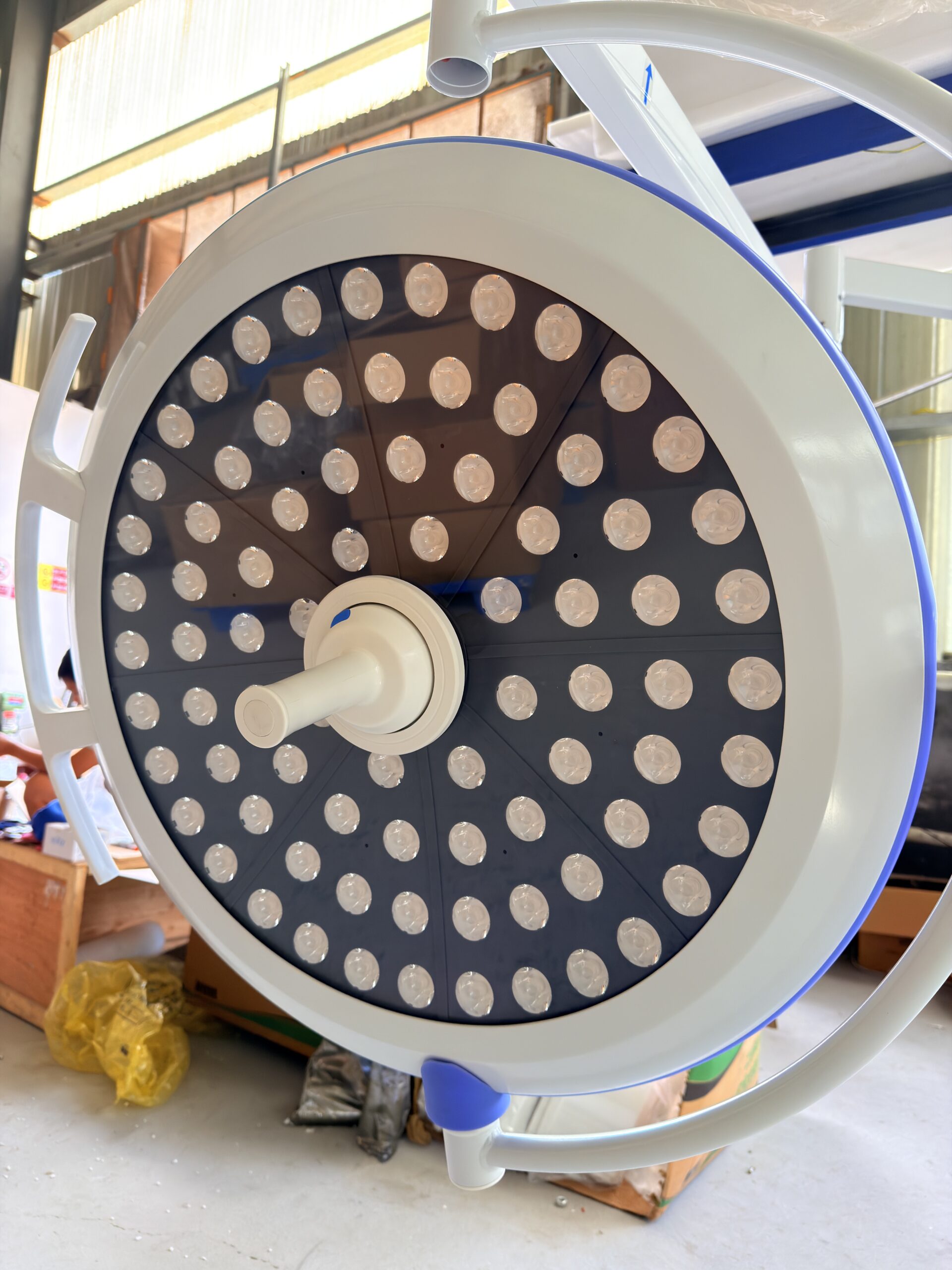

A 13-point CRI drop—from 94 to 81—at 20,000 hours. That’s the threshold where surgical light color rendering degradation stops being a specification footnote and becomes a clinical liability. I’ve sat across from a hospital biomedical engineer who had to explain to her board why a six-month-old $50K order was already producing a greenish-yellow field. The pre-production sample had passed every quality tolerance test at FOB inspection, colors crisp under the 4,300K beam. But the mass production run shipped with a different phosphor binder than the approved sample. Surgeons noticed the shift before any meter did.
The binder material—epoxy or silicone—is the silent differentiator most OEMs bury in the BOM. Epoxy costs 40–60% less and lets suppliers quote an aggressive FOB price that wins the initial tender. It also starts micro-cracking above 85°C, yellowing the phosphor layer and cratering the R9 value long before lumen output drops. When we at Sanyang Medical select Osram silicone-based phosphors for our surgical lights, we’re not just buying a component. We’re committing to publish Δu’v’ aging curves and R9 stability data at 20,000 hours—metrics that most competitors won’t share because the numbers tell an uncomfortable story. That story, and the factory-floor decisions that write it, is what this article unpacks.

How an LED Makes White Light (And How it Fails)
A light can pass L70 brightness tests yet be clinically useless from color shift alone.
A 450-460nm blue LED die sits under a cerium-doped YAG phosphor coating. Blue photons strike the phosphor layer; some get absorbed and re-emitted as a broad yellow spectrum. Your eye blends the residual blue with the new yellow — white light. The material binding that phosphor to the chip — epoxy or silicone — dictates how long this mechanism stays stable under surgical workloads. Most spec sheets never mention the binder.
OR lights run 8-10 hours continuously inside sealed heads with near-zero airflow. Junction temperature spikes when the heat sink is undersized. Past 85°C, epoxy binders begin yellowing and micro-cracking. Cracks scatter blue light unevenly, creating hot spots that accelerate further phosphor damage — a thermal runaway cycle. We engineer our aluminum heat sinks to keep junction temps below 85°C for the full 10-hour shift. Cheap lights routinely breach 100°C by hour three.
- Greenish-yellow cast on tissue: Neutral white fields take on a sickly tinge. This is the earliest and most common complaint surgeons voice — often two years before anyone pulls a spectroradiometer.
- Venous-arterial washout: The contrast between deoxygenated dark blood and oxygenated bright blood flattens. R9 degradation kills red differentiation first, long before Ra drops noticeably.
- Brightness compensation behavior: Surgeons crank intensity to maximum trying to claw back lost contrast. The light meter says output is fine. The phosphor says otherwise — more current only pumps more blue through a dying yellow layer.
- Brownish-red tissue appearance: Deep red structures and inflamed margins appear muted or brown. This directly tracks R9 falling below 70 as phosphor conversion efficiency collapses at the yellow-red boundary.
The L70 standard only measures lumen maintenance. It ignores color entirely. We’ve tested epoxy-based modules that held 82% brightness at 20,000 hours but posted a Δu’v’ shift above 0.012 — a green-yellow cast any surgeon notices immediately. Our silicone-based Osram modules hold Δu’v’ to 0.0021 across the same interval. Write Δu’v’ <0.003 at 20,000 hours into your next tender. Suppliers who cannot meet it will withdraw quietly — and that’s exactly who you want filtered out.

The Difference in Phosphors: Epoxy vs. Silicone
The binder holding the phosphor to the chip is the single greatest determinant of surgical light longevity—and the spec most suppliers will.
Every white LED in a surgical light uses the same basic architecture: a blue diode pumping photons through a yellow phosphor layer. What separates a light that holds its color for a decade from one that fails in year three isn’t the blue chip. It’s the binder material encapsulating that phosphor. Epoxy and silicone are chemically and thermally worlds apart, yet on a datasheet, both can claim ‘CRI 95’ at hour zero. The divergence happens inside the housing, under heat, over thousands of hours.
- Max junction temperature before degradation: Epoxy begins yellowing and micro-cracking at 85°C, with catastrophic breakdown above 120°C. Silicone remains optically clear and chemically stable to 150°C, tolerating brief excursions past 200°C without permanent damage.
- Luminous flux retention at 100°C, 5,000 hours: Epoxy-based modules lose over 20% of output as the binder darkens and scatters light. Silicone-based modules show less than 5% loss under identical test conditions per IES LM-80 protocols.
- Δu’v’ color shift at 20,000 surgical hours: Our accelerated aging data shows silicone modules at 0.0021—barely perceptible to the human eye. Epoxy modules drift past 0.012, producing an unmistakable green-yellow cast that surgeons will notice and complain about.
- CRI and R9 trajectory: Epoxy starts at Ra 94 and R9 85, then collapses to Ra 81 and R9 52 within 20,000 hours—below any defensible surgical standard. Silicone holds Ra above 94 and R9 above 89 across the same interval.
- Component cost multiplier: Epoxy phosphor LEDs cost 40-60% less at the BOM level. Silicone commands a 2-3x premium, which is the entire reason this conversation exists.
Visual inspection tells the same story before any spectrophotometer enters the room. Pull an epoxy-phosphor LED module after 10,000 surgical hours and you’ll see a distinct amber-brown discoloration around the chip surface—the phosphor layer is literally cooking. A silicone-phosphor module from the same batch age looks clear, with no visible yellowing. One of our engineers keeps a pair of these side-by-side in a drawer for supplier audits. It ends the debate faster than any white paper. If a manufacturer won’t send you aged-module photos, assume they have a reason.
So why do most manufacturers ship epoxy? The math is brutally simple. A surgical light BOM with epoxy LEDs saves enough per unit to drop the FOB price by a margin that wins tenders. The procurement committee sees a lower line item, the OEM books the PO, and the phosphor problem lands on the hospital’s biomed desk three years later. No supplier prints ‘epoxy phosphor’ on the quote. You have to ask. And when you ask, most won’t answer—because the answer undercuts the 50,000-hour lifespan claim printed on the same brochure. Silicone isn’t an upgrade. It’s the baseline for any light that’s expected to survive a single depreciation cycle without becoming a clinical liability.

Understanding CRI, R9, and L70 Lifespan
CRI is a snapshot; R9 degradation over time is the real threat.
If a supplier hands you a datasheet showing only initial CRI, they’re giving you half the picture. A new LED module can easily hit Ra 95, but that number plummets as phosphors break down under surgical heat loads. We’ve tested off-the-shelf budget modules that started at CRI 94 and fell to 81 after 20,000 hours of continuous operation—rendering them clinically useless long before their claimed 50,000-hour lifespan.
The binder holding the phosphor to the blue chip is what separates a surgical light that keeps its color accuracy from one that turns greenish-yellow. Epoxy-based phosphors yellow and craze at the junction temperatures surgical lights routinely reach, while silicone-based phosphors stay stable beyond 150°C. This single material choice explains why some lights lose over 15% of their CRI within 10,000 hours, and why hospitals end up replacing them three times faster than necessary.
R9—the score for saturated red rendering—gets the first hit when phosphors degrade. Deep red tissue contrast is how surgeons identify oxygenated blood, inflamed margins, and minute vascular structures. An initial Ra can look great while R9 sits at 50, but R9 erodes faster than the general index. Once R9 drops below 70, clinicians start describing the field as ‘flat’ or ‘muddy,’ even if lumen output still looks fine.
- Competitor epoxy-based module: CRI drops from 94 to 81, R9 from 85 to 52, Δu’v’ color shift >0.012 at 20,000 hours. Visual cast: noticeable green-yellow.
- Sanyang silicone-based module: CRI maintains >94, R9 >89, Δu’v’ <0.003 at 20,000 hours. Color shift remains imperceptible to the human eye.
- Design threshold: A clinically acceptable surgical light should hold CRI above 90 and R9 above 85 across its full rated service life—not just at unboxing.
L70—the industry’s go-to lifespan metric—measures only lumen depreciation, not color shift. We’ve seen budget lights maintain 80% brightness yet produce a greenish cast so severe that surgeons demanded replacement. Our internal test protocol defines end-of-life by chromatashift crossing a Δu’v’ of 0.003, because a bright light that distorts tissue color is a liability, not an asset. DOE studies back this up: color shift is a primary failure mode in 20% of installed LED luminaires, often showing up before output drops.
When you’re building a procurement case, ask for the accelerated aging graphs for both Ra and R9, not just the L70 curve. If the vendor can’t show data at 10,000 and 20,000 hours, they’re either unaware of their phosphor degradation timeline or unwilling to disclose it. Either way, that light becomes your risk.


Sanyang’s Test Data: CRI Stability Over Time
At 20,000 hours, our silicone phosphor modules hit Δu’v’ 0.0021.
We ran two modules side by side in a calibrated integrating sphere: our standard Osram silicone-phosphor surgical light engine, and a widely-sold budget epoxy-phosphor competitor unit rated L70 at 50,000 hours. Both ran continuous at 85°C ambient — the thermal reality of back-to-back 10-hour surgeries inside a sealed OR housing with limited convection. A spectroradiometer logged full spectral power distribution, Ra, R9, and CIE 1976 chromaticity coordinates every 1,000 hours. The competitor module carries zero published color shift warranty. That missing spec is exactly what fails in the OR three years into service.
- Sanyang silicone module — 0 hours: Ra 96.2, R9 93. Measured at Tj 85°C after 100-hour burn-in stabilization per IES LM-80 methodology.
- Sanyang silicone module — 20,000 hours: Ra 94.5, R9 89. Total drop of 1.8% on Ra and 4.3% on R9. Still exceeds the Ra >90, R9 >70 thresholds in most hospital procurement guidelines.
- Epoxy competitor — 0 hours: Ra 94, R9 85. Respectable initial numbers that pass a datasheet review and win bids on upfront price.
- Epoxy competitor — 20,000 hours: Ra 81, R9 52. Drop of 13.8% and 38.8%. At R9 52, deep red tissues lose definition under the beam — oxygenated and deoxygenated blood look the same.
- Sanyang silicone Δu’v’ at 20,000 hours: 0.0021. Below the 0.004 threshold where the human eye begins detecting a shift in the CIE 1976 color space.
- Epoxy competitor Δu’v’ at 20,000 hours: >0.012. Nearly six times the silicone value and triple the perceptibility threshold. The field acquires a measurable green-yellow cast.
- Clinical consequence: At Δu’v’ 0.012, subtle tissue planes blur together. A surgeon compensating with increased brightness does not fix the spectral deficiency — they simply illuminate the wrong color more intensely.
The degradation curves reveal a pattern that initial Ra alone conceals. The silicone module degrades near-linearly — predictable, slow, and clinically usable past 20,000 hours. The epoxy module cruises for roughly 6,000 hours, then enters a steep dive. R9 crashes first because saturated red rendering demands peak phosphor conversion efficiency in the 620–650 nm range, and thermal damage concentrates precisely there. By 12,000 hours, the epoxy module’s R9 had already dropped below 70 — a point where vascular contrast fades enough that surgeons begin requesting more light, unaware the CRI is the real culprit.
Conclusion
Surgical lights that maintain brightness but drift into a green-yellow cast become clinical liabilities. The phosphor binder—silicone or epoxy—determines whether your OR still meets CRI and R9 requirements five years from now. Sanyang’s Osram-based modules keep Δu’v’ shift below 0.003 at 20,000 hours, a level that ensures surgeons see tissue color accurately over the full service life.
Next time you evaluate a supplier, request the Δu’v’ color shift after 20,000 hours of accelerated aging per IES LM-80. A number above 0.005 means the light will likely lose surgical color fidelity in year three or four, forcing an unbudgeted replacement. Use that benchmark to weed out lights that only look good on day one.
Review the 20,000-hour test data and full specification sheets for our Osram-powered surgical lights. You’ll have the Δu’v’ and R9 curves needed to defend a procurement decision based on long-term color stability, not just upfront cost.
Frequently Asked Questions
What is the ideal color temperature (Kelvin) for surgery?
4,000–4,500 K is ideal for most surgical fields, providing a balanced neutral white. CRI and R9 matter more than Kelwin alone for accurate tissue differentiation. Always prioritize CRI ≥90 and R9 ≥90 over just the Kelvin number.
Does dimming an LED light affect its color rendering?
Yes, if the driver uses low-frequency PWM, dimming can cause perceptible flicker and color shift. High-frequency constant-current designs keep color stable across the dimming range. Confirm your surgical light uses flicker-free, constant-current dimming to protect color accuracy.
How can I test the CRI of my current surgical lights?
Use a handheld spectroradiometer like the UPRtek MK350S at 1 m distance to directly measure Ra and R9. Compare against a known high-CRI source if a spectrometer is unavailable. Test annually and replace lights that fall below Ra 85 or R9 80.
What CRI and R9 values should a surgical light maintain?
Spec Ra ≥ 90 and R9 ≥ 90 at delivery, and plan replacement when measurements fall below Ra 85 or R9 80. R9 (deep red) matters most for tissue differentiation under drapes and blood. Verify with a handheld spectroradiometer during annual maintenance instead of relying on visual checks.
You May Also Like...

Surgical Light Control Systems Explained: Touch Panels, Wall Controls, Sterile Handles and Integrated OR Control
A practical guide to the five surgical light control systems - touch panels, wall control...
Surgical Light Tender Specifications: The Complete Procurement Checklist
A practical checklist of the photometric parameters, certifications, and evaluation steps that belong in every...

Surgical Light Installation Requirements: Ceiling Load, Height and Coordination Guide
A practical guide to surgical light installation requirements: ceiling load and moment, clear height, arm...