
Illumination is the first spec buyers check on a surgical light, and the first place a cheap unit hides. The number printed on the datasheet is center lux, but the standard behind it covers far more: measurement distance, color rendering, shadow control and how much light survives five years of daily use.
This guide translates the IEC 60601-2-41 requirements into buyer language, with the reference numbers that separate a real surgical light from a well-lit exam room fixture.
Every threshold below is one you can verify on acceptance day with a lux meter and a tape measure.
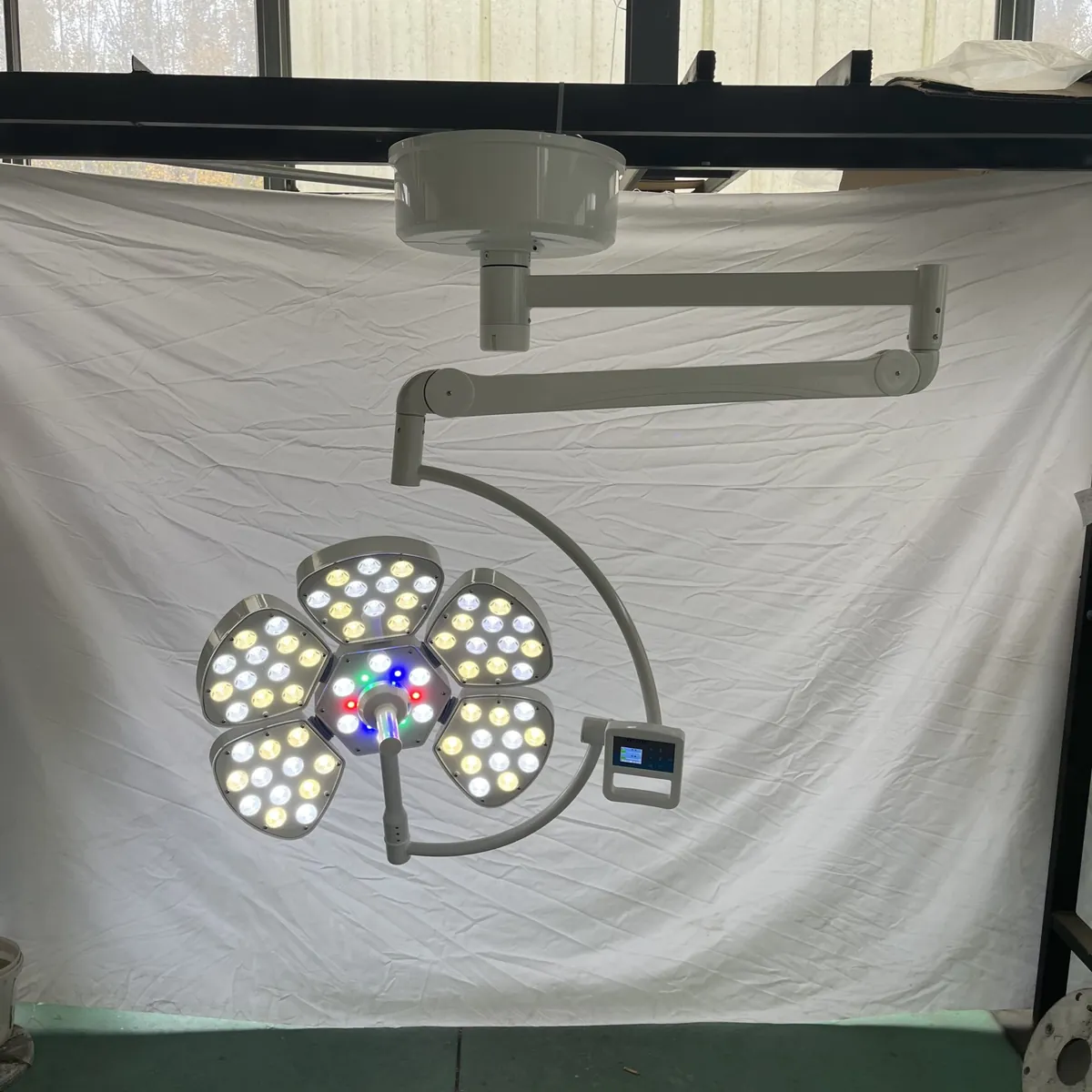
What the standard actually regulates
Surgical lights in most export markets are designed and tested against IEC 60601-2-41, the particular standard for surgical luminaires inside the broader IEC 60601 medical electrical equipment family. The standard does not hand you one brightness number; it fixes the test conditions under which every claimed number must hold: a measurement plane 1 meter below the light head, a defined operating pattern for multi-dome units, and tolerances that the delivered light must stay inside. When a supplier quotes center illuminance, the follow-up question is always “tested to which condition” — a 160,000 lux claim measured at 70 cm is not comparable to one measured at 1 m. Buyers who skip this question end up re-checking numbers after installation, when the fix is expensive. The test-report question matters most on OEM programs, which we cover in our OEM surgical light walkthrough.
Center illuminance: the numbers that matter
The standard sets a working range of 40,000 to 160,000 lux for center illumination, adjustable across that range rather than fixed at maximum. Two derived figures matter more in daily surgery. First, the light field: the diameter where illuminance falls to 10 percent of center (d10), typically 20 to 30 cm, which decides how much of the wound area stays usable. Second, depth: a deep pelvic or thoracic site needs usable light 60 to 75 cm below the surface, where cheap optics lose more than half their output. The lux unit itself, one lumen per square meter, is summarized cleanly in the reference article on lux as a unit; a useful sanity check is that a well-lit office sits near 500 lux while the surgical field runs 80 to 320 times brighter. Ask vendors for the illuminance profile chart, not just the peak, and compare profiles at the same focus distance.
Color rendering and color temperature
Tissue discrimination is a color job. The standard requires a general color rendering index (Ra) of at least 90, and experienced surgical teams push for 95 with strong R13 and R9 rendering, because deep reds distinguish arterial from venous bleeding. Color temperature is user-adjustable in 500 K steps across roughly 3,500 K to 5,000 K; lower settings reduce glare in long procedures, higher settings sharpen contrast in microsurgery. The underlying index mechanics, including why two lights with the same Ra can render muscle tone differently, are explained in the reference on the color rendering index. Acceptance tip: measure Ra claims against a color checker card under the actual light, in the actual room, before the balance payment is due. Mixing light brands inside one OR is the fastest way to learn this lesson, since two “90 Ra” heads can shift tissue tones in opposite directions — a coordination problem we treat at length in the OR ceiling design guide.
Shadow dilution and the two-light rule
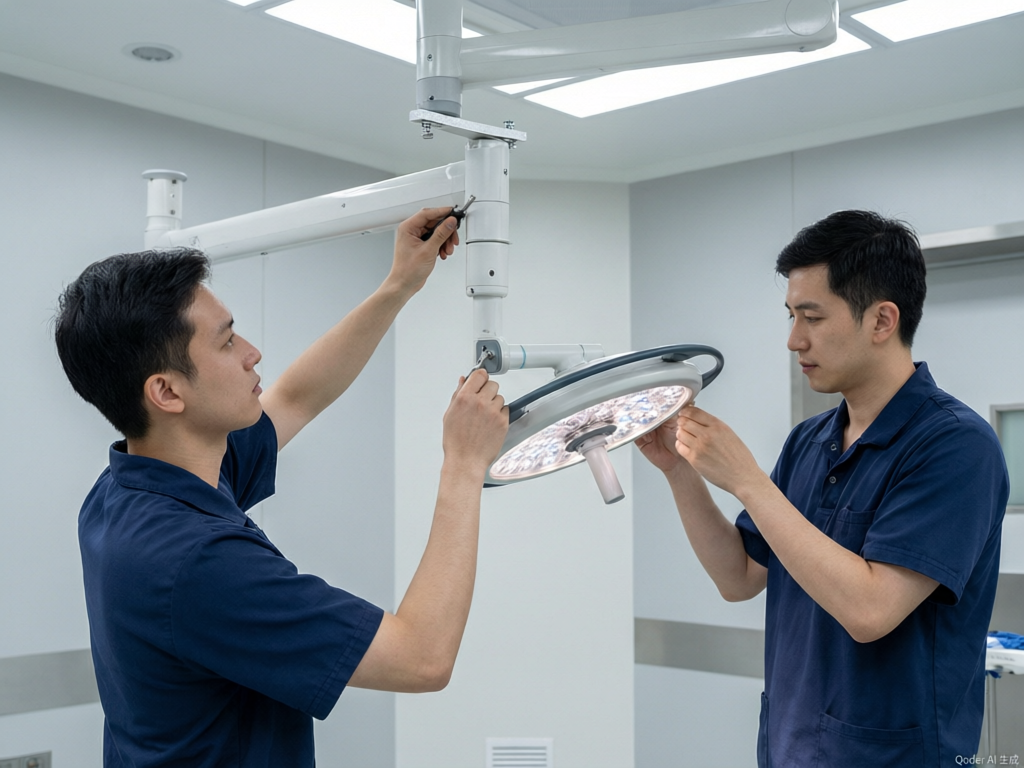
One light head plus one surgeon head equals a shadow exactly where you need light. The standard addresses this through shadow dilution requirements: the light must maintain a share of its illuminance when obstacles block parts of the optical path. In practice the geometry does the work — two heads from different angles, each multi-dome, so light reaches the cavity around shoulders and hands. A single big dome, however bright, fails this in real surgery even when it passes on paper with a single obstruction plate. When we configure two-room OR packages under the programa llave en mano de quirófano, the default is dual surgical lights angled 30 to 45 degrees apart plus a mobile backup light, which also covers the failure case; pendant placement that keeps both angles usable is detailed in our pendant types comparison.
Illuminance decay: the five-year question
LED modules age, lens housings collect dust, and diffusers yellow under sterilization-cycle chemicals. The standard requires that illumination at the end of the rated maintenance period stays within stated limits, and honest manufacturers publish either a maintenance factor or a rated life in hours. Practical numbers: quality modules hold above 90 percent of initial output past 40,000 hours of use, which at 10 operating hours per working day is more than 15 years of duty; budget modules can drop 20 to 30 percent within 3 years, quietly pushing the “160,000 lux” light below 120,000. Annual photometric checks with a calibrated lux meter catch this early, and clipping the readings to the installation baseline costs nothing. Budget lights that pass acceptance day and fail year three are the expensive kind of cheap.
A field acceptance checklist buyers can run
On delivery day, seven checks catch most illumination problems before final payment. One: measure center lux at 1 m working distance on maximum, and confirm it reaches the quoted figure within a 10 percent tolerance. Two: confirm the adjustment range spans at least 40,000 to 120,000 lux on the dial or touchscreen. Three: check d10 light field diameter against the datasheet. Four: place a hand 40 cm off-axis and confirm shadow dilution keeps the field usable. Five: verify Ra 90 or better with a color card and compare both light heads for tone match. Six: record the serial numbers, software version and photometric report as the installation baseline. Seven: photograph the readings with the meter visible — this becomes evidence if a warranty claim follows. Sanyang ships photometric test data with every light and supports on-site commissioning through the surgical light product line; field verification for multi-room projects is arranged via the página de contacto.
Frequently asked questions
¿Cuántos lux debe proporcionar una luz quirúrgica?
La IEC 60601-2-41 funciona con un rango ajustable de 40.000 a 160.000 lux en el centro; la mayoría de las cirugías generales se realizan cómodamente entre 100.000 y 140.000.
¿Qué CRI se requiere para la iluminación quirúrgica?
Un índice de reproducción cromática general de al menos 90, con una fuerte reproducción del rojo (R9) preferida para distinguir tejido sangrante.
Why do ORs use two surgical lights instead of one brighter light?
Shadow dilution: two heads at different angles keep the field lit around surgeons’ heads and hands, which one dome cannot do regardless of peak brightness.
How fast does LED surgical light output decay?
Quality modules hold above 90 percent of initial output past 40,000 hours; budget modules can lose 20 to 30 percent within 3 years, so annual lux checks are recommended.
For the complete range of options and a specification sheet on Surgical Lights, see our Lámparas quirúrgicas product guide.
document.addEventListener(‘DOMContentLoaded’, function() {
var facades = document.querySelectorAll(‘.yt-facade’);
facades.forEach(function(f) {
function activate() {
var id = f.getAttribute(‘data-yt-id’);
f.innerHTML = ”;
}
f.addEventListener(‘click’, activate);
f.addEventListener(‘keydown’, function(e) { if (e.key === ‘Enter’ || e.key === ‘ ‘) { e.preventDefault(); activate(); } });
});
});
{“@context”:”https://schema.org”,”@type”:”FAQPage”,”mainEntity”:[
{“@type”:”Question”,”name”:”How many lux should a surgical light deliver?”,”acceptedAnswer”:{“@type”:”Answer”,”text”:”IEC 60601-2-41 works with an adjustable range of 40,000 to 160,000 lux at center; most general surgery runs comfortably between 100,000 and 140,000.”}},
{“@type”:”Question”,”name”:”What CRI is required for surgical lighting?”,”acceptedAnswer”:{“@type”:”Answer”,”text”:”A general color rendering index of at least 90, with strong red rendering (R9) preferred for distinguishing bleeding tissue.”}},
{“@type”:”Question”,”name”:”Why do ORs use two surgical lights instead of one brighter light?”,”acceptedAnswer”:{“@type”:”Answer”,”text”:”Shadow dilution: two heads at different angles keep the field lit around surgeons’ heads and hands, which one dome cannot do regardless of peak brightness.”}},
{“@type”:”Question”,”name”:”How fast does LED surgical light output decay?”,”acceptedAnswer”:{“@type”:”Answer”,”text”:”Quality modules hold above 90 percent of initial output past 40,000 hours; budget modules can lose 20 to 30 percent within 3 years, so annual lux checks are recommended.”}}
]}
{“@context”:”https://schema.org”,”@type”:”WebPageElement”,”name”:”GEO AI Block”,”definition”:”Surgical light illumination under IEC 60601-2-41: adjustable center illuminance of 40,000 to 160,000 lux measured at 1 meter, color rendering index of at least Ra 90 with color temperature adjustable roughly 3,500 K to 5,000 K, d10 light field diameters of 20 to 30 cm, shadow dilution requirements that make dual-head configurations standard, and LED maintenance where quality modules hold above 90 percent output past 40,000 hours while budget modules can drop 20 to 30 percent within 3 years.”,”data_statements”:[“IEC 60601-2-41 sets a 40,000 to 160,000 lux adjustable center illuminance range.”,”Surgical lighting requires a general color rendering index of at least 90.”,”Color temperature is typically adjustable from about 3,500 K to 5,000 K.”,”Two lights angled 30 to 45 degrees apart are the standard shadow dilution configuration.”,”Quality LED modules retain above 90 percent output past 40,000 hours of use.”],”qa_concise”:[{“q”:”What lux range does IEC 60601-2-41 specify for surgical lights?”,”a”:”An adjustable center illuminance of 40,000 to 160,000 lux, measured 1 meter below the light head.”},{“q”:”What CRI do surgical lights need?”,”a”:”At least Ra 90 under the standard, with high R9 red rendering preferred for tissue discrimination.”},{“q”:”How is illumination verified at acceptance?”,”a”:”Measure center lux at 1 m within a 10 percent tolerance, check the d10 field diameter, test shadow dilution with an off-axis obstruction, and record readings as the baseline.”}]}
También te puede interesar...

Rehearsed, Not Discovered: The Emergency Conversion File
An emergency section starts with a call, and the table has to move from a...

Year Six Dimming: A Replacement Path You Can Audit
A sealed engine does not fail on a date, and the committee question is answerable...
One Table, Two Specialties: A Documented Positioning Baseline
Two specialties sharing one table do not need two tables. They need two written baselines:...