
A table top that blocks a C-arm is not an imaging table, whatever the brochure says, and the proof is one exposure through the production unit, not a datasheet word. Before the next order, ask the factory for three things: the imaging table top’s construction stated by material and thickness, with the radiolucent window dimensioned from the drawing; a C-arm exposure taken through the actual production top, a phantom on the table, image saved, showing the field clear of the column and the base at the angles your surgeons work; and the load rating of the imaging top by itself, because radiolucent means lighter-built, and the imaging top and the general-purpose top are two different products with two different ratings. The demo imaged cleanly because it was set up to; the shipment has to image cleanly because it was built to, and the difference between those two sentences is a purchase order line.
What “Radiolucent” Actually Has to Cover
A C-arm needs to see the patient through the table from two directions, and the table is in the beam the whole time. Everything in the beam adds its own shadow: the top’s core, its reinforcement, the rails, the clamps that hold accessories, and the column and base where the beam passes at the table’s ends and underside. A table can be genuinely radiolucent in the middle third and useless in practice, because the surgeons position patients so the anatomy of interest sits over the column, or because the accessory clamps, exactly the metal parts your existing theatre already owns, sit in the field. The vocabulary of X-ray transparency, and why material thickness matters as much as material choice, is described under radiodensity, and it is the reason the specification carries millimetres, not adjectives.
Ask, too, about the top’s identity: whether the imaging top is a distinct part number with its own construction, or a suffix on the standard model, and make the purchase order quote that number. Factories build both variants on the same line, and the two share everything except the one property the C-arm needs, which is why the suffix is where the whole conversation lives. The demo unit’s configuration belongs in the same line of the file, photographed, because the difference between what was demonstrated and what was quoted is usually exactly one suffix wide.
The demo versus shipment gap has the same three causes it always has. A different top variant was shipped, the imaging top and the standard top share a model number with a suffix. The top is right but the accessory set in the shipment, the clamps, the body straps, the arm boards, sits where the demo’s did not. Or the column and lift assembly on the production units differ from the demo’s, and the shadow at the table’s end is the lift, not the top. Each cause has a different fix, and the exposure test identifies which one you bought.
The Exposure Test, on Production Hardware
Ask for the test done exactly as your theatre will do it. A water-equivalent phantom, or a uniform object of stated thickness, laid across the top at the positions your cases use, centre, over the column junction, and at the foot end where the base sits under the beam. A C-arm in posteroanterior and lateral positions, saved as images, not described in prose. And the accessories that ship with the order fitted during the exposure, because a clean image with a bare top proves nothing about a field that contains four clamps and a strap. The images go in the batch record with the unit’s serial, and they become the reference the biomedical team uses at receiving, when they repeat one exposure and compare.
The same session should capture the fluoroscopy geometry the surgeons care about: how far the C-arm can travel under the top before it strikes the column or the base, in both planes, photographed at the limits. Free space under the table is a number on a drawing until someone loses a quarter turn of angulation to a collision mid-case; the photographed limits turn it into something the theatre can plan around. This belongs to the same family of fit questions as the rail and clamp compatibility checked in the side rail and clamp fit, and the two checks share one factory visit.
Where the theatre also runs longer imaging cases, ask the factory one more construction question while the top is on the bench: how the top manages the imaging chassis’s own weight at its cantilevered positions, and whether the stated load rating assumes the C-arm cradle or any receiver attached under the top. Some imaging setups clamp a pad or a cradle to the underside, and that hardware sits in the beam with everything else. A top that images cleanly bare and shadows once the cradle is fitted has answered the question in the wrong order, and the factory that has been asked will photograph the fitted configuration instead, which is the one that was going to walk into your theatre anyway.
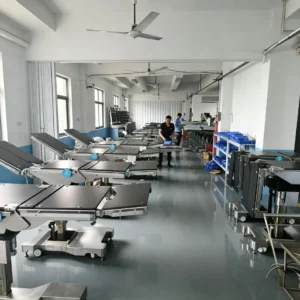
Two Tops, Two Ratings, One Order Line
Imaging tops are built differently from general-purpose tops, and the difference runs exactly along the line your C-arm cares about. Less metal, thinner core, a longer clear window, and usually a lower safe working load, because the material that lets X-rays through does not carry weight the way the standard laminate-and-steel construction does. Ask the factory to state the imaging top’s load rating separately, with the patient weight and the accessory load stated as the datasheet expects them, and to say plainly which accessories are approved on the imaging top. A bariatric imaging case on a general-purpose load rating is the kind of discovery that arrives mid-case, and it is prevented by one line in the order that names the two tops as two products.
State the window dimensioned on the drawing, too: the clear radiolucent area, length and width, measured between rails and between attachments. Surgeons plan positions around it, and a window that is nominally full-length but interrupted by clamp positions is not the window the plan assumed. The sizing logic that connects tabletop dimensions to patient populations, covered in tabletop length versus patient population, extends naturally to the imaging window, because both are statements about who the table can actually serve.
The Cost of Discovering It in the Theatre
An obscured field is not just an inconvenience, and the costs stack in three currencies. Dose: every repeated exposure and every repositioned hunt for a clear angle is radiation to the patient and to the staff standing at the table, and a table that forces three extra shots per case collects that dose across a whole surgical list. Time: an imaging case that runs long does not just delay itself, it moves every case behind it, and the theatre’s day is the scarcest object in the building. And referrals: surgeons who lose cases to a table they cannot see through simply stop booking those cases into that theatre, which is the quietest and most expensive form of the complaint, because the theatre keeps functioning and stops being used for what it was bought to do. The demo imaged cleanly, your surgeons planned around imaging, and the table broke a promise that was made with someone else’s hardware.
This is also why the receiving exposure is not optional bureaucracy. The first case in the new theatre is the worst possible place to discover a shadow, for the patient under the beam and for the schedule behind the case. One phantom exposure at receiving, compared against the batch images, closes the loop the order opened, and it takes the biomedical team fifteen minutes they were already planning to spend uncrating the unit.
If the Shipment Is the One With the Shadow
Where the delivered tops fail the receiving exposure, the dispositions are the same three as any confirmed specification miss, and the images decide which. A wrong variant shipped, the standard top instead of the imaging suffix, is a replacement conversation with the shortest possible evidence file. A right top obstructed by the accessory set that shipped is a parts conversation, different clamps or lower-profile straps, and the factory should price the fix against its own drawing. And a genuinely obstructive construction is a batch conversation, with the receiving images from the first crate preventing the same discovery in the second and third. What the file should not contain is a verbal assurance that “the demo was the same”, because the exposure says otherwise, and photographs of phantoms outrank memories of showrooms every time.
Lines for the Next Order
Four lines carry the whole fix. The imaging top as a distinct line item, construction stated, window dimensioned, load rating stated separately from the general-purpose top. The exposure evidence per batch, phantom, both planes, accessories fitted, images filed with the serial. The photographed C-arm travel limits under the table, both planes. And the receiving exposure, one image through the first delivered top compared against the batch record before the crate is signed for. With those four lines, the imaging question is answered in the factory and confirmed in your basement, and the first case through the new theatre is a surgical event rather than an imaging experiment.
También te puede interesar...

Numbered Document Annex for Equipment Orders
A numbered document annex is a schedule inside the equipment order. The schedule gives every...

A Showroom Demo Rig Dealers Can Stand Behind
Every dealer showroom faces the same gap. Surgical lights and pendants are engineered to hang...

OR Table Controls: Redundancy Worth Ordering
The hand control that hit the floor yesterday cost you an afternoon of theatre time,...