
A medical equipment pre-shipment inspection is the buyer’s last control point before the balance payment leaves the bank. Under the standard factory terms used by Chinese manufacturers, 30 percent T/T deposit starts production and 70 percent is due before shipment, which means the inspection sits exactly at the payment gate. A structured inspection checks five things: electrical safety, configuration, cosmetic condition, packing and documentation. This guide walks each category, tells you which checks you can run remotely, and gives you a failure procedure that protects the 70 percent.
The stakes are higher for medical devices than for general merchandise. A hospital that receives a light with a missing earth connection or a table with the wrong voltage cannot put it into service, and the UK regulator’s MHRA guidance on managing medical devices makes receipt checks an explicit facility duty. Finding the problem at the factory, before the container loads, costs a week. Finding it after arrival costs a shipment, a customs cycle and a service visit.
The good news is that most findings are small: a scratch, a missing spare fuse, a document with the wrong serial number. The inspection exists to catch those small findings while the fix is cheap, and to catch the rare large finding before payment.
Why Inspection Happens Before Payment
The payment sequence decides the leverage. With a 30/70 T/T structure, the factory holds production risk until the first payment and the buyer holds quality risk after the second. The pre-shipment inspection is the moment where the buyer still has a lever: the 70 percent balance is due only when the inspection report clears. Once the money moves, corrections travel across a border and take weeks.
This is why the inspection belongs in the contract, not as a courtesy. The RFQ should state that release of the balance payment requires an inspection report signed by both parties, and the report template should be agreed before production starts. A buyer who negotiates this line at the start never has to argue about it at the factory gate. The medical equipment RFQ structure guide shows where this clause sits in the document, and the T/T and L/C payment terms article explains why the 70 percent is the standard split.
The Five Inspection Categories
Break the inspection into five categories so nothing depends on one person’s eye. Each category produces its own section of the report, and the report is only as strong as its weakest section.
| Inspection category | What the inspector checks | Document produced |
|---|---|---|
| Electrical safety | Earth continuity, leakage, insulation, functional run | Test readings sheet |
| Configuration | Model, voltage, accessories against the PO | Configuration checklist |
| Cosmetic condition | Scratches, dents, stains, weld and seam quality | Photo log |
| Packing | Export cartons, foam, marking, container loading | Packing list verification |
| Documentation | DoC, test reports, IFU, certificates, commercial papers | Document pack review |
Run the categories in this order. Electrical safety and configuration are the reject conditions: a unit that fails either should not proceed to packing. Cosmetic findings are usually conditional, documented and repaired or discounted. Packing and documentation findings rarely stop the shipment but frequently cost money if missed, because customs and the receiving hospital both check them.
Electrical Safety Checks on Site
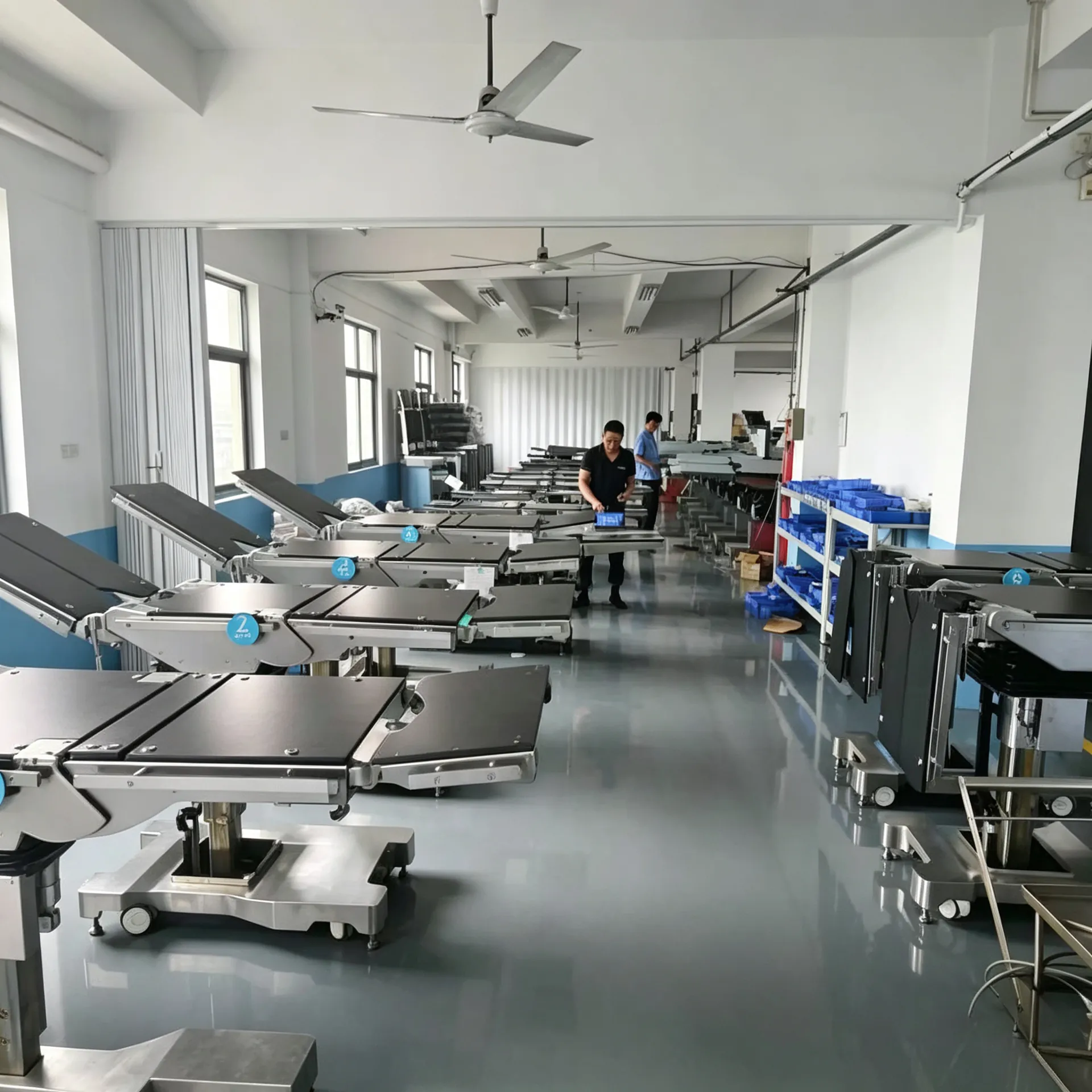
Medical electrical equipment is covered by IEC 60601-1, the general standard for basic safety and essential performance. The checks that run in a factory session are the same family a hospital’s biomedical team runs on receipt: earth continuity from the frame to the supply plug, leakage current at operating voltage, insulation resistance, and a functional run of every motor, light or actuator the device has.
Ask the factory to demonstrate each test live rather than show a report. The report proves the unit passed at some point; the live run proves this unit passed now. Watch the voltage setting on the nameplate against your order, and watch the power-on sequence: a device that trips its own protection on first power-up is not ready to ship, whatever the paperwork says.
If the factory cannot perform these tests on site, that is a finding in itself. A manufacturer with a functioning test station runs through them in minutes. The absence of a test station on the inspection day is the strongest signal that the factory’s quality claims are thinner than its brochure.
Configuration, Quantity and Serial Checks
Configuration errors are the quiet category: every unit looks right in a photo, and the difference hides in the details. Check the model number on the nameplate against the purchase order, the voltage and plug type against your market, and the accessories list against the packing list line by line. Count spare fuses, spare parts, remote controls and mounting hardware. A hospital bed missing its handset pairing instructions will not stop the container, but it will stop the bed.
Record serial numbers for every unit in the report. Serial numbers tie the shipment to the test records, the certificates and the warranty, and they are the only defense if a different unit is substituted later. For sample and trial orders, this check is also the moment to confirm the sample configuration matches what you evaluated. The sample orders evaluation guide lists the comparison points.
Quantity checks sound trivial until a mixed project load arrives short. Count by model and by configuration, not by carton, and verify against the commercial invoice numbers. The MOQ and lead times from Chinese factories article explains how mixed loads and flexible MOQ terms interact when quantities are split across models.
Do the count at line-item level against the purchase order, not against the packing list alone. The packing list describes what the factory packed; the PO describes what you bought, and the gap between the two is where substitutions hide. Match three numbers for every line: ordered quantity, packed quantity and invoiced quantity. When they disagree, resolve the difference at the factory, because after loading, the disagreement becomes a customs discrepancy or a claim.
Packing, Marking and Container Readiness
Export packing is the last line of defense between the factory and the destination. Check the carton construction, the internal foam or cradle, the moisture protection and the marking: model, serial, carton number, handling marks and the shipping mark your forwarder specified. A unit that survived the factory test but ships in a reused, undersized carton arrives with different problems than it left with.
For wood packaging, confirm the fumigation or heat-treatment mark required for your destination, because customs rejects untreated wood and the container waits at port while the paperwork catches up. For container loading, verify the loading plan against the carton dimensions, the weight distribution and the lashing. FOB means the goods are the seller’s responsibility until they cross the ship’s rail, but the buyer owns the cargo five minutes later, and a badly loaded container is a claim nobody wins quickly.
Photograph the container interior before the doors close. That photo set is the evidence baseline for any transit damage claim, and it costs ten minutes at the factory.
Documentation Pack Review Before Payment
The documentation pack is the category where importers lose the most time, because every market wants a slightly different version of the same documents. For medical equipment from a CE and ISO 13485 factory, the core pack contains: the Declaration of Conformity, the IEC 60601 test reports for the actual models shipped, the ISO 13485 certificate, the Instructions for Use, and the commercial invoice, packing list and bill of lading set.
For tender buyers, add the Free Sale Certificate with CCPIT notarization and Apostille, issued in the name that appears on your contract, and check that the certificate dates cover the shipment window. A certificate expiring the week after loading is a finding; a certificate with the wrong company name is a blocker. Verify the serial numbers on the DoC and test reports against the units in front of you.
Review the pack twice: once at inspection and once at the forwarder. Documents travel faster than cargo, and the forwarder’s copy is often the one that reaches customs first.

Running the Inspection With the Factory
The inspection does not have to be an international flight. Three models work, in order of confidence: an on-site inspector, a third-party agency, or a live video session with the factory’s quality team. Many factories now run video inspection as a standard service, and Sanyang Medical’s 7×24 video diagnosis channel supports exactly this workflow: the buyer watches the test station, directs the camera to nameplates and welds, and receives the report the same day.
For quantity inspection across many units, use an acceptance sampling plan based on ISO 2859-1 (the AQL standard) rather than checking everything or nothing. Agree the AQL level and the defect classes before the session, because the class decides the action:
| Defect class | Example finding | Action |
|---|---|---|
| Critical | Wrong voltage, missing earth, wrong model | Reject the lot |
| Major | Scratch, dent, function failure | 100 percent re-inspection |
| Minor | Label error, packing mark missing | Document and repair |
A typical session for one product line runs 2 to 4 hours including the functional run, which fits a morning video call.
When findings appear, follow a fixed procedure: put the finding in the report with a photo, agree the correction and the date, hold the affected units until the correction is done, and re-inspect only the corrected units plus a sample of the untouched ones. Never release the 70 percent balance on a promise; release it against a signed report that lists every finding as closed or waived.

If you are preparing your first inspection with a factory, start with the product lines on the medical equipment product lines page and ask for the inspection checklist and report template before you order. Standard production runs 3 to 7 days and custom configurations 15 to 20 days, which means the inspection can be scheduled into the production plan rather than bolted on at the end. Send us your PO and your destination market, and we will return the inspection schedule with the commercial offer.
Frequently Asked Questions
What does a medical equipment pre-shipment inspection cover?
Five categories: electrical safety, configuration, cosmetic condition, packing and documentation. Each produces its own report section, and electrical safety and configuration are the reject conditions that stop a shipment.
Can a pre-shipment inspection be done by video?
Yes. Factories with a 7×24 video diagnosis channel can run a live inspection session where the buyer watches tests, directs the camera and receives a signed report the same day. On-site and third-party inspections remain the higher-confidence options.
Who pays for the pre-shipment inspection?
Usually the buyer, unless the contract assigns it to the supplier. Third-party agency fees are quoted per man-day plus travel, while video inspection is included by factories that offer the service as standard.
What happens if units fail the inspection?
The failed units are held, the finding is documented with a photo, and the correction date is agreed. The balance payment releases only against a signed report where every finding is closed or waived.