
The digital operating room is not a single product or a marketing label — it is a convergence of imaging, data, and equipment integration that is reshaping how surgical suites are designed, built, and operated. For hospital project planners and distributors, understanding where this convergence is heading determines whether the equipment they buy today will still be relevant in five years or will be functionally obsolete the day a new imaging modality or connectivity standard arrives. See also the robotic surgery equipment requirements guide for related specifications.
For teams working through the same decision, see our AI in the operating room.
What makes an operating room “digital” is not the presence of a screen or a network connection. It is the integration layer: the ability of surgical lights, operating tables, pendants, imaging systems, and hospital information systems to share data, respond to each other, and create a surgical environment where the surgeon’s attention stays on the patient rather than on managing equipment. The technologies driving this shift — camera-integrated lighting, imaging-compatible tables, pendant-mounted connectivity, and remote diagnostics — are available today. The question for buyers is not whether to adopt them, but which to prioritize and how to sequence the investment.
Key Takeaways
- Camera-integrated surgical lights eliminate the separate boom-mounted camera and route video through the light head, reducing ceiling clutter and cabling.
- Imaging-compatible operating tables with carbon fiber tops support C-arm and fluoroscopy without retabling the patient mid-procedure.
- Pendant-mounted connectivity consolidates power, gas, data, and video routing into ceiling infrastructure, freeing floor space.
- Remote diagnostics allow manufacturers to troubleshoot equipment failures via video link, reducing OR downtime from days to hours.
- OR-to-PACS integration routes surgical video and imaging data directly to the hospital’s picture archiving system, eliminating manual transfer.
- Hybrid OR design combines surgical and interventional imaging in one suite — the fastest-growing segment in new OR construction.
Table of Contents
- Camera-Integrated Surgical Lights: Video From the Light Head
- Imaging-Compatible Operating Tables
- Pendant-Mounted Connectivity and Data Routing
- Remote Diagnostics: The After-Sales Shift
- OR-to-PACS Integration and Surgical Video Archiving
- The Hybrid OR: Surgery Meets Interventional Imaging
- What Buyers Should Watch: Five Trends Shaping the Next Five Years
- FAQ

The Future of Digital Surgery — Medtronic Digital Surgery
Camera-Integrated Surgical Lights: Video From the Light Head
Traditional surgical video systems use a boom-mounted camera separate from the surgical light. The camera sits between the light head and the surgical field, requiring its own ceiling mount, its own cabling, and its own positioning adjustments. When the surgeon moves the light, the camera does not follow — a technician must reposition the camera independently, a delay that happens multiple times per procedure.
Camera-integrated surgical lights solve this by embedding the camera directly into the light head. The Sanyang Petal Five camera-integrated model places an HD camera within the light dome’s central aperture, where the camera looks straight down the light beam at the surgical field. When the surgeon repositions the light, the camera follows automatically — the view the surgeon sees on the monitor is always aligned with where the light is pointing.
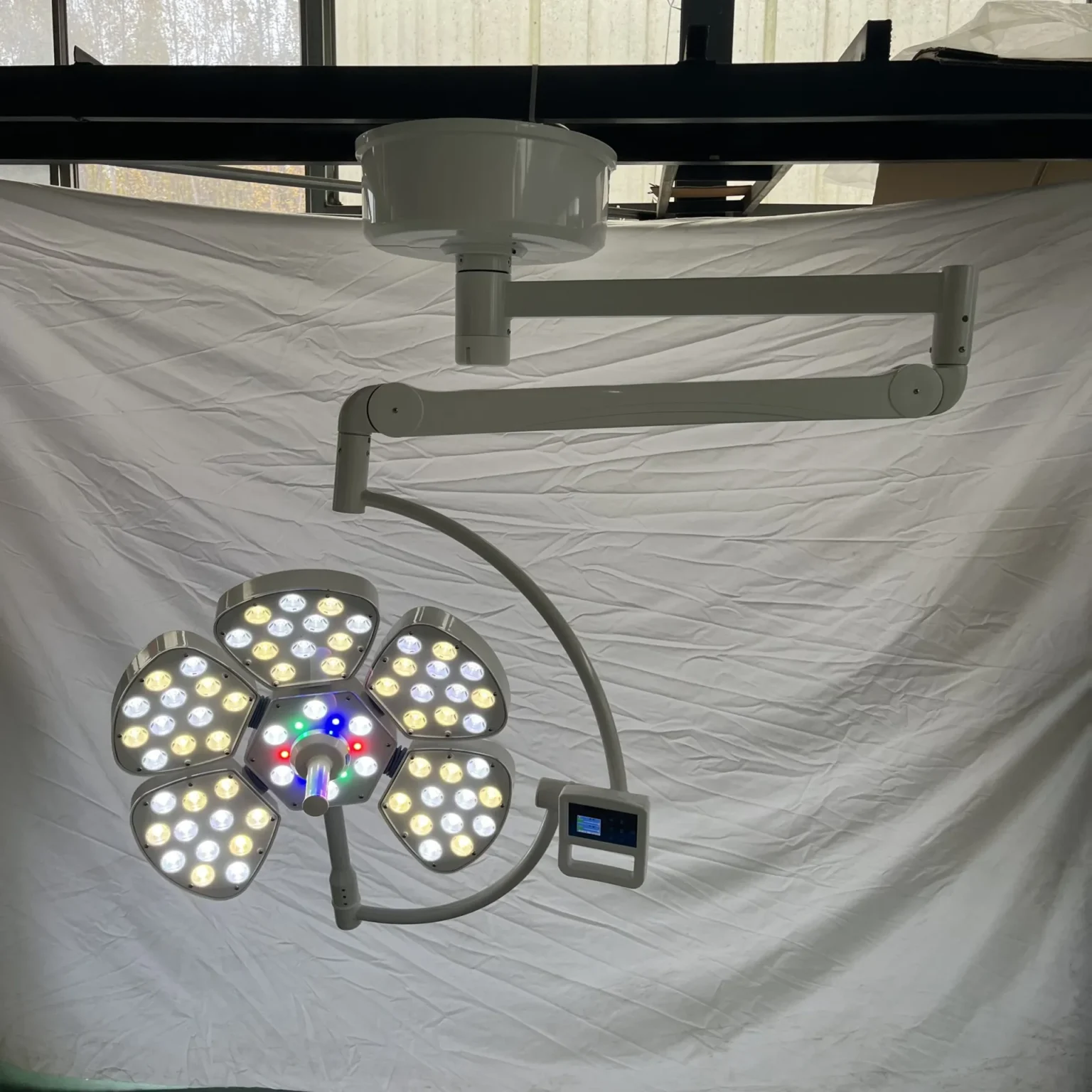
The integration eliminates three ceiling-mounted components: the separate camera boom, the camera control unit mount, and the cable routing tray. This matters because ceiling space in an OR is finite — every boom, pendant, and light competes for mounting points and structural support. A camera-integrated light frees ceiling capacity for additional pendants or imaging equipment, which is the real value proposition for suite planners. The surgical light camera integration guide covers the technical specifications in detail.
Imaging-Compatible Operating Tables
The shift from film-based to digital imaging changed what operating tables must do. A table that only supports the patient is no longer sufficient — it must also be radiolucent, meaning it does not block X-ray or fluoroscopic imaging. Carbon fiber table tops are the standard solution: carbon fiber is radiolucent, strong, and lightweight, allowing C-arm imaging through the table without moving the patient.
Sanyang offers C-arm-compatible operating tables with carbon fiber tops that allow imaging across the full table length, not just a narrow window. The benefit is operational: in orthopedic trauma surgery, vascular surgery, and spinal procedures, the surgeon can image any part of the patient without repositioning or adding a radiolucent extension. The table itself becomes part of the imaging system.
The trend in digital OR design is toward tables that integrate with the imaging workflow rather than just tolerating it. This means tables with built-in longitudinal and lateral slide capabilities — the surgeon can move the patient 200 mm in either direction to center the anatomy under the C-arm without un-draping or repositioning. It also means tables with programmable position memory, where a surgeon can save and recall a specific table configuration for a specific procedure type, reducing setup time between cases.
Pendant-Mounted Connectivity and Data Routing
Medical pendants have evolved from gas-and-power columns to multi-function connectivity hubs. A modern surgical pendant carries medical gases (oxygen, nitrous oxide, medical air, vacuum), electrical outlets (hospital-grade, isolated ground), data ports (Ethernet, fiber), and video routing (HDMI, SDI, DVI) — all suspended from the ceiling, reachable from the surgical field, and adjustable in position.
The digital OR trend is toward pendant systems that consolidate everything the surgical team needs into two pendant arms: the anesthesia pendant (on the head side) and the surgical pendant (on the foot side). Each pendant terminates at a carrier with gas outlets, electrical sockets, data ports, and monitor mounts. The surgeon can plug a video device directly into the pendant rather than running a cable across the floor to a wall outlet — reducing trip hazards and cable management issues.
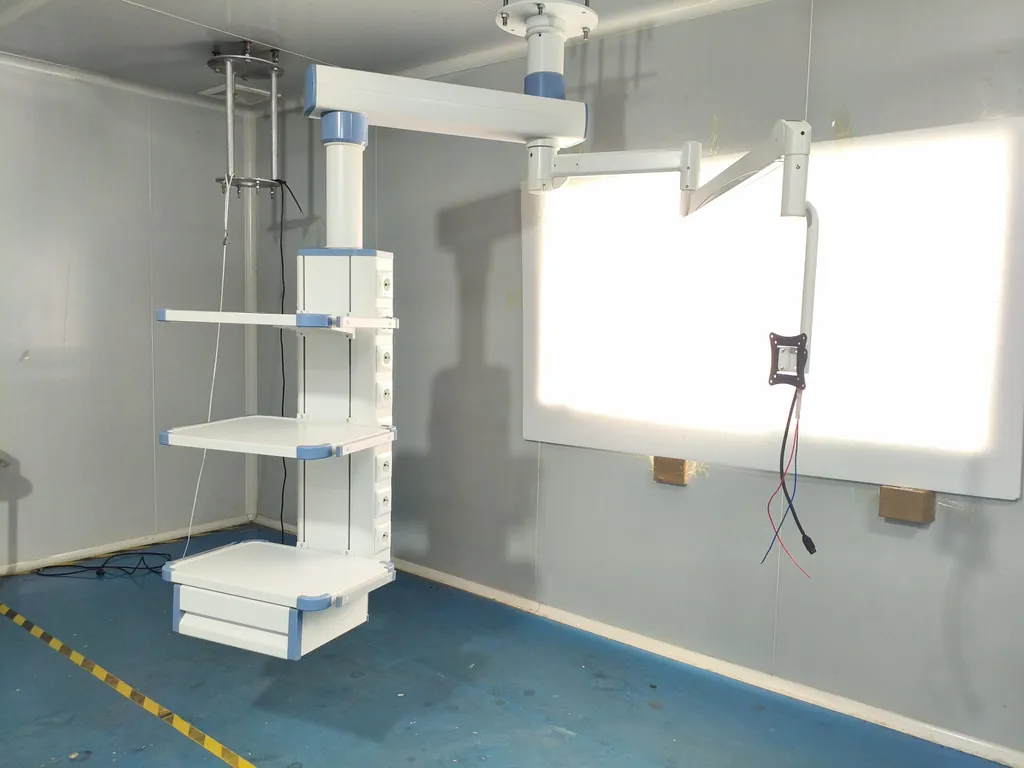
For suite planners, the key decision is pendant load capacity and articulation. A pendant that will carry a 15 kg monitor plus 10 kg of equipment needs a 30+ kg load rating to allow for future additions. A pendant with dual-arm articulation provides greater reach coverage than a single-arm pendant, but requires more ceiling structure and maintenance. The pendant configuration guide covers the specification process.
Remote Diagnostics: The After-Sales Shift
Equipment downtime is the single largest operational cost in an OR after staff salaries. A surgical light that fails on a Monday morning can mean a canceled case list, rescheduled patients, and a service technician visit that takes 2–5 days depending on location. For hospitals in regions without local service infrastructure — Africa, the Middle East, parts of Southeast Asia — this downtime can stretch to weeks while waiting for a manufacturer technician to fly in.
Remote diagnostics changes this equation. Sanyang’s 7×24 video diagnosis service connects a hospital biomedical technician with the factory engineering team via a video link to the failed equipment. The technician shows the fault, the factory engineer guides troubleshooting in real time, and in many cases the problem is resolved without a site visit — a loose connector, a software reset, or a settings adjustment.
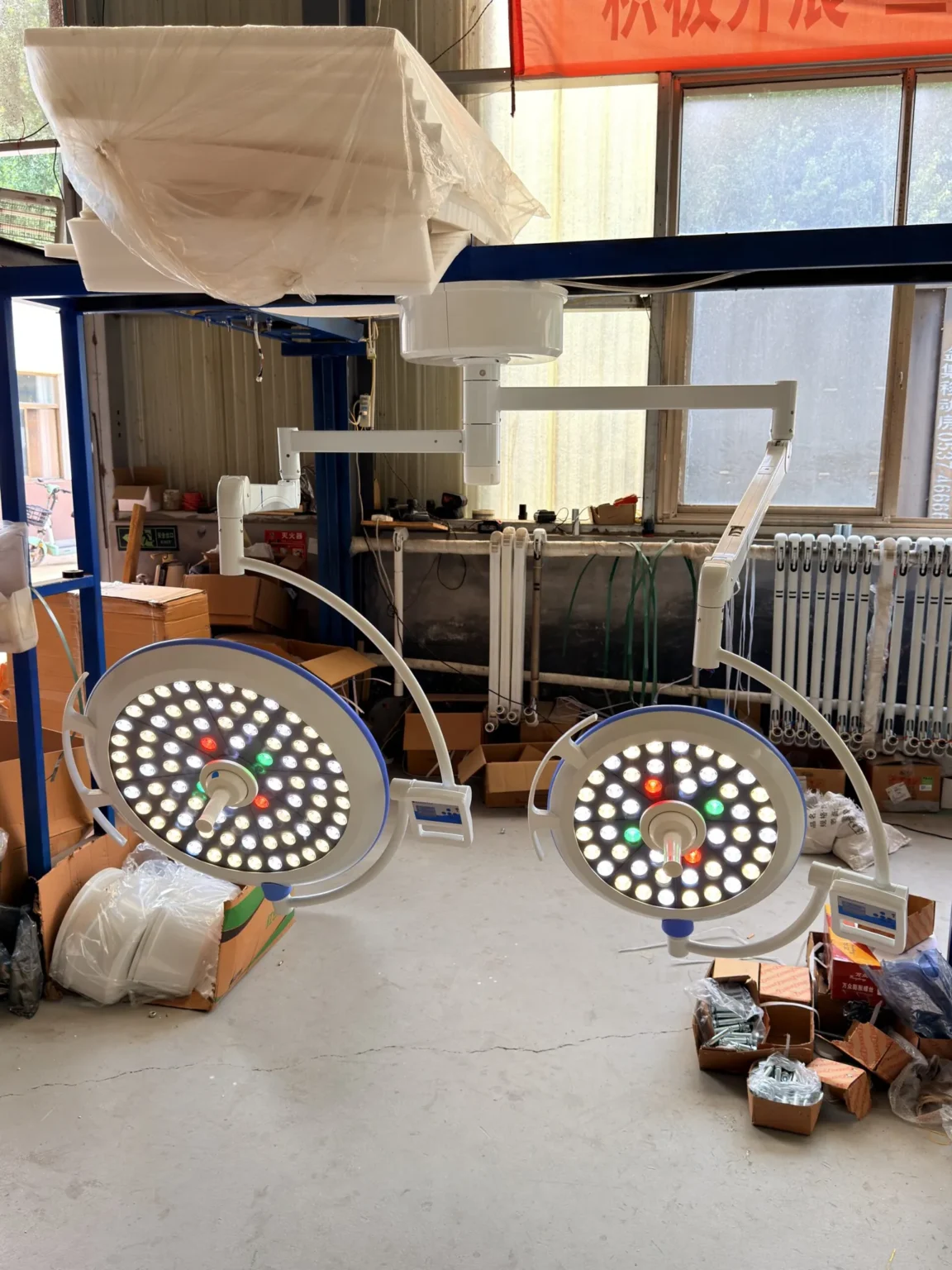
When a site visit is required, remote diagnostics ensures the technician arrives with the correct spare part, the correct tool, and a diagnosed fault — not a vague “the light doesn’t work.” This reduces the typical service call from two visits (first to diagnose, second to repair) to one visit (diagnose remotely, arrive with the part, repair on-site). For distributors managing after-sales support across a national territory, this service model is a competitive differentiator that reduces their own service overhead.
OR-to-PACS Integration and Surgical Video Archiving
Hospital picture archiving and communication systems (PACS) traditionally store radiology images — X-rays, CT, MRI, ultrasound. The digital OR extends PACS — built on the DICOM imaging standard — to include surgical video: the camera-integrated light’s HD feed, the endoscopy tower’s output, and the C-arm’s fluoroscopy frames all route into the hospital’s PACS alongside the radiology images.
The value is twofold. First, the surgical record becomes complete — the hospital can retrieve not just the pre-op imaging and post-op imaging, but the intra-operative video showing exactly what the surgeon saw. This matters for clinical documentation, for teaching hospitals, and for medico-legal records. Second, the surgeon can call up prior imaging on an OR monitor through the pendant-mounted connection, rather than stepping away from the table to view a workstation — a workflow improvement that compounds across every case in the suite.
The technical requirement is a video routing system in the OR that accepts HDMI/SDI inputs from the camera light, the endoscopy tower, and the C-arm, and outputs to both the in-room monitors and the PACS network. This routing system is typically housed in the pendant carrier or a rack-mounted cabinet, controlled by a touch panel on the pendant arm. The control systems guide covers the user interface layer of this integration.
The Hybrid OR: Surgery Meets Interventional Imaging
The hybrid operating room is the most visible manifestation of the digital OR trend. A hybrid OR combines a full surgical suite with fixed interventional imaging — typically a ceiling-mounted C-arm (angiography system) or a robotic CT scanner that moves on rails. The same room handles open surgery, percutaneous intervention, and intra-operative imaging without moving the patient.
Hybrid ORs are the fastest-growing segment in new OR construction, driven by the growth of hybrid procedures: transcatheter aortic valve replacement (TAVR), endovascular aneurysm repair (EVAR), and orthopedic robotic surgery all require both surgical access and real-time imaging guidance. The hybrid OR design requirements guide covers the structural, electrical, and shielding requirements.
For equipment manufacturers, the hybrid OR raises the bar on every product. The operating table must be fully radiolucent and support C-arm rotation around the patient. The surgical light must not interfere with the ceiling-mounted imaging system’s movement arc. The pendant system must carry additional data routing for imaging data. The ceiling structure must support 500+ kg of combined equipment (light, pendant, C-arm, monitor boom). Not every manufacturer can deliver to this specification — it requires engineering depth that separates true OR equipment manufacturers from commodity suppliers.
What Buyers Should Watch: Five Trends Shaping the Next Five Years
For distributors and hospital project managers evaluating equipment today, five trends will determine whether the investment holds value or ages prematurely:
- 4K and 8K surgical video: HD (1080p) is current standard; 4K is becoming the baseline for new camera-integrated lights. Buyers should specify 4K-capable camera modules even if the current monitor fleet is HD, to avoid replacing the light when monitors are upgraded.
- AI-assisted surgical guidance: Machine learning models that overlay anatomical structures on the surgical video feed are in clinical trials. Equipment with open data interfaces (standard video output, not proprietary) will integrate with these systems; closed systems will not.
- Surgical robotics integration: Robotic surgical systems require specific table, light, and pendant configurations. Suites being designed for future robotic adoption need larger floor area (minimum 40 m2) and higher ceiling load capacity.
- Energy efficiency mandates: LED surgical lights already draw 40-60% less power than halogen equivalents. Future building codes in the EU and Middle East will require energy documentation for OR equipment, including standby power consumption.
- Connectivity standardization: The trend is away from proprietary video/data protocols toward IP-based routing (SRT, NDI) and interoperability profiles defined by Integrating the Healthcare Enterprise (IHE). Equipment that uses standard network protocols will be future-compatible; equipment locked to proprietary buses will not.
For a turnkey operating room project, specifying equipment that supports these trends — even if the full implementation comes later — is how a hospital future-proofs its capital investment. The cost of running additional data conduit during construction is a fraction of the cost of retrofitting it after the walls are sealed.
Frequently Asked Questions
What makes an operating room a digital operating room?
A digital OR integrates imaging, data routing, and equipment control so that surgical lights, tables, pendants, and imaging systems share information and respond to each other. The key features are camera-integrated lighting, pendant-mounted connectivity, imaging-compatible tables, and remote diagnostics capability.
What is a camera-integrated surgical light?
A surgical light with an HD camera embedded in the light head’s central aperture. The camera looks down the light beam at the surgical field, so repositioning the light automatically repositions the camera. This eliminates the separate camera boom and its ceiling mount, cabling, and positioning delays.
Why do operating tables need carbon fiber tops?
Carbon fiber is radiolucent — X-rays and fluoroscopy pass through it without distortion. This allows C-arm imaging during surgery without moving the patient or adding a radiolucent extension. Carbon fiber tops make the operating table part of the imaging system rather than an obstacle to it.
How does remote diagnostics reduce OR downtime?
Remote diagnostics connects the hospital biomedical technician with the manufacturer’s engineering team via video link to the failed equipment. The factory engineer guides troubleshooting in real time, resolving many issues without a site visit. When a visit is needed, the technician arrives with the correct diagnosed fault and spare part, reducing service calls from two visits to one.
What is a hybrid operating room?
A hybrid OR combines a full surgical suite with fixed interventional imaging, typically a ceiling-mounted C-arm or robotic CT. The same room handles open surgery, percutaneous intervention, and intra-operative imaging without moving the patient. Hybrid ORs are the fastest-growing segment in new OR construction.
Should I specify 4K video in a new surgical light?
Yes, even if current monitors are HD. Specifying a 4K-capable camera module avoids replacing the entire light head when monitors are upgraded to 4K. The cost difference between HD and 4K camera modules is small compared to the cost of a premature equipment replacement.
Building a digital operating room?
Sanyang Medical delivers camera-integrated surgical lights, carbon fiber imaging tables, multi-function pendants, and turnkey OR solutions with 7×24 remote diagnostics. CE and ISO 13485 certified factory in Qufu, Shandong.
Conclusion
The digital operating room is not a future concept — it is the current trajectory of surgical suite design, and the equipment decisions made today will determine whether a suite is part of that trajectory or stuck behind it. Camera-integrated lighting, imaging-compatible tables, pendant-mounted connectivity, and remote diagnostics are not luxury features. They are the baseline for a suite that will remain clinically relevant as imaging resolution, data routing, and surgical guidance systems continue to advance.
- Specify camera-integrated lights with 4K capability, even if current monitors are HD, to avoid premature replacement.
- Select carbon fiber imaging-compatible tables for any suite that may handle orthopedic, vascular, or spinal procedures.
- Consolidate power, gas, data, and video routing into ceiling pendants to free floor space and reduce cable hazards.
- Require remote diagnostics capability in the after-sales agreement — it is the difference between hours and weeks of downtime.
The manufacturers who can deliver the full digital OR stack — integrated lighting, imaging tables, multi-function pendants, turnkey construction, and remote support — are the ones whose equipment will still be in service when the next wave of surgical technology arrives. Sanyang’s product line covers all five categories from a single factory, with the documentation and support infrastructure to match. For buyers, single-source integration across the OR stack is not just convenient — it is how compatibility and accountability are preserved when something inevitably needs service.
For a closer look, see our guide on medical equipment battery power trends.
You May Also Like...

Hospital Equipment Batteries and Charging: What Importers Should Specify
More hospital equipment moves under its own power than it used to. Beds adjust electrically,...

Single-Use Versus Reusable Surgical Accessories: What Procurement Teams Weigh
The single-use versus reusable argument is usually presented as a cost question and settled as...

Hospital Equipment Rental vs Purchase: The Utilization Test That Decides
Every hospital capital meeting eventually reaches the rent-versus-buy question, and it is usually asked emotionally:...