
Executive Summary
A practical checklist of the photometric parameters, certifications, and evaluation steps that belong in every surgical light tender—anchored to IEC 60601-2-41.
Every year, hospitals pour weeks into surgical light tenders, only to discover—after the contract is signed and the lights are hung—that the specification sheet never actually described what the surgeons needed. The illuminance looked impressive on paper, but the beam washed out at depth. The color rendering index passed the minimum, yet saturated reds turned muddy during a long case. The “60,000-hour” LEDs dimmed far sooner than promised because nobody clarified that the figure referred to 70 percent residual output, not full intensity. These are not product failures; they are specification failures—and in our work equipping operating rooms across multiple continents, we have seen them cost hospitals far more than any defective hardware ever would.
For teams working through the same decision, see our medical equipment RFQ structure.
The root problem is that surgical lighting is deceptively technical. A tender that simply states “LED surgical light, high brightness, good color rendering” invites wildly different interpretations from different bidders—and makes a fair, like-for-like evaluation almost impossible. The committees that get it right translate clinical needs into measurable, testable parameters anchored to recognized standards such as IEC 60601-2-41. If you are new to specifying surgical luminaires, our LED surgical light buying guide is a good companion to this article; here we go deeper into the tender-specific language that protects both.
Why Surgical Light Tender Specifications Make or Break the Purchase
A surgical light is a capital asset that hangs over the sterile field for a decade or more, used for thousands of procedures, so a poor lighting decision compounds every day: surgeon fatigue, longer procedure times, and avoidable repositioning. Studies of operating-room workflow show that surgical lights need repositioning frequently during procedures, and that lighting adjustments are among the most common equipment-related interruptions a team faces. The specification you write today determines how often that disruption happens for the next ten years.
The tender document is also your only objective lever for accountability: once a bid is accepted, the technical specification becomes the contractual baseline, and if a parameter is not written down, it cannot be enforced at acceptance testing. This is why experienced buyers resist keeping specifications “flexible”—flexibility in a tender is just ambiguity by another name, and ambiguity always resolves in favor of the lowest bidder rather than the best product.
A tender specification should be written so that two independent evaluators reading the same bid would reach the same conclusion about whether it complies. If your spec invites interpretation, it is not a specification—it is a wish list.
The Core Photometric Parameters Every Tender Must Define
The heart of any surgical light tender is the photometric data sheet—the parameters that determine whether a light actually performs in the operating room, and that IEC 60601-2-41:2021 (Edition 3.0) defines test methods for.
Central illuminance (Ec)
Central illuminance, Ec, is the light intensity at the center of the beam, measured at a defined distance—typically 1,000 mm from the light-emitting surface—and expressed in lux. Surgical light heads generally operate between roughly 40,000 and 160,000 lux at one meter; lights below about 40,000 lux are not suitable for major surgery. Two traps are common: some manufacturers quote illuminance at a shorter distance to inflate the number, so fix the measurement distance explicitly (state “Ec at 1,000 mm”); and a high maximum is only useful if the light can also be dimmed for delicate work, so specify a dimming range (for example 10–100 percent) and confirm whether adjustment is continuous or stepped.
Color temperature
Color temperature, measured in Kelvin, describes the apparent warmth or coolness of the white light; daylight sits around 5,800 K. The relevant requirement is adjustability, since different procedures and surgeons prefer different tones. Most quality LED surgical lights offer an adjustable range between roughly 3,000 K and 6,700 K, often in defined steps. Specify an adjustable color temperature (for example 3,500–5,000 K in multiple steps) rather than a fixed value, and require the manufacturer to state the chromaticity tolerance (the standard expresses acceptable color deviation using the Duv metric).
Color rendering index: Ra and R9
The color rendering index (CRI) measures how faithfully a light reveals the true colors of tissue. The general index Ra averages eight standard test colors (R1–R8) on a 0–100 scale; for surgical lighting a CRI below 80 is inadequate, high-end luminaires typically exceed Ra 95, and premium units reach Ra 97 or higher.
Here is the part many tenders miss: Ra alone is not enough. The eight reference colors used to calculate Ra do not include saturated red—precisely the color surgeons most need to distinguish blood, vessels, and well-perfused tissue. That is why the R9 value (saturated red) matters as much as Ra, and why IEC 60601-2-41 and modern data sheets report it separately; some manufacturers also report R13 (skin tone). A robust tender requires both: a minimum Ra (for example ≥95) and a separate minimum R9 (for example ≥90 or ≥95). A light can post an excellent Ra yet a mediocre R9, and surgeons notice within a single bleeding field.
Light field diameter, uniformity, and depth
The light field diameter describes the size of the illuminated area at the working distance. The standard defines two diameters: d10, where illuminance falls to 10 percent of the central value, and d50, where it falls to 50 percent. A typical surgical light offers an adjustable field of roughly 170–300 mm at one meter. The d50/d10 ratio (often around 0.5 or higher for a well-designed beam) tells you how uniform the field is: a higher ratio means a flatter, more even distribution rather than a bright hot spot with rapid fall-off. Require d10 and d50 at the working distance, the d50/d10 ratio, and whether the field is adjustable and how.
Depth of illumination describes how far the beam stays effective as you move toward and away from the light—critical when the surgeon works inside a wound whose depth changes during the procedure. The standard expresses this as the working distance around the 1,000 mm point over which illuminance remains at least a given percentage of Ec, commonly reported at the 60 percent threshold (L1 + L2). Specify a minimum depth at 60 percent Ec so the light keeps the bottom of a cavity lit without constant refocusing.
Specification table for the tender data sheet
The table below is a ready-to-adapt template summarizing the photometric and physical parameters to include in a surgical light tender, with typical target values for a major-surgery LED light head. Treat the values as illustrative benchmarks; confirm them against your clinical requirements and the current edition of IEC 60601-2-41.
| Parameter | Symbol / Unit | Typical tender requirement | Why it matters |
|---|---|---|---|
| Central illuminance | Ec (lux @ 1 m) | ≥100,000–160,000, dimming 10–100% | Brightness at the surgical field |
| Color temperature | Kelvin (K) | Adjustable ~3,500–5,000 K, multi-step | Surgeon comfort, reduced eye strain |
| Color rendering index | Ra (0–100) | ≥95 | Overall color fidelity of tissue |
| Red rendering index | R9 | ≥90–95 | Blood and vessel discrimination |
| Light field diameter | d10 / d50 (mm @ 1 m) | ~170–300 mm adjustable | Size and evenness of lit area |
| Field uniformity | d50/d10 ratio | ≥0.5 | Flat beam, no hot spot |
| Depth of illumination | L1+L2 @ 60% Ec (mm) | ≥ several hundred mm | Light stays effective in deep wounds |
| LED service life | hours (to L70) | ≥50,000–60,000 h | Replacement cost and uptime |
| Ingress protection | IP rating | ≥IP54 (fluid ingress per standard) | Cleaning and disinfection durability |
| Irradiance / heat | Ee/Ec, head-area temp rise | Low; head-area rise <1 °C | Patient and staff thermal comfort |
Deep Cavity Illumination and Shadow Dilution
Two related capabilities separate a genuinely surgical light from a merely bright one: performance inside a cavity, and the ability to dilute shadows. Both are addressed in IEC 60601-2-41, which defines test setups using masks and a simulated cavity to measure how much illumination survives when part of the beam is blocked—exactly what happens when a surgeon’s head or hands intrude between the light and the wound.
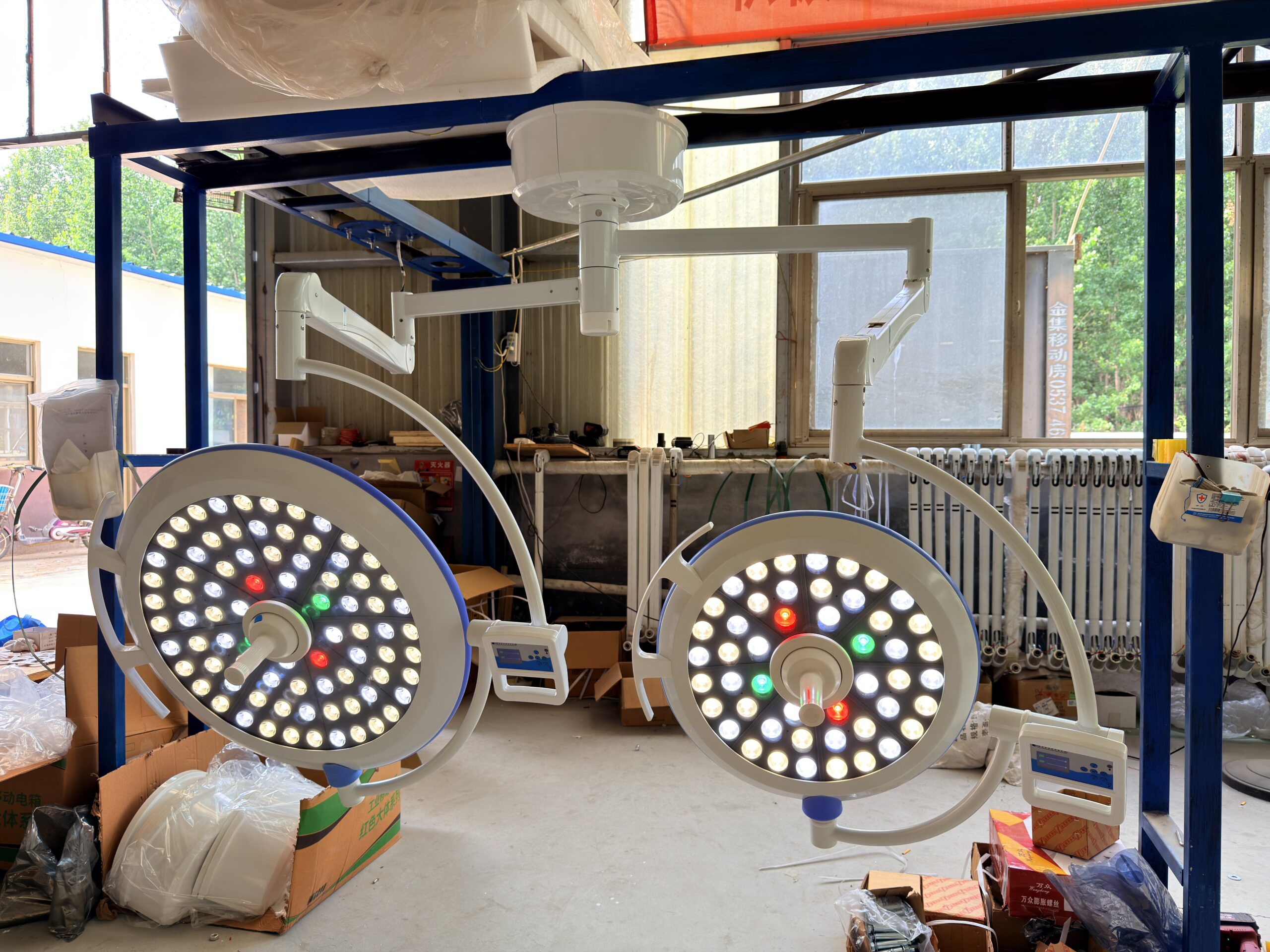
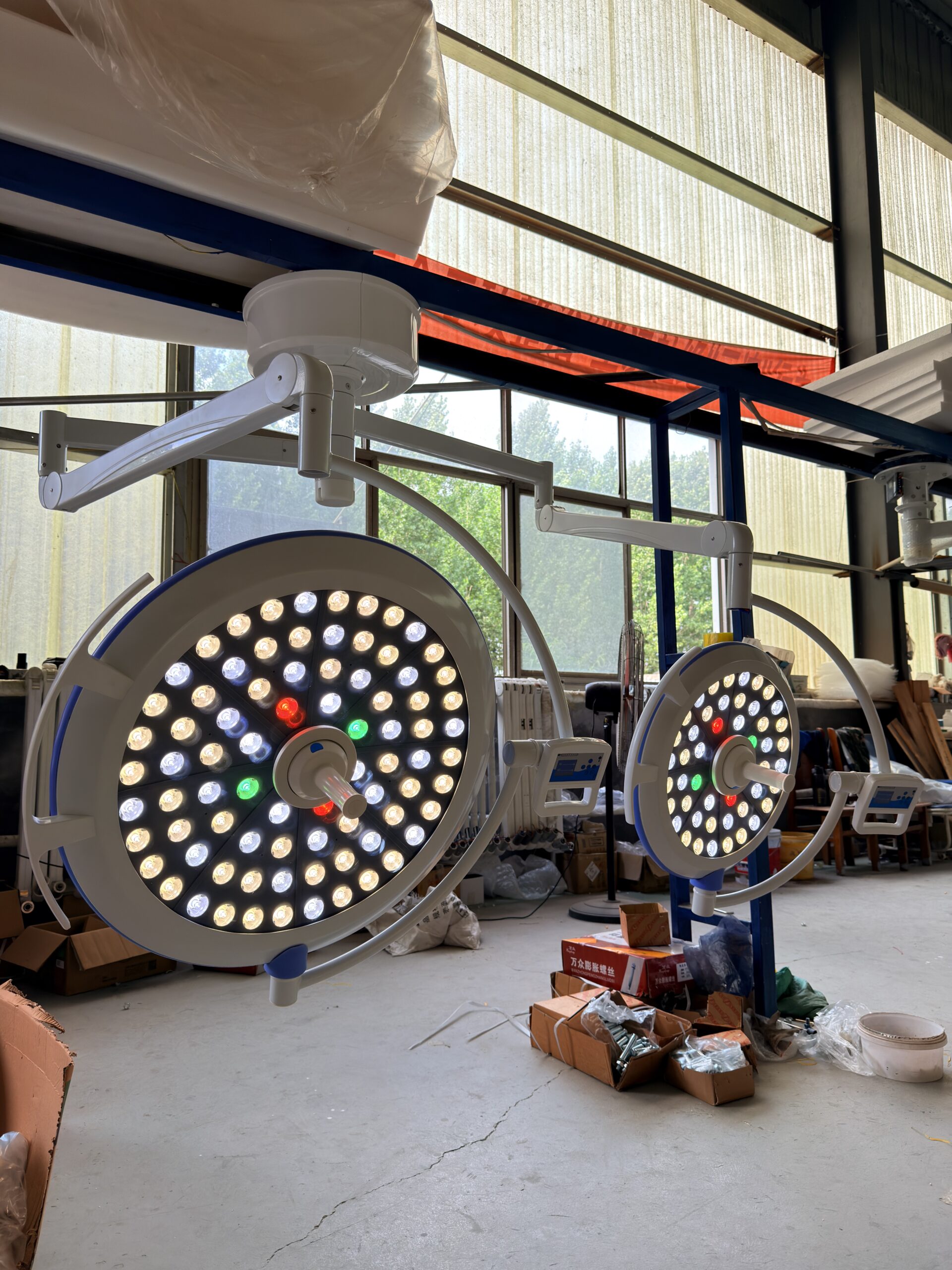
Shadow dilution describes how well a multi-source LED array softens the shadows cast by obstructions. A single light source throws a hard, dark shadow; a well-designed array of many LEDs, each arriving from a slightly different angle, fills that shadow with overlapping beams so the surgeon still sees into the field. The standard specifies a method for measuring illuminance with one mask and with two masks, plus a device for measuring shadow dilution inside a simulated cavity. In your tender, require the manufacturer to declare the residual illuminance with one and two masks (as a percentage of Ec). A light that holds 50–70 percent of Ec behind a mask is far more usable than one that drops to a fraction.
Surgeons rarely operate in an unobstructed beam. The hands, the head, and the instruments all cast shadows into the wound. The lights that earn their reputation are the ones whose shadow dilution and cavity performance keep the field usable when the line of sight is partly blocked—not the ones with the highest unobstructed lux figure.
Deep-cavity performance also depends on combining depth of illumination with a focused, narrow field option. Specify whether the light offers an adjustable or focusable field and an endoscopy or low-output mode, and ask for the cavity illuminance figures from the test report rather than the brochure.
Lifespan, Controls, and Ergonomic Requirements
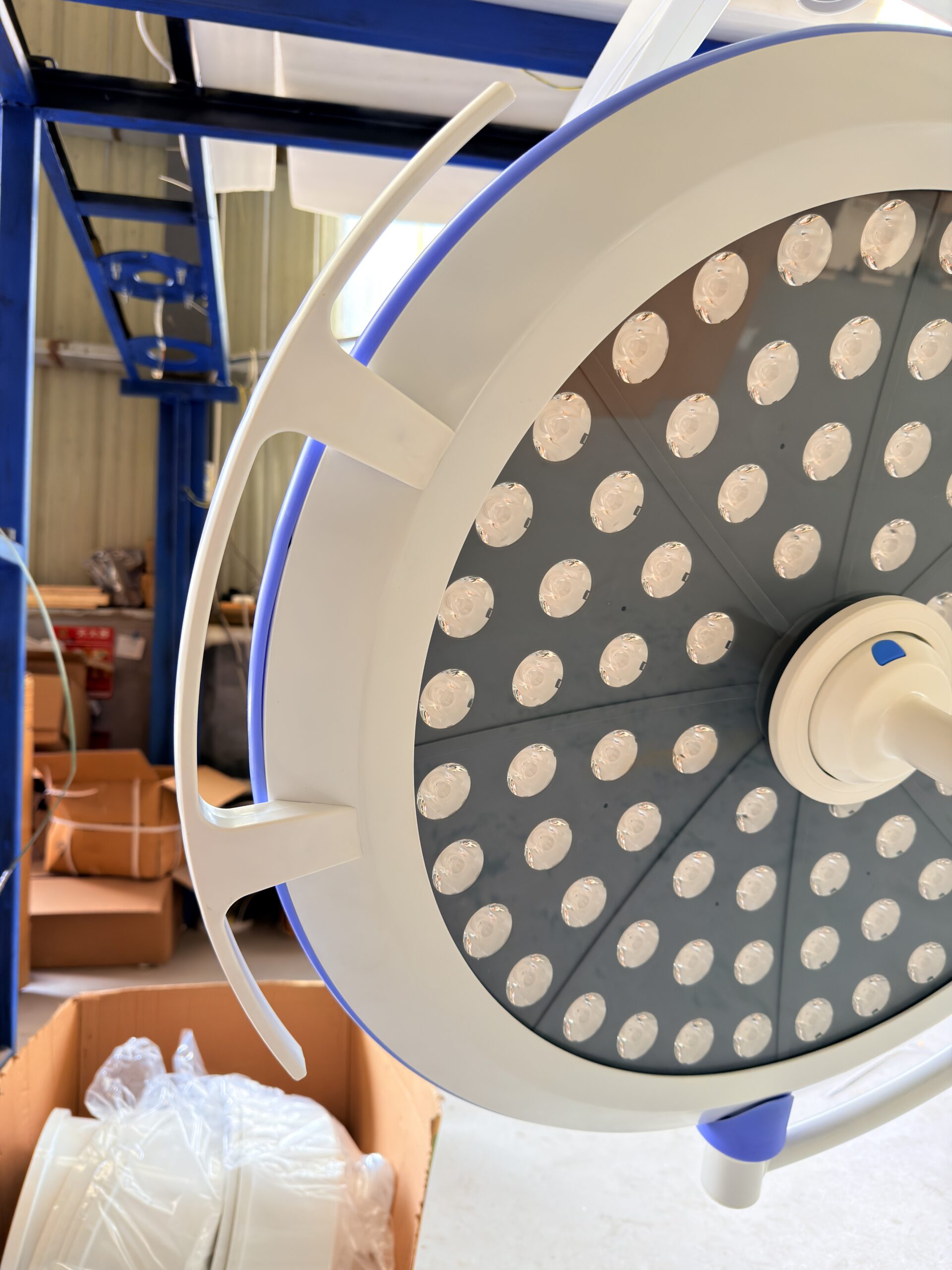
On service life, the critical clarification is what the hour figure actually means. Modern LED surgical lights are typically rated for roughly 40,000 to 60,000 hours, but that number is usually calculated to the point where output falls to about 70 percent of original (the L70 convention), not where the LED fails outright. A tender that simply says “long-life LEDs” is meaningless; require the manufacturer to state the rated life in hours and the residual-output percentage it refers to, and ask whether constant-current or constant-illumination drive technology is used to extend useful life. For the broader ownership picture, see our guide to surgical light maintenance and total cost of ownership.
On controls and ergonomics, specify how the light is operated and what is adjustable. Common requirements include:
- Dimming and color-temperature control at the light head, on a wall panel, or via a sterile, autoclavable handle.
- A sterilizable, autoclavable handle per light head for aseptic repositioning, plus optional single-use covers.
- Synchronization between dual or triple heads so one control adjusts all heads together.
- An endoscopy or low-output mode for minimally invasive work, and optional ambient lighting.
- Optional smart-sensor compensation that maintains illumination when the surgeon moves.
- Camera and monitor integration (HD/4K preparation) if teaching or recording is required.
On mechanics, require a stated ease-of-motion performance, a maximum acceptable lighthead drift when attached to the suspension system (the 2021 edition of the standard added an explicit drift requirement), full 360-degree rotation, and a balanced spring arm that holds position without sagging—a light that drifts forces the same repositioning interruptions you are trying to eliminate. Also specify the mounting configuration (ceiling, wall, or portable), the number of heads, and the suspension-arm reach to suit your room layout.
Certifications and Standards: The Compliance Gate
IEC 60601-2-41 is the particular standard for the basic safety and essential performance of surgical luminaires and luminaires for diagnosis. The current edition is IEC 60601-2-41:2021 (Edition 3.0, published September 2021), which supersedes the 2009 edition and its 2013 amendment. It defines the test methods for central illuminance, light field diameters d10 and d50, depth of illumination, and shadow dilution in a simulated cavity—and, new in the 2021 revision, photobiological hazard exposure limits, lighthead drift, and fluid ingress protection. Requiring a current test report from an accredited laboratory is the single strongest filter you can apply, because it forces every bidder to be measured by the same ruler.
IEC 60601-1 is the general standard for medical electrical equipment safety that the particular standard builds upon, and IEC 60601-1-2 covers electromagnetic compatibility (EMC); require all three. ISO 13485 is the quality-management-system standard for medical devices—a manufacturer certified to it operates under a documented, audited quality system, your assurance that the unit you receive matches the unit that was tested. For verifying that documentation, our ISO 13485 test report checklist explains what to inspect.
Market-access marks depend on where you are buying. In the European Union and countries that follow its framework, surgical lights are regulated medical devices under the Medical Device Regulation (EU) 2017/745 (MDR), and CE marking under MDR—supported by a Notified Body where required—is the legal gateway to market; in the United States, FDA clearance or registration applies. Require the mark appropriate to your jurisdiction plus the supporting certificates and, where relevant, the Notified Body number.
- IEC 60601-2-41:2021 (Ed. 3.0) test report — mandatory for surgical luminaires.
- IEC 60601-1 (general safety) and IEC 60601-1-2 (EMC) — mandatory.
- ISO 13485 quality-management certification — mandatory.
- CE marking under EU MDR 2017/745 (or FDA for the US market) — as applicable to your jurisdiction.
- Ingress protection (e.g., IP54) and photobiological safety per the standard — declared and evidenced.
How to Write the Technical Bid Section
With the parameters and standards defined, the next task is structuring the technical bid section so responses are comparable and verifiable—a disciplined structure tells bidders exactly what to provide, forces evidence rather than claims, and gives evaluators a checklist they can score consistently.
Step 1: Separate mandatory requirements from scored criteria. Divide the specification into “must comply” items (pass/fail) and “preferred” items (scored). Mandatory items typically include the core photometric minimums, the IEC 60601-2-41 and ISO 13485 certifications, and the applicable market-access mark; a bid that fails a mandatory item is non-responsive and set aside before scoring begins. Scored criteria are where you differentiate good from excellent—higher CRI, deeper illumination, longer warranty, better service coverage.
Step 2: Provide a compliance sheet. Require each bidder to return a line-by-line statement that quotes your requirement, states “comply / partial / non-comply,” and gives the offered value plus the page reference in their data sheet or test report. This is standard practice in formal medical-equipment tenders and turns evaluation from reading prose into checking a table; for the wider equipment package, our article on operating-room equipment tender technical specifications goes further.
Step 3: Demand evidence, not adjectives. For every photometric claim, require the supporting IEC 60601-2-41 test report from an accredited lab. For quality and market access, require the actual certificates. For service life, require the stated hours and the residual-output basis. A claim of “excellent color rendering” without an Ra and R9 figure and a test report should score zero.
Step 4: Specify the commercial and service envelope. The technical bid should be accompanied by warranty terms, spare-parts availability and pricing (especially for LED modules and spring arms), installation and commissioning scope, training, and a service-response commitment. Step 5: State the configuration and room context—mounting type, number of heads, arm reach, ceiling height, and integration with pendants, tables, or imaging. The best tender documents are written with the whole operating room in mind, which is why buyers planning a full fit-out often approach it as a turnkey operating-room project rather than purchasing each device in a vacuum.
How to Evaluate and Score Surgical Light Bids
Stage 1 — Preliminary examination. Confirm each bid is complete, signed, accompanied by the required bid security, and submitted on time. Stage 2 — Mandatory compliance (pass/fail). Using the compliance sheets, verify every mandatory requirement: the photometric minimums, the IEC 60601-2-41 / IEC 60601-1 / IEC 60601-1-2 test reports, ISO 13485 certification, and the applicable CE/FDA mark. Any bid that fails a mandatory item is declared non-responsive and excluded from scoring. Cross-check the certificates against the issuing bodies where possible.
Stage 3 — Technical scoring. Score the responsive bids against your weighted criteria. A common, defensible weighting for a capital medical device puts the majority of weight on technical merit and lifecycle value rather than purchase price alone. For example:
- Photometric performance (illuminance, CRI Ra/R9, uniformity, depth, shadow dilution) — 35–40%.
- Build quality, ergonomics, controls, and configuration — 15–20%.
- Compliance depth, certifications, and test-report quality — 10–15%.
- Service, warranty, spare-parts availability, training, and total cost of ownership — 20–25%.
- Commercial price — 15–25%.
Stage 4 — Clarification, not negotiation. Most procurement frameworks allow the committee to seek written clarification of a bid but forbid changing its substance or price; use it to resolve genuine ambiguities, not to let a weak bidder retrofit a missing certificate. Stage 5 — Post-qualification and award. Confirm the apparent winner’s capacity to perform—financial standing, references, manufacturing authorization—then award to the lowest evaluated responsive bid that meets the technical threshold, documenting every score and rationale as your defense against protest.
Price is a tiebreaker between technically qualified bids, not a substitute for technical qualification. The cheapest light that fails to hold illumination at depth, or that cannot produce a current IEC 60601-2-41 report, is not a saving—it is a liability that the operating room will pay for every day of its service life.
Acceptance Testing and Commissioning
At acceptance, verify the documentation first: the IEC 60601-2-41 and IEC 60601-1 test reports, the ISO 13485 certificate, the CE/FDA documentation, the declaration of conformity, and the as-delivered configuration. Then verify performance on site: with a calibrated illuminance meter, confirm central illuminance at the specified distance, the dimming range and color-temperature steps, and the light field diameter and drift behavior. Confirm the mechanical installation—arm balance, rotation, absence of drift, mounting height—and the electrical safety and grounding, then run the user and biomedical training sessions and confirm that spare parts and service contacts are in place.
Record every measured value against the tender requirement in a signed acceptance report. Any shortfall is a contractual non-conformity to be resolved before sign-off, not a conversation to be had later. This discipline is what turns a strong specification into a strong outcome.
Conclusion
A surgical light tender succeeds or fails on the precision of its specifications. The committees that get it right translate clinical needs into measurable, testable parameters—central illuminance at a fixed distance, color rendering as both Ra and R9, light field diameter and uniformity through d10 and d50, depth of illumination, and shadow dilution—and anchor every one of them to the current edition of IEC 60601-2-41. They separate mandatory requirements from scored criteria, demand evidence rather than adjectives, weight the evaluation toward technical merit and lifecycle value, and verify the delivered equipment at acceptance against those same numbers.
Done well, the tender document does more than buy a light: it protects your surgeons’ visualization, your budget, and your ability to hold a supplier accountable for a decade. If you would like help translating these specifications into a concrete configuration—or want IEC 60601-2-41 test reports, ISO 13485 certification, and CE documentation for review—contact our surgical lighting team and we will prepare a compliant, fully-documented proposal for your next tender.
Frequently Asked Questions
What specifications matter most in a surgical light tender?
Focus on the photometric parameters that drive operating-room performance: central illuminance (Ec) at a fixed distance, color rendering as both Ra and the red R9 value, adjustable color temperature, light field diameter and uniformity (d10/d50), depth of illumination, and shadow dilution—plus LED service life, ingress protection, controls, and the mandatory certifications (IEC 60601-2-41, ISO 13485, and CE or FDA).
What illuminance is required for surgical lights?
Surgical light heads typically deliver roughly 40,000–160,000 lux at one meter, and lights below about 40,000 lux are unsuitable for major surgery. In a tender, fix the measurement distance (Ec at 1,000 mm), require a maximum of at least 100,000–160,000 lux, and specify continuous dimming for delicate work.
What certifications should surgical lights have?
Require a current IEC 60601-2-41 test report (2021 Edition 3.0 is latest), IEC 60601-1 for general safety, IEC 60601-1-2 for EMC, and ISO 13485 quality-management certification. For market access, require CE marking under EU MDR 2017/745 or FDA clearance for the US, with supporting certificates and the Notified Body number where relevant.
How do you evaluate surgical light bids fairly?
Evaluate in a fixed sequence: a completeness check, a pass/fail mandatory-compliance review of the photometric minimums and certifications, then a weighted technical score covering photometric performance, build quality, compliance depth, service and total cost of ownership, and price. Use a line-by-line compliance sheet, demand IEC 60601-2-41 test reports as evidence, and document every score.
What is the IEC 60601-2-41 standard for surgical lights?
IEC 60601-2-41 is the international particular standard for the basic safety and essential performance of surgical luminaires. The current edition, IEC 60601-2-41:2021 (Edition 3.0), defines test methods for central illuminance, light field diameters d10 and d50, depth of illumination, and shadow dilution, and adds photobiological-hazard limits, lighthead drift, and fluid-ingress protection.
{“@context”:”https://schema.org”,”@type”:”FAQPage”,”mainEntity”:[{“@type”:”Question”,”name”:”What specifications matter most in a surgical light tender?”,”acceptedAnswer”:{“@type”:”Answer”,”text”:”Focus on the photometric parameters that drive operating-room performance: central illuminance (Ec) at a fixed distance, color rendering as both Ra and the red R9 value, adjustable color temperature, light field diameter and uniformity (d10/d50), depth of illumination, and shadow dilution—plus LED service life, ingress protection, controls, and the mandatory certifications (IEC 60601-2-41, ISO 13485, and CE or FDA).”}},{“@type”:”Question”,”name”:”What illuminance is required for surgical lights?”,”acceptedAnswer”:{“@type”:”Answer”,”text”:”Surgical light heads typically deliver roughly 40,000–160,000 lux at one meter, and lights below about 40,000 lux are unsuitable for major surgery. In a tender, fix the measurement distance (Ec at 1,000 mm), require a maximum of at least 100,000–160,000 lux, and specify continuous dimming for delicate work.”}},{“@type”:”Question”,”name”:”What certifications should surgical lights have?”,”acceptedAnswer”:{“@type”:”Answer”,”text”:”Require a current IEC 60601-2-41 test report (2021 Edition 3.0 is latest), IEC 60601-1 for general safety, IEC 60601-1-2 for EMC, and ISO 13485 quality-management certification. For market access, require CE marking under EU MDR 2017/745 or FDA clearance for the US, with supporting certificates and the Notified Body number where relevant.”}},{“@type”:”Question”,”name”:”How do you evaluate surgical light bids fairly?”,”acceptedAnswer”:{“@type”:”Answer”,”text”:”Evaluate in a fixed sequence: a completeness check, a pass/fail mandatory-compliance review of the photometric minimums and certifications, then a weighted technical score covering photometric performance, build quality, compliance depth, service and total cost of ownership, and price. Use a line-by-line compliance sheet, demand IEC 60601-2-41 test reports as evidence, and document every score.”}},{“@type”:”Question”,”name”:”What is the IEC 60601-2-41 standard for surgical lights?”,”acceptedAnswer”:{“@type”:”Answer”,”text”:”IEC 60601-2-41 is the international particular standard for the basic safety and essential performance of surgical luminaires. The current edition, IEC 60601-2-41:2021 (Edition 3.0), defines test methods for central illuminance, light field diameters d10 and d50, depth of illumination, and shadow dilution, and adds photobiological-hazard limits, lighthead drift, and fluid-ingress protection.”}}]}
For the complete range of options and a specification sheet on Surgical Lights, see our Surgical Lights product guide.
You May Also Like...

Pricing Your Imported Equipment as a Distributor
A distributor’s price is not the factory price plus a flat markup. It is the...

Container Loading Plans: Volume and Cargo Protection
Container loading plans for medical equipment are the packing and stowage layout that decides how...

Budgeting for Installation and Training Costs
The invoice price of medical equipment is the smaller half of its cost. The larger...