
Executive Summary
A practical guide to configuring dual head surgical lights: 700/500 vs 700/700 sizing, shadow compensation, ceiling load planning, department-specific recommendations, and procurement checklist.
Every operating room planner eventually faces the same question: one light head or two? The answer seems obvious until you start calculating ceiling load capacity, arm clearance radius, and whether your 3.2-meter ceiling height can accommodate a dual-arm suspension without forcing the surgeon to work under a low-hanging dome. I have watched hospital projects stall for weeks because the biomedical team specified a dual head surgical light without verifying that the structural engineer had reinforced the mounting point for 105 kg of dynamic off-center moment. The light was perfect on paper. The ceiling was not.
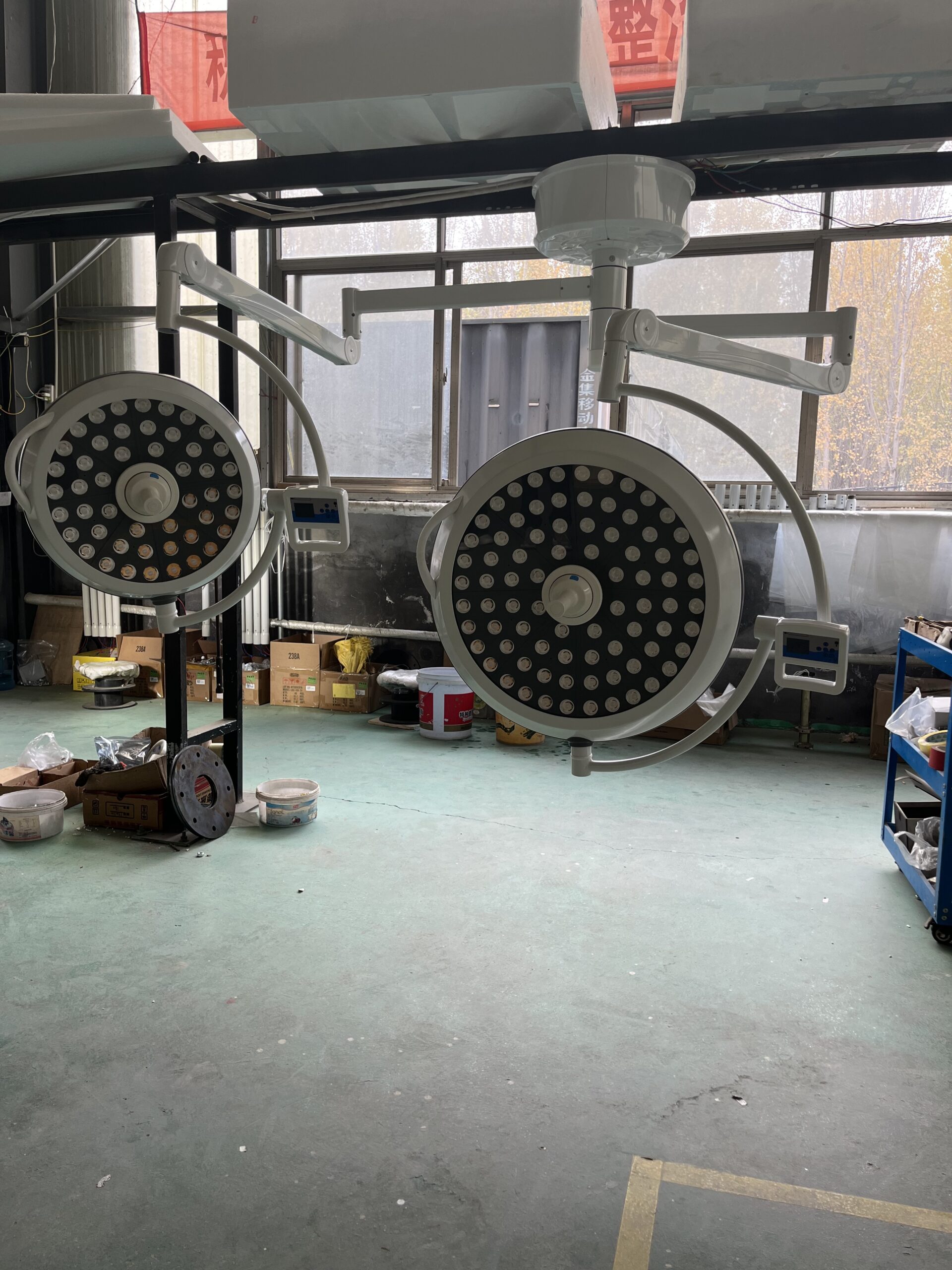
The dual head surgical light configuration is not simply “buy two lights on one mount.” It is a system-level decision that touches illumination geometry, shadow management, workflow ergonomics, installation engineering, and department-specific surgical mix. A 700 mm primary head paired with a 500 mm satellite head behaves differently from a symmetric 700/700 setup. The asymmetry changes how you position the secondary head for retraction lighting, how the anesthesia team navigates around the arm assembly, and how much ceiling reinforcement your contractor must budget. Get the configuration right, and you eliminate shadow-related repositioning delays that cost surgical teams an average of 4-6 minutes per procedure. Get it wrong, and you have a $15,000 fixture that the surgical team works around rather than with.
This guide walks through the engineering and procurement logic behind dual head surgical light configuration. I will cover the optical rationale for two-head setups, how to size the primary and satellite heads, ceiling load and clearance calculations, department-specific recommendations, and the procurement checklist that prevents the most common specification errors. Whether you are outfitting a new-build cardiac suite or upgrading a general surgery department on a budget, the configuration framework here applies.
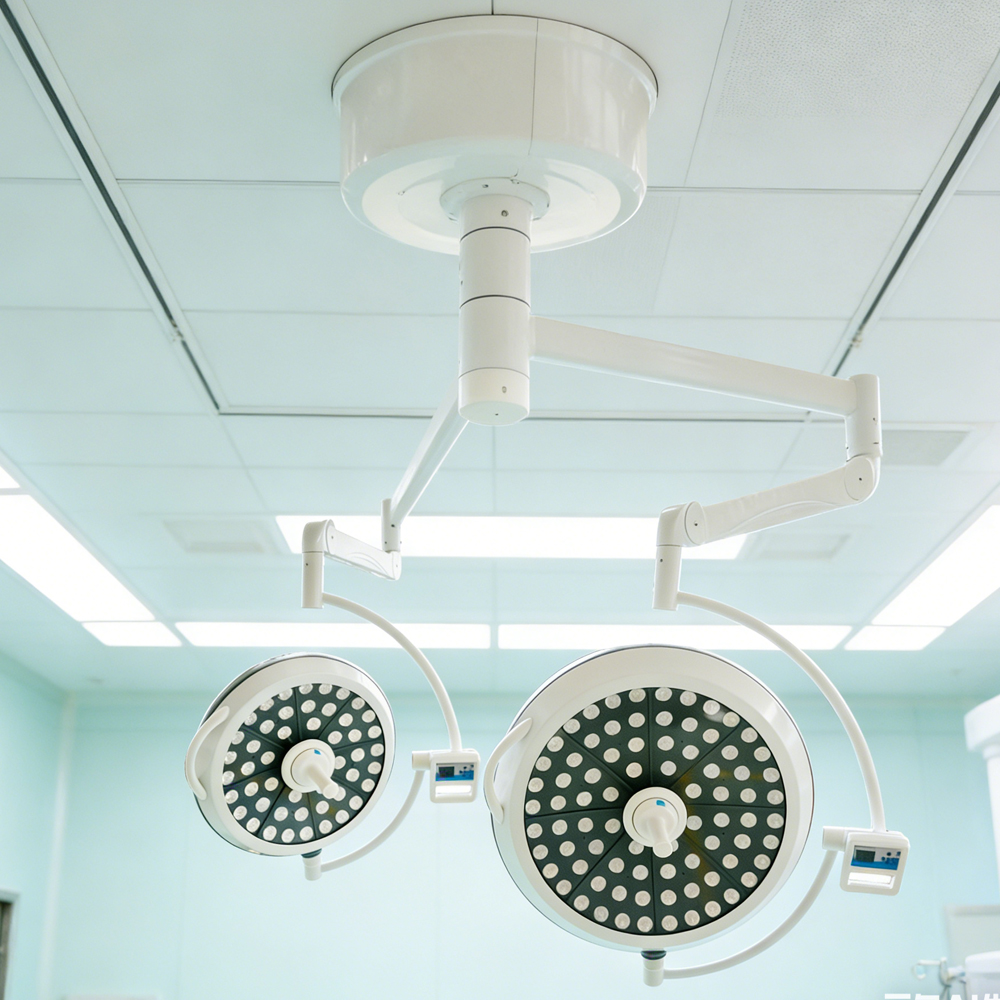
Why Two Heads: The Shadow Compensation Principle
The fundamental reason for a dual head surgical light is shadow dilution. A single light head, no matter how many LED modules it contains, casts shadows when the surgeon’s hands, instruments, or the heads of assisting staff block the optical path. IEC 60601-2-41 requires that surgical luminaires maintain a minimum shadow dilution ratio, but in practice, a single dome cannot eliminate all occlusion during complex procedures where three or four people lean over the operative field simultaneously.
A dual head configuration solves this geometrically. When the primary head is positioned at the standard 110-130 cm working distance directly above the incision site, the satellite head is angled from a secondary position — typically 30-45 degrees offset. Light from the second head fills the shadow zones created by the first. Modern LED surgical lights with Active Illumination Control (AIC) take this further: when sensors detect partial occlusion of one head, the system automatically increases output from unobstructed LED modules in real time. Combined with a second head providing cross-illumination, the result is a surgical field that maintains consistent lux levels even during the most physically crowded procedures.
In our experience across 60+ operating room projects, the most common complaint that triggers a dual head upgrade is not insufficient brightness — it is shadow flicker during multi-surgeon procedures. The surgical team does not need more lux. They need fewer shadows.
The shadow compensation benefit is most pronounced in deep-cavity surgery. During a cardiac sternotomy or a posterior spinal fusion, the operative field is narrow and deep. A single overhead light illuminates the surface but leaves the cavity walls in relative darkness. The satellite head, positioned at a lower angle, directs light into the cavity laterally. This is why cardiac and orthopedic suites almost universally specify dual head configurations, while minor procedure rooms can function with a single head.
Sizing the Pair: 700/500 vs. 700/700 Configurations
The two dominant dual head configurations are the asymmetric 700/500 (primary head 700 mm diameter, satellite 500 mm) and the symmetric 700/700 (two equal heads). The choice between them is driven by surgical volume, procedure complexity, and budget. Understanding the optical trade-offs prevents over-specification or under-specification.
The 700 mm head typically delivers 160,000 lux at 1 meter working distance with a light field diameter adjustable from 24 to 36 cm. The 500 mm satellite produces approximately 120,000 lux with a narrower field of 25-27 cm. In a 700/500 pairing, the primary head handles the main operative field while the satellite provides supplementary fill light for the assistant’s side or for retraction zones. In a 700/700 setup, both heads are interchangeable — either can serve as primary, which is valuable in teaching hospitals where the lead surgeon position rotates.
| Parameter | 700/500 Asymmetric | 700/700 Symmetric |
|---|---|---|
| Primary head illuminance | 160,000 lux @ 1 m | 160,000 lux @ 1 m (both heads) |
| Satellite head illuminance | 120,000 lux @ 1 m | 160,000 lux @ 1 m |
| Total system weight (heads + arms) | Approx. 85-95 kg | Approx. 100-115 kg |
| Ceiling moment load | ~480 ft-lb | ~626 ft-lb |
| Best for | General surgery, mixed-case ORs, budget-conscious upgrades | Cardiac, orthopedic, teaching hospitals, hybrid rooms |
| Relative cost | Baseline | +18-25% over 700/500 |
| Color temperature range | 3,000-5,000 K (both heads) | 3,000-5,000 K (both heads) |
| CRI (Ra) | 96 or above | 96 or above |
For a regional hospital performing 70% general surgery, 15% orthopedic, and 15% gynecological procedures, the 700/500 configuration covers the clinical need without the structural and budget overhead of a full symmetric pair. The satellite head at 120,000 lux is more than sufficient for assistant-side illumination. Reserve the 700/700 for departments where two surgeons work simultaneously at equal intensity — cardiac bypass, bilateral orthopedic work, or transplant procedures.
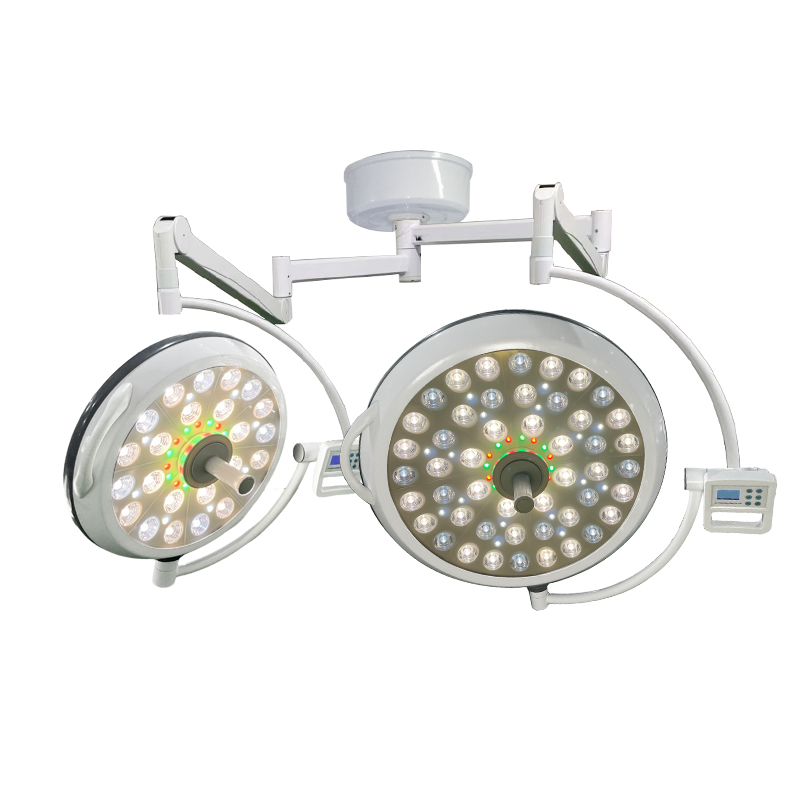
Primary and Satellite Head Switching Logic
In a well-configured dual head surgical light system, the surgeon should never need to think about which head is “primary.” Modern LED surgical lights with synchronized control allow both heads to respond to a single wall panel or sterile handle input. When the surgeon adjusts intensity on the primary head, the satellite follows proportionally. Color temperature changes apply to both heads simultaneously, ensuring consistent tissue rendering across the entire operative field.
However, there are scenarios where independent control matters. During a procedure that transitions from open surgery to endoscopic assistance, the surgeon may want the primary head at full 160,000 lux for the open phase, then dim it to 40,000 lux while the satellite maintains 80,000 lux for the endoscopic camera’s auxiliary lighting. This “endo mode” is a standard feature on current-generation LED surgical lights and should be verified during the specification phase.
- Synchronized mode: Both heads adjust together. Best for standard procedures where uniform field illumination is the priority. The wall panel or sterile handle controls both heads as a single unit.
- Independent mode: Each head has separate intensity, focus, and color temperature control. Necessary for hybrid procedures, teaching demonstrations, or when the satellite head illuminates a secondary field (e.g., a graft harvest site).
- Auto-compensation mode: The AIC system detects occlusion on one head and automatically boosts the other. This is the default operating mode in most dual head installations and requires no manual intervention from the surgical team.
- Emergency backup: If one head fails (LED driver fault, power interruption to one arm), the remaining head continues at full output. IEC 60601-2-41 requires that surgical luminaires maintain safe operation under single-fault conditions.
Specify the control mode during procurement, not after installation. Retrofitting independent control onto a synchronized-only system requires rewiring the arm assembly and replacing the control board — a $2,000-$4,000 field modification that could have been a $0 line-item option at factory build.
Installation Space, Ceiling Load, and Clearance Planning
The most overlooked aspect of dual head surgical light configuration is the structural engineering. A dual ceiling mount system imposes both a vertical dead load and a dynamic off-center moment on the ceiling structure. Industry installation manuals specify that a dual ceiling mount requires the structure to support approximately 105-115 kg (231 lbs) vertical load and resist an off-center moment of 626 ft-lb. The ceiling must constrain rotation to less than 0.1 degrees at the mounting casting. If the structure deflects beyond that threshold, the balanced arms will drift — and two drifting heads in a confined OR create a collision hazard.
Clearance planning is equally critical. Each articulating arm has a sweep radius of 740-1,040 mm depending on the model. In a dual configuration, the two arms must be able to rotate through their full range without colliding with each other, with the anesthesia boom, or with pendant-mounted monitors. The minimum recommended OR floor area for a dual head ceiling mount is 36 square meters (6m x 6m). Below that, the surgical team will spend time repositioning arms rather than focusing on the procedure.
- Ceiling height: Minimum 2.9 m (9.5 ft) finished floor to ceiling. The down-tube length (300 mm for standard ceilings, 500 mm for 3.0 m+ ceilings) positions the arm pivot point so the light heads hang at 1.8-2.0 m above floor — above the surgical team’s head height but reachable for repositioning.
- Mounting point location: Centered over the operating table position, offset 200-300 mm toward the surgeon’s standing side. This gives the primary head a shorter arm path to the operative field and reduces the moment load on the ceiling.
- Structural reinforcement: Steel plate or concrete pad minimum 400 mm x 400 mm, anchored with M16 chemical anchors or equivalent. The mounting plate must be level within 0.5 degrees. Any slope causes arm drift.
- Electrical supply: Dedicated circuit, 220-240 VAC, 50/60 Hz, single phase, capable of supplying 300 W for a dual LED system. The circuit must include an integral breaker that serves as the isolation disconnect.
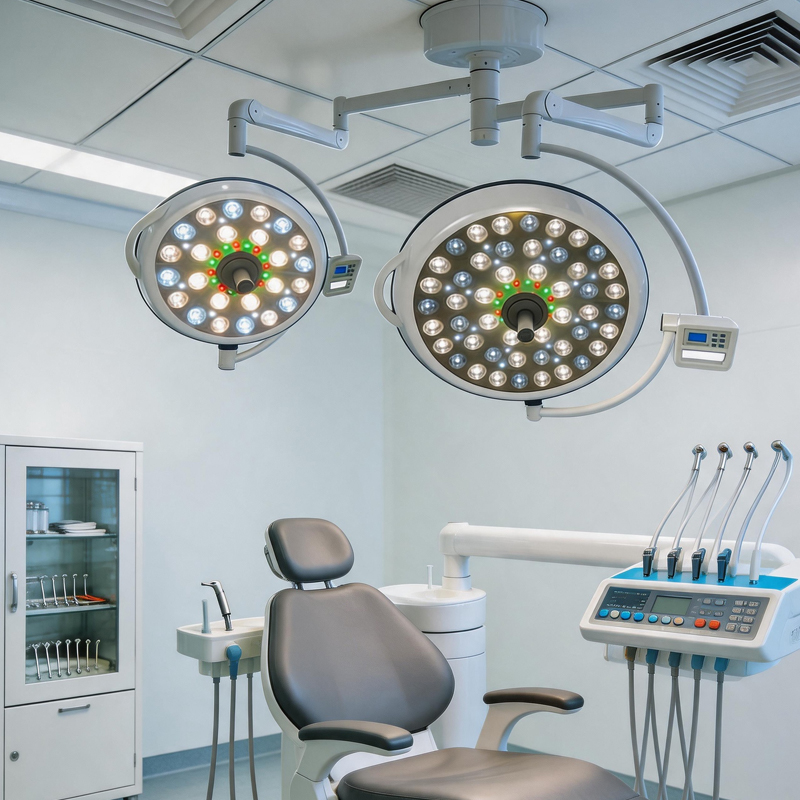
Department-Specific Configuration Recommendations
Not every department needs the same dual head configuration. The surgical mix, room dimensions, and workflow patterns determine whether a 700/500, 700/700, or even a single-head-plus-mobile combination is the right call. Here is how I approach the specification for common hospital departments:
- General surgery (mixed-case OR): 700/500 ceiling mount. The 700 mm primary handles laparotomy, cholecystectomy, and hernia repair at full intensity. The 500 mm satellite provides fill for the assistant’s side. Room size: 36-42 sq m. This is the workhorse configuration for 80% of hospital operating rooms.
- Cardiac surgery: 700/700 ceiling mount with camera integration on the primary head. Sternotomy and bypass procedures require deep-cavity illumination from two angles. The second head must match the primary’s 160,000 lux to illuminate the mediastinum when the sternum retractor blocks the primary’s optical path. Room size: 45-55 sq m (hybrid room compatible).
- Orthopedics and trauma: 700/500 or 700/700 depending on C-arm usage. If the room has a ceiling-mounted C-arm, the light arms must be positioned to avoid the C-arm’s rotation arc. A 700/500 with shorter arm on the satellite side reduces collision risk. Specify radiolucent-compatible positioning if the surgeon needs to shoot fluoroscopy without moving the light.
- Obstetrics and gynecology: 700/500 is sufficient. Cesarean sections and hysterectomies are surface-level procedures where shadow management is less critical than in cardiac work. The satellite head is useful for the neonatal resuscitation area adjacent to the table.
- Day surgery / minor procedures: Single head is often adequate. If the room is under 25 sq m, a dual head creates more obstruction than benefit. Consider a single 700 mm ceiling mount plus a mobile 500 mm floor stand for flexibility.
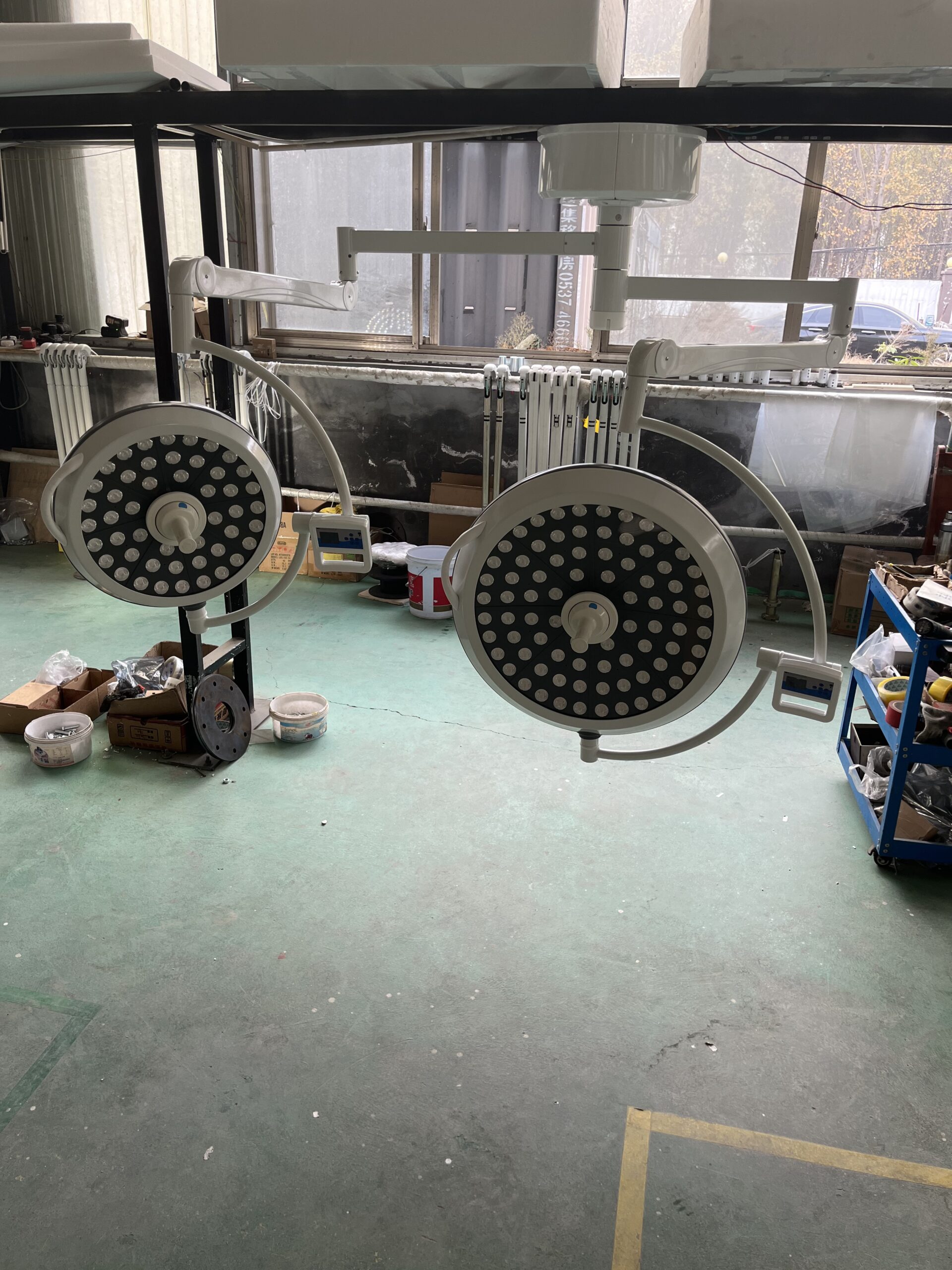
Procurement Decision Framework: What to Specify and Verify
Procuring a dual head surgical light is a specification exercise as much as a purchasing decision. The most common procurement errors I see are: buying on lux alone without verifying CRI at reduced intensity, omitting the control mode requirement, and failing to confirm that the quoted price includes the ceiling mounting hardware and installation engineering support. Here is the checklist I use when evaluating quotes from surgical light manufacturers:
- Illuminance verification: Confirm 160,000 lux (primary) and 120,000 lux (satellite) measured at 1 meter per IEC 60601-2-41. Request the photometric test report, not just the datasheet claim.
- Color rendering at all dimming levels: CRI must remain 95 or above even at 30% intensity. Some budget LED drivers shift color temperature when dimmed, causing tissue to appear different at low light levels.
- Control system scope: Specify whether you need synchronized-only, independent, or both. Confirm whether the wall panel, sterile handle, and optional touchscreen are included or quoted separately.
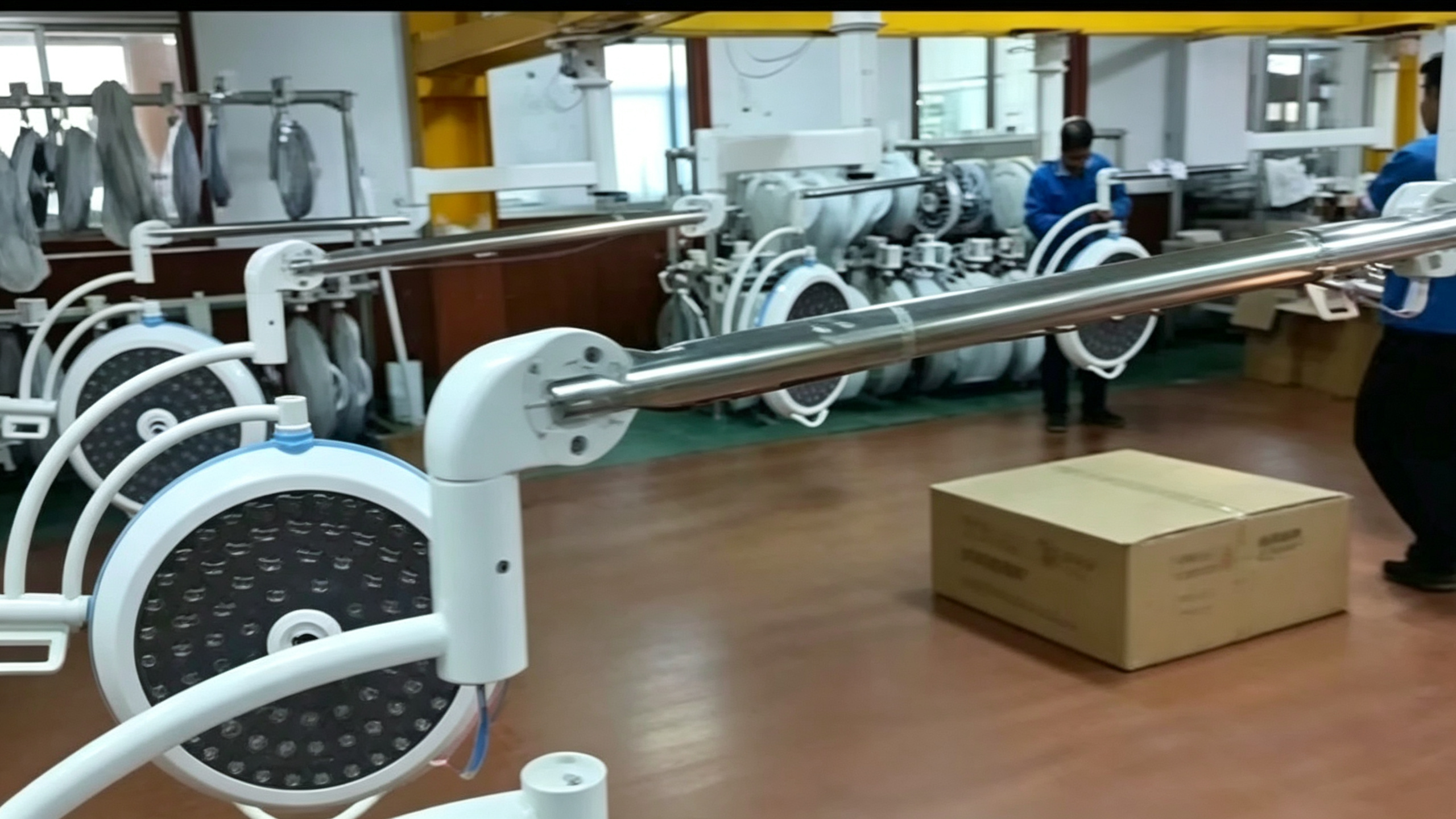
- Mounting hardware inclusion: The quote must include ceiling casting, down-tube (specify length based on your ceiling height), both articulating arms, and all cable routing components. Missing hardware discovered at installation adds 2-4 weeks of delay.
- Certification documentation: CE marking under MDR 2017/745, ISO 13485 manufacturing certificate, and IEC 60601-2-41 type test report. Verify the notified body number on the EU database.
- Warranty and LED lifespan: LED service life should be 60,000 hours or more. Warranty should cover LED modules, drivers, and arm mechanics for minimum 3 years. Confirm whether the warranty includes on-site service or is return-to-factory only.
For hospitals planning a multi-room upgrade or new-build project, consider engaging a turnkey operating room solution provider who can coordinate the surgical light, operating table, pendant, and door interlock specifications as a single package. This eliminates the integration gaps that occur when each device is procured from a different vendor and the ceiling engineer receives four separate load calculations that may conflict.
Common Configuration Mistakes and How to Avoid Them
After reviewing dozens of operating room layouts and field installation reports, certain errors recur. These are not theoretical risks — they are problems that have caused project delays, budget overruns, and surgical team dissatisfaction:
- Undersized ceiling reinforcement: The structural engineer designs for the static weight but ignores the dynamic moment. When both arms are extended to full reach, the off-center moment can exceed 600 ft-lb. The ceiling deflects, the arms drift, and the surgical team files a complaint within the first month. Solution: always design for the worst-case dual ceiling moment specified in the installation manual.
- Wrong down-tube length: Ordering a 300 mm down-tube for a 3.2 m ceiling places the light heads too high, forcing the surgeon to raise the arms uncomfortably to reposition. Conversely, a 500 mm tube in a 2.8 m room puts the heads at head height — a collision risk. Solution: measure finished floor to structural ceiling, subtract 2.0 m target head clearance, and select the tube length accordingly.
- Ignoring the anesthesia zone: The dual arms are positioned without accounting for the anesthesia machine, ventilator tubing, and the anesthesiologist’s working position. During induction and emergence, the anesthesia team needs clear access to the patient’s head. If a light arm blocks that access, someone gets bumped. Solution: map the full 360-degree workflow before finalizing arm lengths and pivot positions.
- Skipping the site survey: Ordering a dual head system based on catalog specifications without a physical site survey of the existing OR. Older buildings may have concrete ceilings that cannot be chemically anchored, or HVAC ductwork directly above the planned mounting point. Solution: conduct a site survey with the supplier’s installation engineer before placing the purchase order.
Conclusion
A dual head surgical light is a system-level investment that rewards careful configuration and punishes hasty specification. The decision between 700/500 and 700/700, the choice of synchronized versus independent control, the ceiling reinforcement calculation, and the department-specific positioning all interact. Treat any one of them as an afterthought and the surgical team will feel it in every procedure — through shadow flicker, arm collisions, or uncomfortable repositioning.
Start with the surgical mix. Match the head sizes to the procedures your team actually performs. Verify the structural capacity before the purchase order goes out. Specify the control mode explicitly. And insist on a site survey from your supplier’s installation team. These four steps eliminate 90% of the configuration errors I see in the field. For hospitals planning a full OR upgrade, explore the full surgical light range and request a configuration consultation that covers both the optical specification and the installation engineering in a single conversation. If you need ongoing support for parts and maintenance, review the spare parts service program to ensure your dual head system stays at peak performance throughout its 60,000-hour LED lifespan.
Frequently Asked Questions
What is the main advantage of a dual head surgical light over a single head?
The primary advantage is shadow dilution. Two light heads positioned at different angles ensure that when the surgeon’s hands or instruments block one head’s optical path, the second head fills the shadow zone. This is critical in deep-cavity procedures and multi-surgeon operations where a single head cannot maintain uniform illumination across the operative field.
How much ceiling reinforcement is needed for a dual head surgical light?
A typical dual ceiling mount requires the structure to support approximately 105-115 kg vertical load and resist an off-center moment of 480-626 ft-lb, depending on the head sizes and arm lengths. The ceiling must constrain rotation to less than 0.1 degrees. Always consult the specific installation manual for your chosen model and engage a structural engineer to verify capacity before installation.
Can the two heads in a dual head system be controlled independently?
Yes, most modern dual head surgical lights offer both synchronized and independent control modes. In synchronized mode, both heads respond to a single input. In independent mode, each head has separate intensity, focus, and color temperature adjustment. Specify your required control mode during procurement — retrofitting independent control after installation is significantly more expensive.
Which configuration is better for a general hospital: 700/500 or 700/700?
For a general hospital performing a mixed case load (general surgery, gynecology, minor orthopedics), the 700/500 asymmetric configuration is the most cost-effective choice. The 700 mm primary delivers 160,000 lux for the main operative field while the 500 mm satellite provides 120,000 lux fill light. Reserve the 700/700 symmetric setup for cardiac suites, orthopedic theaters, and teaching hospitals where two surgeons need equal-intensity illumination simultaneously.
What certifications should I verify when procuring a dual head surgical light?
Verify CE marking under EU MDR 2017/745, ISO 13485 manufacturing quality system certification, and IEC 60601-2-41 type test compliance for surgical luminaires. Request the photometric test report showing measured lux, CRI, and color temperature at multiple dimming levels. Cross-check the notified body number on the EU EUDAMED database to confirm the certificate is current and covers the specific model you are purchasing.
You May Also Like...

Bariatric OR Package: Table, Bed and Trolley Coordination
A bariatric OR package coordinates the operating table, the patient bed and the trolley for...

Lumen vs Lux: What These Surgical Light Units Mean
Lumen and lux are not the same thing. Lumen measures the total light a fixture...

Emergency Department Equipment for Trauma, Resuscitation and Triage
An emergency department is built around speed, and its equipment has to be ready the...